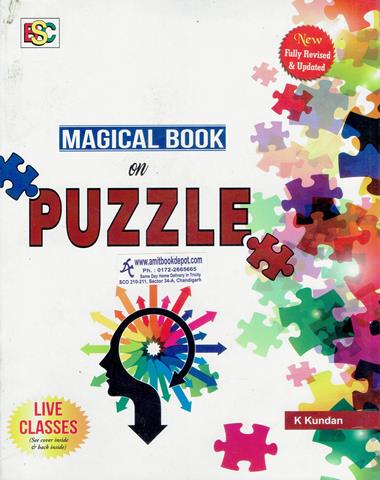
Master the Art of Logical Reasoning with the Magical Book on Puzzles by K. Kundan.
Unlock the secrets to mastering logical and analytical reasoning with Magical Book on Puzzle by acclaimed author K. Kundan, published by BSC Publishing Co. Pvt. Ltd. This comprehensive guide is meticulously designed for aspirants of competitive examinations such as CAT, MBA, Banking (IBPS PO, Clerk, SBI), SSC (CGL, CHSL), UPSC CSAT, CLAT, GMAT, GRE, and other government job entrance tests. It serves as the definitive resource for anyone seeking to conquer the puzzle and seating arrangement sections, which are pivotal for high scores.
This book is not merely a collection of problems; it is a structured learning system. It begins with "An Introduction to Puzzle," providing a solid foundation before progressing to complex concepts. The unique pedagogical approach of separating each chapter into Learner’s Exercise and Practice Exercise ensures a gradual and thorough understanding. The Learner’s Exercise introduces concepts with simplified problems, building confidence and methodology. The Practice Exercise then challenges you with advanced, exam-level puzzles to solidify your skills and speed.
Comprehensive Topic Coverage for Complete Preparation
The book’s detailed table of contents maps a complete journey through all puzzle types. It starts with Matching Puzzles covering tabular, schedule-based, floor, flat, and box puzzles. It then delves deeply into seating arrangements, with dedicated sections on linear seating arrangements (along a line, parallel lines, and distance-based) and enclosed figure seating arrangements (circular, rectangular, square, triangular, and concentric figures). Specialized chapters focus on puzzles based on comparison, conditional selection, direction sense, and blood relations. The complexity escalates with integrated sections on puzzles mixed with blood relations and challenging mixed puzzles, training you to handle the interconnected problems frequently seen in actual exams.
Extensive Practice: The Key to Success
What sets this book apart is its unparalleled volume of practice material. Beyond the chapter exercises, it features a dedicated section of past years’ questions organized into 24 practice sets, allowing you to test yourself against real exam patterns and difficulty levels. Furthermore, the inclusion of 18 additional practice sets provides a massive repository of problems for relentless drilling. A unique section on Data Sufficiency puzzles applies this critical question type to all categories—tabular, floor-based, linear and circular arrangement, comparison, blood relation, and direction sense—ensuring you are prepared for every format.
Designed for Strategic Learning and Self-Assessment
K. Kundan’s Magical Book on Puzzles is engineered for self-study. The logical progression from basic to advanced levels builds competence systematically. Each puzzle is crafted to enhance your logical thinking, analytical ability, and speed. By solving the diverse range of problems, you develop the mental agility to decode complex sets quickly and accurately under time pressure, a decisive advantage in any competitive test.
Key Features of the Book:
1. Structured Learning Path: Clear distinction between learner-focused exercises and practice-oriented problems.
2. Wide Syllabus Coverage: Every major puzzle and seating arrangement type for all competitive exams.
3. Massive Question Bank: Includes hundreds of problems in chapter exercises, 24 past-year sets, and 18 additional practice sets.
4. Exam-Oriented Material: Sections dedicated to past years' questions and data sufficiency formats.
5. Concept Clarity: Foundational chapters ensure a strong grasp of basics before tackling advanced puzzles.
6. Skill Enhancement: Focuses on improving problem-solving speed, accuracy, and logical deduction skills.
Invest in your future with this essential reasoning book. Whether you are beginning your preparation or in the final stages of revision, Magical Book on Puzzle is your ultimate companion to crack the reasoning section with confidence and achieve your career goals.




.jpg)










.jpg)