Categories
College Bookssss >
BA PU Chandigarh
BSC PU Chandigarh
MSC PU Chandigarh
BBA PU Chandigarh
MA PU Chandigarh
Medical Books
Engineering Books
Management Books
PGDCA Books
BCOM PU Chandigarh
MCOM PU Chandigarh
BCA PU Chandigarh
MCA PU Chandigarh
animate-books

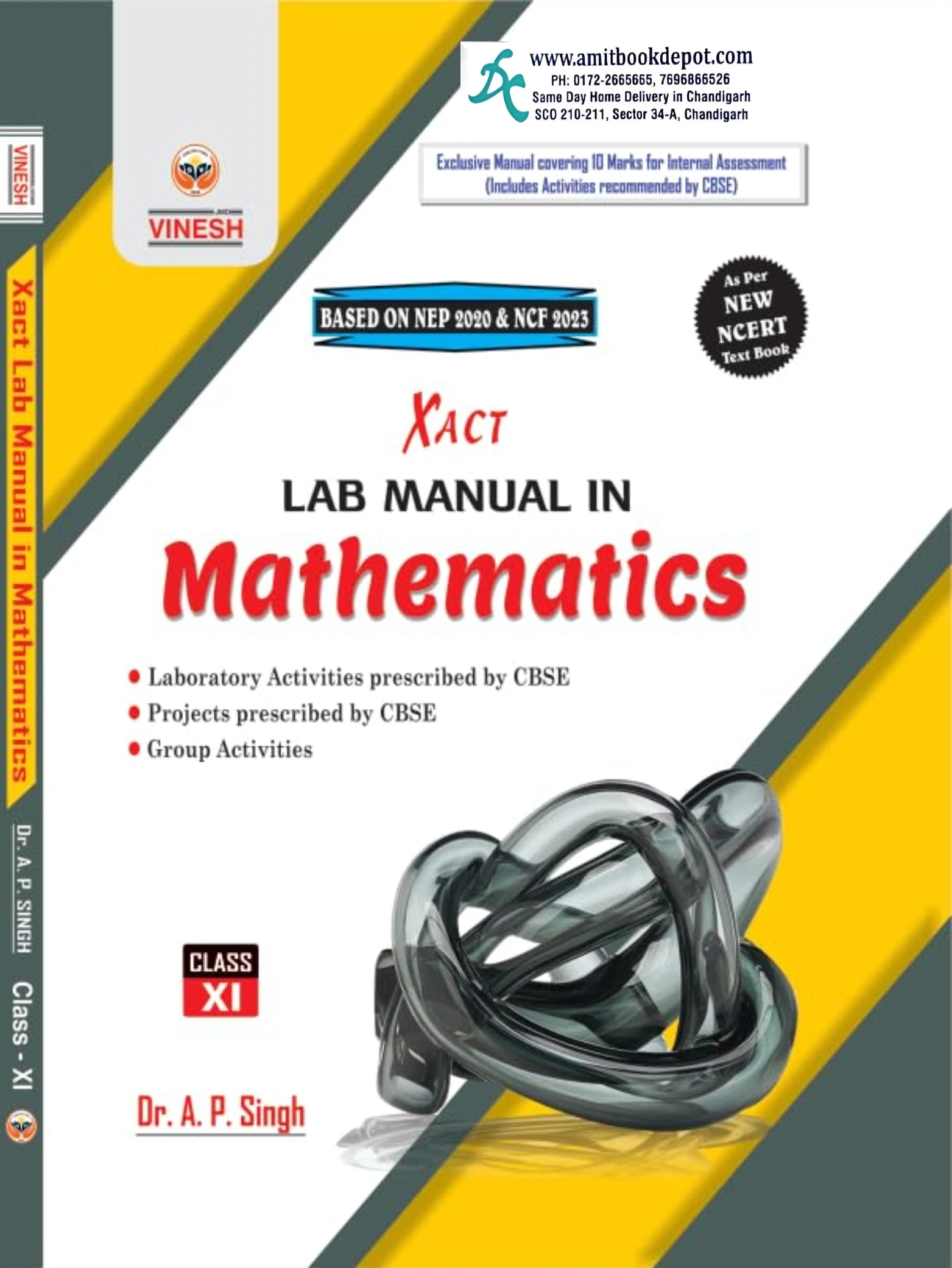
Vinesh Xact Lab Manual in Mathematics 11th

by Madhurima
β‚Ή360 β‚Ή360.00(-/ off)

Rating & Reviews

23 Customer Review

The Vinesh Xact Lab Manual in Mathematics for Class 11 by Dr. A. P. Singh is the complete CBSE-prescribed guide for practical work and internal assessment. This comprehensive manual features 19 detailed lab activities and 3 projects covering key topics like sets, trigonometry, conic sections, and probability. It provides clear instructions for hands-on learning, helps maintain activity records, and details the entire syllabus and marking scheme. An essential resource for both students and teachers, it includes exhaustive lists of required mathematical lab equipment and models. Ensure exam readiness and conceptual clarity with this indispensable Mathematics Lab Manual for Class 11.

Have Doubts Regarding This Product ? Ask Your Question

  • Q1
    Does this lab manual strictly follow the latest CBSE syllabus and evaluation scheme for Class 11 Mathematics internal assessment?
    A1

    Yes, the manual is meticulously designed as per the latest CBSE syllabus. It clearly outlines the 20-mark internal assessment structure, including weightage for activities, record keeping, year-end tests, and viva voce.

  • Q2
    How many activities and projects are included, and are they sufficient for the entire academic year?
    A2

    The manual contains 19 structured Lab Activities and 3 extended Projects. This collection is more than sufficient, as the CBSE requires students to perform and record any 10 activities throughout the year.

  • Q3
    Apart from activity instructions, what unique information does this manual provide for school laboratories?
    A3

    A standout feature is the detailed guide on setting up a Mathematics Lab, including comprehensive lists of necessary Mathematical Lab Equipment, specific Models for Demonstration (e.g., for conic sections, vectors), and all required Stationery and Oddments.

  • Q4
    Are the activities for complex topics like Conic Sections explained in a beginner-friendly manner?
    A4

    Absolutely. Topics like Parabola and Ellipse are broken down into multiple, step-by-step activities (e.g., "Ellipse with Major and Minor Axes," "Ellipse on two fixed points"), using simple materials to build understanding from the ground up.

  • Q5
    How does this manual help in preparing for the practical/viva voce component of the internal assessment?
    A5

    By performing the activities, students gain practical insights that are directly questioned in viva voce. The manual’s focus on conceptual application, rather than rote learning, builds the foundational knowledge needed to answer such oral examinations confidently.

  • Q6
    Does the manual list the specific mathematical instruments required for each activity?
    A6

    While it provides a master list of all necessary equipment, students and teachers can refer to the detailed "Equipment" and "Stationery" sections to ensure they have the required items like geometry boxes, clinometers, graph paper, threads, etc., before starting any activity.

  • Q7
    Is this manual useful for students aspiring for competitive exams like JEE or NEET?
    A7

    Definitely. The hands-on approach solidifies conceptual understanding of fundamental topics like Trigonometry, Coordinate Geometry (Conics), and Probability, which form the bedrock of the Mathematics and Physics sections in these competitive exams.

  • Q8
    Can this manual be used for self-study if a student’s school has limited lab facilities?
    A8

    Many activities are designed to be performed with commonly available materials (paper, threads, pins, etc.). While a full lab setup is ideal, motivated students can undertake a significant number of activities at home with guidance from this manual.

  • Q9
    What topics in Three-Dimensional Geometry are covered practically?
    A9

    The manual includes a specific Lab Activity (Lab Activity 18) on "Three-Dimensional Geometry (Octants)," which helps visualize and plot points in 3D space, a concept often challenging to grasp from theory alone.

  • Q10
    Are there activities that link different mathematical concepts, like the Pascal's Triangle project?
    A10

    Yes, Project III on "Patterns in Pascal’s Triangle" is an excellent example. It encourages exploration of connections between the triangle and concepts in combinations, sequences, and binomial expansions.

0.00

0 Overall Rating
  • 5
    0
  • 4
    0
  • 3
    0
  • 2
    0
  • 1
    0

Try this product & share your review & thoughts

Lab Activity 1: Sets (Venn Diagrams)
Lab Activity 2: Sets (Venn Diagrams)
Lab Activity 3: Relation and Function (Domain, Co-domain)
Lab Activity 4: Trigonometry - I
Lab Activity 5: Trigonometry - II
Lab Activity 6: Pascal’s Triangle
Lab Activity 7: Graph of Trigonometric Function
Lab Activity 8: Integral Powers of i
Lab Activity 9: Permutation and Combination
Lab Activity 10: Arithmetic Mean and Geometric Mean
Lab Activity 11: Conic Sections
Lab Activity 12: Parabola
Lab Activity 13: Parabola
Lab Activity 14: Ellipse
Lab Activity 15: Ellipse with Major and Minor Axes
Lab Activity 16: Ellipse on two fixed points
Lab Activity 17: Limit
Lab Activity 18: Three-Dimensional Geometry (Octants)
Lab Activity 19: Probability

PROJECTS

Project - I Parabola
Project II Ellipse
Project III: Patterns in Pascal’s Triangle

Latest Syllabus of Xact Lab Manual in Mathematics 11th


The following weightages are assigned for evaluation at the higher secondary stage in mathematics.
Theory Examination: 80 marks
Internal Assessment: 20 marks
(a) Periodic text: 10 marks
(b) Activities: 10 marks

Assessment of Activity Work:
Throughout the year any 10 activities shall be performed by the student from the activities given in the Laboratory Manual. A record of the same may be kept by the student. A year-end test on the activity may be conducted at the school level.

The weightage is as under:
1. The activities performed by the student throughout the year and record keeping: 5 marks
2. Assessment of the activity performed during the year-end test: 3 marks
3. Viva voce: 2 marks

Equipment for Mathematics Laboratory at the Higher Secondary Stage

As the students will be involved in a lot of model-making activities under the guidance of the teacher, the smooth running of the mathematics laboratory will depend upon the supply of oddments such as strings and threads, cellotape, white cardboard, hardboard, needles and pins, drawing pins, sandpaper, pliers, screwdrivers, rubber bands of different colors, gummed papers and labels, squared paper, plywood, scissors, saws, paint, soldering, solder wire, steel, etc. made up of good durable sheets, glazed papers, etc. Besides these, some models, charts, slides, etc., made up of a good durable material should also be there for the teacher to demonstrate some mathematical concepts, facts, and properties before the students. Different tables and a ready reckoner should also be there (in the laminated form) so that these can be used by the students for different purposes. Further, there should be equipment like mathematical instruments, calculators, computers, books, journals, mathematical dictionaries, etc., in the laboratory.
In view of the above, the following is the list of suggested instruments/models for the laboratory:

EQUIPMENT

Mathematical instrument set (wooden geometry box for demonstration containing rulers, set squares, dividers, protractors, and compasses), some geometry boxes, meter scales of 100 cm, 50 cm, and 30 cm, measuring tape, diagonal scale, clinometer, calculators, computers including related software, etc.

MODELS FOR DEMONSTRATION OF-

- Set
- Relations and Functions
- Quadratic functions with the help of linear functions
- Sequence and Series
- Pascal’s triangle
- Arithmetic Progression
- Conic Sections
- Increasing decreasing functions
- Maxima, minima, point of inflection
- Lagrange’s minima, point of inflection
- Angle in semicircle using vectors
- Construction of a parabola when the distance between the directrix and focus is given 
- Construction of ellipse when major and minor axes are given
- Octants
- Shortest distance between two skew lines
- Geometrical interpretation of scalar and vector products
- Equation of a straight line passing through a fixed point and parallel to a given vector
- Equation to a plane
- Projection of the line segment
- Sample spaces
- Conditional Probability

STATIONERY AND ODDMENTS

Rubber bands of different colors, marbles of different colors, a pack of playing cards, graph paper/squared paper, dotted paper, drawing pins, erasers, pencils, sketch pens, cellotape, threads of different colors, glazed papers, kite papers, tracing papers, adhesive, pins, scissors and cutters, hammers, a saw, thermocol sheets, sandpaper, nails and screws of different sizes, screwdrivers, a drill machine with a bit set, and pliers.

The Vinesh Xact Lab Manual in Mathematics for Class 11 by Dr. A. P. Singh, published by S Dinesh & Co., is an indispensable and meticulously crafted resource designed to fulfill the CBSE (Central Board of Secondary Education) mandated practical and internal assessment requirements for senior secondary students. This comprehensive lab manual bridges the gap between theoretical knowledge and practical application, transforming abstract mathematical concepts into tangible, hands-on learning experiences. It strictly adheres to the latest prescribed syllabus, ensuring complete alignment with the academic curriculum and evaluation pattern, where internal assessment carries a significant weightage of 20 marks.

This essential Mathematics Lab Manual for Class 11 provides a structured and systematic framework for conducting laboratory activities throughout the academic year. The core of the manual consists of 19 detailed lab activities, covering the fundamental and advanced topics of the Class 11 syllabus. Each activity is engineered to foster a deeper conceptual understanding through doing and observing. Students begin with foundational concepts like sets and Venn diagrams, progress through relations and functions, and explore the intricacies of trigonometry with activities dedicated to trigonometric functions and their graphical representations. The manual delves into crucial areas such as Complex Numbers (Integral Powers of i), Permutations and Combinations, and Sequences and Series (Arithmetic and Geometric Means). A significant portion is devoted to conic sections, with multiple hands-on activities for constructing and understanding parabolas and ellipses, including those with given axes or fixed points. The curriculum is rounded off with practical explorations of limits, three-dimensional geometry (octants), and probability, ensuring holistic coverage.

Beyond routine activities, the manual includes 3 special projects focused on in-depth exploration of parabolas, ellipses, and patterns in Pascal’s triangle. These projects encourage investigative learning, critical thinking, and the development of analytical skills, preparing students for higher-order evaluation and a genuine appreciation of mathematical patterns and beauty.

A unique and highly valuable feature of this CBSE Class 11 Practical Maths guide is its extensive Syllabus and Equipment Guide. It not only outlines the exact Internal Assessment breakdownβ€”dividing 20 marks into Periodic Tests (10 marks), Activities (5 marks), Activity Test (3 marks), and Viva Voce (2 marks)β€”but also serves as a vital reference for schools and teachers setting up a Mathematics Laboratory. The manual provides an exhaustive, syllabus-aligned list of necessary mathematical lab equipment, models for demonstration, and stationery and oddments. This includes everything from mathematical instrument sets, geometry boxes, clinometers, and graph papers to specific models for demonstrating conic sections, vector products, probability sample spaces, and more. This section makes the Vinesh Xact Manual a complete blueprint for practical mathematics education.

For the student, this Class 11 Maths Practical Book is a step-by-step companion that demystifies practical work. It aids in maintaining a meticulous activity record, a task crucial for securing the full 5 marks in internal assessment. By performing the selected activities, students enhance their spatial reasoning, logical deduction, and problem-solving abilities. For teachers and educators, it is a trusted guide to effectively conduct, supervise, and assess lab work, ensuring that the laboratory sessions are productive, syllabus-specific, and evaluation-ready.

In summary, the Vinesh Xact Lab Manual Mathematics Class 11 is more than just a workbook; it is an integrated learning system. It empowers students to master practical mathematics, excel in their CBSE Practical Assessments, and build a strong, application-oriented foundation for competitive exams and future studies in science, technology, engineering, and mathematics (STEM) fields. Its clear instructions, alignment with the CBSE syllabus, and comprehensive resource lists make it the definitive choice for schools, teachers, and students aiming for excellence in practical mathematics.

Lab Activity 1: Sets (Venn Diagrams)
Lab Activity 2: Sets (Venn Diagrams)
Lab Activity 3: Relation and Function (Domain, Co-domain)
Lab Activity 4: Trigonometry - I
Lab Activity 5: Trigonometry - II
Lab Activity 6: Pascal’s Triangle
Lab Activity 7: Graph of Trigonometric Function
Lab Activity 8: Integral Powers of i
Lab Activity 9: Permutation and Combination
Lab Activity 10: Arithmetic Mean and Geometric Mean
Lab Activity 11: Conic Sections
Lab Activity 12: Parabola
Lab Activity 13: Parabola
Lab Activity 14: Ellipse
Lab Activity 15: Ellipse with Major and Minor Axes
Lab Activity 16: Ellipse on two fixed points
Lab Activity 17: Limit
Lab Activity 18: Three-Dimensional Geometry (Octants)
Lab Activity 19: Probability

PROJECTS

Project - I Parabola
Project II Ellipse
Project III: Patterns in Pascal’s Triangle

Have Doubts Regarding This Product ? Ask Your Question

  • Q1
    Does this lab manual strictly follow the latest CBSE syllabus and evaluation scheme for Class 11 Mathematics internal assessment?
    A1

    Yes, the manual is meticulously designed as per the latest CBSE syllabus. It clearly outlines the 20-mark internal assessment structure, including weightage for activities, record keeping, year-end tests, and viva voce.

  • Q2
    How many activities and projects are included, and are they sufficient for the entire academic year?
    A2

    The manual contains 19 structured Lab Activities and 3 extended Projects. This collection is more than sufficient, as the CBSE requires students to perform and record any 10 activities throughout the year.

  • Q3
    Apart from activity instructions, what unique information does this manual provide for school laboratories?
    A3

    A standout feature is the detailed guide on setting up a Mathematics Lab, including comprehensive lists of necessary Mathematical Lab Equipment, specific Models for Demonstration (e.g., for conic sections, vectors), and all required Stationery and Oddments.

  • Q4
    Are the activities for complex topics like Conic Sections explained in a beginner-friendly manner?
    A4

    Absolutely. Topics like Parabola and Ellipse are broken down into multiple, step-by-step activities (e.g., "Ellipse with Major and Minor Axes," "Ellipse on two fixed points"), using simple materials to build understanding from the ground up.

  • Q5
    How does this manual help in preparing for the practical/viva voce component of the internal assessment?
    A5

    By performing the activities, students gain practical insights that are directly questioned in viva voce. The manual’s focus on conceptual application, rather than rote learning, builds the foundational knowledge needed to answer such oral examinations confidently.

  • Q6
    Does the manual list the specific mathematical instruments required for each activity?
    A6

    While it provides a master list of all necessary equipment, students and teachers can refer to the detailed "Equipment" and "Stationery" sections to ensure they have the required items like geometry boxes, clinometers, graph paper, threads, etc., before starting any activity.

  • Q7
    Is this manual useful for students aspiring for competitive exams like JEE or NEET?
    A7

    Definitely. The hands-on approach solidifies conceptual understanding of fundamental topics like Trigonometry, Coordinate Geometry (Conics), and Probability, which form the bedrock of the Mathematics and Physics sections in these competitive exams.

  • Q8
    Can this manual be used for self-study if a student’s school has limited lab facilities?
    A8

    Many activities are designed to be performed with commonly available materials (paper, threads, pins, etc.). While a full lab setup is ideal, motivated students can undertake a significant number of activities at home with guidance from this manual.

  • Q9
    What topics in Three-Dimensional Geometry are covered practically?
    A9

    The manual includes a specific Lab Activity (Lab Activity 18) on "Three-Dimensional Geometry (Octants)," which helps visualize and plot points in 3D space, a concept often challenging to grasp from theory alone.

  • Q10
    Are there activities that link different mathematical concepts, like the Pascal's Triangle project?
    A10

    Yes, Project III on "Patterns in Pascal’s Triangle" is an excellent example. It encourages exploration of connections between the triangle and concepts in combinations, sequences, and binomial expansions.

Latest Syllabus of Xact Lab Manual in Mathematics 11th


The following weightages are assigned for evaluation at the higher secondary stage in mathematics.
Theory Examination: 80 marks
Internal Assessment: 20 marks
(a) Periodic text: 10 marks
(b) Activities: 10 marks

Assessment of Activity Work:
Throughout the year any 10 activities shall be performed by the student from the activities given in the Laboratory Manual. A record of the same may be kept by the student. A year-end test on the activity may be conducted at the school level.

The weightage is as under:
1. The activities performed by the student throughout the year and record keeping: 5 marks
2. Assessment of the activity performed during the year-end test: 3 marks
3. Viva voce: 2 marks

Equipment for Mathematics Laboratory at the Higher Secondary Stage

As the students will be involved in a lot of model-making activities under the guidance of the teacher, the smooth running of the mathematics laboratory will depend upon the supply of oddments such as strings and threads, cellotape, white cardboard, hardboard, needles and pins, drawing pins, sandpaper, pliers, screwdrivers, rubber bands of different colors, gummed papers and labels, squared paper, plywood, scissors, saws, paint, soldering, solder wire, steel, etc. made up of good durable sheets, glazed papers, etc. Besides these, some models, charts, slides, etc., made up of a good durable material should also be there for the teacher to demonstrate some mathematical concepts, facts, and properties before the students. Different tables and a ready reckoner should also be there (in the laminated form) so that these can be used by the students for different purposes. Further, there should be equipment like mathematical instruments, calculators, computers, books, journals, mathematical dictionaries, etc., in the laboratory.
In view of the above, the following is the list of suggested instruments/models for the laboratory:

EQUIPMENT

Mathematical instrument set (wooden geometry box for demonstration containing rulers, set squares, dividers, protractors, and compasses), some geometry boxes, meter scales of 100 cm, 50 cm, and 30 cm, measuring tape, diagonal scale, clinometer, calculators, computers including related software, etc.

MODELS FOR DEMONSTRATION OF-

- Set
- Relations and Functions
- Quadratic functions with the help of linear functions
- Sequence and Series
- Pascal’s triangle
- Arithmetic Progression
- Conic Sections
- Increasing decreasing functions
- Maxima, minima, point of inflection
- Lagrange’s minima, point of inflection
- Angle in semicircle using vectors
- Construction of a parabola when the distance between the directrix and focus is given 
- Construction of ellipse when major and minor axes are given
- Octants
- Shortest distance between two skew lines
- Geometrical interpretation of scalar and vector products
- Equation of a straight line passing through a fixed point and parallel to a given vector
- Equation to a plane
- Projection of the line segment
- Sample spaces
- Conditional Probability

STATIONERY AND ODDMENTS

Rubber bands of different colors, marbles of different colors, a pack of playing cards, graph paper/squared paper, dotted paper, drawing pins, erasers, pencils, sketch pens, cellotape, threads of different colors, glazed papers, kite papers, tracing papers, adhesive, pins, scissors and cutters, hammers, a saw, thermocol sheets, sandpaper, nails and screws of different sizes, screwdrivers, a drill machine with a bit set, and pliers.

0.00

0 Overall Rating
  • 5
    0
  • 4
    0
  • 3
    0
  • 2
    0
  • 1
    0

Try this product & share your review & thoughts

Top Trending Product

Related Product

Related Product

Related Blog Posts

Latest Blogs

Latest Blogs

blog-img
Classic Literature Reimagined: Discuss modern twists on classic novels.
Lorem ipsum dolor sit amet, consectetur adipiscing elit, sed do eiusmod tempor incididunt ut labore et dolore magna aliqua. Ut enim ad minim veniam, quis nostrud exercitation ullamco Lorem ipsum dolor sit amet, consectetur adipiscing elit, sed do eiusmod tempor incididunt ut labore et dolore magna aliqua. Utenim ad minim veniam, quis nostrud exercitation ullamco Lorem ipsum dolor sit amet, consecte...
Read more
Author name | 10 jan, 2025
blog-img
Classic Literature Reimagined: Discuss modern twists on classic novels.
Lorem ipsum dolor sit amet, consectetur adipiscing elit, sed do eiusmod tempor incididunt ut labore et dolore magna aliqua. Ut enim ad minim veniam, quis nostrud exercitation ullamco Lorem ipsum dolor sit amet, consectetur adipiscing elit, sed do eiusmod tempor incididunt ut labore et dolore magna aliqua. Utenim ad minim veniam, quis nostrud exercitation ullamco Lorem ipsum dolor sit amet, consecte...
Read more
Author name | 10 jan, 2025
blog-img
Classic Literature Reimagined: Discuss modern twists on classic novels.
Lorem ipsum dolor sit amet, consectetur adipiscing elit, sed do eiusmod tempor incididunt ut labore et dolore magna aliqua. Ut enim ad minim veniam, quis nostrud exercitation ullamco Lorem ipsum dolor sit amet, consectetur adipiscing elit, sed do eiusmod tempor incididunt ut labore et dolore magna aliqua. Utenim ad minim veniam, quis nostrud exercitation ullamco Lorem ipsum dolor sit amet, consecte...
Read more
Author name | 10 jan, 2025
blog-img
Classic Literature Reimagined: Discuss modern twists on classic novels.
Lorem ipsum dolor sit amet, consectetur adipiscing elit...
Read more
Author Name | 10 Jan, 2025
blog-img
Classic Literature Reimagined: Discuss modern twists on classic novels.
Lorem ipsum dolor sit amet, consectetur adipiscing elit...
Read more
Author Name | 10 Jan, 2025
blog-img
Classic Literature Reimagined: Discuss modern twists on classic novels.
Lorem ipsum dolor sit amet, consectetur adipiscing elit...
Read more
Author Name | 10 Jan, 2025
blog-img
Classic Literature Reimagined: Discuss modern twists on classic novels.
Lorem ipsum dolor sit amet, consectetur adipiscing elit...
Read more
Author Name | 10 Jan, 2025
blog-img
Classic Literature Reimagined: Discuss modern twists on classic novels.
Lorem ipsum dolor sit amet, consectetur adipiscing elit...
Read more
Author Name | 10 Jan, 2025
blog-img
Classic Literature Reimagined: Discuss modern twists on classic novels.
Lorem ipsum dolor sit amet, consectetur adipiscing elit...
Read more
Author Name | 10 Jan, 2025
blog-img
Classic Literature Reimagined: Discuss modern twists on classic novels.
Lorem ipsum dolor sit amet, consectetur adipiscing elit...
Read more
Author Name | 10 Jan, 2025
blog-img
Classic Literature Reimagined: Discuss modern twists on classic novels.
Lorem ipsum dolor sit amet, consectetur adipiscing elit...
Read more
Author Name | 10 Jan, 2025
blog-img
Classic Literature Reimagined: Discuss modern twists on classic novels.
Lorem ipsum dolor sit amet, consectetur adipiscing elit...
Read more
Author Name | 10 Jan, 2025