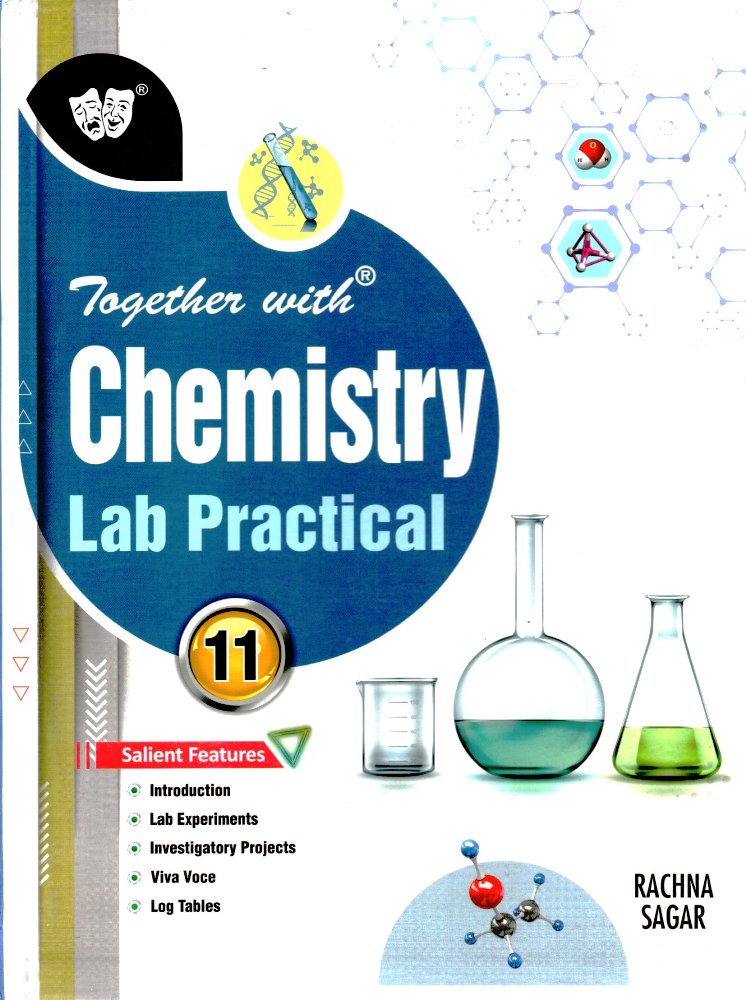
Together With Chemistry Lab Practical For Class 11th
Together With Chemistry Lab Practical For Class 11th
by Madhurima
₹449₹499.00(-/
off)
Rating & Reviews
23 Customer Review
Together With Chemistry Lab Practical For Class 11 by Mrs Veena Suri (Rachna Sagar Pvt Ltd) is a CBSE-aligned lab manual covering basic laboratory techniques, purification of chemical substances (alum, copper sulphate, and benzoic acid), pH experiments, chemical equilibrium, quantitative estimation (titrations and standard solutions of oxalic acid and sodium carbonate), and qualitative analysis of cations and anions. Includes viva voce questions, projects on water testing and soap foaming, log tables, and a notebook. Ideal for mastering Class 11 practical chemistry, volumetric analysis, and exam preparation.
Together With Chemistry Lab Practical For Class 11 by Mrs Veena Suri, published by Rachna Sagar Pvt Ltd, is a comprehensive and meticulously designed practical manual aligned with the latest CBSE syllabus. This lab manual serves as an indispensable resource for Class 11 students aiming to master practical chemistry, from basic laboratory techniques to complex quantitative estimation and qualitative analysis.
The book begins with an introduction to basic laboratory techniques, providing step-by-step guidance on essential skills such as cutting and bending a glass tube, drawing a jet, and boring a cork. Each experiment is clearly outlined to build foundational competence and ensure safe handling of equipment. The characterisation and purification of chemical substances section covers core experiments like determining the melting point and boiling point of compounds, along with crystallisation of pure potash alum, copper sulphate (blue vitriol), and benzoic acid from crude samples. These exercises teach critical methods for obtaining pure substances—a key aspect of analytical chemistry.
A dedicated unit on experiments based on pH allows students to measure the pH of fruit juices, acids, and bases using pH paper and universal indicators. Learners compare strong and weak acids, study pH changes during acid-base titration, and observe the common ion effect on weak acids like acetic acid and weak bases like ammonium hydroxide. These activities strengthen understanding of chemical equilibrium through hands-on study of concentration effects on equilibrium shifts involving ferric ions, thiocyanate ions, and cobalt complexes.
The quantitative estimation section is particularly robust, guiding students to prepare standard solutions of N/10 oxalic acid and N/10 sodium carbonate solution. Learners determine the strength of sodium hydroxide and hydrochloric acid solutions via titration, calculate the percentage purity of anhydrous sodium carbonate, and find the number of water molecules of crystallisation in oxalic acid. These exercises develop precision in volumetric analysis and stoichiometric calculations.
For qualitative analysis, the manual provides a systematic scheme for determining one cation and one anion in a given salt, covering cations such as Pb²⁺, Cu²⁺, Al³⁺, Fe³⁺, Ca²⁺, Mg²⁺, and NH₄⁺, and anions including CO₃²⁻, Cl⁻, Br⁻, I⁻, NO₃⁻, and CH₃COO⁻. It also includes detection of nitrogen, sulphur, chlorine, bromine, and iodine in organic compounds. Each experiment is followed by a Viva Voce section with probable questions to prepare students for practical exams and viva assessments.
The projects section offers eight investigatory projects—such as testing ionic contamination in water, analysing water hardness, studying the foaming capacity of soaps, and determining acidity in tea leaves—encouraging scientific enquiry. Additional features include log tables and a notebook section for recording observations. This CBSE practical book is an essential companion for scoring high marks in the Class 11 chemistry practical examination.
Does it teach detection of elements in organic compounds?
A6
Yes. Detection of nitrogen, sulphur, chlorine, bromine, and iodine in organic compounds is explained systematically.
Q7
Can I determine the percentage purity of a sodium carbonate sample?
A7
Yes. Experiment 5 teaches volumetric determination of purity of anhydrous sodium carbonate using N/10 HCl solution.
Q8
How many water molecules of crystallisation in oxalic acid can I find?
A8
Experiment 6 determines water molecules of crystallisation in oxalic acid (COOH)₂ using M/10 NaOH solution.
Q9
Does this book help in study of soap foaming capacity?
A9
Yes. Project 4 investigates foaming capacity of different washing soaps and effect of adding sodium carbonate.
Q10
What additional materials are provided apart from experiments?
A10
Log tables for calculations and a notebook section for recording observations are included at the end.
0.00
0 Overall Rating
5
0
4
0
3
0
2
0
1
0
Try this product & share your review &
thoughts
INTRODUCTION
A. BASIC LABORATORY TECHNIQUES
Experiment 1. To cut a glass tube or rod of a required length and round off its edges.
Experiment 2. To bend a glass tube at a given angle
Experiment 3. To draw a jet
Experiment 4. To bore a hole in the given cork.
- Viva Voce
B. CHARACTERISATION AND PURIFICATION OF CHEMICAL SUBSTANCES
Experiment 1. To determine the melting point of the given substance.
Experiment 2. To determine the boiling point of the liquid...
Experiment 3. To prepare crystals of pure potash alum from the commercial sample...
Experiment 4. copper sulphate (blue vitriol) To prepare crystals of copper sulphate from the commercial sample of
Experiment 5. To prepare benzoic acid crystals from the crude sample
- Viva Voce
C. EXPERIMENTS BASED ON pH.
Experiment 1. To determine the pH of some solutions obtained from fruit juices and acids and bases of known and varied concentration using pH paper...
Experiment 2: Compare the pH of solutions of strong and weak acids of the same concentration.
Experiment 3. To study the pH change in the titration of a strong base with a strong acid using a universal indicator.
Experiment 4. Study of pH change by common ion effect in case of a weak acid and a weak base (i.e.),
(i)Change in study of pH of acetic acid by the addition of sodium acetate.
(ii) Change in pH of ammonium hydroxide by the addition of ammonium chloride.
- Viva Voce
D. CHEMICAL EQUILIBRIUM
Experiment 1. To study the effect of concentration on the equilibrium between ferric ions and thiocyanate ions.
Experiment 2. To study the shift in equilibrium between [Co(H₂O)]²⁺ ions and Cl⁻ ions by changing the concentration of either ion.
- Viva Voce
E. QUANTITATIVE ESTIMATION
Experiment 1: To prepare 250 mL of standard solution of N/10 (or M/20) oxalic acid, taking pure crystalline oxalic acid (solid)
Experiment 2. To prepare 250 mL of N/10 (or M/20) sodium carbonate solution
Experiment 3: To determine the strength of a given solution of sodium hydroxide by titrating it against a standard solution of N/10 (or M/20) oxalic acid.
Experiment 4. To determine the strength of a given solution of hydrochloric acid by titrating it against standard N/10 (or M/20) sodium carbonate solution.
Experiment 5. To determine volumetrically the percentage purity of the given sample of anhydrous sodium carbonate, 6 g of which has been dissolved per litre of solution. You are provided with an N/10 (or M/10) HCI solution...
Experiment 6: To determine volumetrically the number of water molecules of COOH crystallisation in oxalic acid (HO), 6 g of which has been dissolved to make 1 L of solution. You are provided with an M/10 NaOH solution.
- Viva Voce
F. QUALITATIVE ANALYSIS.
1. Determination of one cation and one anion in a given salt.
- Viva Voce
2. Detection of nitrogen, sulphur, chlorine, bromine and iodine in an organic compound.
- Viva Voce
G. PROJECTS
Project 1. Test the presence of ionic contamination in different samples of contaminated water...
Project 2. Study of the methods of purification of water...
Project 3. To analyse the hardness of different samples of water.
Project 4: Investigation of the foaming capacity of different washing soaps and the effect of the addition of sodium carbonate on them...
Project 5. Study of the acidity of different samples of tea leaves
Project 6. Determination of the rate of evaporation of different liquids.
Project 7. Study of the effect of acids and bases on the tensile strength of fibres...
Project 8. Analysis of fruits and vegetable juices for acidity and presence of proteins, fats and carbohydrates in them...
- LOG TABLES
- NOTEBOOK
PRACTICAL SYLLABUS
Microchemical methods are available for several of the practical experiments; wherever possible, such techniques should be used:
A. Basic Laboratory Techniques
1. Cutting glass tube and glass rod
2. Bending a glass tube
3. Drawing out a glass jet
4. Boring a cork
B. Characterization and Purification of Chemical Substances
1. Determination of the melting point of an organic compound.
2. Determination of boiling point of an organic compound.
3. Crystallization of an impure sample of any one of the following: alum, copper sulfate, or benzoic acid.
C. Experiments based on pH
1. Any one of the following experiments:
- Determination of pH of some solutions obtained from fruit juices and solutions of known and varied concentrations of acids, bases, and salts using pH paper or universal indicator.
- Comparing the pH of solutions of strong and weak acids of the same concentration.
- Study the pH change in the titration of a strong base using a universal indicator.
2. Study the pH change by common ion in the case of weak acids and weak bases.
D. Chemical Equilibrium
- One of the following experiments:
(a) Study the shift in equilibrium between ferric ions by increasing/decreasing the concentration of either of the ions.
(b) Study the shift in equilibrium between [Co(H₂O)₆]²⁺ and chloride ions by changing the concentration of the ions.
E. Quantitative Estimation
(i) Using a mechanical balance/electronic balance.
(ii) Preparation of standard solution of oxalic acid.
(iii) Determination of the strength of a given solution of sodium hydroxide by titrating it against a standard solution of oxalic acid.
(iv) Preparation of standard solution of sodium carbonate.
(v) Determination of strength of a given solution of hydrochloric acid by titrating it against standard
F. Qualitative Analysis
(a) Determination of one anion and one cation in a given salt
(b) Detection of nitrogen, sulfur, and chlorine in organic compounds.
(c) Projects
Scientific investigations involving laboratory testing and collecting information from other sources.
PROJECTS
A Few Suggested Projects.
- Checking the bacterial contamination in drinking water by testing sulphide ion.
- Study of the methods of purification of water.
- Testing the hardness, presence of iron, fluoride, chloride, etc., depending upon the regional variation in drinking water and study of causes of presence of these ions above the permissible limit (if any).
- Investigation of the foaming capacity of different washing soaps and the effect of the addition of sodium carbonate on it.
- Study the acidity of different samples of tea leaves.
- Determination of the rate of evaporation of different liquids.
- Study the effect of acids and bases on the tensile strength of fibers.
- Study of acidity of fruit and vegetable juices.
Note: Any other investigatory project, which involves about 10 periods of work, can be chosen with the approval of the teacher.
Together With Chemistry Lab Practical For Class 11 by Mrs Veena Suri, published by Rachna Sagar Pvt Ltd, is a comprehensive and meticulously designed practical manual aligned with the latest CBSE syllabus. This lab manual serves as an indispensable resource for Class 11 students aiming to master practical chemistry, from basic laboratory techniques to complex quantitative estimation and qualitative analysis.
The book begins with an introduction to basic laboratory techniques, providing step-by-step guidance on essential skills such as cutting and bending a glass tube, drawing a jet, and boring a cork. Each experiment is clearly outlined to build foundational competence and ensure safe handling of equipment. The characterisation and purification of chemical substances section covers core experiments like determining the melting point and boiling point of compounds, along with crystallisation of pure potash alum, copper sulphate (blue vitriol), and benzoic acid from crude samples. These exercises teach critical methods for obtaining pure substances—a key aspect of analytical chemistry.
A dedicated unit on experiments based on pH allows students to measure the pH of fruit juices, acids, and bases using pH paper and universal indicators. Learners compare strong and weak acids, study pH changes during acid-base titration, and observe the common ion effect on weak acids like acetic acid and weak bases like ammonium hydroxide. These activities strengthen understanding of chemical equilibrium through hands-on study of concentration effects on equilibrium shifts involving ferric ions, thiocyanate ions, and cobalt complexes.
The quantitative estimation section is particularly robust, guiding students to prepare standard solutions of N/10 oxalic acid and N/10 sodium carbonate solution. Learners determine the strength of sodium hydroxide and hydrochloric acid solutions via titration, calculate the percentage purity of anhydrous sodium carbonate, and find the number of water molecules of crystallisation in oxalic acid. These exercises develop precision in volumetric analysis and stoichiometric calculations.
For qualitative analysis, the manual provides a systematic scheme for determining one cation and one anion in a given salt, covering cations such as Pb²⁺, Cu²⁺, Al³⁺, Fe³⁺, Ca²⁺, Mg²⁺, and NH₄⁺, and anions including CO₃²⁻, Cl⁻, Br⁻, I⁻, NO₃⁻, and CH₃COO⁻. It also includes detection of nitrogen, sulphur, chlorine, bromine, and iodine in organic compounds. Each experiment is followed by a Viva Voce section with probable questions to prepare students for practical exams and viva assessments.
The projects section offers eight investigatory projects—such as testing ionic contamination in water, analysing water hardness, studying the foaming capacity of soaps, and determining acidity in tea leaves—encouraging scientific enquiry. Additional features include log tables and a notebook section for recording observations. This CBSE practical book is an essential companion for scoring high marks in the Class 11 chemistry practical examination.
INTRODUCTION
A. BASIC LABORATORY TECHNIQUES
Experiment 1. To cut a glass tube or rod of a required length and round off its edges.
Experiment 2. To bend a glass tube at a given angle
Experiment 3. To draw a jet
Experiment 4. To bore a hole in the given cork.
- Viva Voce
B. CHARACTERISATION AND PURIFICATION OF CHEMICAL SUBSTANCES
Experiment 1. To determine the melting point of the given substance.
Experiment 2. To determine the boiling point of the liquid...
Experiment 3. To prepare crystals of pure potash alum from the commercial sample...
Experiment 4. copper sulphate (blue vitriol) To prepare crystals of copper sulphate from the commercial sample of
Experiment 5. To prepare benzoic acid crystals from the crude sample
- Viva Voce
C. EXPERIMENTS BASED ON pH.
Experiment 1. To determine the pH of some solutions obtained from fruit juices and acids and bases of known and varied concentration using pH paper...
Experiment 2: Compare the pH of solutions of strong and weak acids of the same concentration.
Experiment 3. To study the pH change in the titration of a strong base with a strong acid using a universal indicator.
Experiment 4. Study of pH change by common ion effect in case of a weak acid and a weak base (i.e.),
(i)Change in study of pH of acetic acid by the addition of sodium acetate.
(ii) Change in pH of ammonium hydroxide by the addition of ammonium chloride.
- Viva Voce
D. CHEMICAL EQUILIBRIUM
Experiment 1. To study the effect of concentration on the equilibrium between ferric ions and thiocyanate ions.
Experiment 2. To study the shift in equilibrium between [Co(H₂O)]²⁺ ions and Cl⁻ ions by changing the concentration of either ion.
- Viva Voce
E. QUANTITATIVE ESTIMATION
Experiment 1: To prepare 250 mL of standard solution of N/10 (or M/20) oxalic acid, taking pure crystalline oxalic acid (solid)
Experiment 2. To prepare 250 mL of N/10 (or M/20) sodium carbonate solution
Experiment 3: To determine the strength of a given solution of sodium hydroxide by titrating it against a standard solution of N/10 (or M/20) oxalic acid.
Experiment 4. To determine the strength of a given solution of hydrochloric acid by titrating it against standard N/10 (or M/20) sodium carbonate solution.
Experiment 5. To determine volumetrically the percentage purity of the given sample of anhydrous sodium carbonate, 6 g of which has been dissolved per litre of solution. You are provided with an N/10 (or M/10) HCI solution...
Experiment 6: To determine volumetrically the number of water molecules of COOH crystallisation in oxalic acid (HO), 6 g of which has been dissolved to make 1 L of solution. You are provided with an M/10 NaOH solution.
- Viva Voce
F. QUALITATIVE ANALYSIS.
1. Determination of one cation and one anion in a given salt.
- Viva Voce
2. Detection of nitrogen, sulphur, chlorine, bromine and iodine in an organic compound.
- Viva Voce
G. PROJECTS
Project 1. Test the presence of ionic contamination in different samples of contaminated water...
Project 2. Study of the methods of purification of water...
Project 3. To analyse the hardness of different samples of water.
Project 4: Investigation of the foaming capacity of different washing soaps and the effect of the addition of sodium carbonate on them...
Project 5. Study of the acidity of different samples of tea leaves
Project 6. Determination of the rate of evaporation of different liquids.
Project 7. Study of the effect of acids and bases on the tensile strength of fibres...
Project 8. Analysis of fruits and vegetable juices for acidity and presence of proteins, fats and carbohydrates in them...
Does it teach detection of elements in organic compounds?
A6
Yes. Detection of nitrogen, sulphur, chlorine, bromine, and iodine in organic compounds is explained systematically.
Q7
Can I determine the percentage purity of a sodium carbonate sample?
A7
Yes. Experiment 5 teaches volumetric determination of purity of anhydrous sodium carbonate using N/10 HCl solution.
Q8
How many water molecules of crystallisation in oxalic acid can I find?
A8
Experiment 6 determines water molecules of crystallisation in oxalic acid (COOH)₂ using M/10 NaOH solution.
Q9
Does this book help in study of soap foaming capacity?
A9
Yes. Project 4 investigates foaming capacity of different washing soaps and effect of adding sodium carbonate.
Q10
What additional materials are provided apart from experiments?
A10
Log tables for calculations and a notebook section for recording observations are included at the end.
PRACTICAL SYLLABUS
Microchemical methods are available for several of the practical experiments; wherever possible, such techniques should be used:
A. Basic Laboratory Techniques
1. Cutting glass tube and glass rod
2. Bending a glass tube
3. Drawing out a glass jet
4. Boring a cork
B. Characterization and Purification of Chemical Substances
1. Determination of the melting point of an organic compound.
2. Determination of boiling point of an organic compound.
3. Crystallization of an impure sample of any one of the following: alum, copper sulfate, or benzoic acid.
C. Experiments based on pH
1. Any one of the following experiments:
- Determination of pH of some solutions obtained from fruit juices and solutions of known and varied concentrations of acids, bases, and salts using pH paper or universal indicator.
- Comparing the pH of solutions of strong and weak acids of the same concentration.
- Study the pH change in the titration of a strong base using a universal indicator.
2. Study the pH change by common ion in the case of weak acids and weak bases.
D. Chemical Equilibrium
- One of the following experiments:
(a) Study the shift in equilibrium between ferric ions by increasing/decreasing the concentration of either of the ions.
(b) Study the shift in equilibrium between [Co(H₂O)₆]²⁺ and chloride ions by changing the concentration of the ions.
E. Quantitative Estimation
(i) Using a mechanical balance/electronic balance.
(ii) Preparation of standard solution of oxalic acid.
(iii) Determination of the strength of a given solution of sodium hydroxide by titrating it against a standard solution of oxalic acid.
(iv) Preparation of standard solution of sodium carbonate.
(v) Determination of strength of a given solution of hydrochloric acid by titrating it against standard
F. Qualitative Analysis
(a) Determination of one anion and one cation in a given salt
(b) Detection of nitrogen, sulfur, and chlorine in organic compounds.
(c) Projects
Scientific investigations involving laboratory testing and collecting information from other sources.
PROJECTS
A Few Suggested Projects.
- Checking the bacterial contamination in drinking water by testing sulphide ion.
- Study of the methods of purification of water.
- Testing the hardness, presence of iron, fluoride, chloride, etc., depending upon the regional variation in drinking water and study of causes of presence of these ions above the permissible limit (if any).
- Investigation of the foaming capacity of different washing soaps and the effect of the addition of sodium carbonate on it.
- Study the acidity of different samples of tea leaves.
- Determination of the rate of evaporation of different liquids.
- Study the effect of acids and bases on the tensile strength of fibers.
- Study of acidity of fruit and vegetable juices.
Note: Any other investigatory project, which involves about 10 periods of work, can be chosen with the approval of the teacher.
0.00
0 Overall Rating
5
0
4
0
3
0
2
0
1
0
Try this product & share your review &
thoughts
Top Trending Product
Related
Product
Related Product
Related Blog Posts
Latest Blogs
Latest Blogs
Classic Literature Reimagined: Discuss modern twists on classic novels.
Lorem ipsum dolor sit amet, consectetur adipiscing elit, sed
do
eiusmod tempor incididunt ut labore et dolore magna aliqua. Ut enim ad minim
veniam, quis nostrud exercitation ullamco Lorem ipsum dolor sit amet,
consectetur adipiscing elit, sed do eiusmod tempor incididunt ut labore et
dolore magna aliqua. Utenim ad minim veniam, quis nostrud exercitation
ullamco
Lorem ipsum dolor sit amet, consecte...
Classic Literature Reimagined: Discuss modern twists on classic novels.
Lorem ipsum dolor sit amet, consectetur adipiscing elit, sed
do
eiusmod tempor incididunt ut labore et dolore magna aliqua. Ut enim ad minim
veniam, quis nostrud exercitation ullamco Lorem ipsum dolor sit amet,
consectetur adipiscing elit, sed do eiusmod tempor incididunt ut labore et
dolore magna aliqua. Utenim ad minim veniam, quis nostrud exercitation
ullamco
Lorem ipsum dolor sit amet, consecte...
Classic Literature Reimagined: Discuss modern twists on classic novels.
Lorem ipsum dolor sit amet, consectetur adipiscing elit, sed
do
eiusmod tempor incididunt ut labore et dolore magna aliqua. Ut enim ad minim
veniam, quis nostrud exercitation ullamco Lorem ipsum dolor sit amet,
consectetur adipiscing elit, sed do eiusmod tempor incididunt ut labore et
dolore magna aliqua. Utenim ad minim veniam, quis nostrud exercitation
ullamco
Lorem ipsum dolor sit amet, consecte...