Categories
College Bookssss >
BA PU Chandigarh
BSC PU Chandigarh
MSC PU Chandigarh
BBA PU Chandigarh
MA PU Chandigarh
Medical Books
Engineering Books
Management Books
PGDCA Books
BCOM PU Chandigarh
MCOM PU Chandigarh
BCA PU Chandigarh
MCA PU Chandigarh
animate-books

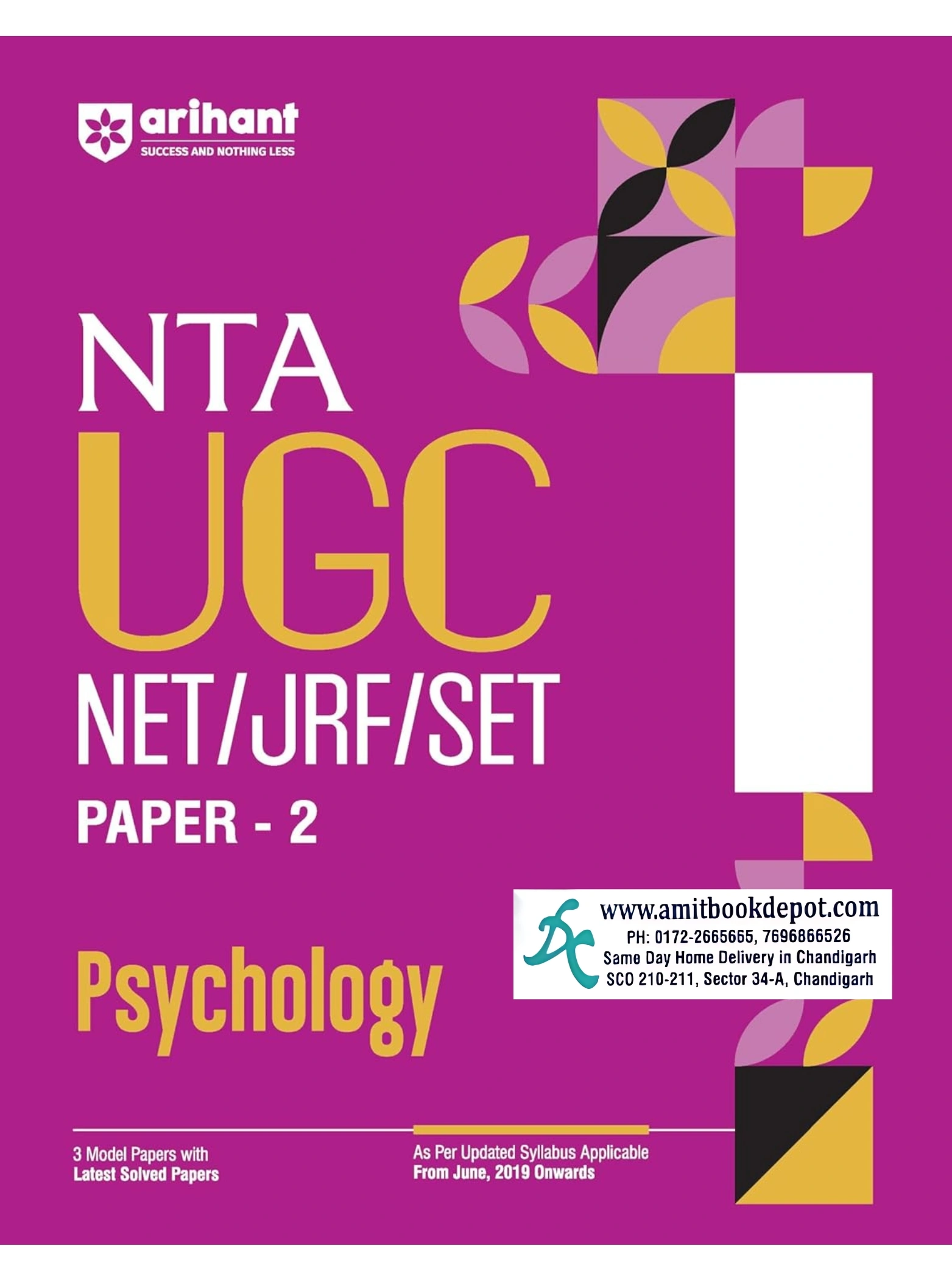
NTA UGC NET JRF SET Psychology Paper 2

by Madhurima
₹745 ₹745.00(-/ off)

Rating & Reviews

23 Customer Review

Master the UGC NET JRF SET Psychology Paper 2 with this definitive guide by Arihant Prakashan. Comprehensively covering the latest syllabus, it features solved papers from 2018 to 2024 and ten detailed units on core topics like research methodology, psychological testing, biological bases of behavior, social psychology, psychotherapies, and emerging areas. Designed for conceptual clarity and exam readiness, it includes key topics such as intelligence theories, stress management, attitude scales, and the psychology-technology interface. With three model papers for practice, this book is an essential psychology study guide for NTA NET and State SET exam success.

Have Doubts Regarding This Product ? Ask Your Question

  • Q1
    Does this book cover the entire syllabus for the December 2024 and June 2025 NTA UGC NET Psychology exams?
    A1

    Yes, this edition is meticulously updated to cover the complete official syllabus for Paper 2, including all recent modifications, making it fully relevant for upcoming cycles including 2024 and 2025.

  • Q2
    Are topics from the 'Emerging Areas' unit, like Peace Psychology and Cyber Psychology, explained in detail?
    A2

    Absolutely. Unit X: Emerging Areas provides dedicated chapters with substantive explanations on Peace Psychology, Well-being, Health Psychology, and the Psychology-Technology Interface, including contemporary issues like cyberbullying.

  • Q3
    Is the section on Indian Psychology and Eastern systems detailed enough for the exam?
    A3

    Yes, Unit I offers comprehensive coverage of Psychological Thoughts in Eastern Systems (Bhagavad Gita, Buddhism, Sufism) and the development of academic psychology in India, as mandated by the syllabus.

  • Q4
    Does the book include practical aspects of Psychological Testing, such as test construction and applications?
    A4

    Yes, Unit III is dedicated to Psychological Testing, covering test construction, standardization, reliability, validity, and specific applications in clinical, organizational, and educational settings.

  • Q5
    How extensive is the coverage of research statistics and experimental designs?
    A5

    Unit II provides in-depth coverage of Research Methodology and Statistics, including parametric/non-parametric tests, ANOVA, MANOVA, factor analysis, correlation, regression, and various experimental designs like Latin Square and Time Series.

  • Q6
    Are modern psychotherapies like Acceptance and Commitment Therapy (ACT) and Dialectical Behavior Therapy (DBT) included?
    A6

    Yes, Unit IX covers a wide range of psychotherapies, including ACT, DBT, CBT, MBCT, positive psychotherapy, and art therapies, as per the latest syllabus.

  • Q7
    Are the biological bases of behavior, including neuroplasticity and physiological methods, well-covered?
    A7

    Unit IV provides a detailed explanation of the nervous system, neuroplasticity, invasive/non-invasive physiological methods, and the biological basis of motivation and emotion.

  • Q8
    Does the Social Psychology unit cover applied aspects relevant today?
    A8

    Yes, Unit VIII includes a dedicated chapter on Applied Social Psychology, covering its applications in health, environment, law, and concepts like crowding and territoriality.

  • Q9
    Is the content useful for the SET (State Eligibility Test) in Psychology as well?
    A9

    Yes, the syllabus for most State SET exams in Psychology is similar to the UGC NET. This comprehensive book serves as an excellent resource for SET Psychology preparation.

  • Q10
    Is this book suitable for someone who is studying Psychology Paper 2 after a long gap or without coaching?
    A10

    Absolutely. It is designed as a self-contained guide. The logical progression from basics to advanced topics, coupled with solved papers and model tests, makes it ideal for self-study, even for those revisiting the subject.


0.00

0 Overall Rating
  • 5
    0
  • 4
    0
  • 3
    0
  • 2
    0
  • 1
    0

Try this product & share your review & thoughts

Solved Paper, August 2024
Solved Paper, June 2023
Solved Paper, October 2022
Solved Paper, November 2021
Solved Paper, September 2020
Solved Paper, December 2019
Solved Paper, July 2018

Unit I: Emergence of Psychology

1. Psychological Thoughts in Eastern Systems
2. Emergence of Western Psychology
3. Essential Aspects of Knowledge Paradigm

Unit II: Research Methodology and Statistics

4. Research: Meaning, Purpose, and Dimensions
5. Paradigms of Research
6. Statistics in Psychology
7. Correlation and Regression Analysis
8. Experimental Designs

Unit III: Psychological Testing

9. Psychological Testing: Test Construction and Standardization
10. Areas of Psychological Testing and Attitude Scales
11. Applications of Psychological Testing

Unit IV: Biological Basis of Behavior

12. Nervous and Sensory Systems
13. Physiological Psychology
14. Muscular and Glandular System and Biological Behavior

Unit V: Attention, Perception, Learning, Memory, and Forgetting

15. Attention and Perception
16. Theories and Perspectives on Perception
17. Learning Process
18. Memory and Forgetting

Unit VI: Thinking, Intelligence, and Creativity

19. Theoretical Perspectives on Thought Processes
20. Problem Solving, Decision-Making, and Metacognition
21. Intelligence and Creativity

Unit VII: Personality, Motivation, Emotion, Stress, and Coping

22. Personality
23. Motivation and Emotion
24. Conflict, Stress, and Coping

Unit VIII Social Psychology

25. Social Psychology
26. Group and Social Influence
27. Applied Social Psychology

Unit IX: Human Development and Interventions

28. Developmental Processes
29. Psychopathology and Psychotherapies
30. Psychological Innovations

Unit X Emerging Areas

31. Psychology and Social Issues
32. Peace Psychology
33. Well-Being and Self-Growth
34. Health
35. Psychology and Technology Interface

Model Papers (1-3)

Latest Syllabus of NTA UGC NET JRF SET Psychology Paper 2


1. Emergence of Psychology

Psychological thought in some major Eastern systems: Bhagavad Gita, Buddhism, Sufism, and Integral Yoga. Academic psychology in India: pre-independence era; post-independence era; 1970s: The move to addressing social issues; 1980s: Indigenization; 1990s: Paradigmatic concerns, disciplinary identity crisis; 2000s: Emergence of Indian psychology in academia. Issues: The colonial encounter, postcolonialism and psychology, and lack of distinct disciplinary identity.
Western: Greek heritage, medieval period, and modern period. Structuralism, functionalism, psychoanalysis, Gestalt, behaviorism, humanistic-existential, transpersonal, the cognitive revolution, and multiculturalism. Four founding paths of academic psychology—Wundt, Freud, James, and Dilthey— Issues: Crisis in psychology due to strict adherence to the experimental-analytical paradigm (logical empiricism). Indic influences on modern psychology.
Essential aspects of knowledge paradigms: ontology, epistemology, and methodology. Paradigms of Western Psychology: Positivism, Post-Positivism, Critical Perspective, Social Constructionism, Existential Phenomenology, and Cooperative Inquiry. Paradigmatic Controversies. Significant Indian paradigms on psychological knowledge: yoga, Bhagavad Gita, Buddhism, Sufism, and Integral Yoga. Science and spirituality (avidya and vidya). The primacy of self-knowledge in Indian psychology.

2. Research Methodology and Statistics

Research: Meaning, Purpose, and Dimensions. Research problems, variables and operational definitions, hypothesis, and sampling. Ethics in conducting and reporting research.
Paradigms of research: quantitative, qualitative, and mixed-methods approaches. Methods of research: Observation, Survey (Interview, Questionnaires), Experimental, Quasi-experimental, Field Studies, Cross-Cultural Studies, Phenomenology, Grounded Theory, Focus Groups, Narratives, Case Studies, and Ethnography.
Statistics in Psychology: Measures of Central Tendency and Dispersion. Normal Probability Curve. Parametric (t-test) and non-parametric tests [sign test, Wilcoxon Signed rank test, Mann-Whitney test, Kruskal-Wallis test, Friedman). Power analysis. Effect size.
Correlational Analysis: Correlation [Product Moment, Rank Order], Partial Correlation, Multiple Correlation.
Special Correlation Methods: Biserial, point biserial, tetrachoric, and phi coefficient. Regression: Simple linear regression, multiple regression. Factor analysis: Assumptions, Methods, Rotation, and Interpretation.
Experimental Designs: ANOVA (One-way, Factorial), Randomized Block Designs, Repeated Measures Design, Latin Square, Cohort Studies, Time Series, MANOVA, and ANCOVA. Single-subject designs.

3. Psychological Testing

Types of tests, Test construction: item writing, item analysis, and test standardization: reliability, validity, and norms.
Areas of testing: Intelligence, Creativity, Neuropsychological tests, Aptitude, Personality assessment, Interest inventories, Attitude scales—semantic differential, Staples, and Likert scale. Computer-based psychological testing.
Applications of psychological testing in various settings: clinical, organizational and business, education, counseling, and military. Career guidance.

4. Biological Basis of Behavior

Sensory systems: General and specific sensations, receptors, and processes. Neurons: Structure. Functions, Types, Neural impulse, synaptic transmission. Neurotransmitters. The Central and Peripheral Nervous Systems—Structure and Functions. Neuroplasticity.
Methods of Physiological Psychology: Invasive methods—anatomical methods, degeneration techniques, lesion techniques, chemical methods, and microelectrode studies. Non-invasive methods—EEG, scanning methods.
Muscular and Glandular System: Types and Functions Biological basis of motivation: hunger, thirst, sleep, and sex. Biological basis of emotion: the limbic system and hormonal regulation of behavior. Genetics and behavior: Chromosomal anomalies; nature-nurture controversy [twin studies and adoption studies].

5. Attention, Perception, Learning, Memory, and Forgetting

Attention: Forms of attention, Models of attention, Perception: Approaches to the Study of Perception: Gestalt and physiological approaches, Perceptual Organization: Gestalt, Figure and Ground, Law of Organization Perceptual Constancy: Size, Shape, and Color; Illusions; Perception of Form, Depth, and Movement Role of motivation and learning in perception.
Signal detection theory: Assumptions and applications, Subliminal perception and related factors, information processing approach to perception, culture and perception, perceptual styles, pattern recognition, Ecological perspective on perception.
Learning Process: Fundamental theories: Thorndike, Guthrie, Hull, Classical conditioning: Procedure, phenomena and related issues, Instrumental learning: Phenomena, paradigms, and theoretical issues; Reinforcement: Basic variables and schedules; Behavior modification and its applications, Cognitive approaches in learning: latent learning and observational learning. Verbal learning and discrimination learning, Recent trends in learning: Neurophysiology of learning.
Memory and Forgetting, Memory processes: Encoding, Storage, Retrieval, Stages of memory: sensory memory, short-term memory (working memory), and long-term memory (declarative—episodic and semantic—and procedural). Theories of Forgetting: Interference, Retrieval Failure, Decay, and Motivated Forgetting.

6. Thinking, Intelligence, and Creativity

Theoretical perspectives on thought processes: Associationism, Gestalt, information processing, feature integration model, concept formation: Rules, Types, and Strategies: Role of concepts in thinking: Types of reasoning, language, and thought.
Problem solving: Types, strategies, and obstacles; decision-making: types and models.
Metacognition: Metacognitive knowledge and metacognitive regulation; Intelligence: Spearman, Thurstone, Jensen, Cattell, Gardner, Stenberg, Goleman, Das, Kar, and Parrila; Creativity: Torrance, Getzels and Jackson, Guilford, Wallach and Kogan, and the Relationship between Intelligence and Creativity.

7. Personality, Motivation, Emotion, Stress, and Coping

Determinants of personality: Biological and socio-cultural approaches to the study of personality: Psychoanalytical, Neo-Freudian, Social Learning, Trait and Type, Cognitive, humanistic, existential, and transpersonal psychology.
Other theories: Rotter's Locus of Control, Seligman's Explanatory Styles, and Kohlberg's Theory of Moral Development.
Basic motivational concepts: instincts, needs, drives, arousal, incentives, and motivational cycle. Approaches to the study of motivation: Psychoanalytical, ethological, S-R cognitive, humanistic; exploratory behavior and curiosity, Zuckerman's sensation seeking, achievement, affiliation and power, motivational competence, self-regulation, Flow Emotions: Physiological correlates Theories of emotions: James-Lange, Canon-Bard, Schachter and Singer, Lazarus, and Lindsley. Emotion regulation, conflicts: sources and types
Stress and Coping: Concept, Models, Type A, B, C, and D Behaviors, and Stress Management Strategies (Biofeedback, Music Therapy, Breathing Exercises, Progressive Muscular Relaxation, Guided Imagery, Mindfulness, Meditation, Yogasana, and Stress Inoculation Training).

8. Social Psychology

Nature, scope, and history of social psychology; traditional theoretical perspectives: field theory, cognitive dissonance, sociobiology, psychodynamic approaches, and social cognition.
Social perception [communication, attributions]; attitude and its change within cultural context; prosocial behavior.
Group and social influence [Social facilitation; Social loafing]; Social influence [Conformity, Peer Pressure, Persuasion, Compliance, Obedience, Social Power, Reactance]. Aggression. Group dynamics, leadership style, and effectiveness. Theories of intergroup relations (Minimal Group Experiment and Social Identity Theory, Relative Deprivation Theory, Realistic Conflict Theory, Balance Theories, Equity Theory, and Social Exchange Theory).
Applied social psychology: Health, environment, and law; personal space, crowding, and territoriality.

9. Human Development and Interventions

Developmental processes: nature, principles, factors in development, and stages of development. Successful aging. Theories of development: Psychoanalytical, behavioristic, and cognitive aspects of various developments: Sensory-motor, cognitive, language, emotional, social, and moral.
Psychopathology: Concept, Mental Status Examination, Classification, Causes.
Psychotherapies: Psychoanalysis, person-centered, Gestalt, existential, acceptance and commitment therapy, behavior therapy, REBT, CBT, MBCT, play therapy, positive psychotherapy, transactional analysis, dialectic behavior therapy, art therapy, performing art therapy, and family therapy.
Applications of theories of motivation and learning in school, Factors in educational achievement Teacher effectiveness, Guidance in schools: Needs, organizational setup, and techniques. Counselling: Process, skills, and techniques.

10. Emerging Areas

Issues of Gender, Poverty, Disability, and Migration: Cultural bias and discrimination. Stigma, Marginalization, and Social Suffering; Child Abuse and Domestic Violence.
Peace psychology: Violence, non-violence, conflict resolution at the macro level, and the role of media in conflict resolution.
Well-being and self-growth: Types of well-being [hedonic and eudemonic], character strengths, resilience, and post-traumatic growth.
Health: Health-promoting and health-compromising behaviors, lifestyle, chronic diseases [diabetes, hypertension, coronary heart disease],and psychoneuroimmunology [cancer, HIV/AIDS].
Psychology and technology interface: digital learning; digital etiquette: cyberbullying; cyber pornography: consumption, implications; parental mediation of digital usage.

The NTA UGC NET JRF SET Psychology Paper 2 book by Arihant Prakashan is an exhaustive and strategically designed guide tailored for aspirants aiming to excel in the National Eligibility Test (NET), Junior Research Fellowship (JRF), and State Eligibility Test (SET) in Psychology. Authored by subject experts Monika Majumdar, Gargi Bansal, Pradyuman Tripathi, and Tushar Shukla, this comprehensive volume is meticulously structured to align with the latest syllabus and examination patterns, serving as an indispensable resource for thorough preparation and concept mastery.

The book’s content is systematically organized to facilitate a logical and phased learning approach. It commences with a vital section of solved papers, featuring detailed solutions for exams from July 2018 to August 2024. This allows candidates to analyze recent NTA NET JRF Psychology trends, understand question patterns, and refine their time-management and problem-solving strategies. Following this, the core content is divided into ten units that comprehensively cover the entire UGC NET Psychology Paper 2 syllabus.

Unit I: Emergence of Psychology delves into both Eastern and Western psychological thought, exploring paradigms from the Bhagavad Gita, Buddhism, and Sufism to structuralism, behaviorism, and the cognitive revolution. It addresses key disciplinary issues and paradigmatic controversies, establishing a strong foundational context. Unit II: Research Methodology and Statistics provides an in-depth exploration of quantitative and qualitative research paradigms, detailed statistical methods including ANOVA, MANOVA, factor analysis, and correlation, and essential experimental designs, crucial for answering technical and applied questions.

Unit III: Psychological Testing covers test construction, standardization, reliability, and validity, alongside applications of intelligence, aptitude, personality, and attitude scales in various settings. Unit IV: Biological Basis of Behavior explains the nervous system, neuroplasticity, physiological methods, and the biological underpinnings of motivation and emotion, integrating genetics and behavior.

Core cognitive processes are exhaustively treated in Unit V: Attention, Perception, Learning, Memory, and Forgetting, including signal detection theory, behavior modification, and stages of memory. Unit VI: Thinking, Intelligence, and Creativity discusses theories of thought processes, problem-solving, metacognition, and models of intelligence and creativity by theorists like Gardner, Sternberg, and Das.

Unit VII: Personality, Motivation, Emotion, Stress, and Coping spans major personality theories, basic motivational concepts, theories of emotion, and detailed stress management strategies like biofeedback and mindfulness. Unit VIII: Social Psychology explores attitude change, group dynamics, social influence, leadership, and applied social psychology in health and law.

Unit IX: Human Development and Interventions is critical, covering developmental theories, psychopathology, and a wide array of psychotherapies such as CBT, REBT, play therapy, and positive psychotherapy, along with applications in educational settings. Finally, the Unit of X: Emerging Areas ensures the aspirant is prepared for contemporary topics, including the psychology of gender, poverty, peace psychology, well-being, health psychology, and the psychology and technology interface covering cyberbullying and digital learning.

To simulate the actual exam environment, the book concludes with three model papers based on the latest examination format and difficulty level. These papers help in self-assessment and identifying areas requiring further revision.

This book stands out as a definitive Psychology Paper 2 study guide due to its syllabus-centric approach, clarity of explanations, and inclusion of both theoretical depth and applied knowledge. It is not just a compilation of facts but a tool for building conceptual clarity and analytical ability. For any serious aspirant targeting UGC NET JRF, SET Psychology, or even preparing for university-level exams, this volume is a complete, reliable, and up-to-date companion for achieving success.

Solved Paper, August 2024
Solved Paper, June 2023
Solved Paper, October 2022
Solved Paper, November 2021
Solved Paper, September 2020
Solved Paper, December 2019
Solved Paper, July 2018

Unit I: Emergence of Psychology

1. Psychological Thoughts in Eastern Systems
2. Emergence of Western Psychology
3. Essential Aspects of Knowledge Paradigm

Unit II: Research Methodology and Statistics

4. Research: Meaning, Purpose, and Dimensions
5. Paradigms of Research
6. Statistics in Psychology
7. Correlation and Regression Analysis
8. Experimental Designs

Unit III: Psychological Testing

9. Psychological Testing: Test Construction and Standardization
10. Areas of Psychological Testing and Attitude Scales
11. Applications of Psychological Testing

Unit IV: Biological Basis of Behavior

12. Nervous and Sensory Systems
13. Physiological Psychology
14. Muscular and Glandular System and Biological Behavior

Unit V: Attention, Perception, Learning, Memory, and Forgetting

15. Attention and Perception
16. Theories and Perspectives on Perception
17. Learning Process
18. Memory and Forgetting

Unit VI: Thinking, Intelligence, and Creativity

19. Theoretical Perspectives on Thought Processes
20. Problem Solving, Decision-Making, and Metacognition
21. Intelligence and Creativity

Unit VII: Personality, Motivation, Emotion, Stress, and Coping

22. Personality
23. Motivation and Emotion
24. Conflict, Stress, and Coping

Unit VIII Social Psychology

25. Social Psychology
26. Group and Social Influence
27. Applied Social Psychology

Unit IX: Human Development and Interventions

28. Developmental Processes
29. Psychopathology and Psychotherapies
30. Psychological Innovations

Unit X Emerging Areas

31. Psychology and Social Issues
32. Peace Psychology
33. Well-Being and Self-Growth
34. Health
35. Psychology and Technology Interface

Model Papers (1-3)

Have Doubts Regarding This Product ? Ask Your Question

  • Q1
    Does this book cover the entire syllabus for the December 2024 and June 2025 NTA UGC NET Psychology exams?
    A1

    Yes, this edition is meticulously updated to cover the complete official syllabus for Paper 2, including all recent modifications, making it fully relevant for upcoming cycles including 2024 and 2025.

  • Q2
    Are topics from the 'Emerging Areas' unit, like Peace Psychology and Cyber Psychology, explained in detail?
    A2

    Absolutely. Unit X: Emerging Areas provides dedicated chapters with substantive explanations on Peace Psychology, Well-being, Health Psychology, and the Psychology-Technology Interface, including contemporary issues like cyberbullying.

  • Q3
    Is the section on Indian Psychology and Eastern systems detailed enough for the exam?
    A3

    Yes, Unit I offers comprehensive coverage of Psychological Thoughts in Eastern Systems (Bhagavad Gita, Buddhism, Sufism) and the development of academic psychology in India, as mandated by the syllabus.

  • Q4
    Does the book include practical aspects of Psychological Testing, such as test construction and applications?
    A4

    Yes, Unit III is dedicated to Psychological Testing, covering test construction, standardization, reliability, validity, and specific applications in clinical, organizational, and educational settings.

  • Q5
    How extensive is the coverage of research statistics and experimental designs?
    A5

    Unit II provides in-depth coverage of Research Methodology and Statistics, including parametric/non-parametric tests, ANOVA, MANOVA, factor analysis, correlation, regression, and various experimental designs like Latin Square and Time Series.

  • Q6
    Are modern psychotherapies like Acceptance and Commitment Therapy (ACT) and Dialectical Behavior Therapy (DBT) included?
    A6

    Yes, Unit IX covers a wide range of psychotherapies, including ACT, DBT, CBT, MBCT, positive psychotherapy, and art therapies, as per the latest syllabus.

  • Q7
    Are the biological bases of behavior, including neuroplasticity and physiological methods, well-covered?
    A7

    Unit IV provides a detailed explanation of the nervous system, neuroplasticity, invasive/non-invasive physiological methods, and the biological basis of motivation and emotion.

  • Q8
    Does the Social Psychology unit cover applied aspects relevant today?
    A8

    Yes, Unit VIII includes a dedicated chapter on Applied Social Psychology, covering its applications in health, environment, law, and concepts like crowding and territoriality.

  • Q9
    Is the content useful for the SET (State Eligibility Test) in Psychology as well?
    A9

    Yes, the syllabus for most State SET exams in Psychology is similar to the UGC NET. This comprehensive book serves as an excellent resource for SET Psychology preparation.

  • Q10
    Is this book suitable for someone who is studying Psychology Paper 2 after a long gap or without coaching?
    A10

    Absolutely. It is designed as a self-contained guide. The logical progression from basics to advanced topics, coupled with solved papers and model tests, makes it ideal for self-study, even for those revisiting the subject.

Latest Syllabus of NTA UGC NET JRF SET Psychology Paper 2


1. Emergence of Psychology

Psychological thought in some major Eastern systems: Bhagavad Gita, Buddhism, Sufism, and Integral Yoga. Academic psychology in India: pre-independence era; post-independence era; 1970s: The move to addressing social issues; 1980s: Indigenization; 1990s: Paradigmatic concerns, disciplinary identity crisis; 2000s: Emergence of Indian psychology in academia. Issues: The colonial encounter, postcolonialism and psychology, and lack of distinct disciplinary identity.
Western: Greek heritage, medieval period, and modern period. Structuralism, functionalism, psychoanalysis, Gestalt, behaviorism, humanistic-existential, transpersonal, the cognitive revolution, and multiculturalism. Four founding paths of academic psychology—Wundt, Freud, James, and Dilthey— Issues: Crisis in psychology due to strict adherence to the experimental-analytical paradigm (logical empiricism). Indic influences on modern psychology.
Essential aspects of knowledge paradigms: ontology, epistemology, and methodology. Paradigms of Western Psychology: Positivism, Post-Positivism, Critical Perspective, Social Constructionism, Existential Phenomenology, and Cooperative Inquiry. Paradigmatic Controversies. Significant Indian paradigms on psychological knowledge: yoga, Bhagavad Gita, Buddhism, Sufism, and Integral Yoga. Science and spirituality (avidya and vidya). The primacy of self-knowledge in Indian psychology.

2. Research Methodology and Statistics

Research: Meaning, Purpose, and Dimensions. Research problems, variables and operational definitions, hypothesis, and sampling. Ethics in conducting and reporting research.
Paradigms of research: quantitative, qualitative, and mixed-methods approaches. Methods of research: Observation, Survey (Interview, Questionnaires), Experimental, Quasi-experimental, Field Studies, Cross-Cultural Studies, Phenomenology, Grounded Theory, Focus Groups, Narratives, Case Studies, and Ethnography.
Statistics in Psychology: Measures of Central Tendency and Dispersion. Normal Probability Curve. Parametric (t-test) and non-parametric tests [sign test, Wilcoxon Signed rank test, Mann-Whitney test, Kruskal-Wallis test, Friedman). Power analysis. Effect size.
Correlational Analysis: Correlation [Product Moment, Rank Order], Partial Correlation, Multiple Correlation.
Special Correlation Methods: Biserial, point biserial, tetrachoric, and phi coefficient. Regression: Simple linear regression, multiple regression. Factor analysis: Assumptions, Methods, Rotation, and Interpretation.
Experimental Designs: ANOVA (One-way, Factorial), Randomized Block Designs, Repeated Measures Design, Latin Square, Cohort Studies, Time Series, MANOVA, and ANCOVA. Single-subject designs.

3. Psychological Testing

Types of tests, Test construction: item writing, item analysis, and test standardization: reliability, validity, and norms.
Areas of testing: Intelligence, Creativity, Neuropsychological tests, Aptitude, Personality assessment, Interest inventories, Attitude scales—semantic differential, Staples, and Likert scale. Computer-based psychological testing.
Applications of psychological testing in various settings: clinical, organizational and business, education, counseling, and military. Career guidance.

4. Biological Basis of Behavior

Sensory systems: General and specific sensations, receptors, and processes. Neurons: Structure. Functions, Types, Neural impulse, synaptic transmission. Neurotransmitters. The Central and Peripheral Nervous Systems—Structure and Functions. Neuroplasticity.
Methods of Physiological Psychology: Invasive methods—anatomical methods, degeneration techniques, lesion techniques, chemical methods, and microelectrode studies. Non-invasive methods—EEG, scanning methods.
Muscular and Glandular System: Types and Functions Biological basis of motivation: hunger, thirst, sleep, and sex. Biological basis of emotion: the limbic system and hormonal regulation of behavior. Genetics and behavior: Chromosomal anomalies; nature-nurture controversy [twin studies and adoption studies].

5. Attention, Perception, Learning, Memory, and Forgetting

Attention: Forms of attention, Models of attention, Perception: Approaches to the Study of Perception: Gestalt and physiological approaches, Perceptual Organization: Gestalt, Figure and Ground, Law of Organization Perceptual Constancy: Size, Shape, and Color; Illusions; Perception of Form, Depth, and Movement Role of motivation and learning in perception.
Signal detection theory: Assumptions and applications, Subliminal perception and related factors, information processing approach to perception, culture and perception, perceptual styles, pattern recognition, Ecological perspective on perception.
Learning Process: Fundamental theories: Thorndike, Guthrie, Hull, Classical conditioning: Procedure, phenomena and related issues, Instrumental learning: Phenomena, paradigms, and theoretical issues; Reinforcement: Basic variables and schedules; Behavior modification and its applications, Cognitive approaches in learning: latent learning and observational learning. Verbal learning and discrimination learning, Recent trends in learning: Neurophysiology of learning.
Memory and Forgetting, Memory processes: Encoding, Storage, Retrieval, Stages of memory: sensory memory, short-term memory (working memory), and long-term memory (declarative—episodic and semantic—and procedural). Theories of Forgetting: Interference, Retrieval Failure, Decay, and Motivated Forgetting.

6. Thinking, Intelligence, and Creativity

Theoretical perspectives on thought processes: Associationism, Gestalt, information processing, feature integration model, concept formation: Rules, Types, and Strategies: Role of concepts in thinking: Types of reasoning, language, and thought.
Problem solving: Types, strategies, and obstacles; decision-making: types and models.
Metacognition: Metacognitive knowledge and metacognitive regulation; Intelligence: Spearman, Thurstone, Jensen, Cattell, Gardner, Stenberg, Goleman, Das, Kar, and Parrila; Creativity: Torrance, Getzels and Jackson, Guilford, Wallach and Kogan, and the Relationship between Intelligence and Creativity.

7. Personality, Motivation, Emotion, Stress, and Coping

Determinants of personality: Biological and socio-cultural approaches to the study of personality: Psychoanalytical, Neo-Freudian, Social Learning, Trait and Type, Cognitive, humanistic, existential, and transpersonal psychology.
Other theories: Rotter's Locus of Control, Seligman's Explanatory Styles, and Kohlberg's Theory of Moral Development.
Basic motivational concepts: instincts, needs, drives, arousal, incentives, and motivational cycle. Approaches to the study of motivation: Psychoanalytical, ethological, S-R cognitive, humanistic; exploratory behavior and curiosity, Zuckerman's sensation seeking, achievement, affiliation and power, motivational competence, self-regulation, Flow Emotions: Physiological correlates Theories of emotions: James-Lange, Canon-Bard, Schachter and Singer, Lazarus, and Lindsley. Emotion regulation, conflicts: sources and types
Stress and Coping: Concept, Models, Type A, B, C, and D Behaviors, and Stress Management Strategies (Biofeedback, Music Therapy, Breathing Exercises, Progressive Muscular Relaxation, Guided Imagery, Mindfulness, Meditation, Yogasana, and Stress Inoculation Training).

8. Social Psychology

Nature, scope, and history of social psychology; traditional theoretical perspectives: field theory, cognitive dissonance, sociobiology, psychodynamic approaches, and social cognition.
Social perception [communication, attributions]; attitude and its change within cultural context; prosocial behavior.
Group and social influence [Social facilitation; Social loafing]; Social influence [Conformity, Peer Pressure, Persuasion, Compliance, Obedience, Social Power, Reactance]. Aggression. Group dynamics, leadership style, and effectiveness. Theories of intergroup relations (Minimal Group Experiment and Social Identity Theory, Relative Deprivation Theory, Realistic Conflict Theory, Balance Theories, Equity Theory, and Social Exchange Theory).
Applied social psychology: Health, environment, and law; personal space, crowding, and territoriality.

9. Human Development and Interventions

Developmental processes: nature, principles, factors in development, and stages of development. Successful aging. Theories of development: Psychoanalytical, behavioristic, and cognitive aspects of various developments: Sensory-motor, cognitive, language, emotional, social, and moral.
Psychopathology: Concept, Mental Status Examination, Classification, Causes.
Psychotherapies: Psychoanalysis, person-centered, Gestalt, existential, acceptance and commitment therapy, behavior therapy, REBT, CBT, MBCT, play therapy, positive psychotherapy, transactional analysis, dialectic behavior therapy, art therapy, performing art therapy, and family therapy.
Applications of theories of motivation and learning in school, Factors in educational achievement Teacher effectiveness, Guidance in schools: Needs, organizational setup, and techniques. Counselling: Process, skills, and techniques.

10. Emerging Areas

Issues of Gender, Poverty, Disability, and Migration: Cultural bias and discrimination. Stigma, Marginalization, and Social Suffering; Child Abuse and Domestic Violence.
Peace psychology: Violence, non-violence, conflict resolution at the macro level, and the role of media in conflict resolution.
Well-being and self-growth: Types of well-being [hedonic and eudemonic], character strengths, resilience, and post-traumatic growth.
Health: Health-promoting and health-compromising behaviors, lifestyle, chronic diseases [diabetes, hypertension, coronary heart disease],and psychoneuroimmunology [cancer, HIV/AIDS].
Psychology and technology interface: digital learning; digital etiquette: cyberbullying; cyber pornography: consumption, implications; parental mediation of digital usage.

0.00

0 Overall Rating
  • 5
    0
  • 4
    0
  • 3
    0
  • 2
    0
  • 1
    0

Try this product & share your review & thoughts

Top Trending Product

Related Product

Related Product

Related Blog Posts

Latest Blogs

Latest Blogs

blog-img
Classic Literature Reimagined: Discuss modern twists on classic novels.
Lorem ipsum dolor sit amet, consectetur adipiscing elit, sed do eiusmod tempor incididunt ut labore et dolore magna aliqua. Ut enim ad minim veniam, quis nostrud exercitation ullamco Lorem ipsum dolor sit amet, consectetur adipiscing elit, sed do eiusmod tempor incididunt ut labore et dolore magna aliqua. Utenim ad minim veniam, quis nostrud exercitation ullamco Lorem ipsum dolor sit amet, consecte...
Read more
Author name | 10 jan, 2025
blog-img
Classic Literature Reimagined: Discuss modern twists on classic novels.
Lorem ipsum dolor sit amet, consectetur adipiscing elit, sed do eiusmod tempor incididunt ut labore et dolore magna aliqua. Ut enim ad minim veniam, quis nostrud exercitation ullamco Lorem ipsum dolor sit amet, consectetur adipiscing elit, sed do eiusmod tempor incididunt ut labore et dolore magna aliqua. Utenim ad minim veniam, quis nostrud exercitation ullamco Lorem ipsum dolor sit amet, consecte...
Read more
Author name | 10 jan, 2025
blog-img
Classic Literature Reimagined: Discuss modern twists on classic novels.
Lorem ipsum dolor sit amet, consectetur adipiscing elit, sed do eiusmod tempor incididunt ut labore et dolore magna aliqua. Ut enim ad minim veniam, quis nostrud exercitation ullamco Lorem ipsum dolor sit amet, consectetur adipiscing elit, sed do eiusmod tempor incididunt ut labore et dolore magna aliqua. Utenim ad minim veniam, quis nostrud exercitation ullamco Lorem ipsum dolor sit amet, consecte...
Read more
Author name | 10 jan, 2025
blog-img
Classic Literature Reimagined: Discuss modern twists on classic novels.
Lorem ipsum dolor sit amet, consectetur adipiscing elit...
Read more
Author Name | 10 Jan, 2025
blog-img
Classic Literature Reimagined: Discuss modern twists on classic novels.
Lorem ipsum dolor sit amet, consectetur adipiscing elit...
Read more
Author Name | 10 Jan, 2025
blog-img
Classic Literature Reimagined: Discuss modern twists on classic novels.
Lorem ipsum dolor sit amet, consectetur adipiscing elit...
Read more
Author Name | 10 Jan, 2025
blog-img
Classic Literature Reimagined: Discuss modern twists on classic novels.
Lorem ipsum dolor sit amet, consectetur adipiscing elit...
Read more
Author Name | 10 Jan, 2025
blog-img
Classic Literature Reimagined: Discuss modern twists on classic novels.
Lorem ipsum dolor sit amet, consectetur adipiscing elit...
Read more
Author Name | 10 Jan, 2025
blog-img
Classic Literature Reimagined: Discuss modern twists on classic novels.
Lorem ipsum dolor sit amet, consectetur adipiscing elit...
Read more
Author Name | 10 Jan, 2025
blog-img
Classic Literature Reimagined: Discuss modern twists on classic novels.
Lorem ipsum dolor sit amet, consectetur adipiscing elit...
Read more
Author Name | 10 Jan, 2025
blog-img
Classic Literature Reimagined: Discuss modern twists on classic novels.
Lorem ipsum dolor sit amet, consectetur adipiscing elit...
Read more
Author Name | 10 Jan, 2025
blog-img
Classic Literature Reimagined: Discuss modern twists on classic novels.
Lorem ipsum dolor sit amet, consectetur adipiscing elit...
Read more
Author Name | 10 Jan, 2025