Categories
College Bookssss >
BA PU Chandigarh
BSC PU Chandigarh
MSC PU Chandigarh
BBA PU Chandigarh
MA PU Chandigarh
Medical Books
Engineering Books
Management Books
PGDCA Books
BCOM PU Chandigarh
MCOM PU Chandigarh
BCA PU Chandigarh
MCA PU Chandigarh
animate-books

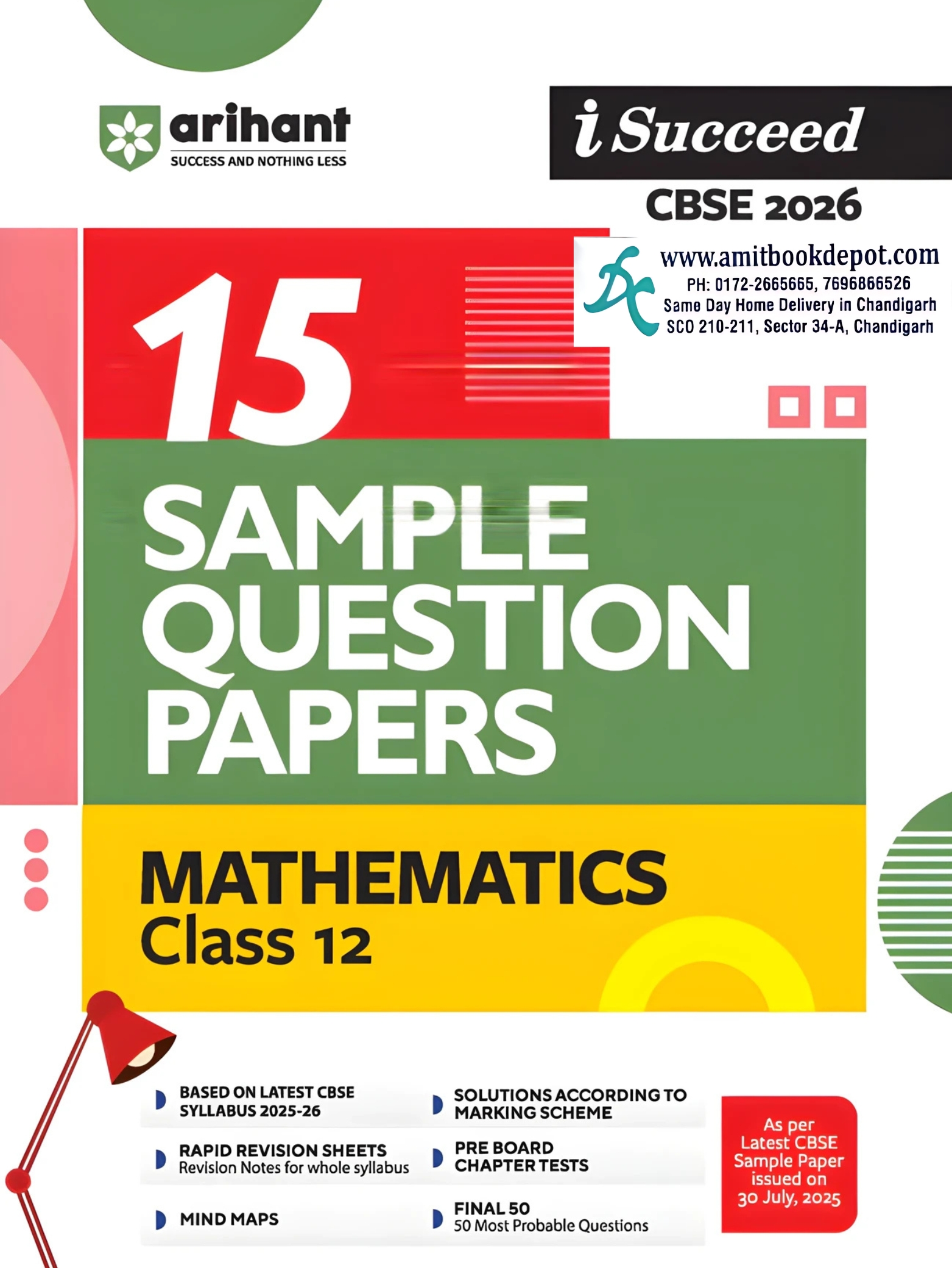
iSucceed 15 Sample Question Papers Mathematics for Class 12th

by Madhurima
₹275 ₹275.00(-/ off)

Rating & Reviews

23 Customer Review

iSucceed 15 Sample Question Papers Mathematics for Class 12th by Arihant Experts is the ultimate practice resource for CBSE board exam preparation. Strictly aligned with the latest CBSE syllabus for NCERT Class 12th, this book contains 15 solved sample papers designed to mirror the actual exam pattern. Covering all chapters from Relations and Functions to Probability, it helps students assess their readiness, improve speed and accuracy, and master key concepts like calculus, algebra, and three-dimensional geometry. An essential tool for self-assessment and strategic practice, this Arihant Prakashan publication is key to achieving high scores in the Class 12 Mathematics exam.

Have Doubts Regarding This Product ? Ask Your Question

  • Q1
    Is this book updated for the latest CBSE Class 12 Mathematics syllabus and exam pattern?
    A1

    Yes, the iSucceed sample papers are meticulously crafted to align with the most recent CBSE syllabus and the official exam pattern, including the prescribed marking scheme and question typology.

  • Q2
    How are the 15 sample papers structured? Do they include solutions?
    A2

    The book contains 15 full-length sample papers. Each paper includes a complete set of questions as per the board blueprint, and detailed, step-by-step solutions are provided for all papers to facilitate self-evaluation and learning.

  • Q3
    Does this book cover all chapters, including both "Mathematics Part 1" and "Part 2" of NCERT?
    A3

    Absolutely. The sample papers comprehensively cover the entire Class 12 Mathematics syllabus, including all units from Relations & Functions, Calculus (Differentiation & Integration), Algebra (Matrices, Determinants), Vectors, 3D Geometry, Linear Programming, and Probability.

  • Q4
    Can this book help me improve my time management during the exam?
    A4

    Definitely. Practicing with timed attempts of these full-length sample papers is one of the most effective ways to build exam endurance, learn to allocate time wisely across sections, and enhance your problem-solving speed.

  • Q5
    Are the questions in these papers based on NCERT, or do they include higher difficulty-level problems?
    A5

    The papers primarily follow the NCERT curriculum's scope and depth. However, they include a mix of questions that test fundamental understanding as well as application-based problems, preparing you for various challenge levels you might encounter.

  • Q6
    Does it include questions on applications of concepts, like "Applications of Derivatives" or "Linear Programming"?
    A6

    Yes, special emphasis is given to application-oriented chapters. You will find numerous problems on finding maxima/minima, rate of change, area under curves, and formulating & solving Linear Programming problems, which are high-scoring sections.

  • Q7
    I struggle with chapters like Three-Dimensional Geometry and Vectors. Can this book help?
    A7

    Yes, consistent practice is key to mastering these topics. The book provides ample and varied problems from these chapters across multiple sample papers, allowing you to repeatedly practice and solidify your understanding of direction cosines, equations of lines/planes, and vector operations.

  • Q8
    Is it useful for competitive exams like JEE Main, or is it strictly for board preparation?
    A8

    While its primary focus is the CBSE Class 12 Board Exam, the strong conceptual foundation and problem-solving practice it provides are undeniably beneficial for the Mathematics section of entrance exams like JEE Main, especially for the NCERT-based portions.

  • Q9
    Can this book be used alongside my regular NCERT textbook and classroom studies?
    A9

    Yes, it is designed to be a perfect companion. Use it for applying the concepts you learn from your NCERT textbook and classroom teaching. It turns theoretical knowledge into exam-ready practice.

  • Q10
    Are the solutions explained in a simple, easy-to-understand manner?
    A10

    The solutions are crafted by Arihant Experts to be clear, logical, and step-by-step. They focus on methodology, helping you grasp the correct approach to solving different types of problems.

0.00

0 Overall Rating
  • 5
    0
  • 4
    0
  • 3
    0
  • 2
    0
  • 1
    0

Try this product & share your review & thoughts

1. Relations and Functions
2. Inverse Trigonometric Functions
3. Matrices
4. Determinants
5. Continuity and Differentiability
6. Applications of Derivatives
7. Integrals
8. Applications of Integrals
9. Differential Equations
10. Vector Algebra
11. Three-Dimensional Geometry
12. Linear Programming
13. Probability

LATEST CBSE SYLLABUS NCERT CLASS 12TH PART 1


UNIT I: RELATIONS AND FUNCTIONS
1. Relations and Functions 
Types of relations: reflexive, symmetric, transitive, and equivalence relations. One-to-one and onto functions, composite functions, and inverse of a function. Binary operations.

2. Inverse Trigonometric Functions
Definition, range, domain, principal value branches. Graphs of inverse trigonometric functions. Elementary properties of inverse trigonometric functions.

UNIT II: ALGEBRA
1. Matrices 
Concept, notation, order, equality, types of matrices, zero matrix, transpose of a matrix, symmetric and skew-symmetric matrices. Addition, multiplication, and scalar multiplication of matrices are simple.
properties of addition, multiplication, and scalar multiplication. Non-commutativity of multiplication of matrices and existence of non-zero matrices whose product is the zero matrix (restrict to square matrices of order 2). Concept of elementary row and column operations. Invertible matrices and proof of the uniqueness of the inverse, if it exists (here all matrices will have real entries).

2. Determinants (Period 20)
Determinant of a square matrix (up to 3 × 3 matrices), properties of determinants, minors, cofactors and applications of determinants in finding the area of a triangle. Adjoint and inverse of a square matrix. Consistency, inconsistency, and number of solutions of a system of linear equations by examples: Solving a system of linear equations in two or three variables (having a unique solution) using the inverse of a matrix.

UNIT III: CALCULUS
1. Continuity and Differentiability 
Continuity and differentiability, derivative of composite functions, chain rule, derivatives of inverse trigonometric functions, derivative of implicit function. Concepts of exponential and logarithmic functions.
Derivatives of loge x and ex. Logarithmic differentiation. Derivative of functions expressed in parametric
forms. Second-order derivatives. Rolle’s and Lagrange’s Mean Value Theorems (without proof) and their geometric interpretations.

2. Applications of Derivatives
Applications of derivatives: rate of change, increasing/decreasing functions, tangents and normals, approximation, maxima and minima (first derivative test motivated geometrically and second derivative test given as a provable tool). Simple problems (that illustrate basic principles and understanding of the subject as well as real-life situations).


LATEST CBSE SYLLABUS NCERT CLASS 12TH PART 2


7. Integrals
Integration as the inverse process of differentiation. Integration of a variety of functions by substitution
by partial fractions and by parts, Definite integrals as a limit of a sum. Fundamental Theorem of Calculus (without proof). Basic properties of definite integrals and evaluation of definite integrals.

8. Applications of the Integrals
Applications in finding the area under simple curves, especially lines, arcs of circles/parabolas/ellipses (in standard form only), and the area between the two above-said curves (the region should be clearly identifiable).

9. Differential Equations
Definition, order and degree, and general and particular solutions of a differential equation. Formation of
differential equation whose general solution is given. Solution of differential equations by method of separation of variables, homogeneous differential equations of first order and first degree.

10. Vectors
Vectors and scalars, magnitude and direction of a vector. Direction cosines/ratios of vectors. Types
of vectors (equal, unit, zero, parallel, and collinear vectors), position vector of a point, negative of a vector, components of a vector, addition of vectors, multiplication of a vector by a scalar, and position vector of a point dividing a line segment in a given ratio. Scalar (dot) product of vectors, projection of a vector on a line. Vector (cross) product of vectors, scalar triple product.

11. Three-Dimensional Geometry
Direction cosines/ratios of a line joining two points. Cartesian and vector equations of a line, coplanar and skew lines, and the shortest distance between two lines. Cartesian and vector equations of a plane. Angle between (i) two lines, (ii) two planes, (iii) a line and a plane. Distance of a point from a plane.

12. Linear Programming
Introduction to related terminology such as constraints, objective function, optimization, and different types
of linear programming (L.P.) problems, mathematical formulation of L.P. problems, graphical method of solution for problems in two variables, feasible and infeasible regions, feasible and infeasible solutions, optimal feasible solutions (up to three non-trivial constraints).

13. Probability
Multiplication theorem on probability. Conditional probability, independent events, total probability, Bayes’s theorem. Random variable and its probability distribution, mean, and variance of haphazard variable. Repeated independent (Bernoulli) trials and binomial distribution.

Master the CBSE Class 12 Mathematics Board Exam with iSucceed 15 Sample Question Papers.

The journey through Class 12 is pivotal, and the mathematics board examination stands as a crucial milestone. Arihant Experts present the definitive tool for achieving excellence: iSucceed 15 Sample Question Papers for Mathematics Class 12th. This meticulously compiled resource, published by Arihant Prakashan, is engineered specifically for CBSE Class 12 students, providing a comprehensive and strategic blueprint for board exam preparation. Aligned perfectly with the latest CBSE syllabus for NCERT Class 12th, this book transforms preparation into practice, bridging the gap between theoretical knowledge and exam-ready performance.

Structured to reflect the exact pattern and rigor of the actual CBSE board exam, this book features 15 full-length sample papers. These papers are designed to simulate the real examination environment, enabling students to manage time, gauge their readiness, and identify strengths and weaknesses across every topic. The content spans the entire Class 12 Mathematics syllabus, from Relations and Functions to advanced topics like Probability and Three-Dimensional Geometry. This exhaustive coverage ensures no chapter is overlooked, building a robust foundation for scoring high marks.

iSucceed is more than just a question bank; it is an integrated learning system. Each of the 15 sample papers is crafted with a balanced mix of questions, adhering to the CBSE marking scheme and typology. This includes Very Short Answer (VSA), Short Answer (SA), and Long Answer (LA) type questions, ensuring students are well-versed with every possible format. By regularly practicing with these papers, students develop speed, accuracy, and confidence—three essential pillars for exam success. The book serves as an indispensable tool for self-assessment, allowing learners to track their progress systematically.

The content is organized to methodically cover all key units. Part A delves into algebra, including matrices and determinants, with a focus on operations, properties, and applications in solving linear equations. Part B thoroughly explores calculus, a significant portion of the syllabus. It covers continuity and differentiability, the applications of derivatives for rate of change and optimization problems, integrals (both indefinite and definite), applications of integrals for calculating areas, and differential equations. The clarity in presenting these complex concepts aids in solidifying understanding. Part C addresses vectors and three-dimensional geometry, crucial for developing spatial reasoning, followed by linear programming and probability, which have significant practical applications and weightage.

One of the standout features of this Arihant publication is its emphasis on conceptual clarity alongside exam practice. The book begins with a detailed syllabus breakdown, helping students prioritize their study plan. Each sample paper pushes the student to apply concepts logically, a skill vital for tackling tricky questions. Practicing with these papers helps in mastering problem-solving techniques for chapters like Inverse Trigonometric Functions, Applications of Derivatives for finding maxima/minima, and using Integration methods effectively.

For any Class 12 student aiming for a perfect score or a significant score improvement, consistent practice with quality material is non-negotiable. iSucceed 15 Sample Question Papers provides exactly that—a rigorous, reliable, and relevant practice platform. It is the preferred choice for students seeking a structured, stress-free, and strategic approach to board exam preparation. By integrating this book into their study regimen, students can move from merely understanding the mathematics syllabus to commanding it, ensuring they walk into the examination hall not just prepared, but poised to succeed.

Invest in your academic future with this essential guide from Arihant Experts. Build endurance, eliminate exam fear, and pave your way to a stellar result in the CBSE Class 12 Mathematics board exam.

1. Relations and Functions
2. Inverse Trigonometric Functions
3. Matrices
4. Determinants
5. Continuity and Differentiability
6. Applications of Derivatives
7. Integrals
8. Applications of Integrals
9. Differential Equations
10. Vector Algebra
11. Three-Dimensional Geometry
12. Linear Programming
13. Probability

Have Doubts Regarding This Product ? Ask Your Question

  • Q1
    Is this book updated for the latest CBSE Class 12 Mathematics syllabus and exam pattern?
    A1

    Yes, the iSucceed sample papers are meticulously crafted to align with the most recent CBSE syllabus and the official exam pattern, including the prescribed marking scheme and question typology.

  • Q2
    How are the 15 sample papers structured? Do they include solutions?
    A2

    The book contains 15 full-length sample papers. Each paper includes a complete set of questions as per the board blueprint, and detailed, step-by-step solutions are provided for all papers to facilitate self-evaluation and learning.

  • Q3
    Does this book cover all chapters, including both "Mathematics Part 1" and "Part 2" of NCERT?
    A3

    Absolutely. The sample papers comprehensively cover the entire Class 12 Mathematics syllabus, including all units from Relations & Functions, Calculus (Differentiation & Integration), Algebra (Matrices, Determinants), Vectors, 3D Geometry, Linear Programming, and Probability.

  • Q4
    Can this book help me improve my time management during the exam?
    A4

    Definitely. Practicing with timed attempts of these full-length sample papers is one of the most effective ways to build exam endurance, learn to allocate time wisely across sections, and enhance your problem-solving speed.

  • Q5
    Are the questions in these papers based on NCERT, or do they include higher difficulty-level problems?
    A5

    The papers primarily follow the NCERT curriculum's scope and depth. However, they include a mix of questions that test fundamental understanding as well as application-based problems, preparing you for various challenge levels you might encounter.

  • Q6
    Does it include questions on applications of concepts, like "Applications of Derivatives" or "Linear Programming"?
    A6

    Yes, special emphasis is given to application-oriented chapters. You will find numerous problems on finding maxima/minima, rate of change, area under curves, and formulating & solving Linear Programming problems, which are high-scoring sections.

  • Q7
    I struggle with chapters like Three-Dimensional Geometry and Vectors. Can this book help?
    A7

    Yes, consistent practice is key to mastering these topics. The book provides ample and varied problems from these chapters across multiple sample papers, allowing you to repeatedly practice and solidify your understanding of direction cosines, equations of lines/planes, and vector operations.

  • Q8
    Is it useful for competitive exams like JEE Main, or is it strictly for board preparation?
    A8

    While its primary focus is the CBSE Class 12 Board Exam, the strong conceptual foundation and problem-solving practice it provides are undeniably beneficial for the Mathematics section of entrance exams like JEE Main, especially for the NCERT-based portions.

  • Q9
    Can this book be used alongside my regular NCERT textbook and classroom studies?
    A9

    Yes, it is designed to be a perfect companion. Use it for applying the concepts you learn from your NCERT textbook and classroom teaching. It turns theoretical knowledge into exam-ready practice.

  • Q10
    Are the solutions explained in a simple, easy-to-understand manner?
    A10

    The solutions are crafted by Arihant Experts to be clear, logical, and step-by-step. They focus on methodology, helping you grasp the correct approach to solving different types of problems.

LATEST CBSE SYLLABUS NCERT CLASS 12TH PART 1


UNIT I: RELATIONS AND FUNCTIONS
1. Relations and Functions 
Types of relations: reflexive, symmetric, transitive, and equivalence relations. One-to-one and onto functions, composite functions, and inverse of a function. Binary operations.

2. Inverse Trigonometric Functions
Definition, range, domain, principal value branches. Graphs of inverse trigonometric functions. Elementary properties of inverse trigonometric functions.

UNIT II: ALGEBRA
1. Matrices 
Concept, notation, order, equality, types of matrices, zero matrix, transpose of a matrix, symmetric and skew-symmetric matrices. Addition, multiplication, and scalar multiplication of matrices are simple.
properties of addition, multiplication, and scalar multiplication. Non-commutativity of multiplication of matrices and existence of non-zero matrices whose product is the zero matrix (restrict to square matrices of order 2). Concept of elementary row and column operations. Invertible matrices and proof of the uniqueness of the inverse, if it exists (here all matrices will have real entries).

2. Determinants (Period 20)
Determinant of a square matrix (up to 3 × 3 matrices), properties of determinants, minors, cofactors and applications of determinants in finding the area of a triangle. Adjoint and inverse of a square matrix. Consistency, inconsistency, and number of solutions of a system of linear equations by examples: Solving a system of linear equations in two or three variables (having a unique solution) using the inverse of a matrix.

UNIT III: CALCULUS
1. Continuity and Differentiability 
Continuity and differentiability, derivative of composite functions, chain rule, derivatives of inverse trigonometric functions, derivative of implicit function. Concepts of exponential and logarithmic functions.
Derivatives of loge x and ex. Logarithmic differentiation. Derivative of functions expressed in parametric
forms. Second-order derivatives. Rolle’s and Lagrange’s Mean Value Theorems (without proof) and their geometric interpretations.

2. Applications of Derivatives
Applications of derivatives: rate of change, increasing/decreasing functions, tangents and normals, approximation, maxima and minima (first derivative test motivated geometrically and second derivative test given as a provable tool). Simple problems (that illustrate basic principles and understanding of the subject as well as real-life situations).


LATEST CBSE SYLLABUS NCERT CLASS 12TH PART 2


7. Integrals
Integration as the inverse process of differentiation. Integration of a variety of functions by substitution
by partial fractions and by parts, Definite integrals as a limit of a sum. Fundamental Theorem of Calculus (without proof). Basic properties of definite integrals and evaluation of definite integrals.

8. Applications of the Integrals
Applications in finding the area under simple curves, especially lines, arcs of circles/parabolas/ellipses (in standard form only), and the area between the two above-said curves (the region should be clearly identifiable).

9. Differential Equations
Definition, order and degree, and general and particular solutions of a differential equation. Formation of
differential equation whose general solution is given. Solution of differential equations by method of separation of variables, homogeneous differential equations of first order and first degree.

10. Vectors
Vectors and scalars, magnitude and direction of a vector. Direction cosines/ratios of vectors. Types
of vectors (equal, unit, zero, parallel, and collinear vectors), position vector of a point, negative of a vector, components of a vector, addition of vectors, multiplication of a vector by a scalar, and position vector of a point dividing a line segment in a given ratio. Scalar (dot) product of vectors, projection of a vector on a line. Vector (cross) product of vectors, scalar triple product.

11. Three-Dimensional Geometry
Direction cosines/ratios of a line joining two points. Cartesian and vector equations of a line, coplanar and skew lines, and the shortest distance between two lines. Cartesian and vector equations of a plane. Angle between (i) two lines, (ii) two planes, (iii) a line and a plane. Distance of a point from a plane.

12. Linear Programming
Introduction to related terminology such as constraints, objective function, optimization, and different types
of linear programming (L.P.) problems, mathematical formulation of L.P. problems, graphical method of solution for problems in two variables, feasible and infeasible regions, feasible and infeasible solutions, optimal feasible solutions (up to three non-trivial constraints).

13. Probability
Multiplication theorem on probability. Conditional probability, independent events, total probability, Bayes’s theorem. Random variable and its probability distribution, mean, and variance of haphazard variable. Repeated independent (Bernoulli) trials and binomial distribution.
0.00

0 Overall Rating
  • 5
    0
  • 4
    0
  • 3
    0
  • 2
    0
  • 1
    0

Try this product & share your review & thoughts

Top Trending Product

Related Product

Related Product

Related Blog Posts

Latest Blogs

Latest Blogs

blog-img
Classic Literature Reimagined: Discuss modern twists on classic novels.
Lorem ipsum dolor sit amet, consectetur adipiscing elit, sed do eiusmod tempor incididunt ut labore et dolore magna aliqua. Ut enim ad minim veniam, quis nostrud exercitation ullamco Lorem ipsum dolor sit amet, consectetur adipiscing elit, sed do eiusmod tempor incididunt ut labore et dolore magna aliqua. Utenim ad minim veniam, quis nostrud exercitation ullamco Lorem ipsum dolor sit amet, consecte...
Read more
Author name | 10 jan, 2025
blog-img
Classic Literature Reimagined: Discuss modern twists on classic novels.
Lorem ipsum dolor sit amet, consectetur adipiscing elit, sed do eiusmod tempor incididunt ut labore et dolore magna aliqua. Ut enim ad minim veniam, quis nostrud exercitation ullamco Lorem ipsum dolor sit amet, consectetur adipiscing elit, sed do eiusmod tempor incididunt ut labore et dolore magna aliqua. Utenim ad minim veniam, quis nostrud exercitation ullamco Lorem ipsum dolor sit amet, consecte...
Read more
Author name | 10 jan, 2025
blog-img
Classic Literature Reimagined: Discuss modern twists on classic novels.
Lorem ipsum dolor sit amet, consectetur adipiscing elit, sed do eiusmod tempor incididunt ut labore et dolore magna aliqua. Ut enim ad minim veniam, quis nostrud exercitation ullamco Lorem ipsum dolor sit amet, consectetur adipiscing elit, sed do eiusmod tempor incididunt ut labore et dolore magna aliqua. Utenim ad minim veniam, quis nostrud exercitation ullamco Lorem ipsum dolor sit amet, consecte...
Read more
Author name | 10 jan, 2025
blog-img
Classic Literature Reimagined: Discuss modern twists on classic novels.
Lorem ipsum dolor sit amet, consectetur adipiscing elit...
Read more
Author Name | 10 Jan, 2025
blog-img
Classic Literature Reimagined: Discuss modern twists on classic novels.
Lorem ipsum dolor sit amet, consectetur adipiscing elit...
Read more
Author Name | 10 Jan, 2025
blog-img
Classic Literature Reimagined: Discuss modern twists on classic novels.
Lorem ipsum dolor sit amet, consectetur adipiscing elit...
Read more
Author Name | 10 Jan, 2025
blog-img
Classic Literature Reimagined: Discuss modern twists on classic novels.
Lorem ipsum dolor sit amet, consectetur adipiscing elit...
Read more
Author Name | 10 Jan, 2025
blog-img
Classic Literature Reimagined: Discuss modern twists on classic novels.
Lorem ipsum dolor sit amet, consectetur adipiscing elit...
Read more
Author Name | 10 Jan, 2025
blog-img
Classic Literature Reimagined: Discuss modern twists on classic novels.
Lorem ipsum dolor sit amet, consectetur adipiscing elit...
Read more
Author Name | 10 Jan, 2025
blog-img
Classic Literature Reimagined: Discuss modern twists on classic novels.
Lorem ipsum dolor sit amet, consectetur adipiscing elit...
Read more
Author Name | 10 Jan, 2025
blog-img
Classic Literature Reimagined: Discuss modern twists on classic novels.
Lorem ipsum dolor sit amet, consectetur adipiscing elit...
Read more
Author Name | 10 Jan, 2025
blog-img
Classic Literature Reimagined: Discuss modern twists on classic novels.
Lorem ipsum dolor sit amet, consectetur adipiscing elit...
Read more
Author Name | 10 Jan, 2025