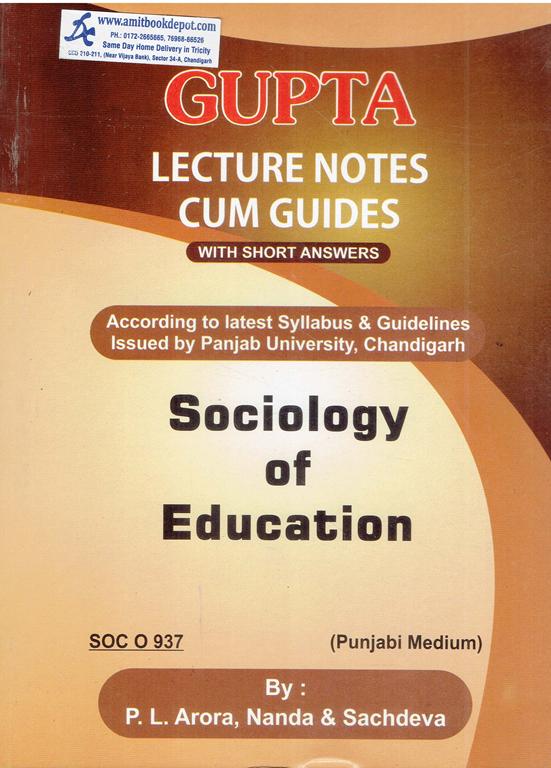
Gupta Sociology of Education SOC O 937 For MA Sociology 3rd Semester Panjab University Chandigarh (Punjabi Medium)
Gupta Sociology of Education SOC O 937 For MA Sociology 3rd Semester Panjab University Chandigarh (Punjabi Medium)
by Madhurima
₹500₹500.00(-/
off)
Rating & Reviews
23 Customer Review
Gupta's Sociology of Education (SOC O 937) is the prescribed Punjabi-medium book for MA Sociology 3rd Semester at Panjab University, Chandigarh. Authored by P.L. Arora, Nanda, and Sachdeva and published by Pepsu Book Depot, it comprehensively covers the latest syllabus across four units. The book explores foundational theories (Gandhian, functional, conflict, and postmodern), education's role in development and empowerment, the Indian educational system's growth and policies, and critical issues of caste, gender, class, and social mobility. Including short answer questions, it is an essential resource for mastering the paper's concepts and securing academic success.
Gupta Sociology of Education (SOC O 937) for MA Sociology 3rd Semester, Panjab University, Chandigarh (Punjabi Medium) by P. L. Arora, Nanda, and Sachdeva is the definitive and prescribed academic book meticulously crafted to fulfill the exact syllabus requirements for the Master of Arts in Sociology program at Panjab University. Published by Pepsu Book Depot, this comprehensive guide serves as an indispensable resource for students navigating the complex interplay between education and societal structures. The book is strategically structured into four cohesive units, each delving into critical themes and theoretical frameworks essential for mastering the paper.
The content begins with a foundational exploration in Unit I, establishing the core concepts of education and its profound relationship with society. It thoroughly examines processes of socialization and education, alongside mechanisms of cultural and social reproduction. A significant portion is dedicated to key theoretical approaches in the sociology of education, including in-depth analyses of the Gandhian perspective on education, the functionalist approach, the conflict theory viewpoint, and contemporary postmodern approaches. This unit provides the essential theoretical bedrock for critical analysis.
Unit II shifts focus to the dynamic and applied roles of education. It investigates the role of education in social and human development from emerging perspectives, highlighting education as a catalyst for change. A crucial chapter addresses the empowerment of marginalized groups—Scheduled Castes (SCs), Scheduled Tribes (STs), and women—analyzing how education can be a tool for social justice. This is directly linked to a detailed discussion on policies of positive discrimination and affirmative action in the Indian educational landscape, a vital topic for understanding equity and access.
Moving to the Indian context, Unit III offers a comprehensive overview of education in India, tracking its expansion and growth. It meticulously details the constitutional provisions related to education and reviews major educational policies in India. The unit tackles both foundational and contemporary challenges, covering the mission of universalization of elementary education (UEE), the ongoing crises in Indian higher education, and the significant trends in the expansion of professional education and the role of the private sector. This unit equips students with a pragmatic understanding of the Indian educational system's evolution and current dilemmas.
Unit IV delves into the core sociological theme of stratification, exploring the intricate relationship between education and social stratification. It offers specialized, critical examinations of how caste, gender, and class intersect with and shape educational access, processes, and outcomes. The unit concludes by analyzing the dual role of education in both perpetuating and challenging inequality through concepts of education and social mobility and the pursuit of equality of educational opportunity.
This book is not merely a compilation of topics; it is a structured academic companion designed for success. It includes a dedicated section of short answer-type questions, invaluable for revision and self-assessment, aligning perfectly with the exam pattern. The content is precisely tailored to the latest syllabus of SOC O 937, ensuring no topic is overlooked. It adheres to the specific instructions for paper-setters and candidates of Panjab University, including the marking scheme of 80 marks for theory and 20 for internal assessment, with a 3-hour duration. The Punjabi medium presentation ensures clarity and accessibility for students, facilitating deeper engagement with complex sociological concepts. For any student pursuing an MA in Sociology from Panjab University, this book is an essential, syllabus-specific investment for academic excellence, thorough exam preparation, and a nuanced understanding of the sociology of education.
Is this book the latest edition and perfectly aligned with the current MA Sociology 3rd Semester syllabus for Panjab University?
A1
Yes, this book is meticulously compiled to match the latest prescribed syllabus for SOC O 937 (Sociology of Education) for the Punjabi medium stream at Panjab University, Chandigarh.
Q2
Does the book cover all the theoretical approaches mentioned in Unit I, including the postmodern perspective?
A2
Absolutely. Unit I provides dedicated chapters on Gandhian, Functional, Conflict, and Postmodern theoretical approaches to the sociology of education.
Q3
How does the book address the topic of education and marginalization as per the syllabus?
A3
Unit II has a specific chapter on the role of education in the empowerment of marginalized groups (SCs, STs, and Women), directly linking it to policies of positive discrimination and affirmative action.
Q4
Are contemporary issues like the crisis in higher education and private sector expansion in professional education covered?
A4
Yes, Unit III includes detailed discussions on the crises in Indian higher education and the expansion of professional education involving the private sector.
Q5
Does the book help in preparing for the section on education and social stratification?
A5
Comprehensively. Unit IV is entirely dedicated to education and social stratification, with separate analytical chapters on Caste, Gender, and Class, followed by education's role in social mobility.
Q6
Are the Panjab University exam pattern and marking scheme reflected in this book's structure?
A6
The content is organized according to the university's four-unit syllabus structure, and it acknowledges the 80+20 marking scheme, ensuring strategic preparation.
Q7
Is the language and terminology used in the book appropriate for Punjabi medium students?
A7
Yes, the book is written entirely in Punjabi, using appropriate academic terminology to facilitate clear understanding of complex sociological concepts for Punjabi-medium students.
Q8
Can this book be used as a sole reference for scoring well in the SOC O 937 paper?
A8
This book is designed as a comprehensive, syllabus-specific core text. While it covers all prescribed topics in detail, students may supplement it with lecture notes and original readings for enhanced depth.
Q9
Does it include discussion on constitutional provisions and major educational policies like the NEP?
A9
Yes, a chapter in Unit III is devoted to constitutional provisions and educational policies in India, providing a historical and policy framework essential for the syllabus.
Q10
Is the concept of "Equality of Educational Opportunity" discussed in relation to social mobility?
A10
Yes, the final part of Unit IV integrates the concepts of education-driven social mobility with the challenges and ideals of achieving equality of educational opportunity.
0.00
0 Overall Rating
5
0
4
0
3
0
2
0
1
0
Try this product & share your review &
thoughts
UNIT - I
1. The Concept of Education
2. Education and Society
3. Socialization and Education
4. Cultural and Social Reproduction
5. Theoretical Approaches: Gandhian
6. Theoretical Approaches: Functional & Conflict
7. Theoretical Approaches: Postmodern Approach
UNIT - II
8. Role of Education in Social and Human Development: Emerging Perspectives
9. Role of Education for Empowerment of Marginalized
10. Education and the Policy of Positive Discrimination and Affirmative Action
UNIT - III
11. Education in India: Expansion & Growth
12. Constitutional Provisions and Educational Policies in India
13. Universalization of Elementary Education
14. Crises in Indian Higher Education
15. Expansion of Professional Education and Private Sector
UNIT - IV
16. Education and Social Stratification
17. Caste and Education
18. Gender and Education
19. Class and Education
20. Education and Social Mobility
21. Mobility and Equality of Educational Opportunities
Short Answer Type Questions
Latest Syllabus of Sociology of Education SOC O 937 For MA Sociology 3rd Semester Panjab University Chandigarh (Punjabi Medium)
SOC O 937: Sociology of Education
Objective
The course provides (a) an introduction to an important branch of sociology that deals with education and society. (b) Students will get acquainted with the approaches and contributions in the sociology of education. (c) familiarizes the student with the growth and expansion of education in India; (d) the role of education in the development process; and (e) the emerging educational scenario under the process of globalization.
INSTRUCTIONS FOR THE PAPER-SETTER AND THE CANDIDATES
(i) The theory question paper will be of 80 marks, and 20 marks will be for internal assessment. The duration of the paper will be 3 hours.
(ii) For private candidates, who have not been assessed earlier for internal assessment, the marks secured by them in the theory paper will proportionately be increased to the maximum marks of the paper in lieu of internal assessment.
The paper setter must put note (ii) in the question paper.
The syllabus has been divided into four units.
There shall be 9 questions in all. The first question is compulsory and shall be a short answer type containing 10 short questions spread over the whole syllabus to be answered in about 30 to 35 words each, carrying 20 marks, i.e., 2 marks each. The rest of the paper shall contain 4 units. Each unit shall have two long questions, and the candidates shall be given an internal choice of attempting one question from each unit—4 in all. Each question will carry 15 marks.
Course Outline
Unit - I
The Concept of Education; Education and Society; Socialization and Education; Cultural and
Social Reproduction
Theoretical Approaches: Gandhian, Functional, Conflict, and Postmodern
Unit - II
1. Role of Education in Social and Human Development—Emerging Perspectives
2. Role of Education for Empowerment of the Marginalized—SCs, STs, and Women
3. Education and the Policy of Positive Discrimination and Affirmative Action
Unit III.
Education: Expansion and Growth
Constitutional Provisions and Educational Policies in India
Universalization of Elementary Education, Crises in Indian Higher Education, Expansion of
Professional Education and the Private Sector
Unit IV
Education and Social Stratification:
Caste and Education
Gender and Education
Class and Education
Education and Social Mobility / (Mobility and Equality of Educational opportunities.)
Gupta Sociology of Education (SOC O 937) for MA Sociology 3rd Semester, Panjab University, Chandigarh (Punjabi Medium) by P. L. Arora, Nanda, and Sachdeva is the definitive and prescribed academic book meticulously crafted to fulfill the exact syllabus requirements for the Master of Arts in Sociology program at Panjab University. Published by Pepsu Book Depot, this comprehensive guide serves as an indispensable resource for students navigating the complex interplay between education and societal structures. The book is strategically structured into four cohesive units, each delving into critical themes and theoretical frameworks essential for mastering the paper.
The content begins with a foundational exploration in Unit I, establishing the core concepts of education and its profound relationship with society. It thoroughly examines processes of socialization and education, alongside mechanisms of cultural and social reproduction. A significant portion is dedicated to key theoretical approaches in the sociology of education, including in-depth analyses of the Gandhian perspective on education, the functionalist approach, the conflict theory viewpoint, and contemporary postmodern approaches. This unit provides the essential theoretical bedrock for critical analysis.
Unit II shifts focus to the dynamic and applied roles of education. It investigates the role of education in social and human development from emerging perspectives, highlighting education as a catalyst for change. A crucial chapter addresses the empowerment of marginalized groups—Scheduled Castes (SCs), Scheduled Tribes (STs), and women—analyzing how education can be a tool for social justice. This is directly linked to a detailed discussion on policies of positive discrimination and affirmative action in the Indian educational landscape, a vital topic for understanding equity and access.
Moving to the Indian context, Unit III offers a comprehensive overview of education in India, tracking its expansion and growth. It meticulously details the constitutional provisions related to education and reviews major educational policies in India. The unit tackles both foundational and contemporary challenges, covering the mission of universalization of elementary education (UEE), the ongoing crises in Indian higher education, and the significant trends in the expansion of professional education and the role of the private sector. This unit equips students with a pragmatic understanding of the Indian educational system's evolution and current dilemmas.
Unit IV delves into the core sociological theme of stratification, exploring the intricate relationship between education and social stratification. It offers specialized, critical examinations of how caste, gender, and class intersect with and shape educational access, processes, and outcomes. The unit concludes by analyzing the dual role of education in both perpetuating and challenging inequality through concepts of education and social mobility and the pursuit of equality of educational opportunity.
This book is not merely a compilation of topics; it is a structured academic companion designed for success. It includes a dedicated section of short answer-type questions, invaluable for revision and self-assessment, aligning perfectly with the exam pattern. The content is precisely tailored to the latest syllabus of SOC O 937, ensuring no topic is overlooked. It adheres to the specific instructions for paper-setters and candidates of Panjab University, including the marking scheme of 80 marks for theory and 20 for internal assessment, with a 3-hour duration. The Punjabi medium presentation ensures clarity and accessibility for students, facilitating deeper engagement with complex sociological concepts. For any student pursuing an MA in Sociology from Panjab University, this book is an essential, syllabus-specific investment for academic excellence, thorough exam preparation, and a nuanced understanding of the sociology of education.
UNIT - I
1. The Concept of Education
2. Education and Society
3. Socialization and Education
4. Cultural and Social Reproduction
5. Theoretical Approaches: Gandhian
6. Theoretical Approaches: Functional & Conflict
7. Theoretical Approaches: Postmodern Approach
UNIT - II
8. Role of Education in Social and Human Development: Emerging Perspectives
9. Role of Education for Empowerment of Marginalized
10. Education and the Policy of Positive Discrimination and Affirmative Action
UNIT - III
11. Education in India: Expansion & Growth
12. Constitutional Provisions and Educational Policies in India
13. Universalization of Elementary Education
14. Crises in Indian Higher Education
15. Expansion of Professional Education and Private Sector
UNIT - IV
16. Education and Social Stratification
17. Caste and Education
18. Gender and Education
19. Class and Education
20. Education and Social Mobility
21. Mobility and Equality of Educational Opportunities
Is this book the latest edition and perfectly aligned with the current MA Sociology 3rd Semester syllabus for Panjab University?
A1
Yes, this book is meticulously compiled to match the latest prescribed syllabus for SOC O 937 (Sociology of Education) for the Punjabi medium stream at Panjab University, Chandigarh.
Q2
Does the book cover all the theoretical approaches mentioned in Unit I, including the postmodern perspective?
A2
Absolutely. Unit I provides dedicated chapters on Gandhian, Functional, Conflict, and Postmodern theoretical approaches to the sociology of education.
Q3
How does the book address the topic of education and marginalization as per the syllabus?
A3
Unit II has a specific chapter on the role of education in the empowerment of marginalized groups (SCs, STs, and Women), directly linking it to policies of positive discrimination and affirmative action.
Q4
Are contemporary issues like the crisis in higher education and private sector expansion in professional education covered?
A4
Yes, Unit III includes detailed discussions on the crises in Indian higher education and the expansion of professional education involving the private sector.
Q5
Does the book help in preparing for the section on education and social stratification?
A5
Comprehensively. Unit IV is entirely dedicated to education and social stratification, with separate analytical chapters on Caste, Gender, and Class, followed by education's role in social mobility.
Q6
Are the Panjab University exam pattern and marking scheme reflected in this book's structure?
A6
The content is organized according to the university's four-unit syllabus structure, and it acknowledges the 80+20 marking scheme, ensuring strategic preparation.
Q7
Is the language and terminology used in the book appropriate for Punjabi medium students?
A7
Yes, the book is written entirely in Punjabi, using appropriate academic terminology to facilitate clear understanding of complex sociological concepts for Punjabi-medium students.
Q8
Can this book be used as a sole reference for scoring well in the SOC O 937 paper?
A8
This book is designed as a comprehensive, syllabus-specific core text. While it covers all prescribed topics in detail, students may supplement it with lecture notes and original readings for enhanced depth.
Q9
Does it include discussion on constitutional provisions and major educational policies like the NEP?
A9
Yes, a chapter in Unit III is devoted to constitutional provisions and educational policies in India, providing a historical and policy framework essential for the syllabus.
Q10
Is the concept of "Equality of Educational Opportunity" discussed in relation to social mobility?
A10
Yes, the final part of Unit IV integrates the concepts of education-driven social mobility with the challenges and ideals of achieving equality of educational opportunity.
Latest Syllabus of Sociology of Education SOC O 937 For MA Sociology 3rd Semester Panjab University Chandigarh (Punjabi Medium)
SOC O 937: Sociology of Education
Objective
The course provides (a) an introduction to an important branch of sociology that deals with education and society. (b) Students will get acquainted with the approaches and contributions in the sociology of education. (c) familiarizes the student with the growth and expansion of education in India; (d) the role of education in the development process; and (e) the emerging educational scenario under the process of globalization.
INSTRUCTIONS FOR THE PAPER-SETTER AND THE CANDIDATES
(i) The theory question paper will be of 80 marks, and 20 marks will be for internal assessment. The duration of the paper will be 3 hours.
(ii) For private candidates, who have not been assessed earlier for internal assessment, the marks secured by them in the theory paper will proportionately be increased to the maximum marks of the paper in lieu of internal assessment.
The paper setter must put note (ii) in the question paper.
The syllabus has been divided into four units.
There shall be 9 questions in all. The first question is compulsory and shall be a short answer type containing 10 short questions spread over the whole syllabus to be answered in about 30 to 35 words each, carrying 20 marks, i.e., 2 marks each. The rest of the paper shall contain 4 units. Each unit shall have two long questions, and the candidates shall be given an internal choice of attempting one question from each unit—4 in all. Each question will carry 15 marks.
Course Outline
Unit - I
The Concept of Education; Education and Society; Socialization and Education; Cultural and
Social Reproduction
Theoretical Approaches: Gandhian, Functional, Conflict, and Postmodern
Unit - II
1. Role of Education in Social and Human Development—Emerging Perspectives
2. Role of Education for Empowerment of the Marginalized—SCs, STs, and Women
3. Education and the Policy of Positive Discrimination and Affirmative Action
Unit III.
Education: Expansion and Growth
Constitutional Provisions and Educational Policies in India
Universalization of Elementary Education, Crises in Indian Higher Education, Expansion of
Professional Education and the Private Sector
Unit IV
Education and Social Stratification:
Caste and Education
Gender and Education
Class and Education
Education and Social Mobility / (Mobility and Equality of Educational opportunities.)
0.00
0 Overall Rating
5
0
4
0
3
0
2
0
1
0
Try this product & share your review &
thoughts
Top Trending Product
Related
Product
Related Product
Related Blog Posts
Latest Blogs
Latest Blogs
Classic Literature Reimagined: Discuss modern twists on classic novels.
Lorem ipsum dolor sit amet, consectetur adipiscing elit, sed
do
eiusmod tempor incididunt ut labore et dolore magna aliqua. Ut enim ad minim
veniam, quis nostrud exercitation ullamco Lorem ipsum dolor sit amet,
consectetur adipiscing elit, sed do eiusmod tempor incididunt ut labore et
dolore magna aliqua. Utenim ad minim veniam, quis nostrud exercitation
ullamco
Lorem ipsum dolor sit amet, consecte...
Classic Literature Reimagined: Discuss modern twists on classic novels.
Lorem ipsum dolor sit amet, consectetur adipiscing elit, sed
do
eiusmod tempor incididunt ut labore et dolore magna aliqua. Ut enim ad minim
veniam, quis nostrud exercitation ullamco Lorem ipsum dolor sit amet,
consectetur adipiscing elit, sed do eiusmod tempor incididunt ut labore et
dolore magna aliqua. Utenim ad minim veniam, quis nostrud exercitation
ullamco
Lorem ipsum dolor sit amet, consecte...
Classic Literature Reimagined: Discuss modern twists on classic novels.
Lorem ipsum dolor sit amet, consectetur adipiscing elit, sed
do
eiusmod tempor incididunt ut labore et dolore magna aliqua. Ut enim ad minim
veniam, quis nostrud exercitation ullamco Lorem ipsum dolor sit amet,
consectetur adipiscing elit, sed do eiusmod tempor incididunt ut labore et
dolore magna aliqua. Utenim ad minim veniam, quis nostrud exercitation
ullamco
Lorem ipsum dolor sit amet, consecte...