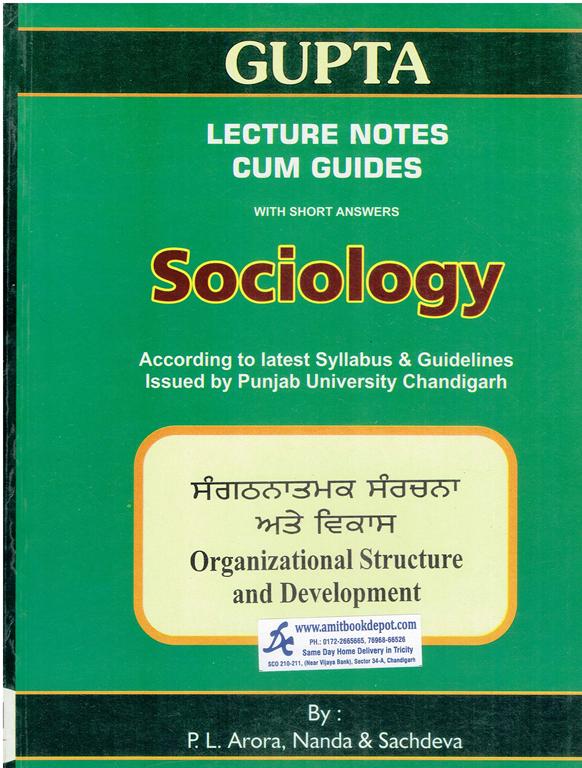
Family in Cross Cultural Perspective for MA Sociology 3rd Semester Panjab University Chandigarh (Punjabi Medium)
Family in Cross Cultural Perspective for MA Sociology 3rd Semester Panjab University Chandigarh (Punjabi Medium)
by Madhurima
₹300₹300.00(-/
off)
Rating & Reviews
23 Customer Review
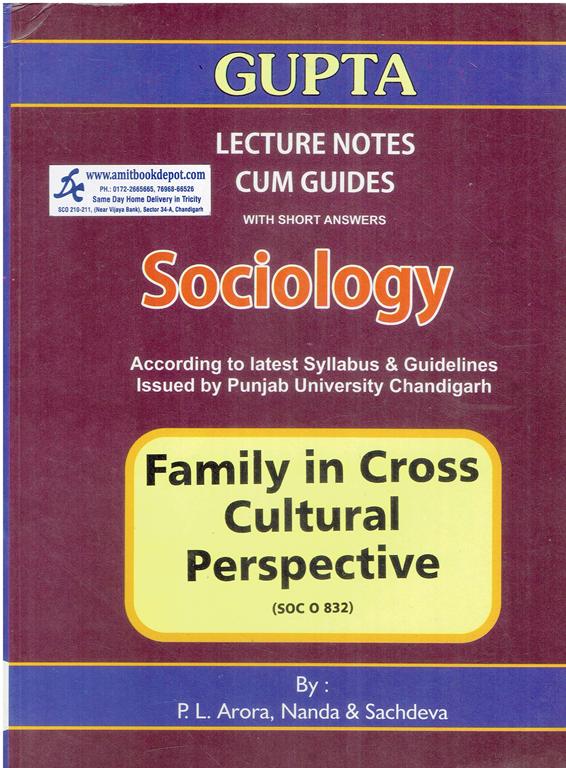
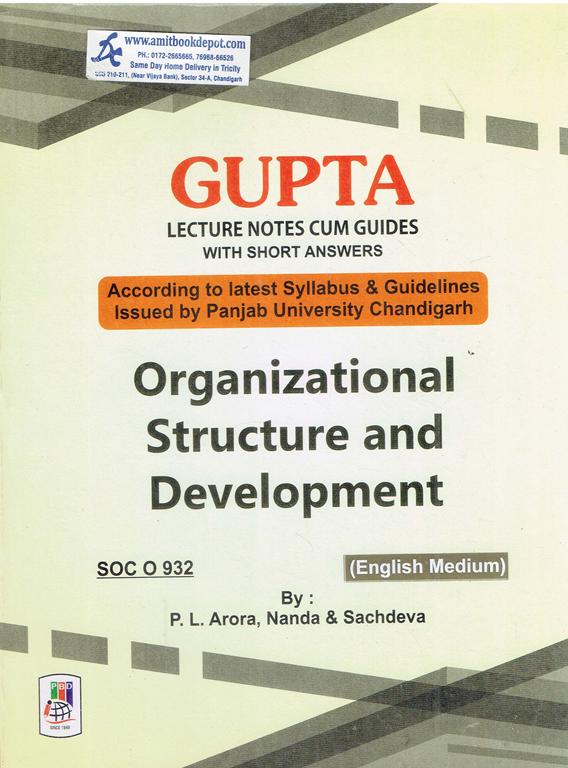
"Family in Cross Cultural Perspective" is the prescribed Punjabi-medium book for MA Sociology, 3rd Semester, at Panjab University, Chandigarh (SOC O 832). Authored by P.L. Arora, Nanda, and Sachdeva, this book provides a comprehensive comparative analysis of family structures and gender relations across diverse global societies. It covers key sociological theories on the universality of family, examines emerging alternative lifestyles like cohabitation and single parenthood, and discusses the future of the family in light of migration and aging. Perfectly aligned with the university syllabus, it includes short answer questions and is essential for exam success.
Product Title: Family in Cross-Cultural Perspective (Punjabi Medium) for MA Sociology 3rd Semester, Panjab University
Authors: P. L. Arora, Nanda, Sachdeva
Publisher: Pepsu Book Depot
Language: Punjabi
Course: SOC O 832, MA Sociology, Semester III, Panjab University, Chandigarh
This book, "Family in Cross-Cultural Perspective," is the prescribed and comprehensive academic resource specifically designed for students pursuing their Master of Arts in Sociology from Panjab University, Chandigarh, in the Punjabi medium. Meticulously authored by P. L. Arora, Nanda, and Sachdeva, and published by the reputable Pepsu Book Depot, this book is structured to align perfectly with the latest university syllabus (SOC O 832). Its core objective is to provide an in-depth, comparative analysis of family structures and gender dynamics across diverse global societies, enabling Punjabi-medium scholars to engage with sophisticated sociological concepts in their native language.
The book is systematically divided into four units, each addressing critical themes outlined in the Panjab University syllabus. Unit I offers a cross-cultural perspective on family and gender relations, providing detailed case studies from a spectrum of nations, including Japan, Belgium, India, Iran, Brazil, Afghanistan, and Ethiopia. This comparative approach allows students to understand the impact of a society's developmental status—whether highly developed, developing, or underdeveloped—on its core familial institutions and gender roles.
Unit II delves into the foundational sociological debate on the universality of family. It presents the seminal theories of renowned sociologists and anthropologists such as Bronislaw Malinowski, George Murdock, Talcott Parsons, and Norman W. Bell & Ezra F. Vogel, who posit the family as a universal social institution. This theoretical foundation is contrasted with empirical examinations of family structures among the Blacks in the West Indies, in parts of Central America, the U.S.A., and the Nayars of Central Kerala in India, challenging and complicating the notion of a single, universal family form.
Moving to contemporary realities, Unit III critically examines emerging alternative lifestyles that have gained prominence globally. This unit provides scholarly insights into singlehood (never married), cohabitation (living together without marriage), single-parent households (both male- and female-headed), and group living models, with a dedicated study of the Kibbutz of Israel. This section is crucial for understanding the diversification and restructuring of traditional family life.
Finally, Unit IV engages with the critical factors shaping the future of the family. It analyzes the influences of gender equity, aging populations, and migration patterns on familial structures and functions. This forward-looking unit equips students to think critically about the evolving nature of this fundamental institution in a rapidly changing world.
As a vital resource for Panjab University MA Sociology students, this book not only covers the entire theory paper scope but also includes a dedicated section of Short Answer Type Questions, which is instrumental for exam preparation, especially for the compulsory first question in the university papers. The content is presented with academic rigor yet in clear, accessible Punjabi, ensuring that complex sociological theories are comprehensible. This book is an indispensable tool for mastering the syllabus, developing a comparative understanding, and excelling in both internal assessments and the final examinations for the 3rd semester.
Key Features:
1. Strictly follows the latest Panjab University Chandigarh syllabus for SOC O 832.
2. Written entirely in the Punjabi medium, catering specifically to the needs of Punjabi-speaking students.
3. Provides a detailed table of contents mirroring the four-unit structure of the course.
4. Includes a section for short answer-type questions for effective exam preparation.
5. Published by Pepsu Book Depot, a trusted name in academic publishing for university texts.
6. Essential for thorough preparation of the 80-mark theory paper and internal assessment.
Is this book the latest edition and perfectly aligned with the current MA Sociology 3rd Semester syllabus of Panjab University, Chandigarh?
A1
Yes, this book is meticulously crafted to follow the latest prescribed syllabus (SOC O 832) for the Punjabi medium course.
Q2
Does the book cover all four units of the syllabus, including the case studies like Japan, Belgium, and the Nayars of Kerala?
A2
Absolutely. The book is divided into four precise units, covering all required topics, including detailed case studies of families in Japan, Belgium, India, Iran, Brazil, Afghanistan, Ethiopia, the West Indies, Central America, the USA, and the Nayars.
Q3
Are the theories of sociologists like Malinowski, Murdock, and Parsons explained in the Punjabi language?
A3
Yes, the book presents the complex theories of seminal thinkers like Bronislaw Malinowski, George Murdock, and Talcott Parsons in clear and academic Punjabi.
Q4
Does it include content on contemporary alternative lifestyles like cohabitation and single-parent households?
A4
Yes, Unit III is dedicated to emerging alternative lifestyles, including detailed discussions on singlehood, cohabitation, single-parent households, and group living communes like the Kibbutz.
Q5
Apart from the main topics, does the book cover the section on the fate of the family in different regions like Central America?
A5
Yes, it includes detailed discussions on the fate of the family among Blacks in the West Indies, in parts of Central America, the USA, and the Nayars of India as specified in Unit II of the syllabus.
Q6
Is the print quality and language clarity good for a Punjabi medium academic book?
A6
Published by Pepsu Book Depot, the book is known for its standard academic print quality and uses clear, formal Punjabi suitable for university-level study.
Q7
Will this book help me understand the debate on whether the family is a universal institution?
A7
Certainly. Unit II is entirely focused on this debate, presenting arguments for universality and examining cases that challenge this notion.
Q8
Is the content only theoretical, or does it include empirical examples and case studies?
A8
The book effectively blends theoretical perspectives (e.g., from Parsons, Murdock) with concrete empirical case studies from around the world.
Q9
oes the book provide a comparative perspective on gender relations in developed and developing countries?
A9
Yes, Unit I specifically offers a cross-cultural comparison of family and gender relations in highly developed, developing, and underdeveloped countries as per the syllabus.
Q10
Are keywords and important sociological concepts highlighted or explained in simple terms for better understanding?
A10
The book presents concepts in an accessible manner in Punjabi, ensuring key terms and theories are clearly explained for master's level students.
0.00
0 Overall Rating
5
0
4
0
3
0
2
0
1
0
Try this product & share your review &
thoughts
UNIT - I
1. Family and Gender Relations
2. Japa: Family & Gender Relation
3. Family and Gender Relations in Belgium
4. India: Family and Gender Relations
5. Gender Relations and Family in Iran
6. Family and Gender Relations in Brazil
7. Family and Gender Relations in Afghanistan
8. Ethiopia: Family and Gender Relations
UNIT - II
9. Bronislaw Malinowski: Family As a Social Institution
10. George Murdock: Family as a Social Institution
11. Talcott Parsons: Family as a Social Institution
12. Norman W. Bell & Ezra F. Vogel
13. Fate of Family among the Blacks in the Island of the West Indies
14. Fate of Family in Parts of Central America
15. Fate of Family in U.S.A.
16. The Nayars of Central Kerala in India
UNIT - III
17. Singlehood/Never Married
18. Cohabitation: Living together without marriage
19. Single Parent: Male/Female-Headed Households
20. Group Living: Communes (The Kibbutz of Israel)
UNIT - IV
21. Future of the Family
22. Gender Equity: Future of the Family
23. Aging and the Future of the Family
24. Migration & Future of the Family
Short Answer Type Questions
Latest Syllabus of Family in Cross Cultural Perspective for MA Sociology 3rd Semester Panjab University Chandigarh (Punjabi Medium)
SOC O 832: FAMILY IN CROSS-CULTURAL PERSPECTIVE
Objective
Students’ exposure to this course is intended to facilitate their comparative understanding of family and gender relations in different societies. Another aim is to make the students aware of whether the family is the basic institution in all societies and whether the family as an institution is near the point of extinction or restructuring itself, and as a consequence, many alternative lifestyles to traditional marriage and family living are emerging.
INSTRUCTIONS FOR THE PAPER-SETTER AND THE CANDIDATES
(i) The theory question paper will be of 80 marks, and 20 marks will be for internal assessment. The duration of the paper will be 3 hours.
(ii) For private candidates, who have not been assessed earlier for internal assessment, the marks secured by them in the theory paper will proportionately be increased to the maximum marks of the paper in lieu of internal assessment.
The paper setter must put note (ii) in the question paper.
The syllabus has been divided into four units.
There shall be 9 questions in all. The first question is compulsory and shall be a short answer type containing 10 short questions spread over the whole syllabus to be answered in about 30 to 35 words each, carrying 20 marks, i.e., 2 marks each. The rest of the paper shall contain 4 units. Each unit shall have two long questions, and the candidates shall be given an internal choice of attempting one question from each unit—4 in all. Each question will carry 15 marks.
Course Outline
Unit-I
Family and Gender Relations
In Highly Developed, Developing, and Underdeveloped Countries
- Japan, Belgium
- India, Iran, Brazil
- Afghanistan and Ethiopia
Unit II
Universality of Family
- Family as a Universal Social Institution—Views of Bronislaw Malinowski, George Murdock, Talcott Parsons, Norman W. Bell, and Ezra F. Vogel
- Fate of Family among the Blacks in the Islands of the West Indies, Parts of Central America and the U.S.A.; the Nayars of Central Kerala in India.
Product Title: Family in Cross-Cultural Perspective (Punjabi Medium) for MA Sociology 3rd Semester, Panjab University
Authors: P. L. Arora, Nanda, Sachdeva
Publisher: Pepsu Book Depot
Language: Punjabi
Course: SOC O 832, MA Sociology, Semester III, Panjab University, Chandigarh
This book, "Family in Cross-Cultural Perspective," is the prescribed and comprehensive academic resource specifically designed for students pursuing their Master of Arts in Sociology from Panjab University, Chandigarh, in the Punjabi medium. Meticulously authored by P. L. Arora, Nanda, and Sachdeva, and published by the reputable Pepsu Book Depot, this book is structured to align perfectly with the latest university syllabus (SOC O 832). Its core objective is to provide an in-depth, comparative analysis of family structures and gender dynamics across diverse global societies, enabling Punjabi-medium scholars to engage with sophisticated sociological concepts in their native language.
The book is systematically divided into four units, each addressing critical themes outlined in the Panjab University syllabus. Unit I offers a cross-cultural perspective on family and gender relations, providing detailed case studies from a spectrum of nations, including Japan, Belgium, India, Iran, Brazil, Afghanistan, and Ethiopia. This comparative approach allows students to understand the impact of a society's developmental status—whether highly developed, developing, or underdeveloped—on its core familial institutions and gender roles.
Unit II delves into the foundational sociological debate on the universality of family. It presents the seminal theories of renowned sociologists and anthropologists such as Bronislaw Malinowski, George Murdock, Talcott Parsons, and Norman W. Bell & Ezra F. Vogel, who posit the family as a universal social institution. This theoretical foundation is contrasted with empirical examinations of family structures among the Blacks in the West Indies, in parts of Central America, the U.S.A., and the Nayars of Central Kerala in India, challenging and complicating the notion of a single, universal family form.
Moving to contemporary realities, Unit III critically examines emerging alternative lifestyles that have gained prominence globally. This unit provides scholarly insights into singlehood (never married), cohabitation (living together without marriage), single-parent households (both male- and female-headed), and group living models, with a dedicated study of the Kibbutz of Israel. This section is crucial for understanding the diversification and restructuring of traditional family life.
Finally, Unit IV engages with the critical factors shaping the future of the family. It analyzes the influences of gender equity, aging populations, and migration patterns on familial structures and functions. This forward-looking unit equips students to think critically about the evolving nature of this fundamental institution in a rapidly changing world.
As a vital resource for Panjab University MA Sociology students, this book not only covers the entire theory paper scope but also includes a dedicated section of Short Answer Type Questions, which is instrumental for exam preparation, especially for the compulsory first question in the university papers. The content is presented with academic rigor yet in clear, accessible Punjabi, ensuring that complex sociological theories are comprehensible. This book is an indispensable tool for mastering the syllabus, developing a comparative understanding, and excelling in both internal assessments and the final examinations for the 3rd semester.
Key Features:
1. Strictly follows the latest Panjab University Chandigarh syllabus for SOC O 832.
2. Written entirely in the Punjabi medium, catering specifically to the needs of Punjabi-speaking students.
3. Provides a detailed table of contents mirroring the four-unit structure of the course.
4. Includes a section for short answer-type questions for effective exam preparation.
5. Published by Pepsu Book Depot, a trusted name in academic publishing for university texts.
6. Essential for thorough preparation of the 80-mark theory paper and internal assessment.
UNIT - I
1. Family and Gender Relations
2. Japa: Family & Gender Relation
3. Family and Gender Relations in Belgium
4. India: Family and Gender Relations
5. Gender Relations and Family in Iran
6. Family and Gender Relations in Brazil
7. Family and Gender Relations in Afghanistan
8. Ethiopia: Family and Gender Relations
UNIT - II
9. Bronislaw Malinowski: Family As a Social Institution
10. George Murdock: Family as a Social Institution
11. Talcott Parsons: Family as a Social Institution
12. Norman W. Bell & Ezra F. Vogel
13. Fate of Family among the Blacks in the Island of the West Indies
14. Fate of Family in Parts of Central America
15. Fate of Family in U.S.A.
16. The Nayars of Central Kerala in India
UNIT - III
17. Singlehood/Never Married
18. Cohabitation: Living together without marriage
19. Single Parent: Male/Female-Headed Households
20. Group Living: Communes (The Kibbutz of Israel)
Is this book the latest edition and perfectly aligned with the current MA Sociology 3rd Semester syllabus of Panjab University, Chandigarh?
A1
Yes, this book is meticulously crafted to follow the latest prescribed syllabus (SOC O 832) for the Punjabi medium course.
Q2
Does the book cover all four units of the syllabus, including the case studies like Japan, Belgium, and the Nayars of Kerala?
A2
Absolutely. The book is divided into four precise units, covering all required topics, including detailed case studies of families in Japan, Belgium, India, Iran, Brazil, Afghanistan, Ethiopia, the West Indies, Central America, the USA, and the Nayars.
Q3
Are the theories of sociologists like Malinowski, Murdock, and Parsons explained in the Punjabi language?
A3
Yes, the book presents the complex theories of seminal thinkers like Bronislaw Malinowski, George Murdock, and Talcott Parsons in clear and academic Punjabi.
Q4
Does it include content on contemporary alternative lifestyles like cohabitation and single-parent households?
A4
Yes, Unit III is dedicated to emerging alternative lifestyles, including detailed discussions on singlehood, cohabitation, single-parent households, and group living communes like the Kibbutz.
Q5
Apart from the main topics, does the book cover the section on the fate of the family in different regions like Central America?
A5
Yes, it includes detailed discussions on the fate of the family among Blacks in the West Indies, in parts of Central America, the USA, and the Nayars of India as specified in Unit II of the syllabus.
Q6
Is the print quality and language clarity good for a Punjabi medium academic book?
A6
Published by Pepsu Book Depot, the book is known for its standard academic print quality and uses clear, formal Punjabi suitable for university-level study.
Q7
Will this book help me understand the debate on whether the family is a universal institution?
A7
Certainly. Unit II is entirely focused on this debate, presenting arguments for universality and examining cases that challenge this notion.
Q8
Is the content only theoretical, or does it include empirical examples and case studies?
A8
The book effectively blends theoretical perspectives (e.g., from Parsons, Murdock) with concrete empirical case studies from around the world.
Q9
oes the book provide a comparative perspective on gender relations in developed and developing countries?
A9
Yes, Unit I specifically offers a cross-cultural comparison of family and gender relations in highly developed, developing, and underdeveloped countries as per the syllabus.
Q10
Are keywords and important sociological concepts highlighted or explained in simple terms for better understanding?
A10
The book presents concepts in an accessible manner in Punjabi, ensuring key terms and theories are clearly explained for master's level students.
Latest Syllabus of Family in Cross Cultural Perspective for MA Sociology 3rd Semester Panjab University Chandigarh (Punjabi Medium)
SOC O 832: FAMILY IN CROSS-CULTURAL PERSPECTIVE
Objective
Students’ exposure to this course is intended to facilitate their comparative understanding of family and gender relations in different societies. Another aim is to make the students aware of whether the family is the basic institution in all societies and whether the family as an institution is near the point of extinction or restructuring itself, and as a consequence, many alternative lifestyles to traditional marriage and family living are emerging.
INSTRUCTIONS FOR THE PAPER-SETTER AND THE CANDIDATES
(i) The theory question paper will be of 80 marks, and 20 marks will be for internal assessment. The duration of the paper will be 3 hours.
(ii) For private candidates, who have not been assessed earlier for internal assessment, the marks secured by them in the theory paper will proportionately be increased to the maximum marks of the paper in lieu of internal assessment.
The paper setter must put note (ii) in the question paper.
The syllabus has been divided into four units.
There shall be 9 questions in all. The first question is compulsory and shall be a short answer type containing 10 short questions spread over the whole syllabus to be answered in about 30 to 35 words each, carrying 20 marks, i.e., 2 marks each. The rest of the paper shall contain 4 units. Each unit shall have two long questions, and the candidates shall be given an internal choice of attempting one question from each unit—4 in all. Each question will carry 15 marks.
Course Outline
Unit-I
Family and Gender Relations
In Highly Developed, Developing, and Underdeveloped Countries
- Japan, Belgium
- India, Iran, Brazil
- Afghanistan and Ethiopia
Unit II
Universality of Family
- Family as a Universal Social Institution—Views of Bronislaw Malinowski, George Murdock, Talcott Parsons, Norman W. Bell, and Ezra F. Vogel
- Fate of Family among the Blacks in the Islands of the West Indies, Parts of Central America and the U.S.A.; the Nayars of Central Kerala in India.
Unit III
Emerging Alternative Lifestyles
- Singlehood – Never Married
- Cohabitation – Living Together Without Marriage
- Single parent – Male/Female Headed Households
- Group Living – Communes (The Kibbutz of Israel)
Unit IV
Future of Family in the Light of
- Gender Equity
- Aging
- Migration
0.00
0 Overall Rating
5
0
4
0
3
0
2
0
1
0
Try this product & share your review &
thoughts
Top Trending Product
Related
Product
Related Product
Related Blog Posts
Latest Blogs
Latest Blogs
Classic Literature Reimagined: Discuss modern twists on classic novels.
Lorem ipsum dolor sit amet, consectetur adipiscing elit, sed
do
eiusmod tempor incididunt ut labore et dolore magna aliqua. Ut enim ad minim
veniam, quis nostrud exercitation ullamco Lorem ipsum dolor sit amet,
consectetur adipiscing elit, sed do eiusmod tempor incididunt ut labore et
dolore magna aliqua. Utenim ad minim veniam, quis nostrud exercitation
ullamco
Lorem ipsum dolor sit amet, consecte...
Classic Literature Reimagined: Discuss modern twists on classic novels.
Lorem ipsum dolor sit amet, consectetur adipiscing elit, sed
do
eiusmod tempor incididunt ut labore et dolore magna aliqua. Ut enim ad minim
veniam, quis nostrud exercitation ullamco Lorem ipsum dolor sit amet,
consectetur adipiscing elit, sed do eiusmod tempor incididunt ut labore et
dolore magna aliqua. Utenim ad minim veniam, quis nostrud exercitation
ullamco
Lorem ipsum dolor sit amet, consecte...
Classic Literature Reimagined: Discuss modern twists on classic novels.
Lorem ipsum dolor sit amet, consectetur adipiscing elit, sed
do
eiusmod tempor incididunt ut labore et dolore magna aliqua. Ut enim ad minim
veniam, quis nostrud exercitation ullamco Lorem ipsum dolor sit amet,
consectetur adipiscing elit, sed do eiusmod tempor incididunt ut labore et
dolore magna aliqua. Utenim ad minim veniam, quis nostrud exercitation
ullamco
Lorem ipsum dolor sit amet, consecte...