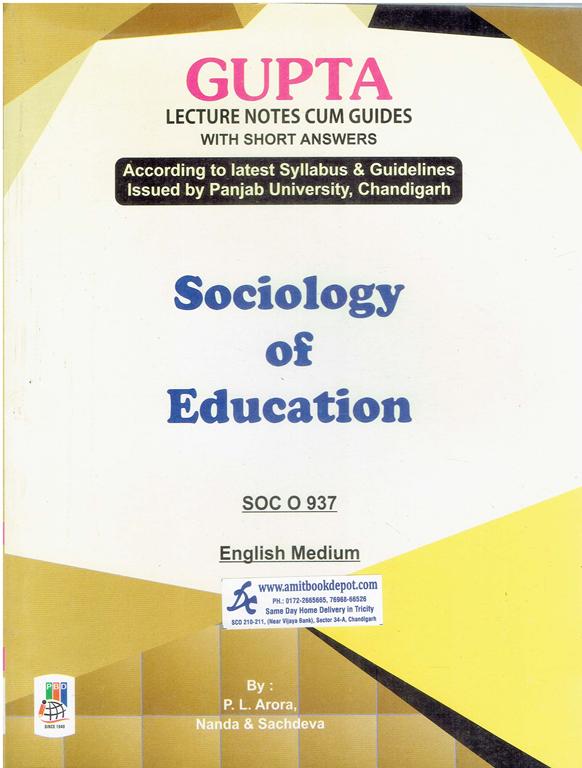
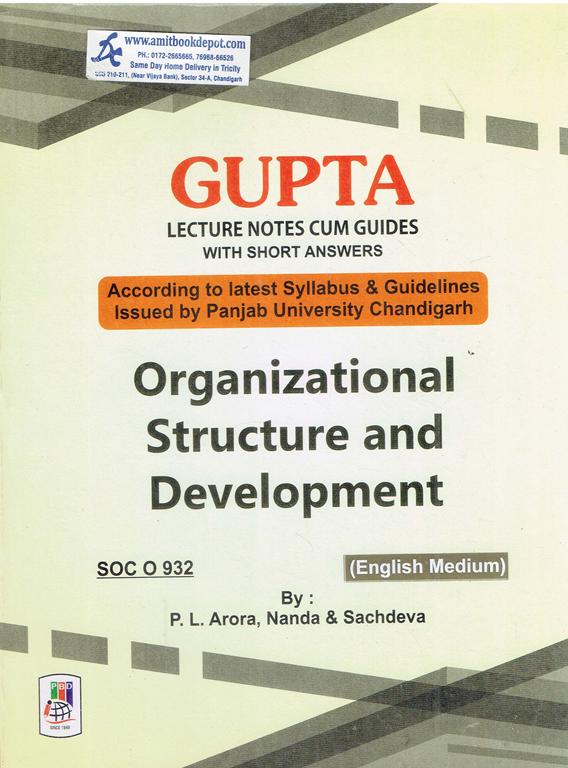
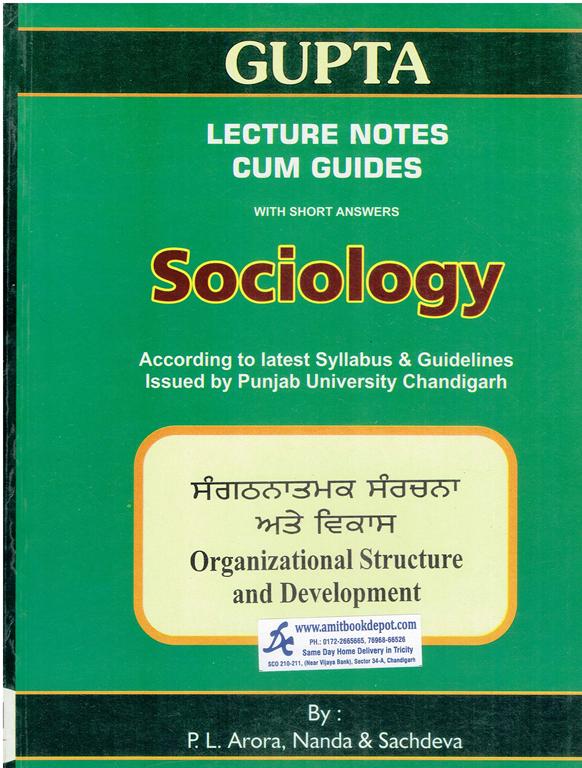
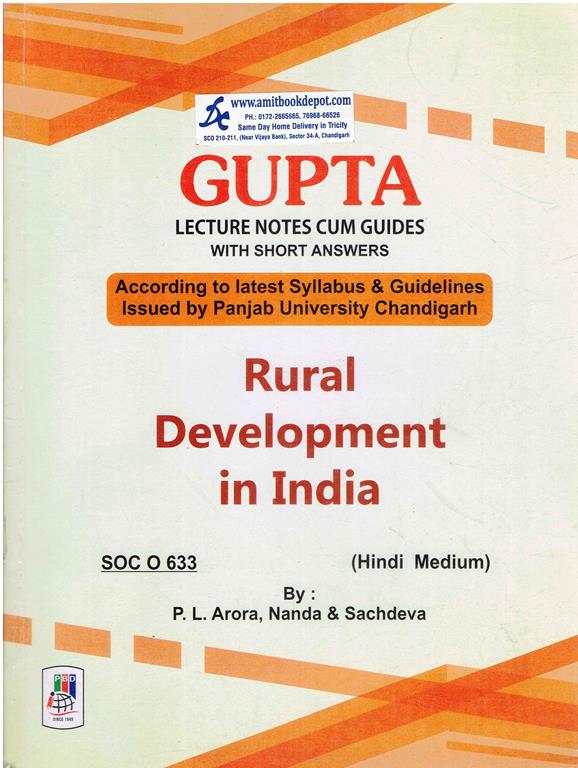
Gupta Sociology of Education SOC O 937 For MA Sociology 3rd Semester Panjab University Chandigarh (English Medium)
Gupta Sociology of Education SOC O 937 For MA Sociology 3rd Semester Panjab University Chandigarh (English Medium)
by Madhurima
₹600₹600.00(-/
off)
Rating & Reviews
23 Customer Review
Gupta's Sociology of Education (SOC O 937) is the prescribed book for MA Sociology 3rd Semester students at Panjab University, Chandigarh. Authored by P.L. Arora, Nanda, and Sachdeva and published by Pepsu Book Depot, it provides complete coverage of the syllabus. The book explores education and society, theoretical approaches (functional, conflict, Gandhian, and postmodern), and the role of education in the empowerment of marginalized groups. It analyzes Indian education through constitutional provisions, universalization of elementary education, and crises in higher education. It also covers education and social stratification regarding caste, gender, and class, making it essential for exam preparation and conceptual clarity.
Gupta Sociology of Education (SOC O 937) for MA Sociology 3rd Semester, Panjab University, is an authoritative and syllabus-specific book meticulously crafted for postgraduate students pursuing their Master of Arts in Sociology from Panjab University, Chandigarh. Authored by the renowned academic trio P. L. Arora, Nanda, and Sachdeva, and published by the trusted Pepsu Book Depot, this book is the definitive study resource designed to provide comprehensive coverage of the prescribed curriculum for the paper SOC O 937: Sociology of Education.
This volume offers a rigorous academic exploration of the intricate relationship between education and society, serving as an essential guide for students to understand education not just as a pedagogical process but as a critical social institution. It systematically addresses all four units outlined in the latest Panjab University syllabus, ensuring students are thoroughly prepared for both their examinations and a nuanced understanding of the subject. The book begins by establishing foundational concepts, including the concept of education, the processes of socialization and education, and the mechanisms of cultural and social reproduction. It delves into key theoretical approaches in the sociology of education, providing in-depth analyses of the functionalist, conflict, Gandhian, and postmodern perspectives, enabling students to critically evaluate the role of education from multiple sociological lenses.
Progressing to contemporary applications, the book critically examines the role of education in social and human development, with a dedicated focus on its power for the empowerment of marginalized communities, including Scheduled Castes (SCs), Scheduled Tribes (STs), and women. It provides a detailed discussion on policies of positive discrimination and affirmative action within the educational framework, linking theory directly to Indian socio-political realities. A significant portion of the book is dedicated to the Indian context, tracing the expansion and growth of education in India. It meticulously covers constitutional provisions and educational policies, analyzes challenges in the universalization of elementary education, discusses the ongoing crises in Indian higher education, and evaluates the impact of the expansion of professional education and the private sector.
The final section provides a critical analysis of education and social stratification, exploring the complex intersections of caste and education, gender and education, and class and education. It further investigates the dynamics of education and social mobility, questioning the ideal of equality of educational opportunities in a stratified society. To aid in exam preparation, the book includes a dedicated section of short answer type questions that help students revise key points and practice for the compulsory first question in the university exam, which consists of short-answer questions spread across the entire syllabus.
Structured to align perfectly with the Panjab University examination pattern, this book helps candidates navigate the paper's format, which includes a compulsory short-answer section and long essays from each unit. Its clear, academic language and logical flow from concept to theory to Indian case studies make it an indispensable resource for achieving academic success in the MA Sociology 3rd Semester exam. For any student at Panjab University Chandigarh seeking a reliable, comprehensive, and syllabus-focused text on the sociology of education, this book by Arora, Nanda, and Sachdeva is the undisputed and recommended choice.
Is this book strictly aligned with the latest syllabus of SOC O 937 for Panjab University's MA Sociology 3rd Semester?
A1
Yes, this book is meticulously crafted to cover all topics and units as per the latest prescribed syllabus for SOC O 937 at Panjab University, Chandigarh. The table of contents directly mirrors the four-unit structure of the course outline.
Q2
Does it include the specific theoretical approaches mentioned in the syllabus, like the Gandhian and Postmodern perspectives?
A2
Absolutely. Unit I of the book provides dedicated chapters on all required theoretical approaches in sociology of education, including Gandhian, Functional, Conflict, and the Postmodern Approach, ensuring comprehensive theoretical coverage.
Q3
Are contemporary issues like affirmative action and empowerment of marginalized groups discussed?
A3
Yes, Unit II specifically deals with the role of education for empowerment of marginalized sections (SCs, STs, Women) and provides a detailed analysis of positive discrimination and affirmative action policies in the Indian educational system.
Q4
Is there content on social stratification and its link to education?
A4
Unit IV offers a detailed examination of education and social stratification, with separate chapters analyzing the intersections of caste and education, gender and education, class and education, and the concepts of social mobility and equality of opportunity.
Q5
Is the internal assessment component of the paper explained or covered in this book?
A5
The book focuses on the theoretical content (80 marks) of the syllabus. The internal assessment (20 marks) is typically managed separately by college departments and is not covered in this textbook, as per university guidelines.
Q6
Does the book cover the topic of "Cultural and Social Reproduction" as per Unit I?
A6
Yes, Chapter 4 in Unit I is specifically dedicated to Cultural and Social Reproduction, a key concept in the sociology of education.
Q7
How is the book structured to help in answering long essay questions from each unit?
A7
The content is organized into clear chapters corresponding to each syllabus unit. The detailed explanations of concepts, theories, and Indian case studies within each chapter provide the substantive material needed to formulate comprehensive 15-mark essay answers.
Q8
Does it discuss the impact of globalization on education, as mentioned in the syllabus objective?
A8
While the syllabus objective mentions globalization, the primary focus of the prescribed units is on the topics listed in the four units. For specific sub-topics like globalization, students should refer to the detailed index or content within relevant chapters on emerging perspectives and policy.
Q9
Is this book suitable for private candidates of Panjab University?
A9
Yes, it is an essential resource for private candidates as it provides the complete theoretical content required for the 80-mark theory paper. Private candidates should note the university's rule that their theory marks are proportionately increased in lieu of internal assessment.
Q10
Can this book be used as a reference for competitive exams like UGC NET in Sociology?
A10
While its primary focus is the Panjab University MA syllabus, the comprehensive coverage of core concepts in the sociology of education, Indian educational policies, and social stratification makes it a valuable secondary reference for the education-related modules in the UGC NET Sociology examination.
0.00
0 Overall Rating
5
0
4
0
3
0
2
0
1
0
Try this product & share your review &
thoughts
UNIT - I
1. The Concept of Education
2. Education and Society
3. Socialization and Education
4. Cultural and Social Reproduction
5. Theoretical Approaches: Gandhian
6. Theoretical Approaches: Functional & Conflict
7. Theoretical Approaches: Postmodern Approach
UNIT - II
8. Role of Education in Social and Human Development: Emerging Perspectives
9. Role of Education for Empowerment of Marginalized
10. Education and the Policy of Positive Discrimination and Affirmative Action
UNIT - III
11. Education in India: Expansion & Growth
12. Constitutional Provisions and Educational Policies in India
13. Universalization of Elementary Education
14. Crises in Indian Higher Education
15. Expansion of Professional Education and Private Sector
UNIT - IV
16. Education and Social Stratification
17. Caste and Education
18. Gender and Education
19. Class and Education
20. Education and Social Mobility
21. Mobility and Equality of Educational Opportunities
Short Answer Type Questions
Latest Syllabus of Sociology of Education SOC O 937 for MA Sociology 3rd Semester, Panjab University (PU), Chandigarh (English Medium)
SOC O 937: Sociology of Education
Objective
The course provides (a) an introduction to an important branch of sociology that deals with education and society. (b) Students will get acquainted with the approaches and contributions in the sociology of education. (c) familiarizes the student with the growth and expansion of education in India; (d) the role of education in the development process; and (e) the emerging educational scenario under the process of globalization.
INSTRUCTIONS FOR THE PAPER-SETTER AND THE CANDIDATES
(i) The theory question paper will be of 80 marks, and 20 marks will be for internal assessment. The duration of the paper will be 3 hours.
(ii) For private candidates, who have not been assessed earlier for internal assessment, the marks secured by them in the theory paper will proportionately be increased to the maximum marks of the paper in lieu of internal assessment.
The paper setter must put note (ii) in the question paper.
The syllabus has been divided into four units.
There shall be 9 questions in all. The first question is compulsory and shall be a short answer type containing 10 short questions spread over the whole syllabus to be answered in about 30 to 35 words each, carrying 20 marks, i.e., 2 marks each. The rest of the paper shall contain 4 units. Each unit shall have two long questions, and the candidates shall be given an internal choice of attempting one question from each unit—4 in all. Each question will carry 15 marks.
Course Outline
Unit - I
The Concept of Education; Education and Society; Socialization and Education; Cultural and
Social Reproduction
Theoretical Approaches: Gandhian, Functional, Conflict, and Postmodern
Unit - II
1. Role of Education in Social and Human Development—Emerging Perspectives
2. Role of Education for Empowerment of the Marginalized—SCs, STs, and Women
3. Education and the Policy of Positive Discrimination and Affirmative Action
Unit III.
Education: Expansion and Growth
Constitutional Provisions and Educational Policies in India
Universalization of Elementary Education, Crises in Indian Higher Education, Expansion of
Professional Education and the Private Sector
Unit IV
Education and Social Stratification:
Caste and Education
Gender and Education
Class and Education
Education and Social Mobility / (Mobility and Equality of Educational opportunities.)
Gupta Sociology of Education (SOC O 937) for MA Sociology 3rd Semester, Panjab University, is an authoritative and syllabus-specific book meticulously crafted for postgraduate students pursuing their Master of Arts in Sociology from Panjab University, Chandigarh. Authored by the renowned academic trio P. L. Arora, Nanda, and Sachdeva, and published by the trusted Pepsu Book Depot, this book is the definitive study resource designed to provide comprehensive coverage of the prescribed curriculum for the paper SOC O 937: Sociology of Education.
This volume offers a rigorous academic exploration of the intricate relationship between education and society, serving as an essential guide for students to understand education not just as a pedagogical process but as a critical social institution. It systematically addresses all four units outlined in the latest Panjab University syllabus, ensuring students are thoroughly prepared for both their examinations and a nuanced understanding of the subject. The book begins by establishing foundational concepts, including the concept of education, the processes of socialization and education, and the mechanisms of cultural and social reproduction. It delves into key theoretical approaches in the sociology of education, providing in-depth analyses of the functionalist, conflict, Gandhian, and postmodern perspectives, enabling students to critically evaluate the role of education from multiple sociological lenses.
Progressing to contemporary applications, the book critically examines the role of education in social and human development, with a dedicated focus on its power for the empowerment of marginalized communities, including Scheduled Castes (SCs), Scheduled Tribes (STs), and women. It provides a detailed discussion on policies of positive discrimination and affirmative action within the educational framework, linking theory directly to Indian socio-political realities. A significant portion of the book is dedicated to the Indian context, tracing the expansion and growth of education in India. It meticulously covers constitutional provisions and educational policies, analyzes challenges in the universalization of elementary education, discusses the ongoing crises in Indian higher education, and evaluates the impact of the expansion of professional education and the private sector.
The final section provides a critical analysis of education and social stratification, exploring the complex intersections of caste and education, gender and education, and class and education. It further investigates the dynamics of education and social mobility, questioning the ideal of equality of educational opportunities in a stratified society. To aid in exam preparation, the book includes a dedicated section of short answer type questions that help students revise key points and practice for the compulsory first question in the university exam, which consists of short-answer questions spread across the entire syllabus.
Structured to align perfectly with the Panjab University examination pattern, this book helps candidates navigate the paper's format, which includes a compulsory short-answer section and long essays from each unit. Its clear, academic language and logical flow from concept to theory to Indian case studies make it an indispensable resource for achieving academic success in the MA Sociology 3rd Semester exam. For any student at Panjab University Chandigarh seeking a reliable, comprehensive, and syllabus-focused text on the sociology of education, this book by Arora, Nanda, and Sachdeva is the undisputed and recommended choice.
UNIT - I
1. The Concept of Education
2. Education and Society
3. Socialization and Education
4. Cultural and Social Reproduction
5. Theoretical Approaches: Gandhian
6. Theoretical Approaches: Functional & Conflict
7. Theoretical Approaches: Postmodern Approach
UNIT - II
8. Role of Education in Social and Human Development: Emerging Perspectives
9. Role of Education for Empowerment of Marginalized
10. Education and the Policy of Positive Discrimination and Affirmative Action
UNIT - III
11. Education in India: Expansion & Growth
12. Constitutional Provisions and Educational Policies in India
13. Universalization of Elementary Education
14. Crises in Indian Higher Education
15. Expansion of Professional Education and Private Sector
UNIT - IV
16. Education and Social Stratification
17. Caste and Education
18. Gender and Education
19. Class and Education
20. Education and Social Mobility
21. Mobility and Equality of Educational Opportunities
Is this book strictly aligned with the latest syllabus of SOC O 937 for Panjab University's MA Sociology 3rd Semester?
A1
Yes, this book is meticulously crafted to cover all topics and units as per the latest prescribed syllabus for SOC O 937 at Panjab University, Chandigarh. The table of contents directly mirrors the four-unit structure of the course outline.
Q2
Does it include the specific theoretical approaches mentioned in the syllabus, like the Gandhian and Postmodern perspectives?
A2
Absolutely. Unit I of the book provides dedicated chapters on all required theoretical approaches in sociology of education, including Gandhian, Functional, Conflict, and the Postmodern Approach, ensuring comprehensive theoretical coverage.
Q3
Are contemporary issues like affirmative action and empowerment of marginalized groups discussed?
A3
Yes, Unit II specifically deals with the role of education for empowerment of marginalized sections (SCs, STs, Women) and provides a detailed analysis of positive discrimination and affirmative action policies in the Indian educational system.
Q4
Is there content on social stratification and its link to education?
A4
Unit IV offers a detailed examination of education and social stratification, with separate chapters analyzing the intersections of caste and education, gender and education, class and education, and the concepts of social mobility and equality of opportunity.
Q5
Is the internal assessment component of the paper explained or covered in this book?
A5
The book focuses on the theoretical content (80 marks) of the syllabus. The internal assessment (20 marks) is typically managed separately by college departments and is not covered in this textbook, as per university guidelines.
Q6
Does the book cover the topic of "Cultural and Social Reproduction" as per Unit I?
A6
Yes, Chapter 4 in Unit I is specifically dedicated to Cultural and Social Reproduction, a key concept in the sociology of education.
Q7
How is the book structured to help in answering long essay questions from each unit?
A7
The content is organized into clear chapters corresponding to each syllabus unit. The detailed explanations of concepts, theories, and Indian case studies within each chapter provide the substantive material needed to formulate comprehensive 15-mark essay answers.
Q8
Does it discuss the impact of globalization on education, as mentioned in the syllabus objective?
A8
While the syllabus objective mentions globalization, the primary focus of the prescribed units is on the topics listed in the four units. For specific sub-topics like globalization, students should refer to the detailed index or content within relevant chapters on emerging perspectives and policy.
Q9
Is this book suitable for private candidates of Panjab University?
A9
Yes, it is an essential resource for private candidates as it provides the complete theoretical content required for the 80-mark theory paper. Private candidates should note the university's rule that their theory marks are proportionately increased in lieu of internal assessment.
Q10
Can this book be used as a reference for competitive exams like UGC NET in Sociology?
A10
While its primary focus is the Panjab University MA syllabus, the comprehensive coverage of core concepts in the sociology of education, Indian educational policies, and social stratification makes it a valuable secondary reference for the education-related modules in the UGC NET Sociology examination.
Latest Syllabus of Sociology of Education SOC O 937 for MA Sociology 3rd Semester, Panjab University (PU), Chandigarh (English Medium)
SOC O 937: Sociology of Education
Objective
The course provides (a) an introduction to an important branch of sociology that deals with education and society. (b) Students will get acquainted with the approaches and contributions in the sociology of education. (c) familiarizes the student with the growth and expansion of education in India; (d) the role of education in the development process; and (e) the emerging educational scenario under the process of globalization.
INSTRUCTIONS FOR THE PAPER-SETTER AND THE CANDIDATES
(i) The theory question paper will be of 80 marks, and 20 marks will be for internal assessment. The duration of the paper will be 3 hours.
(ii) For private candidates, who have not been assessed earlier for internal assessment, the marks secured by them in the theory paper will proportionately be increased to the maximum marks of the paper in lieu of internal assessment.
The paper setter must put note (ii) in the question paper.
The syllabus has been divided into four units.
There shall be 9 questions in all. The first question is compulsory and shall be a short answer type containing 10 short questions spread over the whole syllabus to be answered in about 30 to 35 words each, carrying 20 marks, i.e., 2 marks each. The rest of the paper shall contain 4 units. Each unit shall have two long questions, and the candidates shall be given an internal choice of attempting one question from each unit—4 in all. Each question will carry 15 marks.
Course Outline
Unit - I
The Concept of Education; Education and Society; Socialization and Education; Cultural and
Social Reproduction
Theoretical Approaches: Gandhian, Functional, Conflict, and Postmodern
Unit - II
1. Role of Education in Social and Human Development—Emerging Perspectives
2. Role of Education for Empowerment of the Marginalized—SCs, STs, and Women
3. Education and the Policy of Positive Discrimination and Affirmative Action
Unit III.
Education: Expansion and Growth
Constitutional Provisions and Educational Policies in India
Universalization of Elementary Education, Crises in Indian Higher Education, Expansion of
Professional Education and the Private Sector
Unit IV
Education and Social Stratification:
Caste and Education
Gender and Education
Class and Education
Education and Social Mobility / (Mobility and Equality of Educational opportunities.)
0.00
0 Overall Rating
5
0
4
0
3
0
2
0
1
0
Try this product & share your review &
thoughts
Top Trending Product
Related
Product
Related Product
Related Blog Posts
Latest Blogs
Latest Blogs
Classic Literature Reimagined: Discuss modern twists on classic novels.
Lorem ipsum dolor sit amet, consectetur adipiscing elit, sed
do
eiusmod tempor incididunt ut labore et dolore magna aliqua. Ut enim ad minim
veniam, quis nostrud exercitation ullamco Lorem ipsum dolor sit amet,
consectetur adipiscing elit, sed do eiusmod tempor incididunt ut labore et
dolore magna aliqua. Utenim ad minim veniam, quis nostrud exercitation
ullamco
Lorem ipsum dolor sit amet, consecte...
Classic Literature Reimagined: Discuss modern twists on classic novels.
Lorem ipsum dolor sit amet, consectetur adipiscing elit, sed
do
eiusmod tempor incididunt ut labore et dolore magna aliqua. Ut enim ad minim
veniam, quis nostrud exercitation ullamco Lorem ipsum dolor sit amet,
consectetur adipiscing elit, sed do eiusmod tempor incididunt ut labore et
dolore magna aliqua. Utenim ad minim veniam, quis nostrud exercitation
ullamco
Lorem ipsum dolor sit amet, consecte...
Classic Literature Reimagined: Discuss modern twists on classic novels.
Lorem ipsum dolor sit amet, consectetur adipiscing elit, sed
do
eiusmod tempor incididunt ut labore et dolore magna aliqua. Ut enim ad minim
veniam, quis nostrud exercitation ullamco Lorem ipsum dolor sit amet,
consectetur adipiscing elit, sed do eiusmod tempor incididunt ut labore et
dolore magna aliqua. Utenim ad minim veniam, quis nostrud exercitation
ullamco
Lorem ipsum dolor sit amet, consecte...