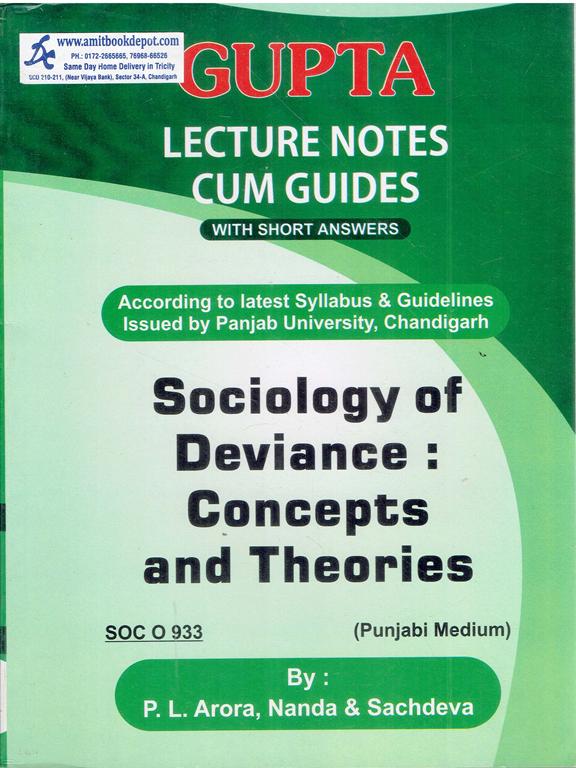
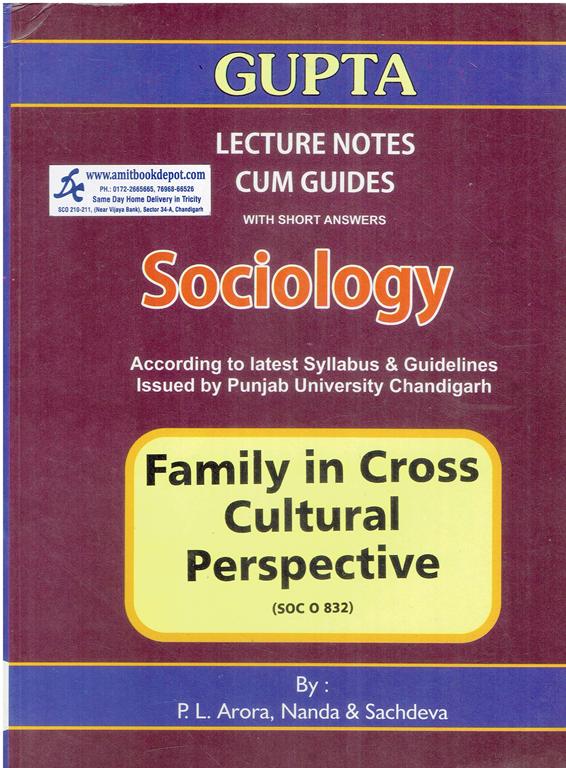
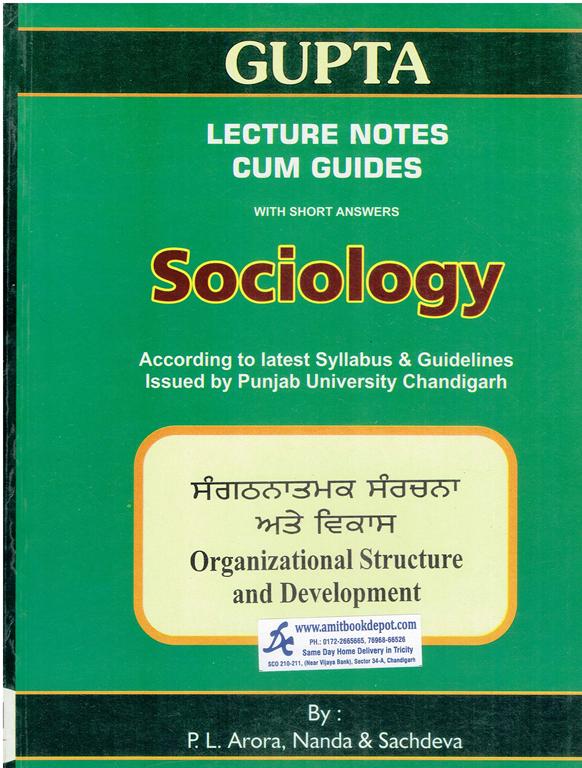
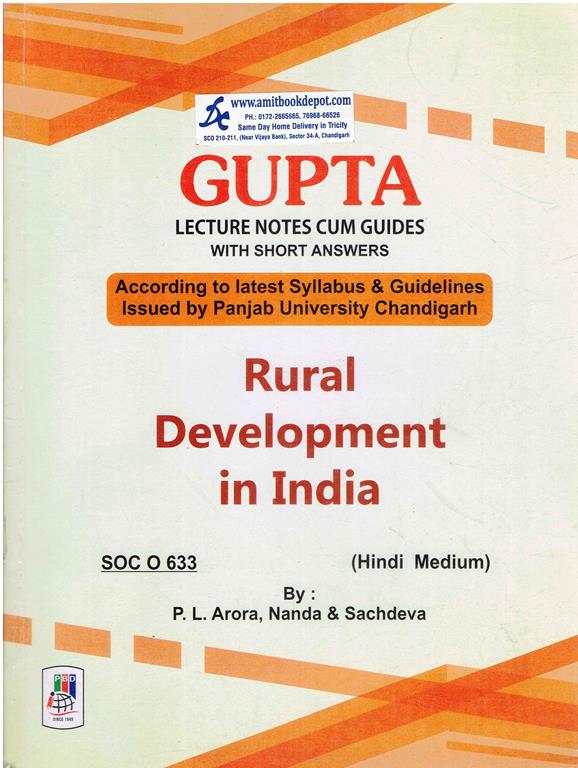
Gupta Sociology of Deviance Concepts and Theories SOC O 933 For MA Sociology 3rd Semester Panjab University Chandigarh (Punjabi Medium)
Gupta Sociology of Deviance Concepts and Theories SOC O 933 For MA Sociology 3rd Semester Panjab University Chandigarh (Punjabi Medium)
by Madhurima
₹400₹400.00(-/
off)
Rating & Reviews
23 Customer Review
This prescribed book, "Sociology of Deviance: Concepts and Theories," is the complete guide for MA Sociology 3rd Semester students at Panjab University, Chandigarh (Syllabus SOC O 933, Punjabi Medium). Authored by P.L. Arora, Nanda, and Sachdeva, it meticulously covers all syllabus units: from Deviant Behavior and Pathological Perspectives to Social Disorganization, Anomie (Durkheim & Merton), Differential Association, and Labelling Theory (Lemert & Becker). Published by Pepsu Book Depot, it includes key theories and exam-focused short answers and is tailored for the Punjabi medium curriculum. Essential for mastering concepts and achieving exam success.
This book, "Sociology of Deviance: Concepts and Theories," is the prescribed and authoritative resource for students pursuing their MA in Sociology, 3rd Semester, at Panjab University, Chandigarh, under the syllabus code SOC O 933. Specifically tailored for the Punjabi medium curriculum, this book by P. L. Arora, Nanda, and Sachdeva provides a comprehensive and syllabus-centric exploration of deviance, ensuring complete coverage of all mandated topics and theories. Published by Pepsu Book Depot, a trusted name in academic publishing for Punjabi University courses, this volume is an indispensable tool for mastering the paper on the sociology of deviance.
The book is meticulously structured to align perfectly with the university's syllabus, divided into four cohesive units that guide the student through the evolution of sociological thought on deviance. It begins with foundational concepts, establishing a clear understanding of deviant behavior, distinguishing it from a deviant role, and examining the debate between relative and absolute definitions of deviance. The initial unit thoroughly covers the pathological perspective, detailing early biological and psychological theories that sought to locate the causes of deviance within the individual.
Progressing to broader societal explanations, the second unit delves into the social disorganization and value-conflict perspective. It analyzes the causes of social disorganization and presents key theories from seminal thinkers like C.H. Cooley, W.I. Thomas, Florian Znaniecki, and W.F. Ogburn. This section also includes the important Theory of Conflict of Values by Richard C. Fuller & Richard R. Myers, helping students understand deviance as a product of systemic breakdowns and competing social values.
The third unit shifts focus to the structural-functional perspective, offering an in-depth analysis of the seminal theory of anomie. It provides detailed expositions of the contributions of Emile Durkheim and Robert K. Merton, crucial for understanding the relationship between social structure, cultural goals, and deviant behavior. This unit also comprehensively covers the Theory of Differential Association by Edwin Sutherland and Donald R. Cressey, explaining how deviant behavior is learned through social interactions.
The final unit explores the interactionist perspective, which revolutionized the study of deviance. It provides a critical examination of the influential labelling theory, with dedicated chapters on the works of Edwin M. Lemert and Howard S. Becker. The book further elucidates the critical concepts of primary and secondary deviance and discusses the profound social and psychological effects of labeling. A significant portion is dedicated to the social consequences of stigma, helping students grasp how societal reactions can solidify deviant identities.
Beyond the detailed theoretical chapters, this book includes a dedicated section of short answer type questions, a vital resource for exam preparation. It is designed to help students navigate the specific paper pattern of Panjab University, which includes compulsory short-answer questions and long-form essay questions with internal choice from each unit. The content is presented in clear, accessible Punjabi, making complex sociological theories understandable for all students.
Key Features of this Book:
1. Strict Syllabus Adherence: Fully covers the latest Panjab University MA Sociology 3rd Semester syllabus for SOC O 933.
2. Punjabi Medium: Authored and published specifically for Punjabi-speaking students, ensuring conceptual clarity in the native language.
3. Comprehensive Coverage: From classical to contemporary perspectives—pathological, social disorganization, value-conflict, structural-functional, and interactionist.
4. Detailed Theory Analysis: Includes dedicated chapters on key theorists like Durkheim, Merton, Sutherland, Lemert, and Becker.
5. Exam-Oriented: Structured according to university units, with included short-answer questions for effective revision.
6. Trusted Publisher: Published by Pepsu Book Depot, renowned for quality academic texts for Punjabi University.
This book is not just a book; it is a complete learning package for MA Sociology students at Panjab University, Chandigarh, aiming to build a robust conceptual foundation in the sociology of deviance.
Is this book the latest edition that exactly matches the current MA Sociology 3rd Semester syllabus (SOC O 933) for Panjab University?
A1
Yes, this book is specifically compiled and updated to align perfectly with the latest prescribed syllabus for SOC O 933 at Panjab University, Chandigarh.
Q2
Is the entire content of the book written in Punjabi, including the sociological terminology and theories?
A2
Yes, this book is authored and published in the Punjabi medium, with complex sociological concepts and theories explained clearly in Punjabi for ease of understanding.
Q3
Does the book cover all four units mentioned in the Panjab University syllabus, including the theories of Lemert, Becker, Durkheim, and Merton?
A3
Absolutely. The book is divided into four units corresponding to the syllabus, with dedicated chapters for all major theorists like Durkheim, Merton, Sutherland, Lemert, and Becker.
Q4
Are the "Short Answer Type Questions" at the back of the book based on previous Panjab University exam patterns?
A4
The short answer questions are designed to cover the entire syllabus comprehensively, helping students prepare for the compulsory short-question section (Question 1) of the university exam paper.
Q5
I am a private/ distance learning candidate. Is this book sufficient for my exam preparation without regular college classes?
A5
Yes, this book is highly recommended for private candidates as it is structured to be self-explanatory, syllabus-focused, and covers all necessary theoretical content required for the exam.
Q6
Does this book explain the difference between "Deviant Behavior" and "Deviant Role" as per the syllabus?
A6
Yes, Unit-I contains a dedicated chapter (Chapter 4) that clearly explains the distinction between Deviant Behavior and Deviant Role, a key part of the syllabus.
Q7
Are the theories of Social Disorganization by Cooley, Thomas, and Ogburn explained separately and in detail?
A7
Yes, Unit-II contains individual chapters (Chapters 9, 10, 11) that detail the Social Disorganization theories of C.H. Cooley, W.I. Thomas & Florian Znaniecki, and W.F. Ogburn separately.
Q8
Is the concept of "Primary and Secondary Deviance" from Labelling Theory covered in the context of its social effects?
A8
Yes, Unit-IV includes a specific chapter (Chapter 20) on the "Social Effects of Labelling for Primary and Secondary Deviance," as outlined in the syllabus.
Q9
Is the "Theory of Differential Association" by Sutherland covered in a simple, understandable way?
A9
Yes, Chapter 16 in Unit-III explains the Theory of Differential Association (by Edwin Sutherland and Donald R. Cressey) in a clear, structured manner suitable for Punjabi medium students.
Q10
Does the book include the "Theory of Conflict of Values" by Fuller and Myers?
A10
Yes, Chapter 12 in Unit-II is dedicated to the "Theory of Conflict of Values: Richard C. Fuller & Richard R. Myers."
0.00
0 Overall Rating
5
0
4
0
3
0
2
0
1
0
Try this product & share your review &
thoughts
UNIT - I
1. Deviant Behavior
2. Sociology of Deviance
3. Relative and Absolute: Deviant Behavior
4. Distinction between Deviant Behavior and Deviant Role
5. Pathological Perspective of Deviance: Biological and Psychological Theories
UNIT - II
6. Social Disorganization and Value Conflict Perspective
7. Causes of Social Disorganization
8. Theories of Social Disorganization
9. Social Disorganization Theory of C.H. Cooley
10. Social Disorganization Theory of W.I. Thomas and Florian Znaniecki
11. Social Disorganization Theory of W.F. Ogburn
12. Theory of Conflict of Values: Richard C. Fuller & Richard R. Myers
UNIT - III
13. Structural-Functional Perspective and Theory of Anomie
14. Emile Durkheim: Theory of Anomie
15. Robert K. Merton: Theory of Anomie
16. Theory of Differential Association
UNIT - IV
17. Interactionist Perspective
18. Theory of Labelling: Edwin M. Lemert
19. Theory of Labelling: Howard S. Becker
20. Social Effects of Labelling for Primary and Secondary Deviance
21. Psychological Effects of Labelling Theory
22. Social Consequences of Stigma and Labeling
Short Answer Type Questions
Latest Syllabus of Sociology of Deviance Concepts and Theories SOC O 933 For MA Sociology 3rd Semester Panjab University Chandigarh (Punjabi Medium)
SOC O 933: SOCIOLOGY OF DEVIANCE: CONCEPTS AND THEORIES
Objective
This paper aims at sensitizing the students regarding the concept of deviance and its related terms. Students will also be made aware of different explanations of deviance ranging from pathological to interactionist perspectives.
INSTRUCTIONS FOR THE PAPER-SETTER AND THE CANDIDATES
(i) The theory question paper will be of 80 marks, and 20 marks will be for internal assessment. The duration of the paper will be 3 hours.
(ii) For private candidates, who have not been assessed earlier for internal assessment, the marks secured by them in the theory paper will proportionately be increased to the maximum marks of the paper in lieu of internal assessment.
The paper setter must put note (ii) in the question paper.
The syllabus has been divided into four units.
There shall be 9 questions in all. The first question is compulsory and shall be a short answer type containing 10 short questions spread over the whole syllabus to be answered in about 30 to 35 words each, carrying 20 marks, i.e., 2 marks each. The rest of the paper shall contain 4 units. Each unit shall have two long questions, and the candidates shall be given an internal choice of attempting one question from each unit—4 in all. Each question will carry 15 marks.
Course Outline
Unit-I
Deviant Behavior:
Definition, Concept – Relative/Absolute.
Distinction between Deviant Behavior and Deviant Role
Pathological Perspective of Deviance—Biological and Psychological Theories.
Unit-II
Social Disorganization and Value-Conflict Perspective:
Causes of Social Disorganization
Theories of Social Disorganization: C.H. Cooley, W.I. Thomas and Florian Znaniechi, and W.F. Ogburn. Theory of Conflict of Values: Richard C. Fuller & Richard R. Myers.
Unit III
Structural-Functional Perspective:
Theory of Anomie: Emile Durkheim and Robert K. Merton
Theory of Differential Association: Edwin Sutherland and Donald R. Cressey.
Unit IV
Interactionist Perspective:
Theory of Labelling: Edwin M. Lemert and Howard S. Becker Social and Psychological Effects of Labelling for Primary and Secondary Deviance, Social Consequences of Stigma Social Consequences of Stigma and Labeling.
This book, "Sociology of Deviance: Concepts and Theories," is the prescribed and authoritative resource for students pursuing their MA in Sociology, 3rd Semester, at Panjab University, Chandigarh, under the syllabus code SOC O 933. Specifically tailored for the Punjabi medium curriculum, this book by P. L. Arora, Nanda, and Sachdeva provides a comprehensive and syllabus-centric exploration of deviance, ensuring complete coverage of all mandated topics and theories. Published by Pepsu Book Depot, a trusted name in academic publishing for Punjabi University courses, this volume is an indispensable tool for mastering the paper on the sociology of deviance.
The book is meticulously structured to align perfectly with the university's syllabus, divided into four cohesive units that guide the student through the evolution of sociological thought on deviance. It begins with foundational concepts, establishing a clear understanding of deviant behavior, distinguishing it from a deviant role, and examining the debate between relative and absolute definitions of deviance. The initial unit thoroughly covers the pathological perspective, detailing early biological and psychological theories that sought to locate the causes of deviance within the individual.
Progressing to broader societal explanations, the second unit delves into the social disorganization and value-conflict perspective. It analyzes the causes of social disorganization and presents key theories from seminal thinkers like C.H. Cooley, W.I. Thomas, Florian Znaniecki, and W.F. Ogburn. This section also includes the important Theory of Conflict of Values by Richard C. Fuller & Richard R. Myers, helping students understand deviance as a product of systemic breakdowns and competing social values.
The third unit shifts focus to the structural-functional perspective, offering an in-depth analysis of the seminal theory of anomie. It provides detailed expositions of the contributions of Emile Durkheim and Robert K. Merton, crucial for understanding the relationship between social structure, cultural goals, and deviant behavior. This unit also comprehensively covers the Theory of Differential Association by Edwin Sutherland and Donald R. Cressey, explaining how deviant behavior is learned through social interactions.
The final unit explores the interactionist perspective, which revolutionized the study of deviance. It provides a critical examination of the influential labelling theory, with dedicated chapters on the works of Edwin M. Lemert and Howard S. Becker. The book further elucidates the critical concepts of primary and secondary deviance and discusses the profound social and psychological effects of labeling. A significant portion is dedicated to the social consequences of stigma, helping students grasp how societal reactions can solidify deviant identities.
Beyond the detailed theoretical chapters, this book includes a dedicated section of short answer type questions, a vital resource for exam preparation. It is designed to help students navigate the specific paper pattern of Panjab University, which includes compulsory short-answer questions and long-form essay questions with internal choice from each unit. The content is presented in clear, accessible Punjabi, making complex sociological theories understandable for all students.
Key Features of this Book:
1. Strict Syllabus Adherence: Fully covers the latest Panjab University MA Sociology 3rd Semester syllabus for SOC O 933.
2. Punjabi Medium: Authored and published specifically for Punjabi-speaking students, ensuring conceptual clarity in the native language.
3. Comprehensive Coverage: From classical to contemporary perspectives—pathological, social disorganization, value-conflict, structural-functional, and interactionist.
4. Detailed Theory Analysis: Includes dedicated chapters on key theorists like Durkheim, Merton, Sutherland, Lemert, and Becker.
5. Exam-Oriented: Structured according to university units, with included short-answer questions for effective revision.
6. Trusted Publisher: Published by Pepsu Book Depot, renowned for quality academic texts for Punjabi University.
This book is not just a book; it is a complete learning package for MA Sociology students at Panjab University, Chandigarh, aiming to build a robust conceptual foundation in the sociology of deviance.
UNIT - I
1. Deviant Behavior
2. Sociology of Deviance
3. Relative and Absolute: Deviant Behavior
4. Distinction between Deviant Behavior and Deviant Role
5. Pathological Perspective of Deviance: Biological and Psychological Theories
UNIT - II
6. Social Disorganization and Value Conflict Perspective
7. Causes of Social Disorganization
8. Theories of Social Disorganization
9. Social Disorganization Theory of C.H. Cooley
10. Social Disorganization Theory of W.I. Thomas and Florian Znaniecki
11. Social Disorganization Theory of W.F. Ogburn
12. Theory of Conflict of Values: Richard C. Fuller & Richard R. Myers
UNIT - III
13. Structural-Functional Perspective and Theory of Anomie
14. Emile Durkheim: Theory of Anomie
15. Robert K. Merton: Theory of Anomie
16. Theory of Differential Association
UNIT - IV
17. Interactionist Perspective
18. Theory of Labelling: Edwin M. Lemert
19. Theory of Labelling: Howard S. Becker
20. Social Effects of Labelling for Primary and Secondary Deviance
Is this book the latest edition that exactly matches the current MA Sociology 3rd Semester syllabus (SOC O 933) for Panjab University?
A1
Yes, this book is specifically compiled and updated to align perfectly with the latest prescribed syllabus for SOC O 933 at Panjab University, Chandigarh.
Q2
Is the entire content of the book written in Punjabi, including the sociological terminology and theories?
A2
Yes, this book is authored and published in the Punjabi medium, with complex sociological concepts and theories explained clearly in Punjabi for ease of understanding.
Q3
Does the book cover all four units mentioned in the Panjab University syllabus, including the theories of Lemert, Becker, Durkheim, and Merton?
A3
Absolutely. The book is divided into four units corresponding to the syllabus, with dedicated chapters for all major theorists like Durkheim, Merton, Sutherland, Lemert, and Becker.
Q4
Are the "Short Answer Type Questions" at the back of the book based on previous Panjab University exam patterns?
A4
The short answer questions are designed to cover the entire syllabus comprehensively, helping students prepare for the compulsory short-question section (Question 1) of the university exam paper.
Q5
I am a private/ distance learning candidate. Is this book sufficient for my exam preparation without regular college classes?
A5
Yes, this book is highly recommended for private candidates as it is structured to be self-explanatory, syllabus-focused, and covers all necessary theoretical content required for the exam.
Q6
Does this book explain the difference between "Deviant Behavior" and "Deviant Role" as per the syllabus?
A6
Yes, Unit-I contains a dedicated chapter (Chapter 4) that clearly explains the distinction between Deviant Behavior and Deviant Role, a key part of the syllabus.
Q7
Are the theories of Social Disorganization by Cooley, Thomas, and Ogburn explained separately and in detail?
A7
Yes, Unit-II contains individual chapters (Chapters 9, 10, 11) that detail the Social Disorganization theories of C.H. Cooley, W.I. Thomas & Florian Znaniecki, and W.F. Ogburn separately.
Q8
Is the concept of "Primary and Secondary Deviance" from Labelling Theory covered in the context of its social effects?
A8
Yes, Unit-IV includes a specific chapter (Chapter 20) on the "Social Effects of Labelling for Primary and Secondary Deviance," as outlined in the syllabus.
Q9
Is the "Theory of Differential Association" by Sutherland covered in a simple, understandable way?
A9
Yes, Chapter 16 in Unit-III explains the Theory of Differential Association (by Edwin Sutherland and Donald R. Cressey) in a clear, structured manner suitable for Punjabi medium students.
Q10
Does the book include the "Theory of Conflict of Values" by Fuller and Myers?
A10
Yes, Chapter 12 in Unit-II is dedicated to the "Theory of Conflict of Values: Richard C. Fuller & Richard R. Myers."
Latest Syllabus of Sociology of Deviance Concepts and Theories SOC O 933 For MA Sociology 3rd Semester Panjab University Chandigarh (Punjabi Medium)
SOC O 933: SOCIOLOGY OF DEVIANCE: CONCEPTS AND THEORIES
Objective
This paper aims at sensitizing the students regarding the concept of deviance and its related terms. Students will also be made aware of different explanations of deviance ranging from pathological to interactionist perspectives.
INSTRUCTIONS FOR THE PAPER-SETTER AND THE CANDIDATES
(i) The theory question paper will be of 80 marks, and 20 marks will be for internal assessment. The duration of the paper will be 3 hours.
(ii) For private candidates, who have not been assessed earlier for internal assessment, the marks secured by them in the theory paper will proportionately be increased to the maximum marks of the paper in lieu of internal assessment.
The paper setter must put note (ii) in the question paper.
The syllabus has been divided into four units.
There shall be 9 questions in all. The first question is compulsory and shall be a short answer type containing 10 short questions spread over the whole syllabus to be answered in about 30 to 35 words each, carrying 20 marks, i.e., 2 marks each. The rest of the paper shall contain 4 units. Each unit shall have two long questions, and the candidates shall be given an internal choice of attempting one question from each unit—4 in all. Each question will carry 15 marks.
Course Outline
Unit-I
Deviant Behavior:
Definition, Concept – Relative/Absolute.
Distinction between Deviant Behavior and Deviant Role
Pathological Perspective of Deviance—Biological and Psychological Theories.
Unit-II
Social Disorganization and Value-Conflict Perspective:
Causes of Social Disorganization
Theories of Social Disorganization: C.H. Cooley, W.I. Thomas and Florian Znaniechi, and W.F. Ogburn. Theory of Conflict of Values: Richard C. Fuller & Richard R. Myers.
Unit III
Structural-Functional Perspective:
Theory of Anomie: Emile Durkheim and Robert K. Merton
Theory of Differential Association: Edwin Sutherland and Donald R. Cressey.
Unit IV
Interactionist Perspective:
Theory of Labelling: Edwin M. Lemert and Howard S. Becker Social and Psychological Effects of Labelling for Primary and Secondary Deviance, Social Consequences of Stigma Social Consequences of Stigma and Labeling.
0.00
0 Overall Rating
5
0
4
0
3
0
2
0
1
0
Try this product & share your review &
thoughts
Top Trending Product
Related
Product
Related Product
Related Blog Posts
Latest Blogs
Latest Blogs
Classic Literature Reimagined: Discuss modern twists on classic novels.
Lorem ipsum dolor sit amet, consectetur adipiscing elit, sed
do
eiusmod tempor incididunt ut labore et dolore magna aliqua. Ut enim ad minim
veniam, quis nostrud exercitation ullamco Lorem ipsum dolor sit amet,
consectetur adipiscing elit, sed do eiusmod tempor incididunt ut labore et
dolore magna aliqua. Utenim ad minim veniam, quis nostrud exercitation
ullamco
Lorem ipsum dolor sit amet, consecte...
Classic Literature Reimagined: Discuss modern twists on classic novels.
Lorem ipsum dolor sit amet, consectetur adipiscing elit, sed
do
eiusmod tempor incididunt ut labore et dolore magna aliqua. Ut enim ad minim
veniam, quis nostrud exercitation ullamco Lorem ipsum dolor sit amet,
consectetur adipiscing elit, sed do eiusmod tempor incididunt ut labore et
dolore magna aliqua. Utenim ad minim veniam, quis nostrud exercitation
ullamco
Lorem ipsum dolor sit amet, consecte...
Classic Literature Reimagined: Discuss modern twists on classic novels.
Lorem ipsum dolor sit amet, consectetur adipiscing elit, sed
do
eiusmod tempor incididunt ut labore et dolore magna aliqua. Ut enim ad minim
veniam, quis nostrud exercitation ullamco Lorem ipsum dolor sit amet,
consectetur adipiscing elit, sed do eiusmod tempor incididunt ut labore et
dolore magna aliqua. Utenim ad minim veniam, quis nostrud exercitation
ullamco
Lorem ipsum dolor sit amet, consecte...