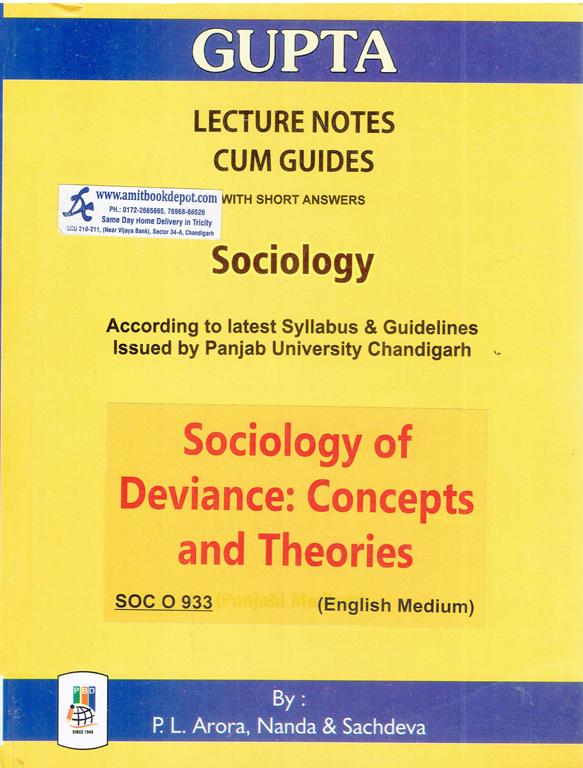
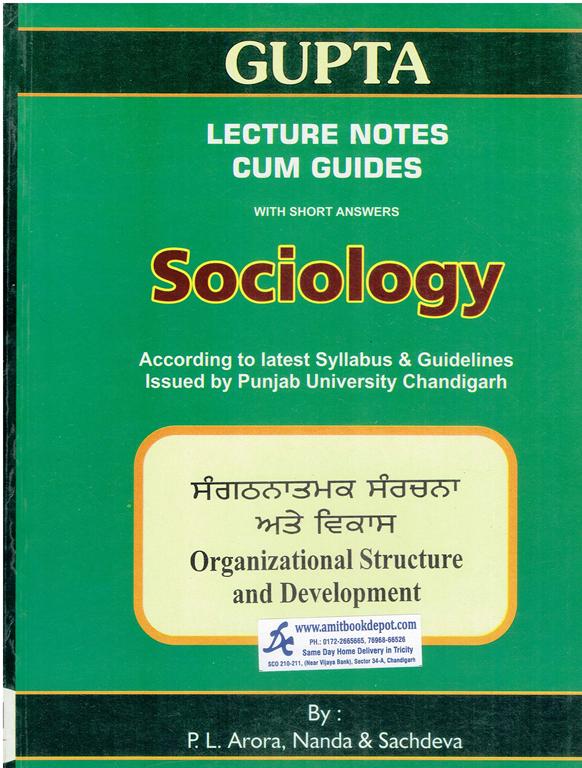
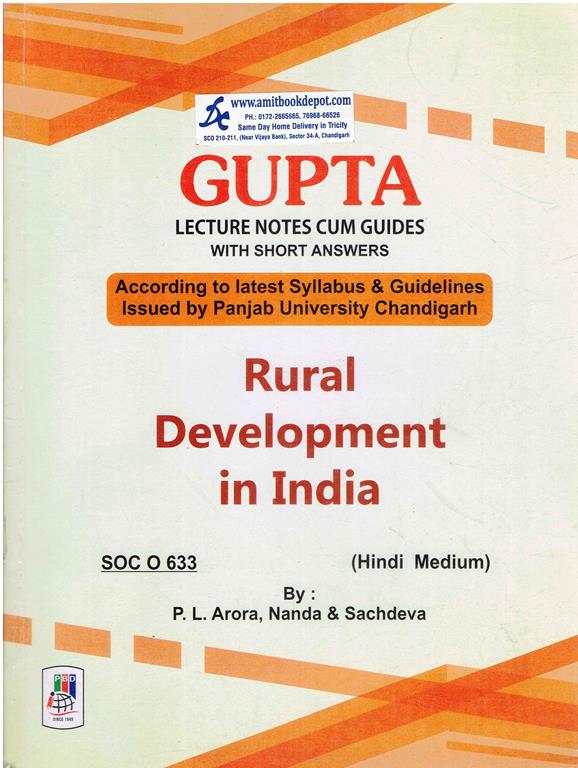
Gupta Sociology of Deviance Concepts and Theories SOC O 933 For MA Sociology 3rd Semester Panjab University Chandigarh (English Medium)
Gupta Sociology of Deviance Concepts and Theories SOC O 933 For MA Sociology 3rd Semester Panjab University Chandigarh (English Medium)
by Madhurima
₹500₹500.00(-/
off)
Rating & Reviews
23 Customer Review
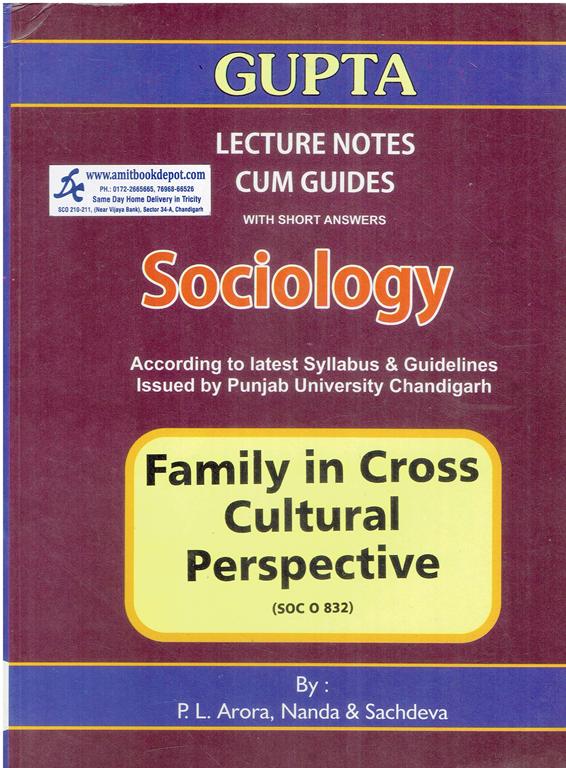
Gupta's Sociology of Deviance Concepts and Theories (SOC O 933) is the prescribed book for MA Sociology 3rd Semester at Panjab University, Chandigarh. Authored by P.L. Arora, Nanda, and Sachdeva, this comprehensive guide covers the entire syllabus, exploring deviant behavior through pathological, social disorganization, structural-functional (Anomie Theory of Durkheim and Merton), and interactionist (Labelling Theory of Lemert and Becker) perspectives. It includes key topics like relative vs. absolute deviance, differential association, and the social consequences of stigma. With a section of short answer questions, it is the essential resource for exam preparation and mastering sociological theories of deviance. Published by Pepsu Book Depot.
Gupta Sociology of Deviance Concepts and Theories (SOC O 933) for MA Sociology 3rd Semester, Panjab University, Chandigarh, is an essential and comprehensive academic book specifically authored and structured to fulfill the exact requirements of the Panjab University MA Sociology syllabus. Authored by the esteemed academicians P. L. Arora, Nanda, and Sachdeva, and published by the reputable Pepsu Book Depot, this book serves as the definitive guide for students navigating the complex landscape of deviance studies. It is meticulously designed to provide a thorough conceptual foundation and a critical examination of major sociological theories explaining deviant behavior, ensuring candidates are thoroughly prepared for both their examinations and advanced academic pursuits.
The book’s content is strategically organized into four distinct units, perfectly mirroring the university’s prescribed syllabus. It begins by establishing a solid conceptual groundwork, meticulously distinguishing between deviant behavior and deviant role, and engaging with the fundamental debate on whether deviance is relative or absolute. This clarity is crucial for students to approach the subject with a nuanced sociological lens. The first unit then delves into the pathological perspective of deviance, covering early biological and psychological theories that sought to locate the causes of deviance within the individual. This historical context sets the stage for understanding the evolution of sociological thought on the subject.
Progressing through the text, students are introduced to macro-level explanations. Unit II provides an in-depth analysis of the social disorganization and value-conflict perspective. It explores the causes of social disorganization and presents detailed examinations of theories by foundational sociologists like C.H. Cooley, W.I. Thomas and Florian Znaniecki, and W.F. Ogburn. This unit also includes the Theory of Conflict of Values by Richard C. Fuller & Richard R. Myers, helping students understand how rapid social change and competing value systems can generate deviance.
Unit III shifts focus to the structural-functional perspective, offering a classic and critical exploration of anomie theory. The works of Emile Durkheim and Robert K. Merton are presented with detailed clarity, allowing students to grasp how social structures and culturally prescribed goals can create strain leading to deviance. This unit is complemented by the theory of differential association (Edwin Sutherland), a cornerstone theory that explains deviance as learned behavior through social interaction.
The final unit engages with the micro-sociological interactionist perspective, which revolutionized the study of deviance. It features a comprehensive breakdown of the influential labeling theory, with dedicated chapters on the seminal works of Edwin M. Lemert (distinguishing between primary and secondary deviance) and Howard S. Becker. The book thoughtfully examines the profound social and psychological effects of labeling, as well as the tangible social consequences of stigma. This unit empowers students to critically analyze how societal reactions themselves construct and perpetuate deviance.
Beyond the core theoretical exposition, this book includes a dedicated section of short answer type questions, an invaluable resource for exam preparation and self-assessment. The book is an indispensable tool for MA Sociology students at Panjab University, Chandigarh, providing syllabus-specific content, theoretical depth, and a structured approach to mastering SOC O 933. It is equally beneficial for professors, researchers, and anyone with a serious academic interest in the concepts and theories of deviance. With its precise alignment to the latest syllabus, authoritative authorship, and clear pedagogical design, this volume from Pepsu Book Depot is the most reliable and recommended resource for achieving academic excellence in the Sociology of Deviance.
Is this book the latest edition and fully updated to match the current Panjab University syllabus for SOC O 933?
A1
Yes, this book is authored and structured specifically according to the latest prescribed syllabus for MA Sociology 3rd Semester at Panjab University, Chandigarh.
Q2
Does the book cover both the theories of Emile Durkheim and Robert K. Merton on Anomie in separate detail?
A2
Absolutely. Unit III has dedicated chapters that individually explain Emile Durkheim's Theory of Anomie and Robert K. Merton's Theory of Anomie, highlighting their distinct contributions.
Q3
How does the book distinguish between the Labelling Theories of Edwin Lemert and Howard Becker?
A3
The book provides separate, focused chapters on Edwin M. Lemert's theory (including primary and secondary deviance) and Howard S. Becker's formulation, allowing for a clear understanding of each scholar's perspective within the Interactionist framework.
Q4
Are the theories of Social Disorganization by Cooley, Thomas & Znaniecki, and Ogburn explained with individual chapters?
A4
Yes, Unit II contains specific chapters for each theorist: C.H. Cooley, W.I. Thomas & Florian Znaniecki, and W.F. Ogburn, ensuring detailed study of their unique approaches to social disorganization.
Q5
Is the concept of "Stigma" and its social consequences discussed in relation to Labelling Theory?
A5
Yes, the book includes a dedicated chapter on the "Social Consequences of Stigma and Labeling," exploring the real-world impacts of societal reactions on individuals.
Q6
Is the difference between "Deviant Behavior" and a "Deviant Role" clearly explained?
A6
Yes, a distinct chapter is devoted to explaining this crucial conceptual distinction, which is fundamental to the sociological study of deviance.
Q7
Does the book address whether deviance is considered "Relative or Absolute"?
A7
Yes, this key sociological debate is explicitly discussed in a dedicated chapter early in the book, setting the stage for understanding deviance as a social construct.
Q8
Is this book useful only for Panjab University students, or can others use it?
A8
While tailored for PU syllabus, its comprehensive coverage of core sociological theories of deviance (Anomie, Labelling, Differential Association, etc.) makes it a valuable reference for students of sociology at other universities and for competitive exams.
Q9
Are the psychological and biological theories of deviance covered, or is the focus purely sociological?
A9
The book begins with the Pathological Perspective, which includes both biological and psychological theories, providing important historical context before delving into mainstream sociological explanations.
Q10
Does the book discuss the "social effects of labelling for primary and secondary deviance"?
A10
Yes, this is a specific chapter title in Unit IV, where the book explores the different social implications of primary versus secondary deviance as per Lemert's model.
0.00
0 Overall Rating
5
0
4
0
3
0
2
0
1
0
Try this product & share your review &
thoughts
UNIT - I
1. Deviant Behavior
2. Sociology of Deviance
3. Relative and Absolute: Deviant Behavior
4. Distinction between Deviant Behavior and Deviant Role
5. Pathological Perspective of Deviance: Biological and Psychological Theories
UNIT - II
6. Social Disorganization and Value Conflict Perspective
7. Causes of Social Disorganization
8. Theories of Social Disorganization
9. Social Disorganization Theory of C.H. Cooley
10. Social Disorganization Theory of W.I. Thomas and Florian Znaniecki
11. Social Disorganization Theory of W.F. Ogburn
12. Theory of Conflict of Values: Richard C. Fuller & Richard R. Myers
UNIT - III
13. Structural-Functional Perspective and Theory of Anomie
14. Emile Durkheim: Theory of Anomie
15. Robert K. Merton: Theory of Anomie
16. Theory of Differential Association
UNIT - IV
17. Interactionist Perspective
18. Theory of Labelling: Edwin M. Lemert
19. Theory of Labelling: Howard S. Becker
20. Social Effects of Labelling for Primary and Secondary Deviance
21. Psychological Effects of Labelling Theory
22. Social Consequences of Stigma and Labeling
Short Answer Type Questions
Latest Syllabus of Sociology of Deviance Concepts and Theories SOC O 933 for MA Sociology 3rd Semester, Panjab University (PU), Chandigarh (English Medium)
SOC O 933: SOCIOLOGY OF DEVIANCE: CONCEPTS AND THEORIES
Objective
This paper aims at sensitizing the students regarding the concept of deviance and its related terms. Students will also be made aware of different explanations of deviance ranging from pathological to interactionist perspectives.
INSTRUCTIONS FOR THE PAPER-SETTER AND THE CANDIDATES
(i) The theory question paper will be of 80 marks, and 20 marks will be for internal assessment. The duration of the paper will be 3 hours.
(ii) For private candidates, who have not been assessed earlier for internal assessment, the marks secured by them in the theory paper will proportionately be increased to the maximum marks of the paper in lieu of internal assessment.
The paper setter must put note (ii) in the question paper.
The syllabus has been divided into four units.
There shall be 9 questions in all. The first question is compulsory and shall be a short answer type containing 10 short questions spread over the whole syllabus to be answered in about 30 to 35 words each, carrying 20 marks, i.e., 2 marks each. The rest of the paper shall contain 4 units. Each unit shall have two long questions, and the candidates shall be given an internal choice of attempting one question from each unit—4 in all. Each question will carry 15 marks.
Course Outline
Unit-I
Deviant Behavior:
Definition, Concept – Relative/Absolute.
Distinction between Deviant Behavior and Deviant Role
Pathological Perspective of Deviance—Biological and Psychological Theories.
Unit-II
Social Disorganization and Value-Conflict Perspective:
Causes of Social Disorganization
Theories of Social Disorganization: C.H. Cooley, W.I. Thomas and Florian Znaniechi, and W.F. Ogburn. Theory of Conflict of Values: Richard C. Fuller & Richard R. Myers.
Unit III
Structural-Functional Perspective:
Theory of Anomie: Emile Durkheim and Robert K. Merton
Theory of Differential Association: Edwin Sutherland and Donald R. Cressey.
Unit IV
Interactionist Perspective:
Theory of Labelling: Edwin M. Lemert and Howard S. Becker Social and Psychological Effects of Labelling for Primary and Secondary Deviance, Social Consequences of Stigma Social Consequences of Stigma and Labeling.
Gupta Sociology of Deviance Concepts and Theories (SOC O 933) for MA Sociology 3rd Semester, Panjab University, Chandigarh, is an essential and comprehensive academic book specifically authored and structured to fulfill the exact requirements of the Panjab University MA Sociology syllabus. Authored by the esteemed academicians P. L. Arora, Nanda, and Sachdeva, and published by the reputable Pepsu Book Depot, this book serves as the definitive guide for students navigating the complex landscape of deviance studies. It is meticulously designed to provide a thorough conceptual foundation and a critical examination of major sociological theories explaining deviant behavior, ensuring candidates are thoroughly prepared for both their examinations and advanced academic pursuits.
The book’s content is strategically organized into four distinct units, perfectly mirroring the university’s prescribed syllabus. It begins by establishing a solid conceptual groundwork, meticulously distinguishing between deviant behavior and deviant role, and engaging with the fundamental debate on whether deviance is relative or absolute. This clarity is crucial for students to approach the subject with a nuanced sociological lens. The first unit then delves into the pathological perspective of deviance, covering early biological and psychological theories that sought to locate the causes of deviance within the individual. This historical context sets the stage for understanding the evolution of sociological thought on the subject.
Progressing through the text, students are introduced to macro-level explanations. Unit II provides an in-depth analysis of the social disorganization and value-conflict perspective. It explores the causes of social disorganization and presents detailed examinations of theories by foundational sociologists like C.H. Cooley, W.I. Thomas and Florian Znaniecki, and W.F. Ogburn. This unit also includes the Theory of Conflict of Values by Richard C. Fuller & Richard R. Myers, helping students understand how rapid social change and competing value systems can generate deviance.
Unit III shifts focus to the structural-functional perspective, offering a classic and critical exploration of anomie theory. The works of Emile Durkheim and Robert K. Merton are presented with detailed clarity, allowing students to grasp how social structures and culturally prescribed goals can create strain leading to deviance. This unit is complemented by the theory of differential association (Edwin Sutherland), a cornerstone theory that explains deviance as learned behavior through social interaction.
The final unit engages with the micro-sociological interactionist perspective, which revolutionized the study of deviance. It features a comprehensive breakdown of the influential labeling theory, with dedicated chapters on the seminal works of Edwin M. Lemert (distinguishing between primary and secondary deviance) and Howard S. Becker. The book thoughtfully examines the profound social and psychological effects of labeling, as well as the tangible social consequences of stigma. This unit empowers students to critically analyze how societal reactions themselves construct and perpetuate deviance.
Beyond the core theoretical exposition, this book includes a dedicated section of short answer type questions, an invaluable resource for exam preparation and self-assessment. The book is an indispensable tool for MA Sociology students at Panjab University, Chandigarh, providing syllabus-specific content, theoretical depth, and a structured approach to mastering SOC O 933. It is equally beneficial for professors, researchers, and anyone with a serious academic interest in the concepts and theories of deviance. With its precise alignment to the latest syllabus, authoritative authorship, and clear pedagogical design, this volume from Pepsu Book Depot is the most reliable and recommended resource for achieving academic excellence in the Sociology of Deviance.
UNIT - I
1. Deviant Behavior
2. Sociology of Deviance
3. Relative and Absolute: Deviant Behavior
4. Distinction between Deviant Behavior and Deviant Role
5. Pathological Perspective of Deviance: Biological and Psychological Theories
UNIT - II
6. Social Disorganization and Value Conflict Perspective
7. Causes of Social Disorganization
8. Theories of Social Disorganization
9. Social Disorganization Theory of C.H. Cooley
10. Social Disorganization Theory of W.I. Thomas and Florian Znaniecki
11. Social Disorganization Theory of W.F. Ogburn
12. Theory of Conflict of Values: Richard C. Fuller & Richard R. Myers
UNIT - III
13. Structural-Functional Perspective and Theory of Anomie
14. Emile Durkheim: Theory of Anomie
15. Robert K. Merton: Theory of Anomie
16. Theory of Differential Association
UNIT - IV
17. Interactionist Perspective
18. Theory of Labelling: Edwin M. Lemert
19. Theory of Labelling: Howard S. Becker
20. Social Effects of Labelling for Primary and Secondary Deviance
Is this book the latest edition and fully updated to match the current Panjab University syllabus for SOC O 933?
A1
Yes, this book is authored and structured specifically according to the latest prescribed syllabus for MA Sociology 3rd Semester at Panjab University, Chandigarh.
Q2
Does the book cover both the theories of Emile Durkheim and Robert K. Merton on Anomie in separate detail?
A2
Absolutely. Unit III has dedicated chapters that individually explain Emile Durkheim's Theory of Anomie and Robert K. Merton's Theory of Anomie, highlighting their distinct contributions.
Q3
How does the book distinguish between the Labelling Theories of Edwin Lemert and Howard Becker?
A3
The book provides separate, focused chapters on Edwin M. Lemert's theory (including primary and secondary deviance) and Howard S. Becker's formulation, allowing for a clear understanding of each scholar's perspective within the Interactionist framework.
Q4
Are the theories of Social Disorganization by Cooley, Thomas & Znaniecki, and Ogburn explained with individual chapters?
A4
Yes, Unit II contains specific chapters for each theorist: C.H. Cooley, W.I. Thomas & Florian Znaniecki, and W.F. Ogburn, ensuring detailed study of their unique approaches to social disorganization.
Q5
Is the concept of "Stigma" and its social consequences discussed in relation to Labelling Theory?
A5
Yes, the book includes a dedicated chapter on the "Social Consequences of Stigma and Labeling," exploring the real-world impacts of societal reactions on individuals.
Q6
Is the difference between "Deviant Behavior" and a "Deviant Role" clearly explained?
A6
Yes, a distinct chapter is devoted to explaining this crucial conceptual distinction, which is fundamental to the sociological study of deviance.
Q7
Does the book address whether deviance is considered "Relative or Absolute"?
A7
Yes, this key sociological debate is explicitly discussed in a dedicated chapter early in the book, setting the stage for understanding deviance as a social construct.
Q8
Is this book useful only for Panjab University students, or can others use it?
A8
While tailored for PU syllabus, its comprehensive coverage of core sociological theories of deviance (Anomie, Labelling, Differential Association, etc.) makes it a valuable reference for students of sociology at other universities and for competitive exams.
Q9
Are the psychological and biological theories of deviance covered, or is the focus purely sociological?
A9
The book begins with the Pathological Perspective, which includes both biological and psychological theories, providing important historical context before delving into mainstream sociological explanations.
Q10
Does the book discuss the "social effects of labelling for primary and secondary deviance"?
A10
Yes, this is a specific chapter title in Unit IV, where the book explores the different social implications of primary versus secondary deviance as per Lemert's model.
Latest Syllabus of Sociology of Deviance Concepts and Theories SOC O 933 for MA Sociology 3rd Semester, Panjab University (PU), Chandigarh (English Medium)
SOC O 933: SOCIOLOGY OF DEVIANCE: CONCEPTS AND THEORIES
Objective
This paper aims at sensitizing the students regarding the concept of deviance and its related terms. Students will also be made aware of different explanations of deviance ranging from pathological to interactionist perspectives.
INSTRUCTIONS FOR THE PAPER-SETTER AND THE CANDIDATES
(i) The theory question paper will be of 80 marks, and 20 marks will be for internal assessment. The duration of the paper will be 3 hours.
(ii) For private candidates, who have not been assessed earlier for internal assessment, the marks secured by them in the theory paper will proportionately be increased to the maximum marks of the paper in lieu of internal assessment.
The paper setter must put note (ii) in the question paper.
The syllabus has been divided into four units.
There shall be 9 questions in all. The first question is compulsory and shall be a short answer type containing 10 short questions spread over the whole syllabus to be answered in about 30 to 35 words each, carrying 20 marks, i.e., 2 marks each. The rest of the paper shall contain 4 units. Each unit shall have two long questions, and the candidates shall be given an internal choice of attempting one question from each unit—4 in all. Each question will carry 15 marks.
Course Outline
Unit-I
Deviant Behavior:
Definition, Concept – Relative/Absolute.
Distinction between Deviant Behavior and Deviant Role
Pathological Perspective of Deviance—Biological and Psychological Theories.
Unit-II
Social Disorganization and Value-Conflict Perspective:
Causes of Social Disorganization
Theories of Social Disorganization: C.H. Cooley, W.I. Thomas and Florian Znaniechi, and W.F. Ogburn. Theory of Conflict of Values: Richard C. Fuller & Richard R. Myers.
Unit III
Structural-Functional Perspective:
Theory of Anomie: Emile Durkheim and Robert K. Merton
Theory of Differential Association: Edwin Sutherland and Donald R. Cressey.
Unit IV
Interactionist Perspective:
Theory of Labelling: Edwin M. Lemert and Howard S. Becker Social and Psychological Effects of Labelling for Primary and Secondary Deviance, Social Consequences of Stigma Social Consequences of Stigma and Labeling.
0.00
0 Overall Rating
5
0
4
0
3
0
2
0
1
0
Try this product & share your review &
thoughts
Top Trending Product
Related
Product
Related Product
Related Blog Posts
Latest Blogs
Latest Blogs
Classic Literature Reimagined: Discuss modern twists on classic novels.
Lorem ipsum dolor sit amet, consectetur adipiscing elit, sed
do
eiusmod tempor incididunt ut labore et dolore magna aliqua. Ut enim ad minim
veniam, quis nostrud exercitation ullamco Lorem ipsum dolor sit amet,
consectetur adipiscing elit, sed do eiusmod tempor incididunt ut labore et
dolore magna aliqua. Utenim ad minim veniam, quis nostrud exercitation
ullamco
Lorem ipsum dolor sit amet, consecte...
Classic Literature Reimagined: Discuss modern twists on classic novels.
Lorem ipsum dolor sit amet, consectetur adipiscing elit, sed
do
eiusmod tempor incididunt ut labore et dolore magna aliqua. Ut enim ad minim
veniam, quis nostrud exercitation ullamco Lorem ipsum dolor sit amet,
consectetur adipiscing elit, sed do eiusmod tempor incididunt ut labore et
dolore magna aliqua. Utenim ad minim veniam, quis nostrud exercitation
ullamco
Lorem ipsum dolor sit amet, consecte...
Classic Literature Reimagined: Discuss modern twists on classic novels.
Lorem ipsum dolor sit amet, consectetur adipiscing elit, sed
do
eiusmod tempor incididunt ut labore et dolore magna aliqua. Ut enim ad minim
veniam, quis nostrud exercitation ullamco Lorem ipsum dolor sit amet,
consectetur adipiscing elit, sed do eiusmod tempor incididunt ut labore et
dolore magna aliqua. Utenim ad minim veniam, quis nostrud exercitation
ullamco
Lorem ipsum dolor sit amet, consecte...