Categories
College Bookssss >
BA PU Chandigarh
BSC PU Chandigarh
MSC PU Chandigarh
BBA PU Chandigarh
MA PU Chandigarh
Medical Books
Engineering Books
Management Books
PGDCA Books
BCOM PU Chandigarh
MCOM PU Chandigarh
BCA PU Chandigarh
MCA PU Chandigarh
animate-books

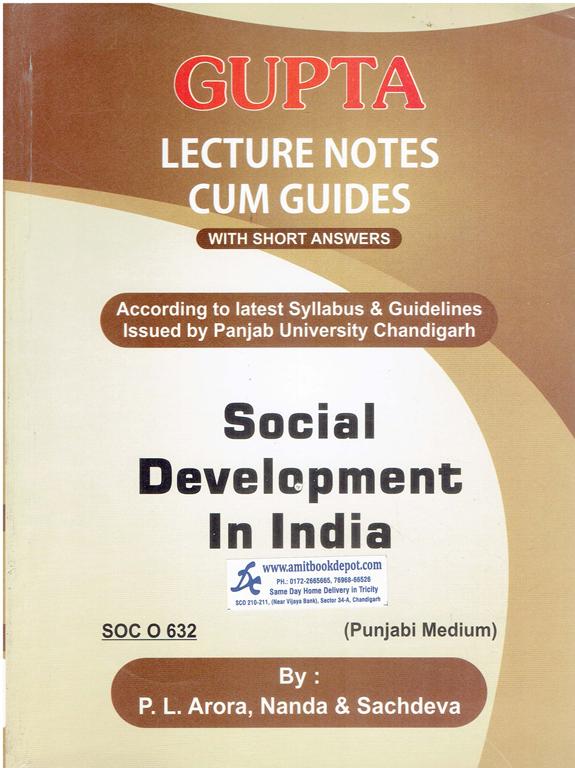
Gupta Social Development in India SOC O 632 for MA Sociology 3rd Semester Panjab University Chandigarh (Punjabi Medium)

by Madhurima
₹350 ₹350.00(-/ off)

Rating & Reviews

23 Customer Review

The book "Gupta Social Development in India" (SOC O 632) is the prescribed book for MA Sociology 3rd Semester, Panjab University Chandigarh (Punjabi Medium). Authored by P. L. Arora, Nanda, and Sachdeva and published by Pepsu Book Depot, it provides complete coverage of the latest syllabus. The content spans four key units: concepts of social development and NITI Aayog; the voluntary sector; development of disadvantaged groups (SCs, STs, BCs), including the Mandal Commission; and globalization's impact on agriculture, labor, women, and youth. It includes short answer questions and is essential for exam success.

Have Doubts Regarding This Product ? Ask Your Question

  • Q1
    Is this the exact textbook prescribed for the Punjabi-medium MA Sociology 3rd Semester at Panjab University?
    A1

    Yes. This book, "Gupta Social Development in India" (SOC O 632) by P.L. Arora, Nanda, and Sachdeva, is specifically written and published as the primary textbook for the Punjabi-medium course at Panjab University, Chandigarh, covering the entire syllabus.

  • Q2
    Does this edition include the updated syllabus topic of NITI Aayog, replacing the Planning Commission?
    A2

    Yes. Unit-I of the book has been updated to cover both the historical role of the Planning Commission and its transition to the current framework of NITI Aayog, as mandated in the latest syllabus.

  • Q3
    Are practical elements like 'Case Studies of Voluntary Organizations' included as per the syllabus?
    A3

    Absolutely. Unit-II contains a dedicated chapter (Chapter 9) providing case studies of voluntary organizations, which is a specific requirement for applying theoretical knowledge to real-world examples.

  • Q4
    How deeply does the book analyze the Mandal Commission and Reservation Debate?
    A4

    Unit-III provides a comprehensive analysis in Chapter 14, covering the Mandal Commission's recommendations, the ensuing national reservation debate, and its contemporary sociological relevance, going beyond just a historical overview.

  • Q5
    Is the section on globalization focused specifically on India's social context?
    A5

    Yes. Unit-IV is entirely dedicated to "Globalization and Its Social Implications in India," with separate chapters analyzing its impact on Indian agriculture, labor, women, and youth, as required by the syllabus.

  • Q6
    Is the Punjabi language used in the book suitable for academic study at the MA level?
    A6

    Yes. The book uses formal, academic Punjabi terminology and prose appropriate for postgraduate-level study, ensuring conceptual clarity and alignment with exam expectations for Punjabi-medium students.

  • Q7
    Does the book offer a critical 'Sociological Appraisal' of policies, or is it only descriptive?
    A7

    It includes both. Particularly in Chapter 15 of Unit-III, the book provides a sociological appraisal of development policies for SCs, STs, and BCs, encouraging critical analysis as per the paper's objectives.

  • Q8
    Can this book be the sole primary resource for preparing the entire SOC O 632 theory paper?
    A8

    Yes, it is designed as a comprehensive, self-contained guide that covers all four units of the prescribed syllabus in detail, making it the core textbook for exam preparation.

  • Q9
    Are the chapters on disadvantaged groups updated with recent legal measures and schemes?
    A9

    The book covers the foundational constitutional provisions, key legal measures, and major development schemes for SCs, STs, and BCs that form the core of the syllabus. For the very latest schemes, students may supplement with recent government publications.

  • Q10
    Does the book help in understanding the 'potential and limitations' of voluntary organizations?
    A10

    Yes. Chapter 8 in Unit-II is specifically titled "Voluntary Sector Organizations: Potential & Limitations," providing a balanced critical assessment required for sociological examination.


0.00

0 Overall Rating
  • 5
    0
  • 4
    0
  • 3
    0
  • 2
    0
  • 1
    0

Try this product & share your review & thoughts

UNIT - I

1. Social Development: Concept
2. Social Development: Meaning and Indicators
3. Development in India: Historical Overview & Present Status
4. Planning Commission - Niti Aayog

UNIT - II

5. Voluntary Sector and Development
6. Voluntary Sector Organizations
7. History of Voluntary Sector
8. Voluntary Sector Organizations: Potential & Limitations
9. Case Studies of Voluntary Organizations

UNIT - III

10. Development of Disadvantaged Groups
11. Problems of SCs, STs, and BCs
12. Compensatory Discrimination Through Constitutional and Legal Measures
13. Development Schemes for SCs, STs, and BCs
14. Mandal Commission and Reservation Debate
15. Sociological Appraisal of the Development Policies for STs, SCs, and BCs

UNIT - IV

16. Globalization and Its Social Implications in India
17. Impacts of Globalization on Agriculture
18. Impacts of Globalization on Labor
19. Impacts of Globalization on Women
20. Globalization and Its Impacts on Youth

Short Answer Type Questions

Latest Syllabus of Social Development in India SOC O 632 for MA Sociology 3rd Semester Panjab University Chandigarh (Punjabi Medium)


SOC O 632: SOCIAL DEVELOPMENT IN INDIA

Objective

This paper examines the development process in India, focusing mainly on the issues of (a) the Indian state and planned development; (b) the role of the voluntary sector in India’s development; (c) the assessment of the problems of and measures taken to improve the conditions of the underprivileged groups such as the SCs, STs, and BCs; and (d) the phenomenon of globalization and its consequences for Indian society.

INSTRUCTIONS FOR THE PAPER-SETTER AND THE CANDIDATES

(i) The theory question paper will be of 80 marks, and 20 marks will be for internal assessment. The duration of the paper will be 3 hours.
(ii) For private candidates, who have not been assessed earlier for internal assessment, the marks secured by them in the theory paper will proportionately be increased to the maximum marks of the paper in lieu of internal assessment.

The paper setter must put note (ii) in the question paper.

The syllabus has been divided into four units.
There shall be 9 questions in all. The first question is compulsory and shall be a short answer type containing 10 short questions spread over the whole syllabus to be answered in about 30 to 35 words each, carrying 20 marks, i.e., 2 marks each. The rest of the paper shall contain 4 units. Each unit shall have two long questions and the Candidates shall be given an internal choice of attempting one question from each unit—4 in all. Each question will carry 15 marks. 

Course Outline

Unit-I

Social Development: Concept, Meaning, and Indicators
Development Planning in India Historical Overview and Present Status Planning
Commission-Niti Aayog)

Unit II

Voluntary Sector and Development: Voluntary sector organizations, their potential, and Limitations as Agencies of Social Transformation: Case Studies of Voluntary
organizations.

Unit III

Development of Disadvantaged Groups: Problems of Scheduled Castes (SCs), Scheduled
Tribes (STs) and Backward Classes (BCs); Compensatory Discrimination through
Constitutional and legal measures; development schemes for SCs, STs, and BCs;
Commissions and Their Recommendations: The Mandal Commission and the Reservation
Debate: Sociological Appraisal of the Development Policies for STs, SCs, and BCs 

Unit IV

Globalization and Its Social Implications in India: Impact on Agriculture and Labor; Women and Youth.

Product Title: Gupta Social Development in India (SOC O 632) for MA Sociology 3rd Semester, Panjab University Chandigarh (Punjabi Medium)
Authors: P. L. Arora, Nanda, Sachdeva
Publisher: Pepsu Book Depot

This comprehensive book, titled "Gupta Social Development in India," is an indispensable academic resource meticulously crafted for students pursuing the MA Sociology 3rd Semester program at Panjab University, Chandigarh, under the Punjabi Medium curriculum. Authored by the esteemed academicians P. L. Arora, Nanda, and Sachdeva, and published by the renowned Pepsu Book Depot, this book offers a rigorous and detailed exploration of the paper SOC O 632: Social Development in India. It is structured to provide complete coverage of the latest prescribed syllabus, making it the definitive guide for exam preparation and conceptual clarity.

The book's content is systematically organized into four cohesive units, aligning perfectly with the university's course outline. Unit I delves into the foundational concepts of social development, examining its meaning and key indicators. It provides a crucial historical overview of development in India, tracing its evolution to the present status. This unit also includes an in-depth analysis of pivotal planning bodies, transitioning from the Planning Commission to NITI Aayog, offering students insights into India's strategic planning framework.

Unit II shifts focus to the critical role of the voluntary sector in Indian development. It explores the nature, history, and functioning of voluntary sector organizations, critically assessing their immense potential and inherent limitations as agents of social transformation. The inclusion of practical case studies of voluntary organizations bridges theoretical knowledge with real-world applications, a key component for sociological analysis.

Unit III is dedicated to the development of disadvantaged groups in India, a core area of sociological inquiry. It thoroughly examines the socio-economic problems of Scheduled Castes (SCs), Scheduled Tribes (STs), and Backward Classes (BCs). The book provides a detailed review of compensatory discrimination policies enshrined in the Indian Constitution and legal statutes. It analyzes various development schemes for SCs, STs, and BCs and engages with the seminal Mandal Commission and the ongoing reservation debate. The unit concludes with a sociological appraisal of development policies for these groups, encouraging critical thinking.

Unit IV addresses the contemporary phenomenon of globalization and its profound social implications in India. It methodically investigates the multifaceted impacts of globalization on critical sectors and demographics, including agriculture, labor, women, and youth. This unit equips students to understand and critique the complex interplay between global forces and local social structures.

Designed to meet the specific assessment patterns of Panjab University, this volume includes a dedicated section for short answer type questions, which is instrumental for revising key concepts and preparing for the compulsory first question in the exam. The content is presented in clear, academic Punjabi, ensuring accessibility for Punjabi-medium students. The language is precise, the explanations are thorough, and the structure mirrors the exam format, featuring a blend of conceptual discussions, policy analyses, and critical appraisals. For any student of MA Sociology at Panjab University seeking to master the syllabus of Social Development in India (SOC O 632), this book by Arora, Nanda, and Sachdeva is not just a book but a complete study companion, essential for achieving academic excellence and a deep understanding of India's developmental trajectory and social challenges.

UNIT - I

1. Social Development: Concept
2. Social Development: Meaning and Indicators
3. Development in India: Historical Overview & Present Status
4. Planning Commission - Niti Aayog

UNIT - II

5. Voluntary Sector and Development
6. Voluntary Sector Organizations
7. History of Voluntary Sector
8. Voluntary Sector Organizations: Potential & Limitations
9. Case Studies of Voluntary Organizations

UNIT - III

10. Development of Disadvantaged Groups
11. Problems of SCs, STs, and BCs
12. Compensatory Discrimination Through Constitutional and Legal Measures
13. Development Schemes for SCs, STs, and BCs
14. Mandal Commission and Reservation Debate
15. Sociological Appraisal of the Development Policies for STs, SCs, and BCs

UNIT - IV

16. Globalization and Its Social Implications in India
17. Impacts of Globalization on Agriculture
18. Impacts of Globalization on Labor
19. Impacts of Globalization on Women
20. Globalization and Its Impacts on Youth

Short Answer Type Questions

Have Doubts Regarding This Product ? Ask Your Question

  • Q1
    Is this the exact textbook prescribed for the Punjabi-medium MA Sociology 3rd Semester at Panjab University?
    A1

    Yes. This book, "Gupta Social Development in India" (SOC O 632) by P.L. Arora, Nanda, and Sachdeva, is specifically written and published as the primary textbook for the Punjabi-medium course at Panjab University, Chandigarh, covering the entire syllabus.

  • Q2
    Does this edition include the updated syllabus topic of NITI Aayog, replacing the Planning Commission?
    A2

    Yes. Unit-I of the book has been updated to cover both the historical role of the Planning Commission and its transition to the current framework of NITI Aayog, as mandated in the latest syllabus.

  • Q3
    Are practical elements like 'Case Studies of Voluntary Organizations' included as per the syllabus?
    A3

    Absolutely. Unit-II contains a dedicated chapter (Chapter 9) providing case studies of voluntary organizations, which is a specific requirement for applying theoretical knowledge to real-world examples.

  • Q4
    How deeply does the book analyze the Mandal Commission and Reservation Debate?
    A4

    Unit-III provides a comprehensive analysis in Chapter 14, covering the Mandal Commission's recommendations, the ensuing national reservation debate, and its contemporary sociological relevance, going beyond just a historical overview.

  • Q5
    Is the section on globalization focused specifically on India's social context?
    A5

    Yes. Unit-IV is entirely dedicated to "Globalization and Its Social Implications in India," with separate chapters analyzing its impact on Indian agriculture, labor, women, and youth, as required by the syllabus.

  • Q6
    Is the Punjabi language used in the book suitable for academic study at the MA level?
    A6

    Yes. The book uses formal, academic Punjabi terminology and prose appropriate for postgraduate-level study, ensuring conceptual clarity and alignment with exam expectations for Punjabi-medium students.

  • Q7
    Does the book offer a critical 'Sociological Appraisal' of policies, or is it only descriptive?
    A7

    It includes both. Particularly in Chapter 15 of Unit-III, the book provides a sociological appraisal of development policies for SCs, STs, and BCs, encouraging critical analysis as per the paper's objectives.

  • Q8
    Can this book be the sole primary resource for preparing the entire SOC O 632 theory paper?
    A8

    Yes, it is designed as a comprehensive, self-contained guide that covers all four units of the prescribed syllabus in detail, making it the core textbook for exam preparation.

  • Q9
    Are the chapters on disadvantaged groups updated with recent legal measures and schemes?
    A9

    The book covers the foundational constitutional provisions, key legal measures, and major development schemes for SCs, STs, and BCs that form the core of the syllabus. For the very latest schemes, students may supplement with recent government publications.

  • Q10
    Does the book help in understanding the 'potential and limitations' of voluntary organizations?
    A10

    Yes. Chapter 8 in Unit-II is specifically titled "Voluntary Sector Organizations: Potential & Limitations," providing a balanced critical assessment required for sociological examination.

Latest Syllabus of Social Development in India SOC O 632 for MA Sociology 3rd Semester Panjab University Chandigarh (Punjabi Medium)


SOC O 632: SOCIAL DEVELOPMENT IN INDIA

Objective

This paper examines the development process in India, focusing mainly on the issues of (a) the Indian state and planned development; (b) the role of the voluntary sector in India’s development; (c) the assessment of the problems of and measures taken to improve the conditions of the underprivileged groups such as the SCs, STs, and BCs; and (d) the phenomenon of globalization and its consequences for Indian society.

INSTRUCTIONS FOR THE PAPER-SETTER AND THE CANDIDATES

(i) The theory question paper will be of 80 marks, and 20 marks will be for internal assessment. The duration of the paper will be 3 hours.
(ii) For private candidates, who have not been assessed earlier for internal assessment, the marks secured by them in the theory paper will proportionately be increased to the maximum marks of the paper in lieu of internal assessment.

The paper setter must put note (ii) in the question paper.

The syllabus has been divided into four units.
There shall be 9 questions in all. The first question is compulsory and shall be a short answer type containing 10 short questions spread over the whole syllabus to be answered in about 30 to 35 words each, carrying 20 marks, i.e., 2 marks each. The rest of the paper shall contain 4 units. Each unit shall have two long questions and the Candidates shall be given an internal choice of attempting one question from each unit—4 in all. Each question will carry 15 marks. 

Course Outline

Unit-I

Social Development: Concept, Meaning, and Indicators
Development Planning in India Historical Overview and Present Status Planning
Commission-Niti Aayog)

Unit II

Voluntary Sector and Development: Voluntary sector organizations, their potential, and Limitations as Agencies of Social Transformation: Case Studies of Voluntary
organizations.

Unit III

Development of Disadvantaged Groups: Problems of Scheduled Castes (SCs), Scheduled
Tribes (STs) and Backward Classes (BCs); Compensatory Discrimination through
Constitutional and legal measures; development schemes for SCs, STs, and BCs;
Commissions and Their Recommendations: The Mandal Commission and the Reservation
Debate: Sociological Appraisal of the Development Policies for STs, SCs, and BCs 

Unit IV

Globalization and Its Social Implications in India: Impact on Agriculture and Labor; Women and Youth.

0.00

0 Overall Rating
  • 5
    0
  • 4
    0
  • 3
    0
  • 2
    0
  • 1
    0

Try this product & share your review & thoughts

Top Trending Product

Related Product

Related Product

Related Blog Posts

Latest Blogs

Latest Blogs

blog-img
Classic Literature Reimagined: Discuss modern twists on classic novels.
Lorem ipsum dolor sit amet, consectetur adipiscing elit, sed do eiusmod tempor incididunt ut labore et dolore magna aliqua. Ut enim ad minim veniam, quis nostrud exercitation ullamco Lorem ipsum dolor sit amet, consectetur adipiscing elit, sed do eiusmod tempor incididunt ut labore et dolore magna aliqua. Utenim ad minim veniam, quis nostrud exercitation ullamco Lorem ipsum dolor sit amet, consecte...
Read more
Author name | 10 jan, 2025
blog-img
Classic Literature Reimagined: Discuss modern twists on classic novels.
Lorem ipsum dolor sit amet, consectetur adipiscing elit, sed do eiusmod tempor incididunt ut labore et dolore magna aliqua. Ut enim ad minim veniam, quis nostrud exercitation ullamco Lorem ipsum dolor sit amet, consectetur adipiscing elit, sed do eiusmod tempor incididunt ut labore et dolore magna aliqua. Utenim ad minim veniam, quis nostrud exercitation ullamco Lorem ipsum dolor sit amet, consecte...
Read more
Author name | 10 jan, 2025
blog-img
Classic Literature Reimagined: Discuss modern twists on classic novels.
Lorem ipsum dolor sit amet, consectetur adipiscing elit, sed do eiusmod tempor incididunt ut labore et dolore magna aliqua. Ut enim ad minim veniam, quis nostrud exercitation ullamco Lorem ipsum dolor sit amet, consectetur adipiscing elit, sed do eiusmod tempor incididunt ut labore et dolore magna aliqua. Utenim ad minim veniam, quis nostrud exercitation ullamco Lorem ipsum dolor sit amet, consecte...
Read more
Author name | 10 jan, 2025
blog-img
Classic Literature Reimagined: Discuss modern twists on classic novels.
Lorem ipsum dolor sit amet, consectetur adipiscing elit...
Read more
Author Name | 10 Jan, 2025
blog-img
Classic Literature Reimagined: Discuss modern twists on classic novels.
Lorem ipsum dolor sit amet, consectetur adipiscing elit...
Read more
Author Name | 10 Jan, 2025
blog-img
Classic Literature Reimagined: Discuss modern twists on classic novels.
Lorem ipsum dolor sit amet, consectetur adipiscing elit...
Read more
Author Name | 10 Jan, 2025
blog-img
Classic Literature Reimagined: Discuss modern twists on classic novels.
Lorem ipsum dolor sit amet, consectetur adipiscing elit...
Read more
Author Name | 10 Jan, 2025
blog-img
Classic Literature Reimagined: Discuss modern twists on classic novels.
Lorem ipsum dolor sit amet, consectetur adipiscing elit...
Read more
Author Name | 10 Jan, 2025
blog-img
Classic Literature Reimagined: Discuss modern twists on classic novels.
Lorem ipsum dolor sit amet, consectetur adipiscing elit...
Read more
Author Name | 10 Jan, 2025
blog-img
Classic Literature Reimagined: Discuss modern twists on classic novels.
Lorem ipsum dolor sit amet, consectetur adipiscing elit...
Read more
Author Name | 10 Jan, 2025
blog-img
Classic Literature Reimagined: Discuss modern twists on classic novels.
Lorem ipsum dolor sit amet, consectetur adipiscing elit...
Read more
Author Name | 10 Jan, 2025
blog-img
Classic Literature Reimagined: Discuss modern twists on classic novels.
Lorem ipsum dolor sit amet, consectetur adipiscing elit...
Read more
Author Name | 10 Jan, 2025