-
Mon-Fri: 10AM to 8PM 01722665665
-
My Account
-
-
0
Total :
₹ 0.00

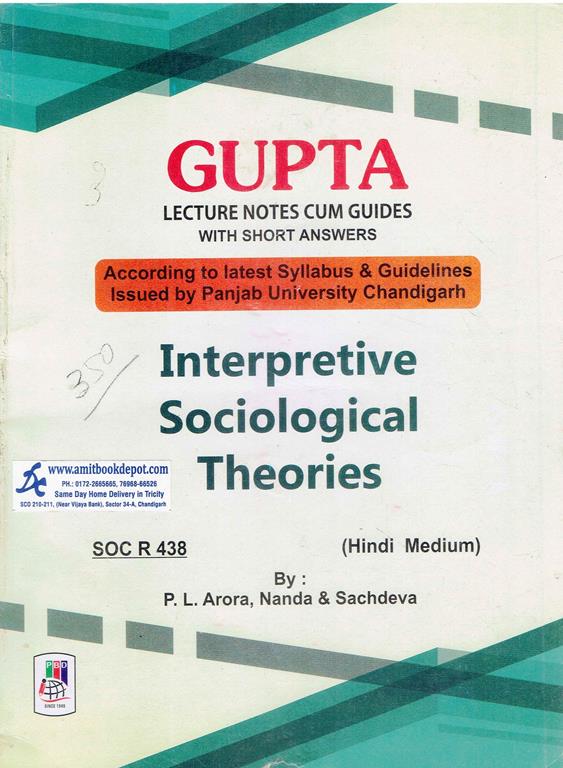

Yes, the book is meticulously structured according to the latest syllabus and unit divisions prescribed for MA Sociology 3rd Semester (Hindi Medium) at Panjab University, Chandigarh.
Absolutely. The book contains dedicated chapters or substantial sections on all prescribed theorists, including E. Husserl in the Phenomenology chapter, and separate chapters for H. Marcuse and H. Garfinkel.
The content is tailored for the theory paper's long-answer format. The included "Short Answer Type Questions" section is specifically designed to prepare for the compulsory 20-mark short-question part of the exam.
Yes, the book is written entirely in clear, academic Hindi, making complex interpretive sociology concepts understandable for Hindi-medium students.
While the textbook itself contains the syllabus outline, the specific administrative note for private candidates is a directive for the question paper setter and is not replicated in the book's content.
This book is designed as a comprehensive, syllabus-specific resource, making it highly suitable for private candidates who need a self-contained guide for the SOC R 438 paper.
The book is divided into four clear units exactly matching the syllabus: Unit I (Action Theories), Unit II (Interactionism & Phenomenology), Unit III (Dramaturgy & Ethnomethodology), and Unit IV (Critical Theory).
Yes, the book covers Parsons' Action Theory framework, focusing specifically on his contributions to the theory of social action and its voluntaristic aspects, as required by the interpretive sociology syllabus.
Yes, it begins with a chapter on Critical Theory as a whole, providing the necessary context before delving into the specific contributions of Jurgen Habermas and Herbert Marcuse.
Yes, the authors use sociological examples and explanations to clarify applied concepts like Goffman's front/back stage and Garfinkel's breaching experiments.
No Description Added
Yes, the book is meticulously structured according to the latest syllabus and unit divisions prescribed for MA Sociology 3rd Semester (Hindi Medium) at Panjab University, Chandigarh.
Absolutely. The book contains dedicated chapters or substantial sections on all prescribed theorists, including E. Husserl in the Phenomenology chapter, and separate chapters for H. Marcuse and H. Garfinkel.
The content is tailored for the theory paper's long-answer format. The included "Short Answer Type Questions" section is specifically designed to prepare for the compulsory 20-mark short-question part of the exam.
Yes, the book is written entirely in clear, academic Hindi, making complex interpretive sociology concepts understandable for Hindi-medium students.
While the textbook itself contains the syllabus outline, the specific administrative note for private candidates is a directive for the question paper setter and is not replicated in the book's content.
This book is designed as a comprehensive, syllabus-specific resource, making it highly suitable for private candidates who need a self-contained guide for the SOC R 438 paper.
The book is divided into four clear units exactly matching the syllabus: Unit I (Action Theories), Unit II (Interactionism & Phenomenology), Unit III (Dramaturgy & Ethnomethodology), and Unit IV (Critical Theory).
Yes, the book covers Parsons' Action Theory framework, focusing specifically on his contributions to the theory of social action and its voluntaristic aspects, as required by the interpretive sociology syllabus.
Yes, it begins with a chapter on Critical Theory as a whole, providing the necessary context before delving into the specific contributions of Jurgen Habermas and Herbert Marcuse.
Yes, the authors use sociological examples and explanations to clarify applied concepts like Goffman's front/back stage and Garfinkel's breaching experiments.