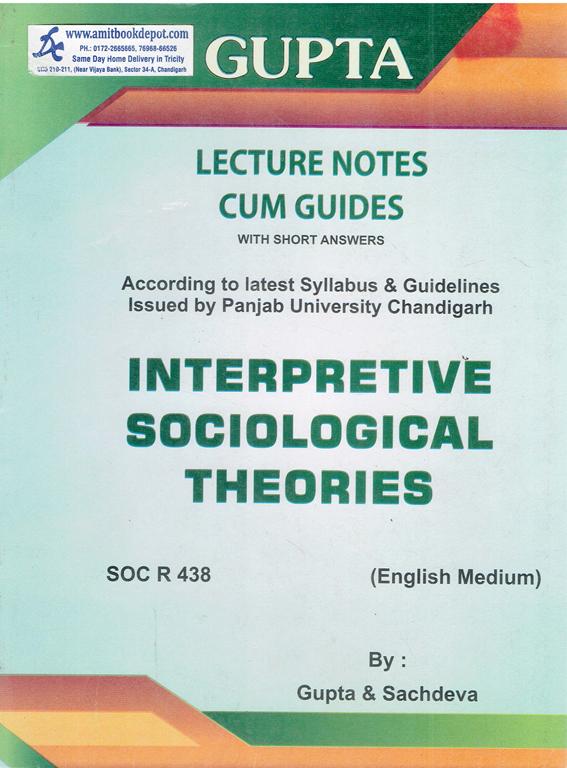
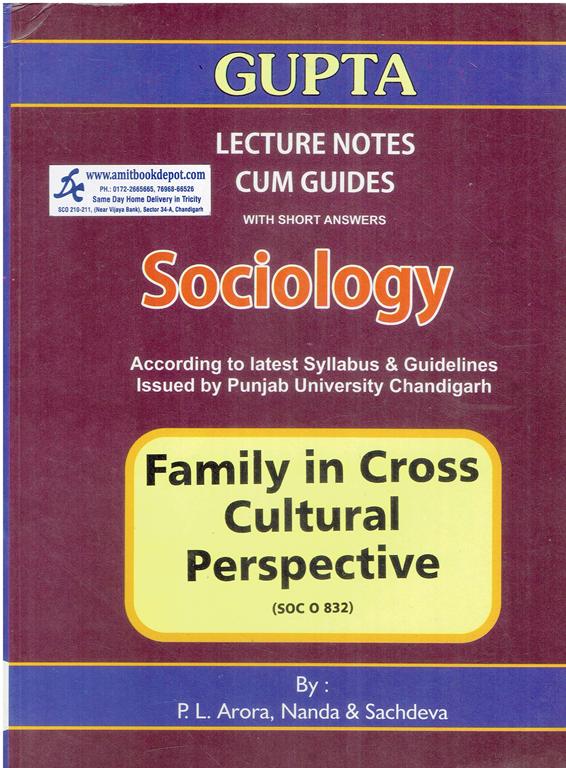
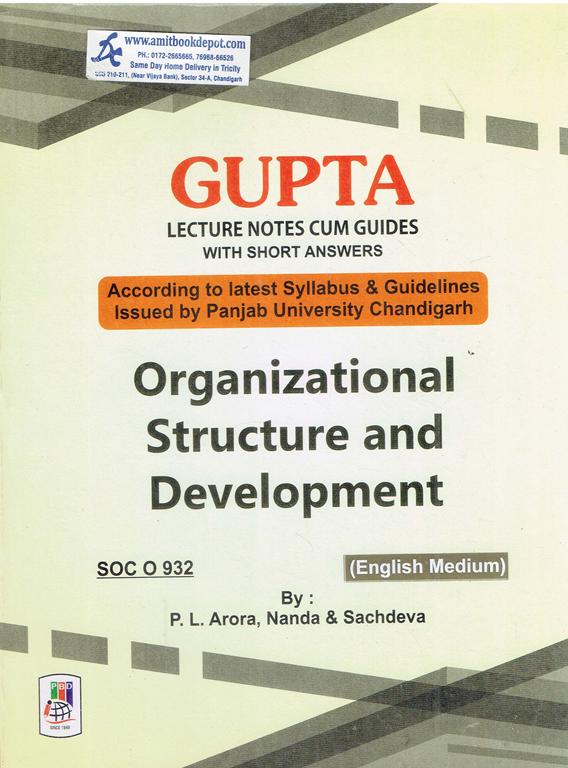
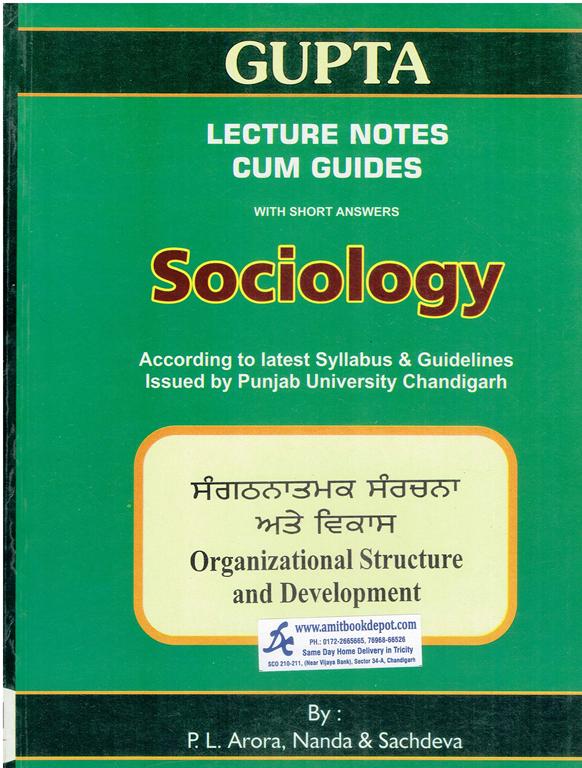
Gupta Interpretive Sociological Theories SOC R 438 MA Sociology 3rd Semester Panjab University Chandigarh (English Medium)
by Madhurima
₹500₹500.00(-/
off)
Rating & Reviews
23 Customer Review
"Gupta Interpretive Sociological Theories" is the prescribed book for MA Sociology, 3rd Semester (SOC R 438) at Panjab University, Chandigarh (English Medium). Authored by P.L. Arora, Nanda, and Sachdeva, and published by Pepsu Book Depot, it provides complete syllabus coverage of key paradigms like action theory (Weber, Parsons), symbolic interactionism (Mead, Blumer), phenomenology (Schutz), dramaturgy (Goffman), ethnomethodology (Garfinkel), and critical theory (Habermas, Marcuse). Designed for exam success, it includes structured units and short answer questions, making it an essential guide for mastering interpretive sociology concepts and excelling in university examinations.
This book, "Gupta Interpretive Sociological Theories," is the prescribed and authoritative guide for students of MA Sociology, 3rd Semester, at Panjab University, Chandigarh, following the English Medium curriculum under the course code SOC R 438. Authored by P. L. Arora, Nanda, and Sachdeva, and published by Pepsu Book Depot, this book is meticulously designed to provide a comprehensive and structured exploration of the foundational and advanced concepts within interpretive sociological paradigms.
The core objective of this academic text is to sensitize students to the works of seminal sociologists who have shaped the interpretive sociology perspective, which emphasizes understanding the subjective meanings and motivations behind human social action, standing in contrast to positivist approaches. The book is engineered to align perfectly with the Panjab University syllabus, ensuring complete coverage of all mandated topics and theories, making it an indispensable resource for both thorough exam preparation and deep conceptual understanding.
Organized into four systematic units, the content delivers a logical progression through key theoretical frameworks. Unit I delves into action theory, providing a foundational analysis of the concepts of social action, beginning with an overview of interpretive theory, followed by detailed exegeses of the seminal contributions of Max Weber and Talcott Parsons. This unit equips students to comprehend the shift from macro-structural analyses to theories centered on individual agency and intentionality.
Unit II is dedicated to symbolic interactionism and phenomenology. It offers insightful chapters on the foundational ideas of George Herbert Mead, including the concepts of 'self,' 'I,' and 'me,' and the pragmatic philosophy underpinning the tradition. This is extended through the work of Herbert Blumer, who coined the term and formalized its core principles. The unit then transitions into phenomenology, introducing students to the philosophical roots via Husserl and their sociological application through Alfred Schutz's theories of lifeworld and social reality construction.
Unit III explores two distinctive micro-sociological approaches: dramaturgy and ethnomethodology. The section on Dramaturgy focuses comprehensively on Erving Goffman's groundbreaking metaphor of social life as a theatrical performance, analyzing concepts like impression management, front stage, and backstage behavior. Subsequently, the unit examines Harold Garfinkel's ethnomethodology, challenging students to understand how social order is continually created and sustained through everyday methods and practices.
Unit IV introduces the critical dimension of interpretive thought with critical theory from the Frankfurt School. It presents the sophisticated works of Jürgen Habermas, focusing on communicative action and the public sphere, and Herbert Marcuse, analyzing his critiques of advanced industrial society and one-dimensional man. This unit connects micro-level interactions to broader macro-level critiques of power, culture, and rationality.
The book is pedagogically strengthened with a dedicated section of Short Answer Type Questions, tailored to the exam pattern, which aids in revision and self-assessment. The structure directly mirrors the university's exam format, with clear divisions per unit, supporting the internal choice pattern of long questions. Published by Pepsu Book Depot, a trusted name for Panjab University texts, this volume is not merely a compilation but a structured academic companion. It is essential for MA Sociology students aiming to master interpretive sociological theories, secure high marks in their 3rd semester examinations, and build a robust theoretical foundation for advanced sociological analysis.
Is this book the latest and officially prescribed edition for the current academic year's MA Sociology (3rd Semester) exam at Panjab University?
A1
This book is published as per the prescribed syllabus for SOC R 438. We recommend confirming the specific academic year with your department or the latest university notification to ensure complete alignment.
Q2
Does the book cover all four units exactly as specified in the Panjab University syllabus for SOC R 438?
A2
Yes, the book is structured into four precise units covering Action Theories, Symbolic Interactionism & Phenomenology, Dramaturgy & Ethnomethodology, and Critical Theory, matching the official syllabus outline.
Q3
Are the theories of both Jürgen Habermas and Herbert Marcuse included under the Critical Theory unit?
A3
Absolutely. Unit-IV contains dedicated chapters on both Jürgen Habermas's Critical Theory (e.g., communicative action) and Herbert Marcuse's Critical Theory, as required by the syllabus.
Q4
Is the section on Phenomenology based only on Alfred Schutz, or does it also cover Edmund Husserl?
A4
The book covers Phenomenology with a focus on its sociological application by Alfred Schutz, as per the syllabus. It typically includes an introduction to the philosophical foundations by Edmund Husserl for contextual understanding.
Q5
As a private candidate, is this book sufficient for my preparation without internal assessment guidance?
A5
Yes, this book comprehensively covers the entire theoretical content for the 80-mark theory paper. Private candidates should focus solely on this syllabus material, as their final marks are proportionately calculated based on the theory paper score, as noted in the syllabus instructions.
Q6
Does the chapter on Ethnomethodology explain Harold Garfinkel's breaching experiments in detail?
A6
Yes, the chapter dedicated to Harold Garfinkel's Ethnomethodology explains core concepts, including the methodology and significance of breaching experiments in revealing the construction of social order.
Q7
Are key concepts like Goffman's dramaturgy, impression management, and front/back stage covered thoroughly?
A7
Yes, the Dramaturgy chapter provides a detailed analysis of Erving Goffman's framework, including his central metaphor and essential concepts like impression management, front stage, backstage, and role-playing.
Q8
How does the book present the connection between George Herbert Mead's ideas and the development of Symbolic Interactionism by Herbert Blumer?
A8
The book has separate, sequential chapters for George Herbert Mead and Herbert Blumer. It first establishes Mead's foundational concepts (self, mind, society) and then shows how Blumer systematized these ideas into the three core premises of Symbolic Interactionism.
Q9
Is this book useful only for Panjab University students, or can students from other universities use it?
A9
While tailor-made for Panjab University's SOC R 438, the book serves as an excellent introductory resource on major Interpretive Sociological Theories for undergraduate and postgraduate sociology students across universities.
Q10
Is the language and presentation suitable for English Medium students at the postgraduate level?
A10
Yes, the book is written in clear, academic English suitable for postgraduate-level study, specifically designed for the English Medium curriculum of Panjab University.

0.00
0 Overall Rating
5
0
4
0
3
0
2
0
1
0
Try this product & share your review &
thoughts
UNIT - I
1. Interpretive Theory
2. Action Theory
3. Max Weber’s Action Theory
4. Action Theory: Talcott Parsons
UNIT - II
5. Symbolic Interactionism
6. Symbolic Interactionism: George Herbert Mead
7. Symbolic Interactionism: Herbert Blumer
8. Phenomenology
9. Phenomenology of Alfred Schutz
UNIT - III
10. Dramaturgy
11. Erving Goffman’s Dramaturgy
12. Ethnomethodology
13. Ethnomethodology: Harold Garfinkel
UNIT - IV
14. Critical Theory
15. Jurgen Habermas’s Critical Theory
16. Herbert Marcuse’s Critical Theory
Short Answer Type Questions
Latest Syllabus of Interpretive Sociological Theories SOC R 438 MA Sociology 3rd Semester Panjab University (PU) Chandigarh (English Medium)
SEMESTER-III
SOC R 438: INTERPRETIVE SOCIOLOGICAL THEORIES
Objective
This course sensitizes the students to the works and ideas of sociologists who have contributed to the perspective of interpretive sociology, as opposed to positivistic sociology. It focuses on the work of action theorists, interactionist theorists, and the scholars belonging to the Frankfurt School of Critical Theory.
INSTRUCTIONS FOR THE PAPER-SETTER AND THE CANDIDATES
(i) The theory question paper will be of 80 marks, and 20 marks will be for internal assessment. The duration of the paper will be 3 hours.
(ii) For private candidates, who have not been assessed earlier for internal assessment, the marks secured by them in the theory paper will proportionately be increased to the maximum marks of the paper in lieu of internal assessment.
The paper setter must put note (ii) in the question paper.
The syllabus has been divided into four units.
There shall be 9 questions in all. The first question is compulsory and shall be a short answer type containing 10 short questions spread over the whole syllabus to be answered in about 30 to 35 words each, carrying 20 marks, i.e., 2 marks each. The rest of the paper shall contain 4 units. Each unit shall have two long questions and the Candidates shall be given an internal choice of attempting one question from each unit—4 in all. Each question will carry 15 marks.
This book, "Gupta Interpretive Sociological Theories," is the prescribed and authoritative guide for students of MA Sociology, 3rd Semester, at Panjab University, Chandigarh, following the English Medium curriculum under the course code SOC R 438. Authored by P. L. Arora, Nanda, and Sachdeva, and published by Pepsu Book Depot, this book is meticulously designed to provide a comprehensive and structured exploration of the foundational and advanced concepts within interpretive sociological paradigms.
The core objective of this academic text is to sensitize students to the works of seminal sociologists who have shaped the interpretive sociology perspective, which emphasizes understanding the subjective meanings and motivations behind human social action, standing in contrast to positivist approaches. The book is engineered to align perfectly with the Panjab University syllabus, ensuring complete coverage of all mandated topics and theories, making it an indispensable resource for both thorough exam preparation and deep conceptual understanding.
Organized into four systematic units, the content delivers a logical progression through key theoretical frameworks. Unit I delves into action theory, providing a foundational analysis of the concepts of social action, beginning with an overview of interpretive theory, followed by detailed exegeses of the seminal contributions of Max Weber and Talcott Parsons. This unit equips students to comprehend the shift from macro-structural analyses to theories centered on individual agency and intentionality.
Unit II is dedicated to symbolic interactionism and phenomenology. It offers insightful chapters on the foundational ideas of George Herbert Mead, including the concepts of 'self,' 'I,' and 'me,' and the pragmatic philosophy underpinning the tradition. This is extended through the work of Herbert Blumer, who coined the term and formalized its core principles. The unit then transitions into phenomenology, introducing students to the philosophical roots via Husserl and their sociological application through Alfred Schutz's theories of lifeworld and social reality construction.
Unit III explores two distinctive micro-sociological approaches: dramaturgy and ethnomethodology. The section on Dramaturgy focuses comprehensively on Erving Goffman's groundbreaking metaphor of social life as a theatrical performance, analyzing concepts like impression management, front stage, and backstage behavior. Subsequently, the unit examines Harold Garfinkel's ethnomethodology, challenging students to understand how social order is continually created and sustained through everyday methods and practices.
Unit IV introduces the critical dimension of interpretive thought with critical theory from the Frankfurt School. It presents the sophisticated works of Jürgen Habermas, focusing on communicative action and the public sphere, and Herbert Marcuse, analyzing his critiques of advanced industrial society and one-dimensional man. This unit connects micro-level interactions to broader macro-level critiques of power, culture, and rationality.
The book is pedagogically strengthened with a dedicated section of Short Answer Type Questions, tailored to the exam pattern, which aids in revision and self-assessment. The structure directly mirrors the university's exam format, with clear divisions per unit, supporting the internal choice pattern of long questions. Published by Pepsu Book Depot, a trusted name for Panjab University texts, this volume is not merely a compilation but a structured academic companion. It is essential for MA Sociology students aiming to master interpretive sociological theories, secure high marks in their 3rd semester examinations, and build a robust theoretical foundation for advanced sociological analysis.
Is this book the latest and officially prescribed edition for the current academic year's MA Sociology (3rd Semester) exam at Panjab University?
A1
This book is published as per the prescribed syllabus for SOC R 438. We recommend confirming the specific academic year with your department or the latest university notification to ensure complete alignment.
Q2
Does the book cover all four units exactly as specified in the Panjab University syllabus for SOC R 438?
A2
Yes, the book is structured into four precise units covering Action Theories, Symbolic Interactionism & Phenomenology, Dramaturgy & Ethnomethodology, and Critical Theory, matching the official syllabus outline.
Q3
Are the theories of both Jürgen Habermas and Herbert Marcuse included under the Critical Theory unit?
A3
Absolutely. Unit-IV contains dedicated chapters on both Jürgen Habermas's Critical Theory (e.g., communicative action) and Herbert Marcuse's Critical Theory, as required by the syllabus.
Q4
Is the section on Phenomenology based only on Alfred Schutz, or does it also cover Edmund Husserl?
A4
The book covers Phenomenology with a focus on its sociological application by Alfred Schutz, as per the syllabus. It typically includes an introduction to the philosophical foundations by Edmund Husserl for contextual understanding.
Q5
As a private candidate, is this book sufficient for my preparation without internal assessment guidance?
A5
Yes, this book comprehensively covers the entire theoretical content for the 80-mark theory paper. Private candidates should focus solely on this syllabus material, as their final marks are proportionately calculated based on the theory paper score, as noted in the syllabus instructions.
Q6
Does the chapter on Ethnomethodology explain Harold Garfinkel's breaching experiments in detail?
A6
Yes, the chapter dedicated to Harold Garfinkel's Ethnomethodology explains core concepts, including the methodology and significance of breaching experiments in revealing the construction of social order.
Q7
Are key concepts like Goffman's dramaturgy, impression management, and front/back stage covered thoroughly?
A7
Yes, the Dramaturgy chapter provides a detailed analysis of Erving Goffman's framework, including his central metaphor and essential concepts like impression management, front stage, backstage, and role-playing.
Q8
How does the book present the connection between George Herbert Mead's ideas and the development of Symbolic Interactionism by Herbert Blumer?
A8
The book has separate, sequential chapters for George Herbert Mead and Herbert Blumer. It first establishes Mead's foundational concepts (self, mind, society) and then shows how Blumer systematized these ideas into the three core premises of Symbolic Interactionism.
Q9
Is this book useful only for Panjab University students, or can students from other universities use it?
A9
While tailor-made for Panjab University's SOC R 438, the book serves as an excellent introductory resource on major Interpretive Sociological Theories for undergraduate and postgraduate sociology students across universities.
Q10
Is the language and presentation suitable for English Medium students at the postgraduate level?
A10
Yes, the book is written in clear, academic English suitable for postgraduate-level study, specifically designed for the English Medium curriculum of Panjab University.

Latest Syllabus of Interpretive Sociological Theories SOC R 438 MA Sociology 3rd Semester Panjab University (PU) Chandigarh (English Medium)
SEMESTER-III
SOC R 438: INTERPRETIVE SOCIOLOGICAL THEORIES
Objective
This course sensitizes the students to the works and ideas of sociologists who have contributed to the perspective of interpretive sociology, as opposed to positivistic sociology. It focuses on the work of action theorists, interactionist theorists, and the scholars belonging to the Frankfurt School of Critical Theory.
INSTRUCTIONS FOR THE PAPER-SETTER AND THE CANDIDATES
(i) The theory question paper will be of 80 marks, and 20 marks will be for internal assessment. The duration of the paper will be 3 hours.
(ii) For private candidates, who have not been assessed earlier for internal assessment, the marks secured by them in the theory paper will proportionately be increased to the maximum marks of the paper in lieu of internal assessment.
The paper setter must put note (ii) in the question paper.
The syllabus has been divided into four units.
There shall be 9 questions in all. The first question is compulsory and shall be a short answer type containing 10 short questions spread over the whole syllabus to be answered in about 30 to 35 words each, carrying 20 marks, i.e., 2 marks each. The rest of the paper shall contain 4 units. Each unit shall have two long questions and the Candidates shall be given an internal choice of attempting one question from each unit—4 in all. Each question will carry 15 marks.
Course Outline
Unit-I
Action Theories: Max Weber, Talcott Parsons
Unit-II
Symbolic Interactionism: G.H. Mead, H. Blumer
Phenomenology: E. Husserl, A. Schutz
Unit III
Dramaturgy: E. Goffman
Ethnomethodology: H. Garfinkel
Unit IV
Critical Theory: J. Habermas
H. Marcuse
0.00
0 Overall Rating
5
0
4
0
3
0
2
0
1
0
Try this product & share your review &
thoughts
Top Trending Product
Related
Product
Related Product
Related Blog Posts
Latest Blogs
Latest Blogs
Classic Literature Reimagined: Discuss modern twists on classic novels.
Lorem ipsum dolor sit amet, consectetur adipiscing elit, sed
do
eiusmod tempor incididunt ut labore et dolore magna aliqua. Ut enim ad minim
veniam, quis nostrud exercitation ullamco Lorem ipsum dolor sit amet,
consectetur adipiscing elit, sed do eiusmod tempor incididunt ut labore et
dolore magna aliqua. Utenim ad minim veniam, quis nostrud exercitation
ullamco
Lorem ipsum dolor sit amet, consecte...
Classic Literature Reimagined: Discuss modern twists on classic novels.
Lorem ipsum dolor sit amet, consectetur adipiscing elit, sed
do
eiusmod tempor incididunt ut labore et dolore magna aliqua. Ut enim ad minim
veniam, quis nostrud exercitation ullamco Lorem ipsum dolor sit amet,
consectetur adipiscing elit, sed do eiusmod tempor incididunt ut labore et
dolore magna aliqua. Utenim ad minim veniam, quis nostrud exercitation
ullamco
Lorem ipsum dolor sit amet, consecte...
Classic Literature Reimagined: Discuss modern twists on classic novels.
Lorem ipsum dolor sit amet, consectetur adipiscing elit, sed
do
eiusmod tempor incididunt ut labore et dolore magna aliqua. Ut enim ad minim
veniam, quis nostrud exercitation ullamco Lorem ipsum dolor sit amet,
consectetur adipiscing elit, sed do eiusmod tempor incididunt ut labore et
dolore magna aliqua. Utenim ad minim veniam, quis nostrud exercitation
ullamco
Lorem ipsum dolor sit amet, consecte...