Categories
College Bookssss >
BA PU Chandigarh
BSC PU Chandigarh
MSC PU Chandigarh
BBA PU Chandigarh
MA PU Chandigarh
Medical Books
Engineering Books
Management Books
PGDCA Books
BCOM PU Chandigarh
MCOM PU Chandigarh
BCA PU Chandigarh
MCA PU Chandigarh
animate-books

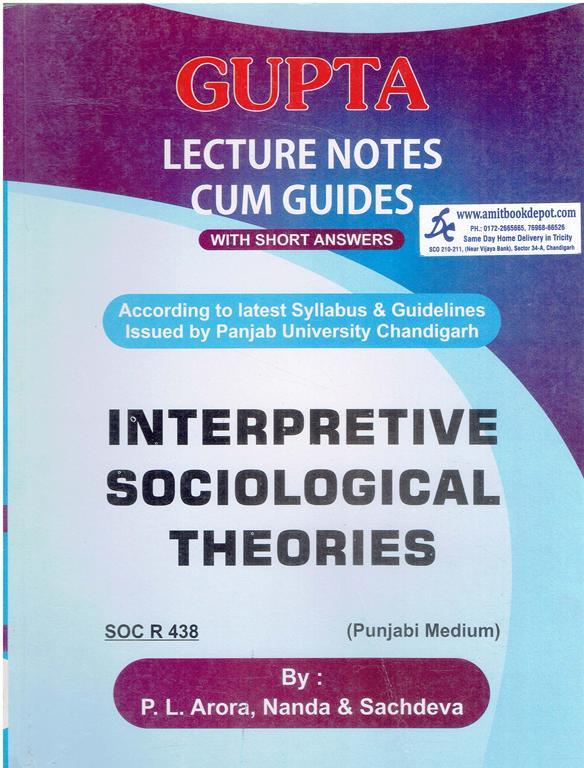
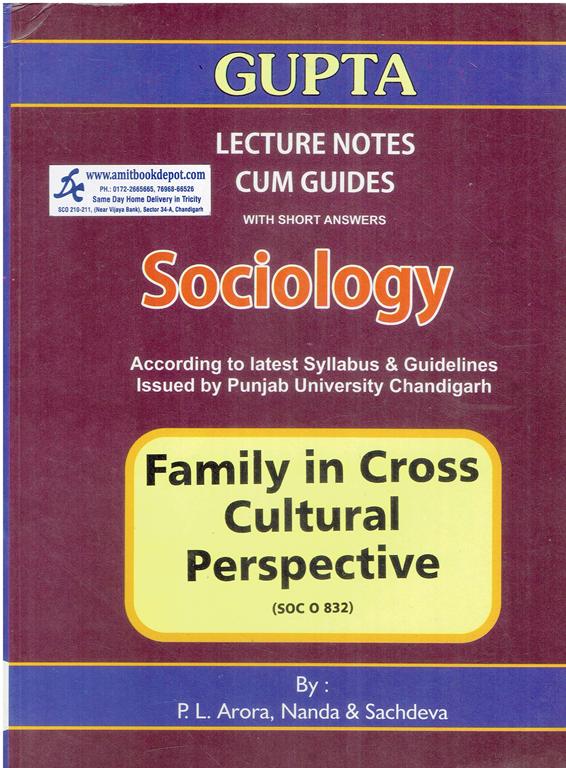
Gupta Interpretive Sociological Theories SOC R 438 For MA Sociology 3rd Semester Panjab University Chandigarh (Punjabi Medium)

by Madhurima
₹450 ₹450.00(-/ off)

Rating & Reviews

23 Customer Review

"Gupta Interpretive Sociological Theories (SOC R 438)" is the prescribed Punjabi-medium book for MA Sociology 3rd Semester students at Panjab University, Chandigarh. Authored by P.L. Arora, Nanda, and Sachdeva, this comprehensive guide covers the entire syllabus on interpretive sociological theories. It provides detailed, unit-wise explanations of action theory (Weber, Parsons), symbolic interactionism (Mead, Blumer), phenomenology (Schutz), dramaturgy (Goffman), ethnomethodology (Garfinkel), and critical theory (Habermas, Marcuse). With a dedicated section for short answer type questions, this book by Pepsu Book Depot is an essential resource for mastering the course content and excelling in university examinations.
Have Doubts Regarding This Product ? Ask Your Question

  • Q1
    Is this book written entirely in Punjabi, as per the Panjab University Punjabi Medium requirement?
    A1

    Yes, this textbook is authored and published in the Punjabi language, specifically designed for students enrolled in the Punjabi Medium stream of MA Sociology at Panjab University.

  • Q2
    Are the theories of all sociologists mentioned in the Panjab University SOC R 438 syllabus covered in this single book?
    A2

    Absolutely. The book is structured into four units that comprehensively cover Max Weber, Talcott Parsons, G.H. Mead, H. Blumer, Alfred Schutz, Erving Goffman, Harold Garfinkel, Jurgen Habermas, and Herbert Marcuse as per the latest syllabus.

  • Q3
    Is this book useful for students from other universities studying Interpretive Sociology?
    A3

    While the core theoretical content is universally applicable, this book is specifically tailored to the syllabus, exam pattern, and Punjabi-medium instruction of Panjab University, Chandigarh. Students from other universities should check their specific syllabus.

  • Q4
    How does this book help in understanding complex theorists like Habermas and Garfinkel in Punjabi?
    A4

    The authors have explained complex concepts of Critical Theory, Ethnomethodology, and other paradigms in clear, accessible Punjabi terminology, breaking down sophisticated ideas for easier comprehension by Punjabi-medium learners.

  • Q5
    Is the book aligned with the latest syllabus and exam pattern for SOC R 438?
    A5

    Yes, the book explicitly states it follows the latest syllabus. Its unit division and inclusion of short-answer practice directly correspond to the Panjab University exam structure of one compulsory short-answer question and four long-answer questions from each unit.

  • Q6
    Does it cover both micro (e.g., Symbolic Interactionism) and macro (e.g., Critical Theory) interpretive perspectives?
    A6

    Yes, the book provides a balanced study, covering micro-sociological perspectives like Symbolic Interactionism, Phenomenology, Dramaturgy, and Ethnomethodology in Units II & III, and the macro-perspective of Critical Theory in Unit IV.

  • Q7
    I am a private candidate. Is this book sufficient for my exam preparation without internal assessment guidance?
    A7

    This textbook covers 100% of the theoretical syllabus required for the 80-mark theory paper. Private candidates should focus thoroughly on this text and practice the short and long-answer questions, as their final marks are based solely on the theory paper performance.

  • Q8
    How current is the publication date of this edition, and does it include recent developments in Interpretive Theory?
    A8

    This book covers the classical and foundational theorists prescribed in the Panjab University syllabus. For the specific publication year of this edition, please refer to the product details page or the book's copyright page.

  • Q9
    Does the explanation of Talcott Parsons' Action Theory also connect to his later work on social systems?
    A9

    The coverage focuses on Parsons' Action Theory (voluntaristic action, pattern variables) as specified in the Panjab University Unit-I syllabus, providing the necessary foundation for the exam.

  • Q10
    How does this book explain practical applications of theories like Ethnomethodology or Dramaturgy?
    A10

    Through explanations of concepts like Garfinkel's breaching experiments and Goffman's impression management, the book illustrates how these theories apply to everyday social interactions, making the abstract concepts more relatable and understandable.
0.00

0 Overall Rating
  • 5
    0
  • 4
    0
  • 3
    0
  • 2
    0
  • 1
    0

Try this product & share your review & thoughts

UNIT - I

1. Interpretive Theory
2. Action Theory
3. Max Weber’s Action Theory
4. Action Theory: Talcott Parsons

UNIT - II

5. Symbolic Interactionism
6. Symbolic Interactionism: George Herbert Mead
7. Symbolic Interactionism: Herbert Blumer
8. Phenomenology
9. Phenomenology of Alfred Schutz

UNIT - III

10. Dramaturgy
11. Erving Goffman’s Dramaturgy
12. Ethnomethodology
13. Ethnomethodology: Harold Garfinkel

UNIT - IV

14. Critical Theory
15. Jurgen Habermas’s Critical Theory
16. Herbert Marcuse’s Critical Theory

Short Answer Type Questions

Latest Syllabus of Interpretive Sociological Theories SOC R 438 For MA Sociology 3rd Semester Panjab University Chandigarh (Punjabi Medium)


SEMESTER-III
SOC R 438: INTERPRETIVE SOCIOLOGICAL THEORIES

Objective

This course sensitizes the students to the works and ideas of sociologists who have contributed to the perspective of interpretive sociology, as opposed to positivistic sociology. It focuses on the work of action theorists, interactionist theorists, and the scholars belonging to the Frankfurt School of Critical Theory.

INSTRUCTIONS FOR THE PAPER-SETTER AND THE CANDIDATES

(i) The theory question paper will be of 80 marks, and 20 marks will be for internal assessment. The duration of the paper will be 3 hours.
(ii) For private candidates, who have not been assessed earlier for internal assessment, the marks secured by them in the theory paper will proportionately be increased to the maximum marks of the paper in lieu of internal assessment.

The paper setter must put note (ii) in the question paper.

The syllabus has been divided into four units.
There shall be 9 questions in all. The first question is compulsory and shall be a short answer type containing 10 short questions spread over the whole syllabus to be answered in about 30 to 35 words each, carrying 20 marks, i.e., 2 marks each. The rest of the paper shall contain 4 units. Each unit shall have two long questions and the Candidates shall be given an internal choice of attempting one question from each unit—4 in all. Each question will carry 15 marks.

Course Outline
Unit-I

Action Theories: Max Weber, Talcott Parsons

Unit-II

Symbolic Interactionism: G.H. Mead, H. Blumer
Phenomenology: E. Husserl, A. Schutz

Unit III

Dramaturgy: E. Goffman
Ethnomethodology: H. Garfinkel 

Unit IV

Critical Theory: J. Habermas
H. Marcuse 

This book, "Gupta Interpretive Sociological Theories" (SOC R 438), is an indispensable and meticulously crafted academic resource designed explicitly for Master of Arts (MA) Sociology, 3rd Semester students at Panjab University, Chandigarh, studying under the Punjabi Medium curriculum. Authored by the esteemed academicians P. L. Arora, Nanda, and Sachdeva, and published by Pepsu Book Depot, this book is the definitive guide for mastering the prescribed syllabus with precision and conceptual clarity.

The book is structured to provide a comprehensive exploration of interpretive sociological theories, a core paradigm that contrasts with positivistic sociology by emphasizing the subjective meanings individuals attach to their social world. It aligns perfectly with the latest syllabus (SOC R 438) mandated by Panjab University, ensuring complete coverage of all examination topics and unit-wise divisions. The content is presented in clear, accessible Punjabi, making complex theoretical frameworks understandable for Punjabi-medium students and fostering a deeper connection with the subject matter.

Organized into four systematic units, the book delves into the foundational and advanced strands of interpretive thought. Unit I commences with an introduction to interpretive theory itself before providing an in-depth analysis of action theory. It offers dedicated chapters on the seminal contributions of Max Weber, focusing on his typology of social action, and Talcott Parsons, exploring his voluntaristic action frame of reference and pattern variables. This unit lays the crucial groundwork for understanding sociology as a science concerned with meaningful social action.

Unit II transitions into the micro-sociological perspectives, beginning with symbolic interactionism. It meticulously examines the foundational ideas of George Herbert Mead, including the concepts of 'self,' 'I,' and 'me,' and the significance of symbols. This is followed by an exploration of Herbert Blumer's formalization of the perspective and his core principles. The unit then expands into phenomenology, concluding with a focused study on Alfred Schutz and his work on lifeworld, typifications, and the social construction of reality.

Unit III explores two further innovative approaches within interpretive sociology. It introduces dramaturgy, providing a detailed chapter on Erving Goffman's groundbreaking dramaturgical analysis, where social life is examined as a theatrical performance involving impression management and front and back stages. Subsequently, the book tackles ethnomethodology, with a specific chapter on Harold Garfinkel's provocative breaching experiments and his focus on the methods people use to create and sustain a shared sense of social order.

Finally, Unit IV elevates the discussion to the macro-level with critical theory. It introduces the key tenets of the Frankfurt School before presenting dedicated analyses of two of its most influential thinkers: Jurgen Habermas, focusing on communicative action and the public sphere, and Herbert Marcuse, exploring his critiques of one-dimensional society and advanced industrial capitalism. This unit connects interpretive insights with a critical edge, examining power, domination, and the potential for emancipation.

A significant and practical feature of this book is its dedicated section of short answer type questions. This segment is tailored specifically for exam preparation, helping students to consolidate their understanding and practice for the compulsory short-answer section of the Panjab University exam paper. The book’s structure mirrors the university's examination pattern, with clear unit divisions that facilitate organized study and revision.

Published by Pepsu Book Depot, a trusted name in academic publishing for Punjabi University circles, this volume is more than just a book; it is a structured learning companion. It is an essential purchase for any MA Sociology 3rd Semester student at Panjab University aiming to achieve academic excellence in their Interpretive Sociological Theories paper. By offering syllabus-specific content, authoritative explanations in Punjabi, and strategic exam-oriented material, this book stands as the most reliable and targeted resource for successfully navigating SOC R 438.

UNIT - I

1. Interpretive Theory
2. Action Theory
3. Max Weber’s Action Theory
4. Action Theory: Talcott Parsons

UNIT - II

5. Symbolic Interactionism
6. Symbolic Interactionism: George Herbert Mead
7. Symbolic Interactionism: Herbert Blumer
8. Phenomenology
9. Phenomenology of Alfred Schutz

UNIT - III

10. Dramaturgy
11. Erving Goffman’s Dramaturgy
12. Ethnomethodology
13. Ethnomethodology: Harold Garfinkel

UNIT - IV

14. Critical Theory
15. Jurgen Habermas’s Critical Theory
16. Herbert Marcuse’s Critical Theory

Short Answer Type Questions

Have Doubts Regarding This Product ? Ask Your Question

  • Q1
    Is this book written entirely in Punjabi, as per the Panjab University Punjabi Medium requirement?
    A1

    Yes, this textbook is authored and published in the Punjabi language, specifically designed for students enrolled in the Punjabi Medium stream of MA Sociology at Panjab University.

  • Q2
    Are the theories of all sociologists mentioned in the Panjab University SOC R 438 syllabus covered in this single book?
    A2

    Absolutely. The book is structured into four units that comprehensively cover Max Weber, Talcott Parsons, G.H. Mead, H. Blumer, Alfred Schutz, Erving Goffman, Harold Garfinkel, Jurgen Habermas, and Herbert Marcuse as per the latest syllabus.

  • Q3
    Is this book useful for students from other universities studying Interpretive Sociology?
    A3

    While the core theoretical content is universally applicable, this book is specifically tailored to the syllabus, exam pattern, and Punjabi-medium instruction of Panjab University, Chandigarh. Students from other universities should check their specific syllabus.

  • Q4
    How does this book help in understanding complex theorists like Habermas and Garfinkel in Punjabi?
    A4

    The authors have explained complex concepts of Critical Theory, Ethnomethodology, and other paradigms in clear, accessible Punjabi terminology, breaking down sophisticated ideas for easier comprehension by Punjabi-medium learners.

  • Q5
    Is the book aligned with the latest syllabus and exam pattern for SOC R 438?
    A5

    Yes, the book explicitly states it follows the latest syllabus. Its unit division and inclusion of short-answer practice directly correspond to the Panjab University exam structure of one compulsory short-answer question and four long-answer questions from each unit.

  • Q6
    Does it cover both micro (e.g., Symbolic Interactionism) and macro (e.g., Critical Theory) interpretive perspectives?
    A6

    Yes, the book provides a balanced study, covering micro-sociological perspectives like Symbolic Interactionism, Phenomenology, Dramaturgy, and Ethnomethodology in Units II & III, and the macro-perspective of Critical Theory in Unit IV.

  • Q7
    I am a private candidate. Is this book sufficient for my exam preparation without internal assessment guidance?
    A7

    This textbook covers 100% of the theoretical syllabus required for the 80-mark theory paper. Private candidates should focus thoroughly on this text and practice the short and long-answer questions, as their final marks are based solely on the theory paper performance.

  • Q8
    How current is the publication date of this edition, and does it include recent developments in Interpretive Theory?
    A8

    This book covers the classical and foundational theorists prescribed in the Panjab University syllabus. For the specific publication year of this edition, please refer to the product details page or the book's copyright page.

  • Q9
    Does the explanation of Talcott Parsons' Action Theory also connect to his later work on social systems?
    A9

    The coverage focuses on Parsons' Action Theory (voluntaristic action, pattern variables) as specified in the Panjab University Unit-I syllabus, providing the necessary foundation for the exam.

  • Q10
    How does this book explain practical applications of theories like Ethnomethodology or Dramaturgy?
    A10

    Through explanations of concepts like Garfinkel's breaching experiments and Goffman's impression management, the book illustrates how these theories apply to everyday social interactions, making the abstract concepts more relatable and understandable.

Latest Syllabus of Interpretive Sociological Theories SOC R 438 For MA Sociology 3rd Semester Panjab University Chandigarh (Punjabi Medium)


SEMESTER-III
SOC R 438: INTERPRETIVE SOCIOLOGICAL THEORIES

Objective

This course sensitizes the students to the works and ideas of sociologists who have contributed to the perspective of interpretive sociology, as opposed to positivistic sociology. It focuses on the work of action theorists, interactionist theorists, and the scholars belonging to the Frankfurt School of Critical Theory.

INSTRUCTIONS FOR THE PAPER-SETTER AND THE CANDIDATES

(i) The theory question paper will be of 80 marks, and 20 marks will be for internal assessment. The duration of the paper will be 3 hours.
(ii) For private candidates, who have not been assessed earlier for internal assessment, the marks secured by them in the theory paper will proportionately be increased to the maximum marks of the paper in lieu of internal assessment.

The paper setter must put note (ii) in the question paper.

The syllabus has been divided into four units.
There shall be 9 questions in all. The first question is compulsory and shall be a short answer type containing 10 short questions spread over the whole syllabus to be answered in about 30 to 35 words each, carrying 20 marks, i.e., 2 marks each. The rest of the paper shall contain 4 units. Each unit shall have two long questions and the Candidates shall be given an internal choice of attempting one question from each unit—4 in all. Each question will carry 15 marks.

Course Outline
Unit-I

Action Theories: Max Weber, Talcott Parsons

Unit-II

Symbolic Interactionism: G.H. Mead, H. Blumer
Phenomenology: E. Husserl, A. Schutz

Unit III

Dramaturgy: E. Goffman
Ethnomethodology: H. Garfinkel 

Unit IV

Critical Theory: J. Habermas
H. Marcuse 

0.00

0 Overall Rating
  • 5
    0
  • 4
    0
  • 3
    0
  • 2
    0
  • 1
    0

Try this product & share your review & thoughts

Top Trending Product

Related Product

Related Product

Related Blog Posts

Latest Blogs

Latest Blogs

blog-img
Classic Literature Reimagined: Discuss modern twists on classic novels.
Lorem ipsum dolor sit amet, consectetur adipiscing elit, sed do eiusmod tempor incididunt ut labore et dolore magna aliqua. Ut enim ad minim veniam, quis nostrud exercitation ullamco Lorem ipsum dolor sit amet, consectetur adipiscing elit, sed do eiusmod tempor incididunt ut labore et dolore magna aliqua. Utenim ad minim veniam, quis nostrud exercitation ullamco Lorem ipsum dolor sit amet, consecte...
Read more
Author name | 10 jan, 2025
blog-img
Classic Literature Reimagined: Discuss modern twists on classic novels.
Lorem ipsum dolor sit amet, consectetur adipiscing elit, sed do eiusmod tempor incididunt ut labore et dolore magna aliqua. Ut enim ad minim veniam, quis nostrud exercitation ullamco Lorem ipsum dolor sit amet, consectetur adipiscing elit, sed do eiusmod tempor incididunt ut labore et dolore magna aliqua. Utenim ad minim veniam, quis nostrud exercitation ullamco Lorem ipsum dolor sit amet, consecte...
Read more
Author name | 10 jan, 2025
blog-img
Classic Literature Reimagined: Discuss modern twists on classic novels.
Lorem ipsum dolor sit amet, consectetur adipiscing elit, sed do eiusmod tempor incididunt ut labore et dolore magna aliqua. Ut enim ad minim veniam, quis nostrud exercitation ullamco Lorem ipsum dolor sit amet, consectetur adipiscing elit, sed do eiusmod tempor incididunt ut labore et dolore magna aliqua. Utenim ad minim veniam, quis nostrud exercitation ullamco Lorem ipsum dolor sit amet, consecte...
Read more
Author name | 10 jan, 2025
blog-img
Classic Literature Reimagined: Discuss modern twists on classic novels.
Lorem ipsum dolor sit amet, consectetur adipiscing elit...
Read more
Author Name | 10 Jan, 2025
blog-img
Classic Literature Reimagined: Discuss modern twists on classic novels.
Lorem ipsum dolor sit amet, consectetur adipiscing elit...
Read more
Author Name | 10 Jan, 2025
blog-img
Classic Literature Reimagined: Discuss modern twists on classic novels.
Lorem ipsum dolor sit amet, consectetur adipiscing elit...
Read more
Author Name | 10 Jan, 2025
blog-img
Classic Literature Reimagined: Discuss modern twists on classic novels.
Lorem ipsum dolor sit amet, consectetur adipiscing elit...
Read more
Author Name | 10 Jan, 2025
blog-img
Classic Literature Reimagined: Discuss modern twists on classic novels.
Lorem ipsum dolor sit amet, consectetur adipiscing elit...
Read more
Author Name | 10 Jan, 2025
blog-img
Classic Literature Reimagined: Discuss modern twists on classic novels.
Lorem ipsum dolor sit amet, consectetur adipiscing elit...
Read more
Author Name | 10 Jan, 2025
blog-img
Classic Literature Reimagined: Discuss modern twists on classic novels.
Lorem ipsum dolor sit amet, consectetur adipiscing elit...
Read more
Author Name | 10 Jan, 2025
blog-img
Classic Literature Reimagined: Discuss modern twists on classic novels.
Lorem ipsum dolor sit amet, consectetur adipiscing elit...
Read more
Author Name | 10 Jan, 2025
blog-img
Classic Literature Reimagined: Discuss modern twists on classic novels.
Lorem ipsum dolor sit amet, consectetur adipiscing elit...
Read more
Author Name | 10 Jan, 2025