Categories
College Bookssss >
BA PU Chandigarh
BSC PU Chandigarh
MSC PU Chandigarh
BBA PU Chandigarh
MA PU Chandigarh
Medical Books
Engineering Books
Management Books
PGDCA Books
BCOM PU Chandigarh
MCOM PU Chandigarh
BCA PU Chandigarh
MCA PU Chandigarh
animate-books

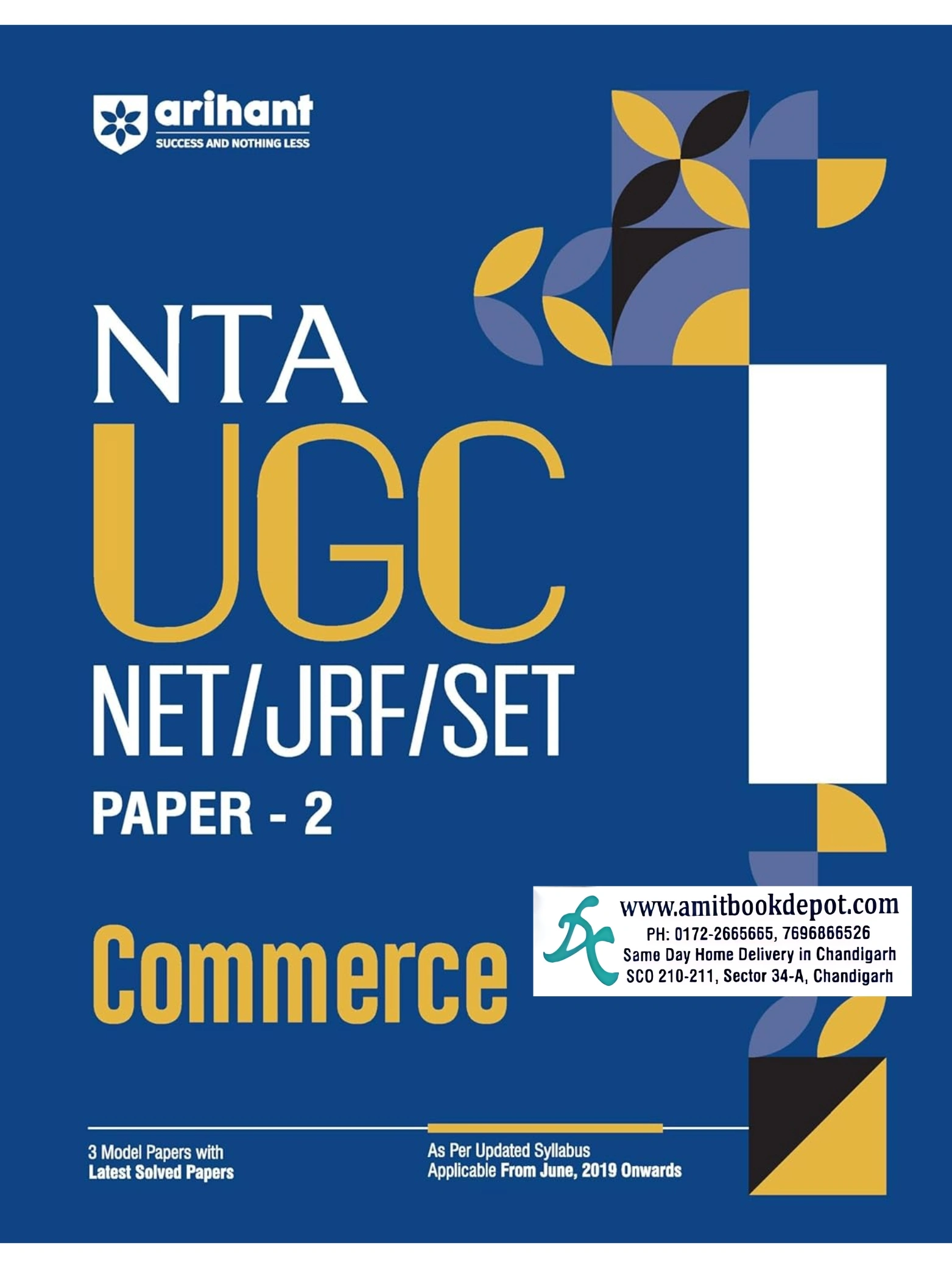
Arihant NTA UGC NET JRF SET Commerce Paper 2

by Madhurima
₹660 ₹745.00(-/ off)

Rating & Reviews

23 Customer Review

Master the UGC NET JRF SET Commerce Paper 2 exam with this definitive guide by Arihant Prakashan. Authored by experts Neetu Singh, Apeksha Agiwal, and Satyabroto Roy, this comprehensive book offers complete coverage of the latest NTA syllabus across 10 detailed units. Gain an edge with solved papers from 2024 to 2019 for trend analysis. Reinforce learning with three model test papers for self-assessment. Key topics include business environment, accounting & auditing, business economics, business finance, statistics, HRM, banking, marketing, legal aspects, and taxation. This all-in-one resource is essential for NTA NET, JRF, and SET Commerce exam success.

Have Doubts Regarding This Product ? Ask Your Question

  • Q1
    Does this book cover the entire syllabus for the UGC NET Commerce Paper 2 as per the latest NTA notification?
    A1

    Yes, the book is meticulously structured into 10 units that comprehensively cover every topic outlined in the latest official UGC NET Commerce Paper 2 syllabus provided by the NTA.

  • Q2
    Are the Model Papers at the end of the book based on the latest exam pattern and marking scheme?
    A2

    Absolutely. The three included Model Papers are carefully designed to simulate the latest exam pattern, question format, and difficulty level of the actual NTA UGC NET Commerce exam.

  • Q3
    Is this book useful for State Eligibility Test (SET/SLET) in Commerce as well?
    A3

    Yes, since the core syllabus for most state-level SET/SLET exams in Commerce aligns closely with the UGC NET syllabus, this book serves as an excellent resource for those examinations too.

  • Q4
    Does the unit on Accounting and Auditing include topics like Human Resource Accounting and IFRS?
    A4

    Yes, Unit 2 provides dedicated coverage of contemporary areas including Human Resource Accounting, Inflation Accounting, Indian Accounting Standards, and IFRS, along with core accounting and auditing concepts.

  • Q5
    How in-depth is the coverage of the Legal Aspects of Business, specifically for the Companies Act 2013 and GST?
    A5

    Unit 9 offers detailed coverage of key legislation, including dedicated chapters on the Companies Act 2013 (formation, management, winding up) and a comprehensive explanation of the Goods and Services Tax (GST) framework, objectives, and provisions.

  • Q6
    Does the Business Finance unit cover international financial topics relevant for the exam?
    A6

    Yes, Unit 4 includes detailed chapters on the International Financial Market, foreign exchange risk hedging, Euro currency, ADRs, GDRs, and multinational capital budgeting.

  • Q7
    Are modern marketing trends like Digital Marketing and CRM included in the Marketing Management unit?
    A7

    Yes, Unit 8 has a dedicated chapter on Trends in Marketing, which elaborates on Social Marketing, Online/Digital Marketing, Green Marketing, Direct Marketing, Rural Marketing, and Customer Relationship Management (CRM).

  • Q8
    Does the book explain complex economic concepts like the Oligopoly price leadership model?
    A8

    Yes, Unit 3 on Business Economics clearly explains price determination under different market structures, including detailed analysis of the Oligopoly market and the price leadership model.

  • Q9
    Is the topic of Corporate Tax Planning and techniques for tax avoidance vs. evasion covered?
    A9

    Yes, Unit 10 delves into Corporate Tax Planning, distinguishing between tax avoidance and evasion, and discusses various techniques and tax considerations for specific business decisions.

  • Q10
    Is the content presented in a theory-heavy manner, or does it include diagrams and tables for better understanding?
    A10

    The content prioritizes clarity and uses diagrams, tables, and bulleted points strategically to break down complex information, such as in chapters on accounting, statistics, and organizational structure, aiding in visual learning and retention.

0.00

0 Overall Rating
  • 5
    0
  • 4
    0
  • 3
    0
  • 2
    0
  • 1
    0

Try this product & share your review & thoughts

Solved Paper, September 2024
Solved Paper, December 2023
Solved Paper, October 2022
Solved Paper, November 2021
Solved Paper, October 2020
Solved Paper, December 2019

Unit 1: Business Environment and International Business

1. Business Environment
2. Concept of International Business
3. Foreign Direct Investment and Balance of Payment
4. Regional Economic Integration and WTO

Unit 2 Accounting and Auditing

5. Accounting and Its Concepts
6. Partnership Accounts
7. Corporate Accounting
8. Cost and Management Accounting
9. Auditing and Its Recent Trends

Unit 3: Business Economics

10. Business Economics and Demand Analysis
11. Consumer's Behavior and Producer's Behavior
12. Market Structure and Price Determination

Unit 4 Business Finance

13. Finance and Its Sources
14. Capital Structure and Budgeting
15. Working Capital and Dividend Policy
16. International Financial Market

Unit 5: Business Statistics and Research Methods

17. Measures of Statistics
18. Data Collection and Statistical Methods
19. Probability, Research, and Hypothesis Testing

Unit 6: Business Management and Human Resource Management

20. Principles and Functions of Management
21. Organizational Structure and Its Culture
22. Motivation, Leadership, and Corporate Governance
23. Human Resource Management and Planning
24. Compensation Management and Performance Appraisal

Unit 7 Banking and Financial Institutions

25. Bank and Its Types
26. Banking Sector Reforms in India
27. Financial Markets and Institutions
28. Insurance

Unit 8: Marketing Management

29. Marketing and Market Segmentation
30. Service Marketing and Trends in Marketing
31. Marketing Decisions

Unit 9: Legal Aspects of Business

32. Indian Contract Act
33. Legal Aspects of Companies and Firms-l
34. Legal Aspects of Companies and Firms-II
35. Legal Aspects of Goods and Services

Unit 10: Income Tax and Corporate Tax Planning

36. Basic Concepts of Income Tax
37. Corporate Tax Planning and International Taxation

Model Papers (1-3)

Latest Syllabus of NTA UGC NET JRF SET Commerce Paper 2


UNIT 1 Business Environment and International Business

- Concepts and elements of  the business environment. Economic environment: economic systems, economic policies (monetary and fiscal policies): Political environment Role of government in business: Legal environment -Consumer Protection Act, FEMA: Socio-cultural factors and their influence on business: Corporate Social Responsibility (CSR)
- Scope and importance of international business; globalization and its drivers: Modes of entry into international business
- Theories of international trade, government intervention in international trade; Tariff and non-tariff barriers: India's foreign trade policy
- Foreign direct investment (FDI) and foreign portfolio investment (FPI); types of FDI; costs and benefits of FDI to home and host countries: Trends in FDI; India's FDI policy
- Balance of payments (BOP): Importance and components of BOP
- Regional Economic Integration: Levels of Regional Economic Integration; Trade creation and diversion effects; Regional Trade Agreements: European Union (EU), ASEAN, SAARC, NAFTA
- International Economic Institutions: IMF, World Bank, UNCTAD
- World Trade Organization (WTO): Functions and objectives of WTO, Agriculture Agreement: GATS, TRIPS, and TRIMS

UNIT 2 Accounting and Auditing

- Basic accounting principles, concepts, and postulates
- Partnership Accounts: Admission, Retirement, Death, Dissolution, and Insolvency of Partnership Firms
- Corporate Accounting: Issue, forfeiture, and reissue of shares: Liquidation of companies: Acquisition, merger, amalgamation, and reconstruction of companies
- Holding company accounts
- Cost and Management Accounting: Marginal costing and break-even analysis: Standard costing: Budgetary control: Process costing: Activity Based Costing (ABC); Costing for decision-making: Life cycle costing, target costing, kaizen costing, and JIT
- Financial Statement Analysis: Ratio analysis; Funds flow analysis; Cash flow analysis
- Human Resources Accounting: Inflation Accounting: Environmental Accounting
- Indian Accounting Standards and IFRS
- Auditing: Independent financial audit; Vouching: Verification and valuation of assets and liabilities;
- Audit of financial statements and audit report: Cost audit
- Recent Trends in Auditing: Management audit; Energy audit; Environment audit; Systems audit; Safety audit

UNIT 3 Business Economics

- Meaning and scope of business economics
- Objectives of business firms
- Demand analysis: Law of demand, elasticity of demand and its measurement, Relationship between AR and MIR
- Consumer behavior: Utility analysis, indifference curve analysis
- Law of Variable Proportions: Law of Returns to Scale
- Theory of cost: Short-run and long-run cost curves
- Price determination under different market forms: Perfect competition: Monopolistic competition,
- Oligopoly price leadership model, monopoly: price discrimination
- Pricing strategies: Price skimming Price penetration, peak load pricing

UNIT 4 Business Finance

- Scope and sources of finance, lease financing
- Cost of capital and time value of money
- Capital structure
- Capital budgeting decisions: Conventional and scientific techniques of capital budgeting analysis
- Working capital management, dividend decision: theories and policies
- Risk and return analysis; asset securitization
- International monetary system
- Foreign exchange market: Exchange rate risk and hedging techniques
- International financial markets and instruments: Euro currency; GDRs; ADRs
- International arbitrage; multinational capital budgeting

UNIT 5 Business Statistics and Research Methods

- Measures of central tendency
- Measures of dispersion
- Measures of skewness
- Correlation and regression of two variables
- Probability: Approaches to probability; Bayes' theorem
- Probability distributions: binomial, Poisson, and normal distributions
- Research: Concept and types: Research designs
- Data: Collection and classification of data
- Sampling and estimation: Concepts: Methods of sampling—probability and non-probability methods: Sampling distribution; Central limit theorem; Standard error; Statistical estimation
- Hypothesis testing: z-test, t-test, ANOVA, Chi-square test, Mann-Whitney test (U-test), Kruskal-Wallis test (H-test), Rank correlation test
- Report writing

UNIT 6 Business Management and Human Resource Management

- Principles and functions of management
- Organization structure: Formal and informal organizations: Span of control
- Responsibility and authority: Delegation of authority and decentralization
- Motivation and leadership: Concept and theories
- Corporate governance and business ethics
- Human resource management: Concept, role, and functions of HRM; Human resource planning: Recruitment and selection: Training and development: Succession planning
- Compensation management: Job evaluation; incentives and fringe benefits
- Performance appraisal, including 360-degree performance appraisal
- Collective bargaining and workers' participation in management
- Personality: Perception: Attitudes, Emotions; Group dynamics; Power and politics; Conflict and negotiation: Stress management
- Organizational Culture: Organizational development and organizational change

UNIT 7 Banking and Financial Institutions

- Overview of the Indian financial system
- Types of banks: Commercial banks, Regional Rural Banks (RRBs), Foreign banks, and Cooperative banks
- Reserve Bank of India: Functions, role, and monetary policy management
- Banking sector reforms in India: Basel norms, risk management, NPA management
- Financial markets: Money market; Capital market: Government securities market
- Financial Institutions: Development Finance Institutions (DFIs); Non-Banking Financial Companies (NBFCs); Mutual Funds; Pension Funds
- Financial Regulators in India
- Financial sector reforms, including financial inclusion
- Digitization of banking and other financial services: Internet banking, mobile banking, and digital payment systems
- Insurance: Types of insurance—life and non-life insurance; risk classification and management; factors limiting the insurability of risk; Reinsurance; Regulatory framework of insurance—IRDA and its role

UNIT 8 Marketing Management

- Marketing: Concept and approaches; marketing channels; marketing mix; strategic marketing planning; market segmentation, targeting, and positioning
- Product decisions: Concept; product line; product mix decisions; product life cycle; new product development
- Pricing decisions: Factors affecting price determination; pricing policies and strategies
- Promotion decisions: Role of promotion in marketing; Promotion methods—Advertising, personal selling, publicity, sales promotion tools and techniques, and promotion mix
- Distribution decisions: Channels of distribution; channel management
- Consumer Behavior: Consumer buying process, factors influencing consumer buying decisions
- Service marketing
- Trends in marketing: Social marketing: Online marketing: Green marketing: Direct marketing: Rural marketing: CRM
- Logistics management

UNIT 9 Legal Aspects of Business

- Indian Contract Act, 1872: Elements of a valid contract; Capacity of parties; free consent; discharge of a contract; Breach of contract and remedies against breach; Quasi contracts
- Special contracts: Contracts of indemnity and guarantee, contracts of bailment and pledge, and contracts of agency 
- Sale of Goods Act, 1930: Sale and agreement to sell; Doctrine of Caveat Emptor; Rights of unpaid seller and rights of buyer
- Negotiable Instruments Act, 1881: Types of negotiable instruments: Negotiation and assignment: Dishonor and discharge of negotiable instruments 
- The Companies Act, 2013: Nature and kinds of companies: Company formation; management, meetings, and winding up of a joint stock company 
- Limited Liability Partnership: Structure and procedure of formation of LLP in India
- The Competition Act, 2002: Objectives and main provisions
- The Information Technology Act, 2000: Objectives and main provisions; cybercrimes and penalties
- The RTI Act, 2005: Objectives and main provisions
- Intellectual Property Rights (IPRs): Patents, trademarks, and copyrights; emerging issues in intellectual property
- Goods and Services Tax (GST): Objectives and main provisions; benefits of GST; implementation mechanism; working of dual GST

UNIT 10 Income Tax and Corporate Tax Planning

- Income tax: Basic concepts; residential status and tax incidence; exempted incomes; agricultural income; computation of taxable income under various heads; Deductions from gross total income; Assessment of Individuals; Clubbing of Incomes
- International Taxation: Double taxation and its avoidance mechanism; transfer pricing
- Corporate Tax Planning: Concepts and significance of corporate tax planning; tax avoidance versus tax evasion; techniques of corporate tax planning; Tax considerations in specific business situations: Make-or-buy decisions; Own or lease an asset; retain; renewal or replacement of asset; Shut down or continue operations
- Deduction and collection of tax at source; advance payment of tax; E-filing of income-tax returns

The Arihant NTA UGC NET JRF SET Commerce Paper 2 book is an exhaustive and meticulously structured guide designed for aspirants aiming to secure eligibility for Assistant Professorship and Junior Research Fellowship in Commerce. Authored by the expert trio of Neetu Singh, Apeksha Agiwal, and Satyabroto Roy, and published by Arihant Prakashan, this comprehensive volume stands as a definitive resource for mastering the expansive and challenging syllabus prescribed by the National Testing Agency (NTA). This book is engineered not just for the UGC NET Commerce exam but also proves indispensable for state-level SET and SLET examinations, ensuring complete coverage and conceptual clarity.

The book commences with a powerful strategic advantage: a collection of six fully solved previous years' papers from September 2024 back to December 2019. This section is critical for exam pattern analysis, understanding the question paper trend, and gauging the difficulty level. It allows aspirants to familiarize themselves with the NTA's questioning style, practice time management, and self-assess their preparation from the outset, building a solid foundation for targeted study.

Structured precisely according to the latest UGC NET Commerce syllabus, the content is divided into ten logically sequenced units, each addressing a core domain of commerce. Unit 1: Business Environment and International Business covers the macro-environment, CSR, FDI, balance of payments, WTO, and regional blocs like ASEAN and SAARC. Unit 2: Accounting and Auditing is a deep dive into Partnership Accounts, Corporate Accounting, Cost & Management Accounting, Indian Accounting Standards, IFRS, and contemporary auditing trends, including environmental and energy audits. Unit 3: Business Economics elaborates on demand analysis, consumer behavior, market structures, and pricing strategies.

For financial acumen, Unit 4: Business Finance extensively discusses capital structure, capital budgeting, working capital management, dividend policies, and international financial markets, including ADRs, GDRs, and forex risk hedging. Unit 5: Business Statistics and Research Methods provides a robust toolkit covering measures of central tendency, probability distributions, hypothesis testing (z-test, t-test, ANOVA, Chi-square), and research methodology. Unit 6: Business Management and Human Resource Management encompasses principles of management, organizational behavior, motivation theories, corporate governance, HR planning, compensation management, and 360-degree performance appraisal.

Unit 7: Banking and Financial Institutions offers a thorough overview of the Indian financial system, RBI functions, banking sector reforms (Basel norms, NPA management), and the regulatory landscape, including IRDA. Unit 8: Marketing Management details the marketing mix, segmentation, consumer behavior, service marketing, and modern trends like digital marketing, CRM, and green marketing. Unit 9: Legal Aspects of Business is a vital compendium on the Indian Contract Act, Sale of Goods Act, Companies Act 2013, Competition Act, IT Act, IPR, and the framework of GST. Concluding the syllabus, Unit 10: Income Tax and Corporate Tax Planning deals with the computation of taxable income, corporate tax planning techniques, and international taxation aspects.

Each chapter within these units is crafted to build conceptual clarity through lucid explanations, supported by relevant examples, diagrams, and tables where necessary. To reinforce learning and ensure exam readiness, the book incorporates three full-length model papers designed to simulate the actual UGC NET JRF Commerce exam. These papers help in comprehensive revision and self-evaluation, identifying strengths and areas needing improvement.

This book is more than a compilation of topics; it is a strategic learning partner. It serves as a one-stop solution for UGC NET Commerce preparation, effectively bridging the gap between the vast syllabus and the aspirant's goal of success. The authoritative content, alignment with the latest exam patterns and syllabus, and the inclusion of solved papers and model tests make it an essential asset for any serious candidate aiming to clear the NTA UGC NET JRF SET Commerce Paper 2 exam with a high score.

Solved Paper, September 2024
Solved Paper, December 2023
Solved Paper, October 2022
Solved Paper, November 2021
Solved Paper, October 2020
Solved Paper, December 2019

Unit 1: Business Environment and International Business

1. Business Environment
2. Concept of International Business
3. Foreign Direct Investment and Balance of Payment
4. Regional Economic Integration and WTO

Unit 2 Accounting and Auditing

5. Accounting and Its Concepts
6. Partnership Accounts
7. Corporate Accounting
8. Cost and Management Accounting
9. Auditing and Its Recent Trends

Unit 3: Business Economics

10. Business Economics and Demand Analysis
11. Consumer's Behavior and Producer's Behavior
12. Market Structure and Price Determination

Unit 4 Business Finance

13. Finance and Its Sources
14. Capital Structure and Budgeting
15. Working Capital and Dividend Policy
16. International Financial Market

Unit 5: Business Statistics and Research Methods

17. Measures of Statistics
18. Data Collection and Statistical Methods
19. Probability, Research, and Hypothesis Testing

Unit 6: Business Management and Human Resource Management

20. Principles and Functions of Management
21. Organizational Structure and Its Culture
22. Motivation, Leadership, and Corporate Governance
23. Human Resource Management and Planning
24. Compensation Management and Performance Appraisal

Unit 7 Banking and Financial Institutions

25. Bank and Its Types
26. Banking Sector Reforms in India
27. Financial Markets and Institutions
28. Insurance

Unit 8: Marketing Management

29. Marketing and Market Segmentation
30. Service Marketing and Trends in Marketing
31. Marketing Decisions

Unit 9: Legal Aspects of Business

32. Indian Contract Act
33. Legal Aspects of Companies and Firms-l
34. Legal Aspects of Companies and Firms-II
35. Legal Aspects of Goods and Services

Unit 10: Income Tax and Corporate Tax Planning

36. Basic Concepts of Income Tax
37. Corporate Tax Planning and International Taxation

Model Papers (1-3)

Have Doubts Regarding This Product ? Ask Your Question

  • Q1
    Does this book cover the entire syllabus for the UGC NET Commerce Paper 2 as per the latest NTA notification?
    A1

    Yes, the book is meticulously structured into 10 units that comprehensively cover every topic outlined in the latest official UGC NET Commerce Paper 2 syllabus provided by the NTA.

  • Q2
    Are the Model Papers at the end of the book based on the latest exam pattern and marking scheme?
    A2

    Absolutely. The three included Model Papers are carefully designed to simulate the latest exam pattern, question format, and difficulty level of the actual NTA UGC NET Commerce exam.

  • Q3
    Is this book useful for State Eligibility Test (SET/SLET) in Commerce as well?
    A3

    Yes, since the core syllabus for most state-level SET/SLET exams in Commerce aligns closely with the UGC NET syllabus, this book serves as an excellent resource for those examinations too.

  • Q4
    Does the unit on Accounting and Auditing include topics like Human Resource Accounting and IFRS?
    A4

    Yes, Unit 2 provides dedicated coverage of contemporary areas including Human Resource Accounting, Inflation Accounting, Indian Accounting Standards, and IFRS, along with core accounting and auditing concepts.

  • Q5
    How in-depth is the coverage of the Legal Aspects of Business, specifically for the Companies Act 2013 and GST?
    A5

    Unit 9 offers detailed coverage of key legislation, including dedicated chapters on the Companies Act 2013 (formation, management, winding up) and a comprehensive explanation of the Goods and Services Tax (GST) framework, objectives, and provisions.

  • Q6
    Does the Business Finance unit cover international financial topics relevant for the exam?
    A6

    Yes, Unit 4 includes detailed chapters on the International Financial Market, foreign exchange risk hedging, Euro currency, ADRs, GDRs, and multinational capital budgeting.

  • Q7
    Are modern marketing trends like Digital Marketing and CRM included in the Marketing Management unit?
    A7

    Yes, Unit 8 has a dedicated chapter on Trends in Marketing, which elaborates on Social Marketing, Online/Digital Marketing, Green Marketing, Direct Marketing, Rural Marketing, and Customer Relationship Management (CRM).

  • Q8
    Does the book explain complex economic concepts like the Oligopoly price leadership model?
    A8

    Yes, Unit 3 on Business Economics clearly explains price determination under different market structures, including detailed analysis of the Oligopoly market and the price leadership model.

  • Q9
    Is the topic of Corporate Tax Planning and techniques for tax avoidance vs. evasion covered?
    A9

    Yes, Unit 10 delves into Corporate Tax Planning, distinguishing between tax avoidance and evasion, and discusses various techniques and tax considerations for specific business decisions.

  • Q10
    Is the content presented in a theory-heavy manner, or does it include diagrams and tables for better understanding?
    A10

    The content prioritizes clarity and uses diagrams, tables, and bulleted points strategically to break down complex information, such as in chapters on accounting, statistics, and organizational structure, aiding in visual learning and retention.

Latest Syllabus of NTA UGC NET JRF SET Commerce Paper 2


UNIT 1 Business Environment and International Business

- Concepts and elements of  the business environment. Economic environment: economic systems, economic policies (monetary and fiscal policies): Political environment Role of government in business: Legal environment -Consumer Protection Act, FEMA: Socio-cultural factors and their influence on business: Corporate Social Responsibility (CSR)
- Scope and importance of international business; globalization and its drivers: Modes of entry into international business
- Theories of international trade, government intervention in international trade; Tariff and non-tariff barriers: India's foreign trade policy
- Foreign direct investment (FDI) and foreign portfolio investment (FPI); types of FDI; costs and benefits of FDI to home and host countries: Trends in FDI; India's FDI policy
- Balance of payments (BOP): Importance and components of BOP
- Regional Economic Integration: Levels of Regional Economic Integration; Trade creation and diversion effects; Regional Trade Agreements: European Union (EU), ASEAN, SAARC, NAFTA
- International Economic Institutions: IMF, World Bank, UNCTAD
- World Trade Organization (WTO): Functions and objectives of WTO, Agriculture Agreement: GATS, TRIPS, and TRIMS

UNIT 2 Accounting and Auditing

- Basic accounting principles, concepts, and postulates
- Partnership Accounts: Admission, Retirement, Death, Dissolution, and Insolvency of Partnership Firms
- Corporate Accounting: Issue, forfeiture, and reissue of shares: Liquidation of companies: Acquisition, merger, amalgamation, and reconstruction of companies
- Holding company accounts
- Cost and Management Accounting: Marginal costing and break-even analysis: Standard costing: Budgetary control: Process costing: Activity Based Costing (ABC); Costing for decision-making: Life cycle costing, target costing, kaizen costing, and JIT
- Financial Statement Analysis: Ratio analysis; Funds flow analysis; Cash flow analysis
- Human Resources Accounting: Inflation Accounting: Environmental Accounting
- Indian Accounting Standards and IFRS
- Auditing: Independent financial audit; Vouching: Verification and valuation of assets and liabilities;
- Audit of financial statements and audit report: Cost audit
- Recent Trends in Auditing: Management audit; Energy audit; Environment audit; Systems audit; Safety audit

UNIT 3 Business Economics

- Meaning and scope of business economics
- Objectives of business firms
- Demand analysis: Law of demand, elasticity of demand and its measurement, Relationship between AR and MIR
- Consumer behavior: Utility analysis, indifference curve analysis
- Law of Variable Proportions: Law of Returns to Scale
- Theory of cost: Short-run and long-run cost curves
- Price determination under different market forms: Perfect competition: Monopolistic competition,
- Oligopoly price leadership model, monopoly: price discrimination
- Pricing strategies: Price skimming Price penetration, peak load pricing

UNIT 4 Business Finance

- Scope and sources of finance, lease financing
- Cost of capital and time value of money
- Capital structure
- Capital budgeting decisions: Conventional and scientific techniques of capital budgeting analysis
- Working capital management, dividend decision: theories and policies
- Risk and return analysis; asset securitization
- International monetary system
- Foreign exchange market: Exchange rate risk and hedging techniques
- International financial markets and instruments: Euro currency; GDRs; ADRs
- International arbitrage; multinational capital budgeting

UNIT 5 Business Statistics and Research Methods

- Measures of central tendency
- Measures of dispersion
- Measures of skewness
- Correlation and regression of two variables
- Probability: Approaches to probability; Bayes' theorem
- Probability distributions: binomial, Poisson, and normal distributions
- Research: Concept and types: Research designs
- Data: Collection and classification of data
- Sampling and estimation: Concepts: Methods of sampling—probability and non-probability methods: Sampling distribution; Central limit theorem; Standard error; Statistical estimation
- Hypothesis testing: z-test, t-test, ANOVA, Chi-square test, Mann-Whitney test (U-test), Kruskal-Wallis test (H-test), Rank correlation test
- Report writing

UNIT 6 Business Management and Human Resource Management

- Principles and functions of management
- Organization structure: Formal and informal organizations: Span of control
- Responsibility and authority: Delegation of authority and decentralization
- Motivation and leadership: Concept and theories
- Corporate governance and business ethics
- Human resource management: Concept, role, and functions of HRM; Human resource planning: Recruitment and selection: Training and development: Succession planning
- Compensation management: Job evaluation; incentives and fringe benefits
- Performance appraisal, including 360-degree performance appraisal
- Collective bargaining and workers' participation in management
- Personality: Perception: Attitudes, Emotions; Group dynamics; Power and politics; Conflict and negotiation: Stress management
- Organizational Culture: Organizational development and organizational change

UNIT 7 Banking and Financial Institutions

- Overview of the Indian financial system
- Types of banks: Commercial banks, Regional Rural Banks (RRBs), Foreign banks, and Cooperative banks
- Reserve Bank of India: Functions, role, and monetary policy management
- Banking sector reforms in India: Basel norms, risk management, NPA management
- Financial markets: Money market; Capital market: Government securities market
- Financial Institutions: Development Finance Institutions (DFIs); Non-Banking Financial Companies (NBFCs); Mutual Funds; Pension Funds
- Financial Regulators in India
- Financial sector reforms, including financial inclusion
- Digitization of banking and other financial services: Internet banking, mobile banking, and digital payment systems
- Insurance: Types of insurance—life and non-life insurance; risk classification and management; factors limiting the insurability of risk; Reinsurance; Regulatory framework of insurance—IRDA and its role

UNIT 8 Marketing Management

- Marketing: Concept and approaches; marketing channels; marketing mix; strategic marketing planning; market segmentation, targeting, and positioning
- Product decisions: Concept; product line; product mix decisions; product life cycle; new product development
- Pricing decisions: Factors affecting price determination; pricing policies and strategies
- Promotion decisions: Role of promotion in marketing; Promotion methods—Advertising, personal selling, publicity, sales promotion tools and techniques, and promotion mix
- Distribution decisions: Channels of distribution; channel management
- Consumer Behavior: Consumer buying process, factors influencing consumer buying decisions
- Service marketing
- Trends in marketing: Social marketing: Online marketing: Green marketing: Direct marketing: Rural marketing: CRM
- Logistics management

UNIT 9 Legal Aspects of Business

- Indian Contract Act, 1872: Elements of a valid contract; Capacity of parties; free consent; discharge of a contract; Breach of contract and remedies against breach; Quasi contracts
- Special contracts: Contracts of indemnity and guarantee, contracts of bailment and pledge, and contracts of agency 
- Sale of Goods Act, 1930: Sale and agreement to sell; Doctrine of Caveat Emptor; Rights of unpaid seller and rights of buyer
- Negotiable Instruments Act, 1881: Types of negotiable instruments: Negotiation and assignment: Dishonor and discharge of negotiable instruments 
- The Companies Act, 2013: Nature and kinds of companies: Company formation; management, meetings, and winding up of a joint stock company 
- Limited Liability Partnership: Structure and procedure of formation of LLP in India
- The Competition Act, 2002: Objectives and main provisions
- The Information Technology Act, 2000: Objectives and main provisions; cybercrimes and penalties
- The RTI Act, 2005: Objectives and main provisions
- Intellectual Property Rights (IPRs): Patents, trademarks, and copyrights; emerging issues in intellectual property
- Goods and Services Tax (GST): Objectives and main provisions; benefits of GST; implementation mechanism; working of dual GST

UNIT 10 Income Tax and Corporate Tax Planning

- Income tax: Basic concepts; residential status and tax incidence; exempted incomes; agricultural income; computation of taxable income under various heads; Deductions from gross total income; Assessment of Individuals; Clubbing of Incomes
- International Taxation: Double taxation and its avoidance mechanism; transfer pricing
- Corporate Tax Planning: Concepts and significance of corporate tax planning; tax avoidance versus tax evasion; techniques of corporate tax planning; Tax considerations in specific business situations: Make-or-buy decisions; Own or lease an asset; retain; renewal or replacement of asset; Shut down or continue operations
- Deduction and collection of tax at source; advance payment of tax; E-filing of income-tax returns

0.00

0 Overall Rating
  • 5
    0
  • 4
    0
  • 3
    0
  • 2
    0
  • 1
    0

Try this product & share your review & thoughts

Top Trending Product

Related Product

Related Product

Related Blog Posts

Latest Blogs

Latest Blogs

blog-img
Classic Literature Reimagined: Discuss modern twists on classic novels.
Lorem ipsum dolor sit amet, consectetur adipiscing elit, sed do eiusmod tempor incididunt ut labore et dolore magna aliqua. Ut enim ad minim veniam, quis nostrud exercitation ullamco Lorem ipsum dolor sit amet, consectetur adipiscing elit, sed do eiusmod tempor incididunt ut labore et dolore magna aliqua. Utenim ad minim veniam, quis nostrud exercitation ullamco Lorem ipsum dolor sit amet, consecte...
Read more
Author name | 10 jan, 2025
blog-img
Classic Literature Reimagined: Discuss modern twists on classic novels.
Lorem ipsum dolor sit amet, consectetur adipiscing elit, sed do eiusmod tempor incididunt ut labore et dolore magna aliqua. Ut enim ad minim veniam, quis nostrud exercitation ullamco Lorem ipsum dolor sit amet, consectetur adipiscing elit, sed do eiusmod tempor incididunt ut labore et dolore magna aliqua. Utenim ad minim veniam, quis nostrud exercitation ullamco Lorem ipsum dolor sit amet, consecte...
Read more
Author name | 10 jan, 2025
blog-img
Classic Literature Reimagined: Discuss modern twists on classic novels.
Lorem ipsum dolor sit amet, consectetur adipiscing elit, sed do eiusmod tempor incididunt ut labore et dolore magna aliqua. Ut enim ad minim veniam, quis nostrud exercitation ullamco Lorem ipsum dolor sit amet, consectetur adipiscing elit, sed do eiusmod tempor incididunt ut labore et dolore magna aliqua. Utenim ad minim veniam, quis nostrud exercitation ullamco Lorem ipsum dolor sit amet, consecte...
Read more
Author name | 10 jan, 2025
blog-img
Classic Literature Reimagined: Discuss modern twists on classic novels.
Lorem ipsum dolor sit amet, consectetur adipiscing elit...
Read more
Author Name | 10 Jan, 2025
blog-img
Classic Literature Reimagined: Discuss modern twists on classic novels.
Lorem ipsum dolor sit amet, consectetur adipiscing elit...
Read more
Author Name | 10 Jan, 2025
blog-img
Classic Literature Reimagined: Discuss modern twists on classic novels.
Lorem ipsum dolor sit amet, consectetur adipiscing elit...
Read more
Author Name | 10 Jan, 2025
blog-img
Classic Literature Reimagined: Discuss modern twists on classic novels.
Lorem ipsum dolor sit amet, consectetur adipiscing elit...
Read more
Author Name | 10 Jan, 2025
blog-img
Classic Literature Reimagined: Discuss modern twists on classic novels.
Lorem ipsum dolor sit amet, consectetur adipiscing elit...
Read more
Author Name | 10 Jan, 2025
blog-img
Classic Literature Reimagined: Discuss modern twists on classic novels.
Lorem ipsum dolor sit amet, consectetur adipiscing elit...
Read more
Author Name | 10 Jan, 2025
blog-img
Classic Literature Reimagined: Discuss modern twists on classic novels.
Lorem ipsum dolor sit amet, consectetur adipiscing elit...
Read more
Author Name | 10 Jan, 2025
blog-img
Classic Literature Reimagined: Discuss modern twists on classic novels.
Lorem ipsum dolor sit amet, consectetur adipiscing elit...
Read more
Author Name | 10 Jan, 2025
blog-img
Classic Literature Reimagined: Discuss modern twists on classic novels.
Lorem ipsum dolor sit amet, consectetur adipiscing elit...
Read more
Author Name | 10 Jan, 2025