Categories
College Bookssss >
BA PU Chandigarh
BSC PU Chandigarh
MSC PU Chandigarh
BBA PU Chandigarh
MA PU Chandigarh
Medical Books
Engineering Books
Management Books
PGDCA Books
BCOM PU Chandigarh
MCOM PU Chandigarh
BCA PU Chandigarh
MCA PU Chandigarh
animate-books

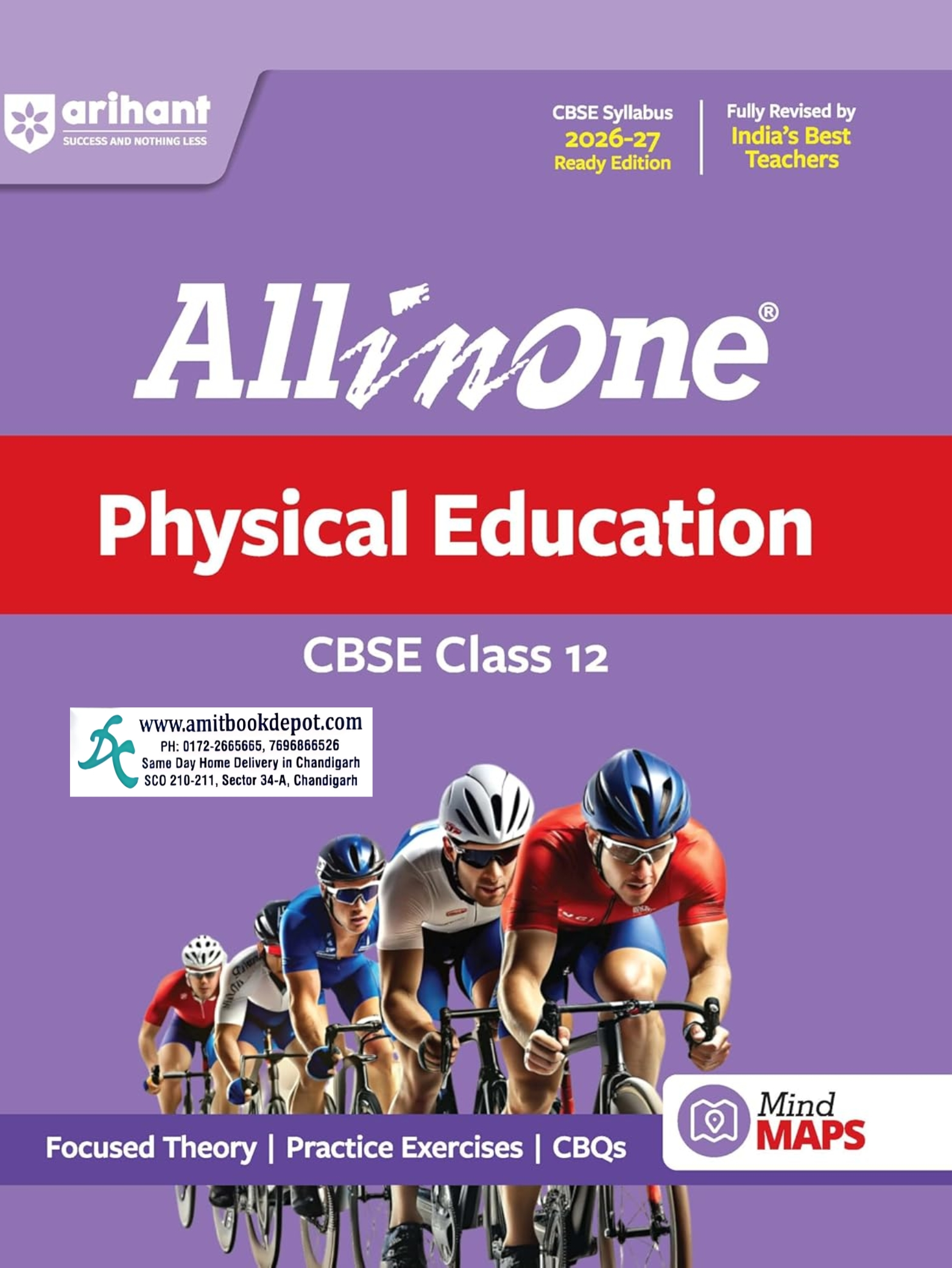
All In One Physical Education CBSE Class 12th 2026

by Madhurima
₹325 ₹350.00(-/ off)

Rating & Reviews

23 Customer Review

"All In One Physical Education CBSE Class 12th 2026" by Arihant Prakashan is the complete guide for CBSE board exams. It thoroughly covers the latest theory syllabus, including sports management, yoga, nutrition, and sports psychology. The book features a dedicated practical section on inclusive sports and fitness tests, along with CBSE Solved Papers 2024 & 2025, Sample Papers, and New Pattern Questions. Designed for concept clarity and exam success, this all-in-one resource is ideal for comprehensive preparation and high scores in physical education.

Have Doubts Regarding This Product ? Ask Your Question

  • Q1
    Does this 2026 edition include the latest CBSE syllabus and the most recent updates to the SAI Khelo India Fitness Test protocols?
    A1

    Yes, the book is meticulously updated for the 2025-26 academic session and includes the complete, latest CBSE syllabus along with the most current protocols for the SAI Khelo India Fitness Test.

  • Q2
    How detailed is the practical section, and does it cover all the games mentioned in the CBSE practical syllabus like Goalball and Unified Sports?
    A2

    The Practical (Part II) is exceptionally detailed, providing rules, setup, adaptations, and playing guidelines for all listed activities, including Bocce, Sitting Volleyball, Wheelchair Basketball, Unified Badminton/Basketball/Football, Blind Cricket, Goalball, Floorball, and Athletics.

  • Q3
    Does the chapter on "Training in Sports" explain Micro, Meso, and Macro cycles in a way that is easy to understand?
    A3

    Absolutely. The book breaks down the concept of sports training cycles (Micro, Meso, Macro) with clear definitions and practical examples, making it easy for students to grasp and apply.

  • Q4
    I struggle with the biomechanics unit. Does this book explain Newton's Laws and Levers with relevant sports examples?
    A4

    Yes, the Biomechanics chapter specifically focuses on applying theoretical concepts like Newton's Laws of Motion, Types of Levers, and Projectiles to real-life sports scenarios, enhancing comprehension.

  • Q5
    Are the corrective measures for common postural deformities (like knock knees, lordosis) illustrated or described step-by-step?
    A5

    Yes, the chapter "Children and Women in Sports" provides detailed descriptive corrective measures and exercises for common postural deformities as per the CBSE syllabus.

  • Q6
    Does the book cover the "Female Athlete Triad" and concepts of inclusion for CWSN (Children with Special Needs) in detail?
    A6

    Yes, it dedicates specific sections to the Female Athlete Triad (osteoporosis, amenorrhea, eating disorders) and has a full chapter on Physical Education for CWSN, covering inclusion, adaptive sports, and organizations like Paralympics and Special Olympics.

  • Q7
    Are the yoga asanas for lifestyle diseases listed with their specific procedures, benefits, and contraindications as per the CBSE syllabus?
    A7

    Yes, Chapter 3 lists each prescribed yoga asana and pranayama for conditions like Obesity, Diabetes, and Asthma with clear points on procedure, benefits, and contraindications.

  • Q8
    Is the calculation for tests like the Harvard Step Test and BMR explained with solved examples?
    A8

    Yes, the "Test and Measurement" chapter provides the formulas and includes step-by-step calculations and examples for the Harvard Step Test, BMR, and other fitness tests.

  • Q9
    Are psychological attributes like self-talk, mental imagery, and goal-setting covered in the Psychology chapter?
    A9

    Yes, the "Psychology and Sports" chapter covers key psychological attributes including self-esteem, mental imagery, self-talk, and goal setting, along with personality theories and motivation.

  • Q10
    Is this book sufficient for self-study without any additional reference material for the CBSE Class 12 Physical Education board exam?
    A10

    "All In One" is designed as a self-contained resource. With its complete theory, practical guide, solved papers, sample papers, and self-assessment tools, it is comprehensively sufficient for thorough board exam preparation.


0.00

0 Overall Rating
  • 5
    0
  • 4
    0
  • 3
    0
  • 2
    0
  • 1
    0

Try this product & share your review & thoughts

PART I THEORY

1. MANAGEMENT OF SPORTING EVENTS

- Functions of Sports Events Management
- Various Committees and Their Responsibilities
- Fixtures and Their Procedures
- Combination Tournaments
- Intramural and Extramural
- Community Sports Programs
- Chapter Practice
- Self-Assessment

2. CHILDREN AND WOMEN IN SPORTS

- Exercise Guidelines at Different Stages of
- Growth and Development
- Common Postural Deformities
- Women’s Participation in Sports
- Special Consideration
- Female Athlete Triad
- Chapter Practice
- Self-Assessment

3. YOGA AS PREVENTIVE MEASURES FOR LIFESTYLE DISEASE

- Yoga
- Obesity
- Diabetes
- Asthma
- Hypertension
- Back Pain and Arthritis
- Chapter Practice
- Self-Assessment

4. PHYSICAL EDUCATION AND SPORTS FOR CWSN

- Adaptive Sports/Disability Sports
- Classification in Sports
- Divisioning in Sports by Special Olympics
- Concept of Inclusion in Sports
- Physical Activities for Children With
- Special Needs (CWSN)
- Chapter Practice
- Self-Assessment

5. SPORTS AND NUTRITION

- Balanced Diet
- Nutrition
- Nutritive and Non-nutritive Components of Diet
- Eating for Weight Control (A Healthy Weight, Pitfalls of Dieting, Food Intolerance & Food Myths)
- Importance of Diet: Pre-, During-, and Post-Competition Requirements
- Chapter Practice
- Self-Assessment

6. TEST AND MEASUREMENT IN SPORTS

- Importance of Test and Measurement in Sports
- Fitness Test - SAI Khelo India Fitness Test in School
- Measurement of Cardiovascular Fitness
- Basal Metabolic Rate (BMR)
- Rikli and Jones - Senior Citizen Fitness Test
- Johnsen-Methney Test of Motor Educability
- Chapter Practice
- Self-Assessment

7. PHYSIOLOGY AND INJURIES IN SPORTS

- Physiological Factors Determining Components of Physical Fitness
- Effects of Exercise
- Physiological Changes due to Aging
- Sports Injuries
- Chapter Practice
- Self-Assessment

8. BIOMECHANICS AND SPORTS

- Newton’s Laws of Motion
- Levers
- Equilibrium
- Friction and Sports
- Projectiles in Sports
- Chapter Practice
- Self-Assessment

9. PSYCHOLOGY AND SPORTS

- Personality
- Motivation
- Exercise Adherence
- Aggression
- Psychological Attributes in Sports
- Chapter Practice
- Self-Assessment

10. TRAINING IN SPORTS

- Talent Identification in Sports
- Talent Development in Sports
- Sports Training Cycles
- Strength
- Endurance
- Speed
- Flexibility
- Coordinative Abilities
- Circuit Training
- Chapter Practice
- Self-Assessment

PART II PRACTICAL

- Brockport Physical Fitness Test
- Game 1: Bocce
- Game 2: Sitting Volleyball
- Game 3 Wheelchair Basketball
- Game 4 Unified Badminton
- Game 5 Unified Basketball
- Game 6 Unified Football (Soccer)
- Game 7 Blind Cricket
- Game 8: Goalball
- Game 9 Floorball
- Game 10 Wheelchair Racing
- Game 11 Wheelchair Throws
- Game 12 Athletics (400 m Track and Field)

CBSE Solved Paper 2024
CBSE Solved Paper 2025
Sample Question Papers
Latest CBSE Sample Paper
New Pattern Questions

Latest Syllabus of Physical Education CBSE Class 12th 2026


THEORY 
Max. Marks: 70

Unit 1: Management of Sporting Events

1. Functions of Sports Events Management (Planning, Organizing, Staffing, Directing & Controlling)
2. Various Committees & Their Responsibilities (pre-, during, & post-)
3. Fixtures and Their Procedures—Knock-Out (Bye & Seeding) & League (Staircase, Cyclic, and Tabular Methods) and Combination Tournaments
4. Intramural & Extramural Tournaments—Meaning, Objectives & Its Significance
5. Community sports program (Sports Day, Health Run, Run for Fun, Run for Specific Cause & Run for Unity)

Unit 2: Children & Women in Sports

1. Exercise guidelines of WHO for different age groups.
2. Common postural deformities: knock knees, flat feet, round shoulders, lordosis, kyphosis, scoliosis, and bow legs and their respective corrective measures.
3. Women’s participation in sports has physical, psychological, and social benefits.
4. Special consideration (menarche and menstrual dysfunction)
5. Female athlete triad (osteoporosis, amenorrhea, eating disorders)

Unit 3: Yoga as a Preventive Measure for Lifestyle Disease

1. Obesity: Procedure, Benefits & Contraindications for Tadasana, Katichakrasana, Pavanmuktasana, Matsayasana, Halasana, Pachimottansana, Ardha–Matsyendrasana, Dhanurasana, Ushtrasana, and Suryabedhan Pranayama.
2. Diabetes: Procedure, Benefits & Contraindications for Katichakrasana, Pavanmuktasana, Bhujangasana, Shalabhasana, Dhanurasana, Supta-vajarasana, Paschimottanasan-a, Ardha-Mastendrasana, Mandukasana, Gomukasana, Yogmudra, Ushtrasana, and Kapalabhati.
3. Asthma: Procedure, Benefits & Contraindications for Tadasana, Urdhwahastottansan a, UttanMandukasan a, Bhujangasana, Dhanurasana, Ushtrasana, Vakrasana, Kapalbhati, Gomukhasana, Matsyaasana, and Anuloma-Viloma.
4. Hypertension: Procedure, Benefits & Contraindications for Tadasana, Katichakransan, Uttanpadasana, Ardha Halasana, Sarala Matyasana, Gomukhasana, Uttan Mandukasan, Vakrasana, Bhujangasana, Makarasana, Shavasana, Nadi-shodhanapranayam, and Sitlipranayam.
5. Back Pain and Arthritis: Procedure, Benefits & Contraindications of Tadasan, Urdhawahastootansana, Ardh-Chakrasana, Ushtrasana, Vakrasana, Sarala Maysyendrsana, Bhujandgasana, Gomukhasana, Bhadrasana, Makarasana, and NadiShodhana pranayama.

Unit 4 Physical Education and Sports for CWSN (Children with Special Needs - Divyang)

1. Organizations promoting disability sports (Special Olympics, Paralympics, Deaflympics)
2. Concept of Classification and Divisioning in Sports.
3. Concept of inclusion in sports, its need, and implementation;
4. Advantages of Physical Activities for Children with Special Needs.
5. Strategies to make physical activities accessible for children with special needs.

Unit 5: Sports & Nutrition

1. Concept of balanced diet and nutrition
2. Macro- and Micronutrients: Food sources & functions
3. Nutritive & Non-Nutritive Components of Diet
4. Eating for Weight Control—A Healthy Weight, The Pitfalls of Dieting, Food Intolerance, and Food Myths
5. Importance of Diet in Sports—Pre-, During, and Post-Competition Requirements

Unit 6: Test & Measurement in Sports

1. Fitness Test – SAI Khelo India Fitness Test in School: Age group 5-8 years/class 1-3: BMI, Flamingo Balance Test, Plate Tapping Test Age group 9-18 years/class 4-12: BMI, 50 mt speed test, 600 mt run/walk, sit & reach flexibility test, strength test (partial abdominal curl-up, push-ups for boys, modified push-ups for girls).
2. Measurement of Cardiovascular Fitness – Harvard Step Test – Duration of the Exercise in Seconds x100/5.5 x Pulse Count of 1-1.5 Min after Exercise.
3. Computing Basal Metabolic Rate (BMR)
4. Rikli & Jones - Senior Citizen Fitness Test
• Chair Stand Test for lower body strength
• Arm Curl Test for upper body strength
• Chair Sit & Reach Test for lower body flexibility
• Back Scratch Test for upper body flexibility
• Eight-Foot Up & Go Test for agility
• Six-Minute Walk Test for Aerobic Endurance
5. Johnsen–Methney Test of Motor Educability (Front Roll, Roll, Jumping Half-Turn, Jumping Full-Turn)

Unit 7: Physiology & Injuries in Sport

1. Physiological factors determining components of physical fitness
2. Effect of exercise on the muscular system
3. Effect of exercise on the cardiorespiratory system
4. Physiological changes due to aging
5. Sports injuries: Classification (Soft Tissue Injuries—Abrasion, Contusion, Laceration, Incision, Sprain & Strain; Bone & Joint Injuries—Dislocation, Fractures—Green Stick, Comminuted, Transverse Oblique & Impacted)

Unit 8: Biomechanics and Sports

1. Newton’s Law of Motion & its application in sports
2. Types of Levers and Their Application in Sports.
3. Equilibrium—Dynamic & Static and Center of Gravity and its application in sports
4. Friction & Sports
5. Projectiles in Sports

Unit 9: Psychology and Sports

1. Personality: its definition & types (Jung Classification & Big Five Theory)
2. Motivation, its type & techniques.
3. Exercise Adherence: Reasons, Benefits & Strategies for Enhancing It
4. Meaning, Concept & Types of Aggressions in Sports
5. Psychological Attributes in Sports—Self-Esteem, Mental Imagery, Self-Talk, Goal Setting

Unit 10: Training in Sports

1. Concept of Talent Identification and Talent Development in Sports
2. Introduction to Sports Training Cycle – Micro, Meso, and Macro Cycles.
3. Types & Methods to Develop – Strength, Endurance, and Speed.
4. Types & Methods to Develop – Flexibility and Coordinative Ability.
5. Circuit Training—Introduction & Its Importance

"All In One Physical Education CBSE Class 12th 2026" by Subhasis Swain, published by Arihant Prakashan, is the definitive and comprehensive guide designed to empower students aiming for academic excellence in the CBSE Class 12 Physical Education board exams. Meticulously crafted to align perfectly with the latest CBSE syllabus and examination pattern, this book serves as an all-encompassing resource, integrating complete theory, practical applications, and extensive practice material into a single, student-friendly volume. It is the ultimate tool for concept clarity, effective revision, and assured success.

The book is strategically divided into two parts: theory and practical. Part I covers the entire CBSE Physical Education theory syllabus across ten exhaustive chapters. Each chapter begins with a lucid explanation of concepts, adhering to the latest NCERT guidelines and CBSE curriculum. Topics such as sports management, yoga for lifestyle diseases, sports nutrition, sports psychology, biomechanics, and training in sports are presented with exceptional clarity. Special focus is given to contemporary and crucial areas like Children and Women in Sports, Physical Education for CWSN (Children with Special Needs—Divyang), and Sports Injuries, ensuring holistic learning. The chapter on Test and Measurement includes detailed protocols for the SAI Khelo India Fitness Test and the Rikli & Jones Senior Citizen Fitness Test, bridging theoretical knowledge with real-world application. Each chapter is fortified with a Chapter Practice section and a Self-Assessment module to reinforce learning and enable self-evaluation.

Uniquely, Part II is dedicated to the CBSE Physical Education practical syllabus, a feature that sets this book apart. It provides detailed guidelines, rules, and adaptations for a wide array of inclusive sports and tests. From the Brockport Physical Fitness Test to practical modules for Bocce, Sitting Volleyball, Wheelchair Basketball, Unified Sports (Badminton, Basketball, and Football), Blind Cricket, Goalball, and Athletics, this section is an invaluable manual for both students and teachers to successfully execute and understand the practical examination components.

A significant portion of the book is devoted to exam preparedness. It includes CBSE solved papers for 2024 and 2025, offering insight into previous years' question trends. Additionally, it features Sample Question Papers and the Latest CBSE Sample Paper formulated as per the updated marking scheme. The inclusion of new pattern questions ensures students are well-versed with HOTS (higher order thinking skills) and application-based questions. This multifaceted approach ensures the book is not just a book but a complete CBSE Class 12 Physical Education guide for board exam preparation.

Keywords such as "solved papers," "sample papers," "chapter-wise practice," "self-assessment," "NCERT-based," "syllabus-oriented," "inclusive sports," "practical guide," and "exam-ready" encapsulate its core utility. "All In One Physical Education CBSE Class 12th 2026" is more than a study aid; it is a strategic partner for students seeking to achieve top scores, fostering a deep understanding of physical education as a science and its vital role in health, sports, and society. Choose this Arihant publication for a structured, thorough, and confident journey towards securing outstanding marks in your CBSE Class 12 Physical Education exam.

PART I THEORY

1. MANAGEMENT OF SPORTING EVENTS

- Functions of Sports Events Management
- Various Committees and Their Responsibilities
- Fixtures and Their Procedures
- Combination Tournaments
- Intramural and Extramural
- Community Sports Programs
- Chapter Practice
- Self-Assessment

2. CHILDREN AND WOMEN IN SPORTS

- Exercise Guidelines at Different Stages of
- Growth and Development
- Common Postural Deformities
- Women’s Participation in Sports
- Special Consideration
- Female Athlete Triad
- Chapter Practice
- Self-Assessment

3. YOGA AS PREVENTIVE MEASURES FOR LIFESTYLE DISEASE

- Yoga
- Obesity
- Diabetes
- Asthma
- Hypertension
- Back Pain and Arthritis
- Chapter Practice
- Self-Assessment

4. PHYSICAL EDUCATION AND SPORTS FOR CWSN

- Adaptive Sports/Disability Sports
- Classification in Sports
- Divisioning in Sports by Special Olympics
- Concept of Inclusion in Sports
- Physical Activities for Children With
- Special Needs (CWSN)
- Chapter Practice
- Self-Assessment

5. SPORTS AND NUTRITION

- Balanced Diet
- Nutrition
- Nutritive and Non-nutritive Components of Diet
- Eating for Weight Control (A Healthy Weight, Pitfalls of Dieting, Food Intolerance & Food Myths)
- Importance of Diet: Pre-, During-, and Post-Competition Requirements
- Chapter Practice
- Self-Assessment

6. TEST AND MEASUREMENT IN SPORTS

- Importance of Test and Measurement in Sports
- Fitness Test - SAI Khelo India Fitness Test in School
- Measurement of Cardiovascular Fitness
- Basal Metabolic Rate (BMR)
- Rikli and Jones - Senior Citizen Fitness Test
- Johnsen-Methney Test of Motor Educability
- Chapter Practice
- Self-Assessment

7. PHYSIOLOGY AND INJURIES IN SPORTS

- Physiological Factors Determining Components of Physical Fitness
- Effects of Exercise
- Physiological Changes due to Aging
- Sports Injuries
- Chapter Practice
- Self-Assessment

8. BIOMECHANICS AND SPORTS

- Newton’s Laws of Motion
- Levers
- Equilibrium
- Friction and Sports
- Projectiles in Sports
- Chapter Practice
- Self-Assessment

9. PSYCHOLOGY AND SPORTS

- Personality
- Motivation
- Exercise Adherence
- Aggression
- Psychological Attributes in Sports
- Chapter Practice
- Self-Assessment

10. TRAINING IN SPORTS

- Talent Identification in Sports
- Talent Development in Sports
- Sports Training Cycles
- Strength
- Endurance
- Speed
- Flexibility
- Coordinative Abilities
- Circuit Training
- Chapter Practice
- Self-Assessment

PART II PRACTICAL

- Brockport Physical Fitness Test
- Game 1: Bocce
- Game 2: Sitting Volleyball
- Game 3 Wheelchair Basketball
- Game 4 Unified Badminton
- Game 5 Unified Basketball
- Game 6 Unified Football (Soccer)
- Game 7 Blind Cricket
- Game 8: Goalball
- Game 9 Floorball
- Game 10 Wheelchair Racing
- Game 11 Wheelchair Throws
- Game 12 Athletics (400 m Track and Field)

CBSE Solved Paper 2024
CBSE Solved Paper 2025
Sample Question Papers
Latest CBSE Sample Paper
New Pattern Questions

Have Doubts Regarding This Product ? Ask Your Question

  • Q1
    Does this 2026 edition include the latest CBSE syllabus and the most recent updates to the SAI Khelo India Fitness Test protocols?
    A1

    Yes, the book is meticulously updated for the 2025-26 academic session and includes the complete, latest CBSE syllabus along with the most current protocols for the SAI Khelo India Fitness Test.

  • Q2
    How detailed is the practical section, and does it cover all the games mentioned in the CBSE practical syllabus like Goalball and Unified Sports?
    A2

    The Practical (Part II) is exceptionally detailed, providing rules, setup, adaptations, and playing guidelines for all listed activities, including Bocce, Sitting Volleyball, Wheelchair Basketball, Unified Badminton/Basketball/Football, Blind Cricket, Goalball, Floorball, and Athletics.

  • Q3
    Does the chapter on "Training in Sports" explain Micro, Meso, and Macro cycles in a way that is easy to understand?
    A3

    Absolutely. The book breaks down the concept of sports training cycles (Micro, Meso, Macro) with clear definitions and practical examples, making it easy for students to grasp and apply.

  • Q4
    I struggle with the biomechanics unit. Does this book explain Newton's Laws and Levers with relevant sports examples?
    A4

    Yes, the Biomechanics chapter specifically focuses on applying theoretical concepts like Newton's Laws of Motion, Types of Levers, and Projectiles to real-life sports scenarios, enhancing comprehension.

  • Q5
    Are the corrective measures for common postural deformities (like knock knees, lordosis) illustrated or described step-by-step?
    A5

    Yes, the chapter "Children and Women in Sports" provides detailed descriptive corrective measures and exercises for common postural deformities as per the CBSE syllabus.

  • Q6
    Does the book cover the "Female Athlete Triad" and concepts of inclusion for CWSN (Children with Special Needs) in detail?
    A6

    Yes, it dedicates specific sections to the Female Athlete Triad (osteoporosis, amenorrhea, eating disorders) and has a full chapter on Physical Education for CWSN, covering inclusion, adaptive sports, and organizations like Paralympics and Special Olympics.

  • Q7
    Are the yoga asanas for lifestyle diseases listed with their specific procedures, benefits, and contraindications as per the CBSE syllabus?
    A7

    Yes, Chapter 3 lists each prescribed yoga asana and pranayama for conditions like Obesity, Diabetes, and Asthma with clear points on procedure, benefits, and contraindications.

  • Q8
    Is the calculation for tests like the Harvard Step Test and BMR explained with solved examples?
    A8

    Yes, the "Test and Measurement" chapter provides the formulas and includes step-by-step calculations and examples for the Harvard Step Test, BMR, and other fitness tests.

  • Q9
    Are psychological attributes like self-talk, mental imagery, and goal-setting covered in the Psychology chapter?
    A9

    Yes, the "Psychology and Sports" chapter covers key psychological attributes including self-esteem, mental imagery, self-talk, and goal setting, along with personality theories and motivation.

  • Q10
    Is this book sufficient for self-study without any additional reference material for the CBSE Class 12 Physical Education board exam?
    A10

    "All In One" is designed as a self-contained resource. With its complete theory, practical guide, solved papers, sample papers, and self-assessment tools, it is comprehensively sufficient for thorough board exam preparation.

Latest Syllabus of Physical Education CBSE Class 12th 2026


THEORY 
Max. Marks: 70

Unit 1: Management of Sporting Events

1. Functions of Sports Events Management (Planning, Organizing, Staffing, Directing & Controlling)
2. Various Committees & Their Responsibilities (pre-, during, & post-)
3. Fixtures and Their Procedures—Knock-Out (Bye & Seeding) & League (Staircase, Cyclic, and Tabular Methods) and Combination Tournaments
4. Intramural & Extramural Tournaments—Meaning, Objectives & Its Significance
5. Community sports program (Sports Day, Health Run, Run for Fun, Run for Specific Cause & Run for Unity)

Unit 2: Children & Women in Sports

1. Exercise guidelines of WHO for different age groups.
2. Common postural deformities: knock knees, flat feet, round shoulders, lordosis, kyphosis, scoliosis, and bow legs and their respective corrective measures.
3. Women’s participation in sports has physical, psychological, and social benefits.
4. Special consideration (menarche and menstrual dysfunction)
5. Female athlete triad (osteoporosis, amenorrhea, eating disorders)

Unit 3: Yoga as a Preventive Measure for Lifestyle Disease

1. Obesity: Procedure, Benefits & Contraindications for Tadasana, Katichakrasana, Pavanmuktasana, Matsayasana, Halasana, Pachimottansana, Ardha–Matsyendrasana, Dhanurasana, Ushtrasana, and Suryabedhan Pranayama.
2. Diabetes: Procedure, Benefits & Contraindications for Katichakrasana, Pavanmuktasana, Bhujangasana, Shalabhasana, Dhanurasana, Supta-vajarasana, Paschimottanasan-a, Ardha-Mastendrasana, Mandukasana, Gomukasana, Yogmudra, Ushtrasana, and Kapalabhati.
3. Asthma: Procedure, Benefits & Contraindications for Tadasana, Urdhwahastottansan a, UttanMandukasan a, Bhujangasana, Dhanurasana, Ushtrasana, Vakrasana, Kapalbhati, Gomukhasana, Matsyaasana, and Anuloma-Viloma.
4. Hypertension: Procedure, Benefits & Contraindications for Tadasana, Katichakransan, Uttanpadasana, Ardha Halasana, Sarala Matyasana, Gomukhasana, Uttan Mandukasan, Vakrasana, Bhujangasana, Makarasana, Shavasana, Nadi-shodhanapranayam, and Sitlipranayam.
5. Back Pain and Arthritis: Procedure, Benefits & Contraindications of Tadasan, Urdhawahastootansana, Ardh-Chakrasana, Ushtrasana, Vakrasana, Sarala Maysyendrsana, Bhujandgasana, Gomukhasana, Bhadrasana, Makarasana, and NadiShodhana pranayama.

Unit 4 Physical Education and Sports for CWSN (Children with Special Needs - Divyang)

1. Organizations promoting disability sports (Special Olympics, Paralympics, Deaflympics)
2. Concept of Classification and Divisioning in Sports.
3. Concept of inclusion in sports, its need, and implementation;
4. Advantages of Physical Activities for Children with Special Needs.
5. Strategies to make physical activities accessible for children with special needs.

Unit 5: Sports & Nutrition

1. Concept of balanced diet and nutrition
2. Macro- and Micronutrients: Food sources & functions
3. Nutritive & Non-Nutritive Components of Diet
4. Eating for Weight Control—A Healthy Weight, The Pitfalls of Dieting, Food Intolerance, and Food Myths
5. Importance of Diet in Sports—Pre-, During, and Post-Competition Requirements

Unit 6: Test & Measurement in Sports

1. Fitness Test – SAI Khelo India Fitness Test in School: Age group 5-8 years/class 1-3: BMI, Flamingo Balance Test, Plate Tapping Test Age group 9-18 years/class 4-12: BMI, 50 mt speed test, 600 mt run/walk, sit & reach flexibility test, strength test (partial abdominal curl-up, push-ups for boys, modified push-ups for girls).
2. Measurement of Cardiovascular Fitness – Harvard Step Test – Duration of the Exercise in Seconds x100/5.5 x Pulse Count of 1-1.5 Min after Exercise.
3. Computing Basal Metabolic Rate (BMR)
4. Rikli & Jones - Senior Citizen Fitness Test
• Chair Stand Test for lower body strength
• Arm Curl Test for upper body strength
• Chair Sit & Reach Test for lower body flexibility
• Back Scratch Test for upper body flexibility
• Eight-Foot Up & Go Test for agility
• Six-Minute Walk Test for Aerobic Endurance
5. Johnsen–Methney Test of Motor Educability (Front Roll, Roll, Jumping Half-Turn, Jumping Full-Turn)

Unit 7: Physiology & Injuries in Sport

1. Physiological factors determining components of physical fitness
2. Effect of exercise on the muscular system
3. Effect of exercise on the cardiorespiratory system
4. Physiological changes due to aging
5. Sports injuries: Classification (Soft Tissue Injuries—Abrasion, Contusion, Laceration, Incision, Sprain & Strain; Bone & Joint Injuries—Dislocation, Fractures—Green Stick, Comminuted, Transverse Oblique & Impacted)

Unit 8: Biomechanics and Sports

1. Newton’s Law of Motion & its application in sports
2. Types of Levers and Their Application in Sports.
3. Equilibrium—Dynamic & Static and Center of Gravity and its application in sports
4. Friction & Sports
5. Projectiles in Sports

Unit 9: Psychology and Sports

1. Personality: its definition & types (Jung Classification & Big Five Theory)
2. Motivation, its type & techniques.
3. Exercise Adherence: Reasons, Benefits & Strategies for Enhancing It
4. Meaning, Concept & Types of Aggressions in Sports
5. Psychological Attributes in Sports—Self-Esteem, Mental Imagery, Self-Talk, Goal Setting

Unit 10: Training in Sports

1. Concept of Talent Identification and Talent Development in Sports
2. Introduction to Sports Training Cycle – Micro, Meso, and Macro Cycles.
3. Types & Methods to Develop – Strength, Endurance, and Speed.
4. Types & Methods to Develop – Flexibility and Coordinative Ability.
5. Circuit Training—Introduction & Its Importance

0.00

0 Overall Rating
  • 5
    0
  • 4
    0
  • 3
    0
  • 2
    0
  • 1
    0

Try this product & share your review & thoughts

Top Trending Product

Related Product

Related Product

Related Blog Posts

Latest Blogs

Latest Blogs

blog-img
Classic Literature Reimagined: Discuss modern twists on classic novels.
Lorem ipsum dolor sit amet, consectetur adipiscing elit, sed do eiusmod tempor incididunt ut labore et dolore magna aliqua. Ut enim ad minim veniam, quis nostrud exercitation ullamco Lorem ipsum dolor sit amet, consectetur adipiscing elit, sed do eiusmod tempor incididunt ut labore et dolore magna aliqua. Utenim ad minim veniam, quis nostrud exercitation ullamco Lorem ipsum dolor sit amet, consecte...
Read more
Author name | 10 jan, 2025
blog-img
Classic Literature Reimagined: Discuss modern twists on classic novels.
Lorem ipsum dolor sit amet, consectetur adipiscing elit, sed do eiusmod tempor incididunt ut labore et dolore magna aliqua. Ut enim ad minim veniam, quis nostrud exercitation ullamco Lorem ipsum dolor sit amet, consectetur adipiscing elit, sed do eiusmod tempor incididunt ut labore et dolore magna aliqua. Utenim ad minim veniam, quis nostrud exercitation ullamco Lorem ipsum dolor sit amet, consecte...
Read more
Author name | 10 jan, 2025
blog-img
Classic Literature Reimagined: Discuss modern twists on classic novels.
Lorem ipsum dolor sit amet, consectetur adipiscing elit, sed do eiusmod tempor incididunt ut labore et dolore magna aliqua. Ut enim ad minim veniam, quis nostrud exercitation ullamco Lorem ipsum dolor sit amet, consectetur adipiscing elit, sed do eiusmod tempor incididunt ut labore et dolore magna aliqua. Utenim ad minim veniam, quis nostrud exercitation ullamco Lorem ipsum dolor sit amet, consecte...
Read more
Author name | 10 jan, 2025
blog-img
Classic Literature Reimagined: Discuss modern twists on classic novels.
Lorem ipsum dolor sit amet, consectetur adipiscing elit...
Read more
Author Name | 10 Jan, 2025
blog-img
Classic Literature Reimagined: Discuss modern twists on classic novels.
Lorem ipsum dolor sit amet, consectetur adipiscing elit...
Read more
Author Name | 10 Jan, 2025
blog-img
Classic Literature Reimagined: Discuss modern twists on classic novels.
Lorem ipsum dolor sit amet, consectetur adipiscing elit...
Read more
Author Name | 10 Jan, 2025
blog-img
Classic Literature Reimagined: Discuss modern twists on classic novels.
Lorem ipsum dolor sit amet, consectetur adipiscing elit...
Read more
Author Name | 10 Jan, 2025
blog-img
Classic Literature Reimagined: Discuss modern twists on classic novels.
Lorem ipsum dolor sit amet, consectetur adipiscing elit...
Read more
Author Name | 10 Jan, 2025
blog-img
Classic Literature Reimagined: Discuss modern twists on classic novels.
Lorem ipsum dolor sit amet, consectetur adipiscing elit...
Read more
Author Name | 10 Jan, 2025
blog-img
Classic Literature Reimagined: Discuss modern twists on classic novels.
Lorem ipsum dolor sit amet, consectetur adipiscing elit...
Read more
Author Name | 10 Jan, 2025
blog-img
Classic Literature Reimagined: Discuss modern twists on classic novels.
Lorem ipsum dolor sit amet, consectetur adipiscing elit...
Read more
Author Name | 10 Jan, 2025
blog-img
Classic Literature Reimagined: Discuss modern twists on classic novels.
Lorem ipsum dolor sit amet, consectetur adipiscing elit...
Read more
Author Name | 10 Jan, 2025