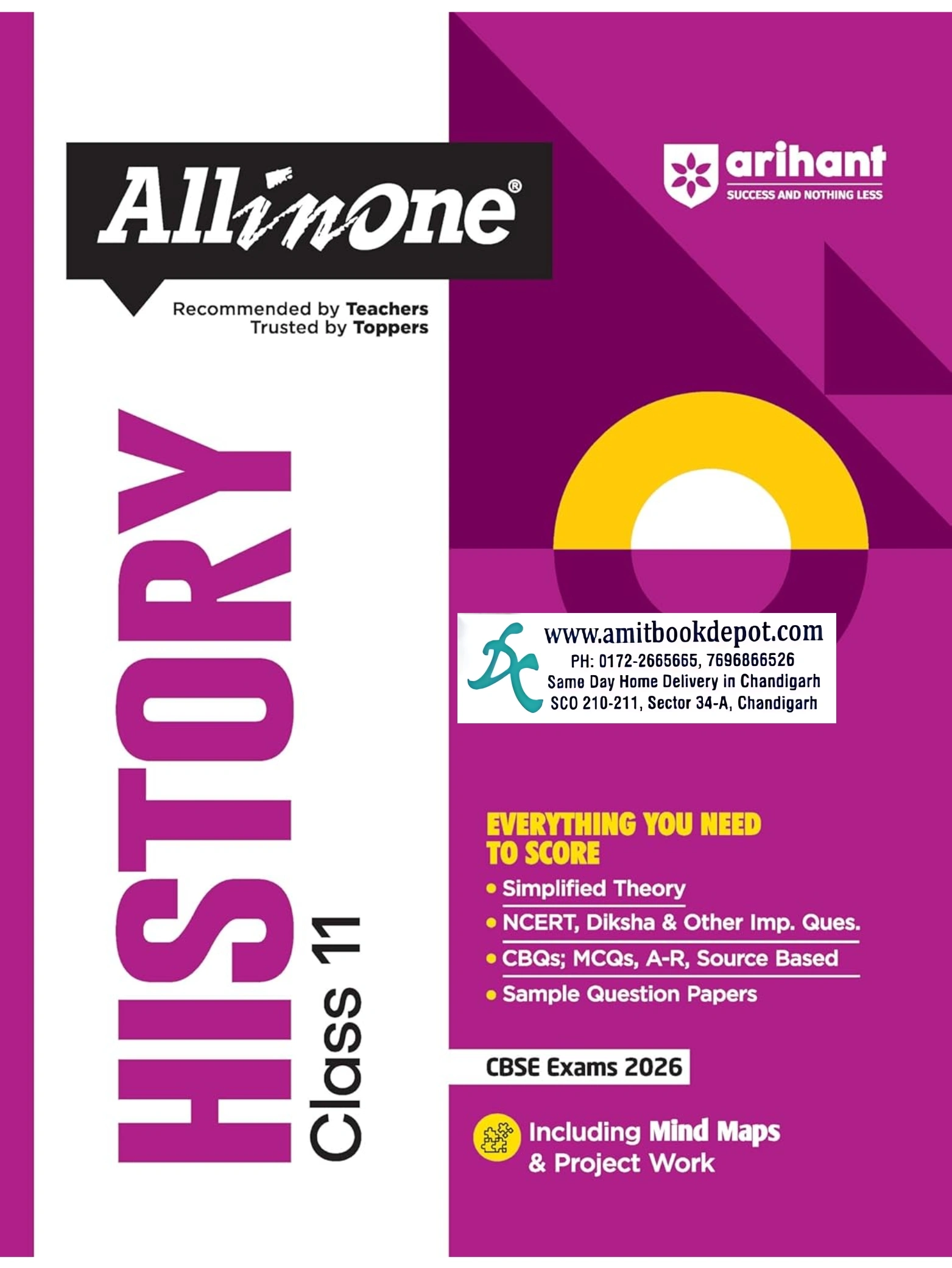
All in One History CBSE Class 11th by Arihant Prakashan is the ultimate 2025-26 guide for complete syllabus mastery. Aligned with the latest NCERT and CBSE patterns, it covers all themes—from Early Societies and Empires to Changing Traditions and Modernization. Each chapter features clear explanations, mind maps, NCERT highlights, exam-pattern questions, and self-assessment tests. With solved sample papers and project work, it provides comprehensive exam preparation. This book is the indispensable CBSE Class 11 History guide for building strong concepts and achieving high scores in board exams.
Master the vast panorama of world history and excel in your CBSE Class 11 examinations with All in One History for Class 11th by Arihant Prakashan. Specifically crafted for the 2025-26 academic session, this comprehensive guidebook by Charu Tripathi is your definitive, one-stop solution for achieving academic success. Meticulously aligned with the latest NCERT syllabus and CBSE curriculum, this book seamlessly integrates detailed theory, strategic exam preparation tools, and extensive practice material, ensuring a complete command over the subject.
The book is strategically structured into four thematic sections, mirroring the CBSE Class 11 History syllabus: Early Societies, Empires, Changing Traditions, and Paths to Modernization. This logical progression helps students build a coherent understanding of global historical developments, from the emergence of writing in Mesopotamia to the complex processes of modernization in China and Japan. Each chapter begins with a clear, lucid explanation of concepts, breaking down complex historical events, such as the Roman Empire across three continents or the social dynamics of Feudalism and the Three Orders, into easily digestible segments. This foundational knowledge is crucial for both school exams and competitive understanding.
Beyond mere textual content, this CBSE History guide is engineered for effective learning and high-score achievement. Each chapter features a Mind Map that visually summarizes key themes, aiding in quick revision and retention of chronological events and their interlinkages. The dedicated NCERT Folder section within every chapter provides a focused review of the NCERT book’s content, ensuring no line from the prescribed syllabus is overlooked. To transition from learning to application, the book offers a robust collection of Exam Pattern Questions, including Very Short, Short, and Long Answer Type Questions, tailored to the latest CBSE marking scheme and paper design. This practice is essential for mastering History exam preparation.
A unique feature designed for self-evaluation is the Self-Assessment Test at the end of each chapter. This allows students to gauge their understanding, identify areas of weakness, and consolidate their learning before moving forward. The book concludes with a Project Work section to assist in practical assignments and a set of three Solved Sample Question Papers modeled exactly on the CBSE blueprint. These papers provide essential practice in time management and familiarize students with the final exam’s format, question typology, and difficulty level, building confidence and exam readiness.
Published by Arihant Prakashan, a trusted name in educational publishing, this book stands out as the perfect blend of depth and exam-centric approach. It is more than just a book; it is a complete study package for Class 11 History. Whether you aim to build a strong conceptual foundation, excel in your school unit tests, or secure top marks in the CBSE board exams, All in One History CBSE Class 11th is your indispensable companion. Invest in this best-selling History book for Class 11 to navigate the fascinating journey of world history with clarity, confidence, and competence.
Is this Arihant All in One History book fully updated for the CBSE Class 11 2025-26 academic session?
A1
Yes, this edition is meticulously revised and updated to align perfectly with the latest CBSE syllabus and exam pattern for the 2025-26 session.
Q2
How does the "Mind Map" feature in each chapter aid in studying history?
A2
The Mind Maps provide a visual summary of key events, concepts, and chronologies, enabling quick revision, better retention of interconnected themes, and a clear overview of the entire chapter.
Q3
How can the "Self-Assessment Test" at the end of each chapter help me?
A3
These tests allow you to evaluate your understanding immediately after studying a chapter, helping you identify weak areas and solidify your grasp of the concepts before proceeding.
Q4
Is the Project Work section helpful for completing school assignments?
A4
Absolutely. The Project Work section offers guidance, ideas, and a framework to help you successfully complete and present your history project as required by CBSE.
Q5
Does the book cover all four sections of the Class 11 History syllabus (Early Societies, Empires, etc.)?
A5
Yes, it comprehensively covers all four sections and their respective themes, including Writing and City Life, Nomadic Empires, The Three Orders, and Paths to Modernization.
Q6
Can I use this book as my primary study material, replacing the NCERT textbook?
A6
This book is designed to be a comprehensive companion. It includes and explains all NCERT content within its "NCERT Folder," but we recommend using it alongside the official NCERT textbook for complete coverage.
Q7
How is the chapter on "An Empire Across Three Continents" structured to simplify such a vast topic?
A7
The chapter is broken into logical sub-themes like geography, society, economy, and phases of the empire, with timelines and mind maps to simplify the vast chronology and scope.
Q8
Does it include content on non-European histories, like Japan and China's modernization?
A8
Yes, Section D ("Paths to Modernization") provides detailed coverage of the distinct modernization journeys of Japan and China, as per the CBSE syllabus.
Q9
Is this book useful for competitive exams that have history sections, or is it only for CBSE boards?
A9
While it is specifically tailored for the CBSE curriculum, the strong conceptual clarity it provides can serve as a valuable foundation for various competitive examinations that include world history.
Q10
What makes this "All in One" book different from other regular CBSE History guides in the market?
A10
Its unique integrated approach combines simplified theory, visual mind maps, focused NCERT content, chapter-wise self-tests, and full-length sample papers—all in a single, student-centric resource, making it a complete study and revision package.
0.00
0 Overall Rating
5
0
4
0
3
0
2
0
1
0
Try this product & share your review &
thoughts
SECTION A: EARLY SOCIETIES
1. Writing and City Life
- Mesopotamia
- Urbanism in Mesopotamia
- Life in the City
- The Development of Writing
- Mind Map
- NCERT Folder
- Exam Pattern Questions
- Self-Assessment Test
SECTION B: EMPIRES
2. An Empire Across Three Continents
- Archaeological Sources of the Roman Empire
- Geography of the Roman Empire
- Phases of the Roman Empire
- Early Roman Society
- Economy of Early Roman Empire
- Late Roman Empire (Late Antiquity)
- Mind Map
- NCERT Folder
- Exam Pattern Questions
- Self-Assessment Test
3. Nomadic Empires
- Sources of History About Mongols
- Mongols
- Genghis Khan
- Mongols after Genghis Khan
- The Mongols in World History
- Mind Map
- NCERT Folder
- Exam Pattern Questions
- Self-Assessment Test
SECTION C: CHANGING TRADITIONS
4. The Three Orders
- Sources of Medieval European Society
- An Introduction to Feudalism
- The Three Orders
- Social and Economic Relations between People of Three Orders
- The Crisis of the 14th Century
- The Evolution of French and English Governments
- Mind Map
- NCERT Folder
- Exam Pattern Questions
- Self-Assessment Test
5. Changing Cultural Traditions
- Sources of History about Changes That Occurred in Europe
- The Revival of Italian Cities
- Universities and Humanism
- The Arab’s Contribution to Science and Philosophy
- Architecture: Paintings, Sculptors, Relief
- The First Printed Books in Europe
- A New Concept of Human Beings
- The Copernican Revolution
- European Renaissance in the Fourteenth Century
- Mind Map
- NCERT Folder
- Exam Pattern Questions
- Self-Assessment Test
SECTION D: PATHS TO MODERNIZATION
6. Displacing Indigenous Peoples
- History of American and Australian Natives
- European Imperialism
- North America
- Australia
- The Winds of Change
- Mind Map
- NCERT Folder
- Exam Pattern Questions
- Self-Assessment Test
7. Paths of Modernization
- History of Japan and China
- Japan
- China
- Modernization in Japan and China
- The Story of Taiwan
- The Story of Korea
- Mind Map
- NCERT Folder
- Exam Pattern Questions
- Self-Assessment Test
Project Work
Sample Question Papers (1-3)
Latest CBSE Syllabus for Class 11 History
Rationalization of Content in the Textbooks: On Reading World History
An introduction to understanding the methodology of studying world history and the importance of critical analysis of historical narratives.
Section I: Early Societies
Introduction: Overview of early human societies and their development.
Timeline I (6 MYA to 1 BCE): Key milestones in the evolution of early civilizations.
Theme 1: Writing and City Life: Exploration of the emergence of writing, urbanization, and their impacts on social organization and culture.
Section II: Empires
Introduction: Discussion on the rise and significance of empires in shaping history.
Timeline II (c. 100 BCE to 1300 CE): Significant chronological events related to empires.
Theme 2: An Empire Across Three Continents: An analysis of a major empire's influence across Africa, Asia, and Europe.
Theme 3: Nomadic Empires: Examination of nomadic societies and their contributions to world history.
Section III: Changing Traditions
Introduction: Insights into the evolution of cultural and social traditions.
Timeline III (c. 1300 to 1700): Important developments during this transformative period.
Theme 4: The Three Orders: Study of social hierarchies and common societal structures.
Theme 5: Changing Cultural Traditions: Exploration of shifts in cultural practices and beliefs.
Section IV: Towards Modernization
Introduction: The transition from traditional societies to modernity.
Timeline IV (c. 1700 to 2000): Major events that propelled modernization.
Theme 6: Displacing Indigenous Peoples: A critical look at colonialism and its effects on indigenous populations.
Theme 7: Paths to Modernization: Various routes nations took towards modernization, examining both successes and challenges.
Conclusion: A synthesis of the themes discussed and reflection on their implications for understanding contemporary global issues.
Master the vast panorama of world history and excel in your CBSE Class 11 examinations with All in One History for Class 11th by Arihant Prakashan. Specifically crafted for the 2025-26 academic session, this comprehensive guidebook by Charu Tripathi is your definitive, one-stop solution for achieving academic success. Meticulously aligned with the latest NCERT syllabus and CBSE curriculum, this book seamlessly integrates detailed theory, strategic exam preparation tools, and extensive practice material, ensuring a complete command over the subject.
The book is strategically structured into four thematic sections, mirroring the CBSE Class 11 History syllabus: Early Societies, Empires, Changing Traditions, and Paths to Modernization. This logical progression helps students build a coherent understanding of global historical developments, from the emergence of writing in Mesopotamia to the complex processes of modernization in China and Japan. Each chapter begins with a clear, lucid explanation of concepts, breaking down complex historical events, such as the Roman Empire across three continents or the social dynamics of Feudalism and the Three Orders, into easily digestible segments. This foundational knowledge is crucial for both school exams and competitive understanding.
Beyond mere textual content, this CBSE History guide is engineered for effective learning and high-score achievement. Each chapter features a Mind Map that visually summarizes key themes, aiding in quick revision and retention of chronological events and their interlinkages. The dedicated NCERT Folder section within every chapter provides a focused review of the NCERT book’s content, ensuring no line from the prescribed syllabus is overlooked. To transition from learning to application, the book offers a robust collection of Exam Pattern Questions, including Very Short, Short, and Long Answer Type Questions, tailored to the latest CBSE marking scheme and paper design. This practice is essential for mastering History exam preparation.
A unique feature designed for self-evaluation is the Self-Assessment Test at the end of each chapter. This allows students to gauge their understanding, identify areas of weakness, and consolidate their learning before moving forward. The book concludes with a Project Work section to assist in practical assignments and a set of three Solved Sample Question Papers modeled exactly on the CBSE blueprint. These papers provide essential practice in time management and familiarize students with the final exam’s format, question typology, and difficulty level, building confidence and exam readiness.
Published by Arihant Prakashan, a trusted name in educational publishing, this book stands out as the perfect blend of depth and exam-centric approach. It is more than just a book; it is a complete study package for Class 11 History. Whether you aim to build a strong conceptual foundation, excel in your school unit tests, or secure top marks in the CBSE board exams, All in One History CBSE Class 11th is your indispensable companion. Invest in this best-selling History book for Class 11 to navigate the fascinating journey of world history with clarity, confidence, and competence.
SECTION A: EARLY SOCIETIES
1. Writing and City Life
- Mesopotamia
- Urbanism in Mesopotamia
- Life in the City
- The Development of Writing
- Mind Map
- NCERT Folder
- Exam Pattern Questions
- Self-Assessment Test
SECTION B: EMPIRES
2. An Empire Across Three Continents
- Archaeological Sources of the Roman Empire
- Geography of the Roman Empire
- Phases of the Roman Empire
- Early Roman Society
- Economy of Early Roman Empire
- Late Roman Empire (Late Antiquity)
- Mind Map
- NCERT Folder
- Exam Pattern Questions
- Self-Assessment Test
3. Nomadic Empires
- Sources of History About Mongols
- Mongols
- Genghis Khan
- Mongols after Genghis Khan
- The Mongols in World History
- Mind Map
- NCERT Folder
- Exam Pattern Questions
- Self-Assessment Test
SECTION C: CHANGING TRADITIONS
4. The Three Orders
- Sources of Medieval European Society
- An Introduction to Feudalism
- The Three Orders
- Social and Economic Relations between People of Three Orders
- The Crisis of the 14th Century
- The Evolution of French and English Governments
- Mind Map
- NCERT Folder
- Exam Pattern Questions
- Self-Assessment Test
5. Changing Cultural Traditions
- Sources of History about Changes That Occurred in Europe
- The Revival of Italian Cities
- Universities and Humanism
- The Arab’s Contribution to Science and Philosophy
Is this Arihant All in One History book fully updated for the CBSE Class 11 2025-26 academic session?
A1
Yes, this edition is meticulously revised and updated to align perfectly with the latest CBSE syllabus and exam pattern for the 2025-26 session.
Q2
How does the "Mind Map" feature in each chapter aid in studying history?
A2
The Mind Maps provide a visual summary of key events, concepts, and chronologies, enabling quick revision, better retention of interconnected themes, and a clear overview of the entire chapter.
Q3
How can the "Self-Assessment Test" at the end of each chapter help me?
A3
These tests allow you to evaluate your understanding immediately after studying a chapter, helping you identify weak areas and solidify your grasp of the concepts before proceeding.
Q4
Is the Project Work section helpful for completing school assignments?
A4
Absolutely. The Project Work section offers guidance, ideas, and a framework to help you successfully complete and present your history project as required by CBSE.
Q5
Does the book cover all four sections of the Class 11 History syllabus (Early Societies, Empires, etc.)?
A5
Yes, it comprehensively covers all four sections and their respective themes, including Writing and City Life, Nomadic Empires, The Three Orders, and Paths to Modernization.
Q6
Can I use this book as my primary study material, replacing the NCERT textbook?
A6
This book is designed to be a comprehensive companion. It includes and explains all NCERT content within its "NCERT Folder," but we recommend using it alongside the official NCERT textbook for complete coverage.
Q7
How is the chapter on "An Empire Across Three Continents" structured to simplify such a vast topic?
A7
The chapter is broken into logical sub-themes like geography, society, economy, and phases of the empire, with timelines and mind maps to simplify the vast chronology and scope.
Q8
Does it include content on non-European histories, like Japan and China's modernization?
A8
Yes, Section D ("Paths to Modernization") provides detailed coverage of the distinct modernization journeys of Japan and China, as per the CBSE syllabus.
Q9
Is this book useful for competitive exams that have history sections, or is it only for CBSE boards?
A9
While it is specifically tailored for the CBSE curriculum, the strong conceptual clarity it provides can serve as a valuable foundation for various competitive examinations that include world history.
Q10
What makes this "All in One" book different from other regular CBSE History guides in the market?
A10
Its unique integrated approach combines simplified theory, visual mind maps, focused NCERT content, chapter-wise self-tests, and full-length sample papers—all in a single, student-centric resource, making it a complete study and revision package.
Latest CBSE Syllabus for Class 11 History
Rationalization of Content in the Textbooks: On Reading World History
An introduction to understanding the methodology of studying world history and the importance of critical analysis of historical narratives.
Section I: Early Societies
Introduction: Overview of early human societies and their development.
Timeline I (6 MYA to 1 BCE): Key milestones in the evolution of early civilizations.
Theme 1: Writing and City Life: Exploration of the emergence of writing, urbanization, and their impacts on social organization and culture.
Section II: Empires
Introduction: Discussion on the rise and significance of empires in shaping history.
Timeline II (c. 100 BCE to 1300 CE): Significant chronological events related to empires.
Theme 2: An Empire Across Three Continents: An analysis of a major empire's influence across Africa, Asia, and Europe.
Theme 3: Nomadic Empires: Examination of nomadic societies and their contributions to world history.
Section III: Changing Traditions
Introduction: Insights into the evolution of cultural and social traditions.
Timeline III (c. 1300 to 1700): Important developments during this transformative period.
Theme 4: The Three Orders: Study of social hierarchies and common societal structures.
Theme 5: Changing Cultural Traditions: Exploration of shifts in cultural practices and beliefs.
Section IV: Towards Modernization
Introduction: The transition from traditional societies to modernity.
Timeline IV (c. 1700 to 2000): Major events that propelled modernization.
Theme 6: Displacing Indigenous Peoples: A critical look at colonialism and its effects on indigenous populations.
Theme 7: Paths to Modernization: Various routes nations took towards modernization, examining both successes and challenges.
Conclusion: A synthesis of the themes discussed and reflection on their implications for understanding contemporary global issues.
0.00
0 Overall Rating
5
0
4
0
3
0
2
0
1
0
Try this product & share your review &
thoughts
Top Trending Product
Related
Product
Related Product
Related Blog Posts
Latest Blogs
Latest Blogs
Classic Literature Reimagined: Discuss modern twists on classic novels.
Lorem ipsum dolor sit amet, consectetur adipiscing elit, sed
do
eiusmod tempor incididunt ut labore et dolore magna aliqua. Ut enim ad minim
veniam, quis nostrud exercitation ullamco Lorem ipsum dolor sit amet,
consectetur adipiscing elit, sed do eiusmod tempor incididunt ut labore et
dolore magna aliqua. Utenim ad minim veniam, quis nostrud exercitation
ullamco
Lorem ipsum dolor sit amet, consecte...
Classic Literature Reimagined: Discuss modern twists on classic novels.
Lorem ipsum dolor sit amet, consectetur adipiscing elit, sed
do
eiusmod tempor incididunt ut labore et dolore magna aliqua. Ut enim ad minim
veniam, quis nostrud exercitation ullamco Lorem ipsum dolor sit amet,
consectetur adipiscing elit, sed do eiusmod tempor incididunt ut labore et
dolore magna aliqua. Utenim ad minim veniam, quis nostrud exercitation
ullamco
Lorem ipsum dolor sit amet, consecte...
Classic Literature Reimagined: Discuss modern twists on classic novels.
Lorem ipsum dolor sit amet, consectetur adipiscing elit, sed
do
eiusmod tempor incididunt ut labore et dolore magna aliqua. Ut enim ad minim
veniam, quis nostrud exercitation ullamco Lorem ipsum dolor sit amet,
consectetur adipiscing elit, sed do eiusmod tempor incididunt ut labore et
dolore magna aliqua. Utenim ad minim veniam, quis nostrud exercitation
ullamco
Lorem ipsum dolor sit amet, consecte...