-
Mon-Fri: 10AM to 8PM 01722665665
-
My Account
-
-
0
Total :
₹ 0.00

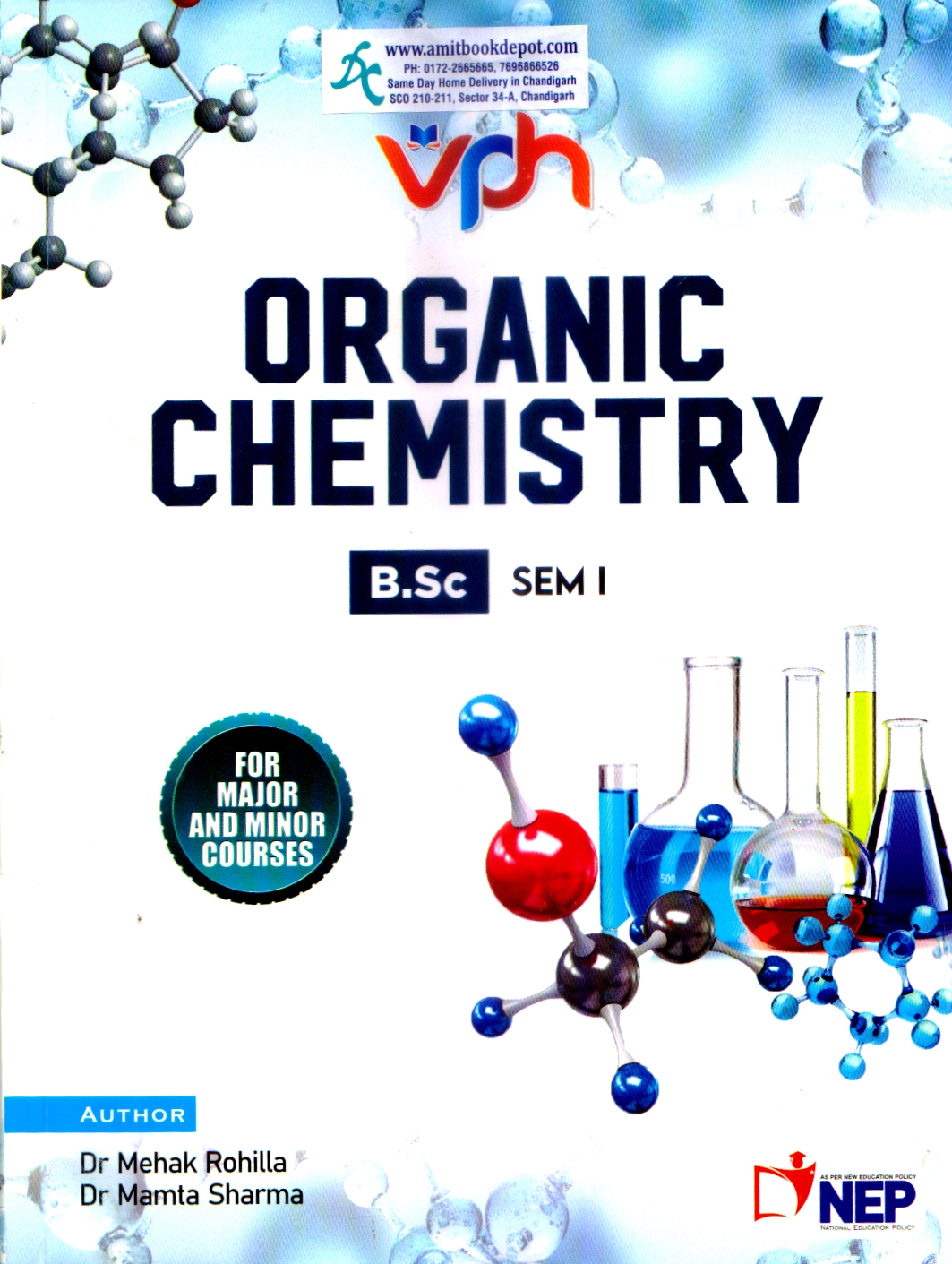
Dive into the world of organic compounds with Organic Chemistry by Mehak Rohilla and Mamta Sharma, an essential textbook for BSc 1st Year Semester 1 students at Punjab University, Chandigarh. Published by Vohra Publishing House, this book offers a clear exploration of fundamental concepts like molecular structure, bonding, and reaction mechanisms, making complex topics accessible and engaging. With practical examples and illustrations, it enhances understanding and facilitates retention. Perfect for students seeking to excel in their studies, this resource equips you with the knowledge needed for exams and future courses.
The book provides a comprehensive understanding of organic chemistry, covering fundamental concepts like molecular structure, bonding, and reaction mechanisms, making complex topics accessible and engaging for BSc 1st Year Semester 1 students at Punjab University, Chandigarh.
The "Organic Chemistry" book is authored by Mehak Rohilla and Mamta Sharma, experienced educators who bring a wealth of knowledge and expertise to the subject.
Yes, the book is designed to align with the NEP, ensuring that its content is relevant and up-to-date with current educational standards.
Unit I covers structure and bonding, including hybridization, bond lengths and angles, localized and delocalized chemical bonds, and resonance.
Understanding intermediate species is pivotal in mastering reaction mechanisms, as it helps predict how and why reactions occur.
The book provides an in-depth exploration of these concepts, including their importance in drug design, materials science, and biological systems.
Unit III covers optical isomerism, including elements of symmetry, molecular chirality, enantiomers, stereogenic center, optical activity, and properties of enantiomers.
The book explains configuration using relative and absolute configuration, sequence rules, D & L and R & S systems of nomenclature.
Unit IV covers geometric isomerism, conformational isomerism, including conformational analysis of ethane and n-butane, conformations of cyclohexane, axial and equatorial bonds.
Absolutely! With its structured content and engaging explanations, "Organic Chemistry" is suitable for both classroom learning and independent study.
1.Structure and Bonding
2.Reactive intermediates
3.Geometrical and conformational isomerism
Embark on an exciting journey into the realm of organic chemistry with "Organic Chemistry," authored by the esteemed Mehak Rohilla and Mamta Sharma. This meticulously crafted textbook is an essential resource for BSc 1st Year Semester 1 students at Punjab University, Chandigarh, providing the foundational knowledge necessary to grasp the complexities of organic compounds and their interactions. Published by Vohra Publishing House, this book aligns with the National Education Policy (NEP), ensuring that its content is relevant and up-to-date with current educational standards.
Organic chemistry is more than just a subject; it is the backbone of numerous scientific disciplines, including biochemistry, pharmacology, and environmental science. This textbook serves to demystify the intricate world of organic reactions and molecular structures, equipping students with the tools and understanding needed to excel in their academic journeys. The authors bring a wealth of knowledge and experience, presenting information in a manner that is both accessible and engaging, which is particularly beneficial for first-year students navigating this complex field.
One of the standout features of “Organic Chemistry” is the detailed exploration of the fundamental principles of structure and bonding. Learning about how atoms connect through various types of bonds—such as ionic, covalent, and metallic—is essential for students to develop a robust understanding of molecular behavior. The text breaks down these concepts into digestible sections, using diagrams and illustrations to enhance comprehension, making it easier for students to visualize molecular interactions and the three-dimensional nature of molecules.
The book also delves into the critical concept of reactive intermediates. Understanding intermediate species is pivotal in mastering reaction mechanisms, as it helps students predict how and why reactions occur. The authors provide a wealth of examples and exercises designed to reinforce these concepts, allowing students to practice and internalize their learning. By the end of this section, students will be equipped to analyze reactions and articulate the underlying processes that govern them.
Another significant area covered in the book is geometrical and conformational isomerism. These concepts are vital for comprehending how the arrangement of atoms affects a compound's properties and reactivity. The in-depth coverage of this topic helps students appreciate the importance of isomerism in the real world, including its implications in drug design, materials science, and biological systems. By integrating real-life applications with theoretical concepts, the authors make the subject matter relatable and intriguing.
As you search for "BSc 1st year semester 1 Vohra Organic Chemistry" or seek to augment your studies with additional resources, this textbook stands out as a must-have companion on your academic shelf. It not only prepares you for examinations but also fosters a genuine interest in the subject, inspiring future learning and exploration in the vast field of chemistry.
In addition to its comprehensive content, "Organic Chemistry" emphasizes the development of critical thinking and problem-solving skills. Each chapter includes review questions and problems that challenge students to apply their knowledge in practical scenarios, reinforcing their understanding and aiding in retention.
Investing in "Organic Chemistry" means investing in your academic future. You will be well-prepared to tackle upcoming challenges in your education and career, especially as you continue through related subjects like basic mathematics and analytical chemistry. This book is not just a textbook; it’s a gateway to understanding the molecular world around you.
1.Structure and Bonding
2.Reactive intermediates
3.Geometrical and conformational isomerism
The book provides a comprehensive understanding of organic chemistry, covering fundamental concepts like molecular structure, bonding, and reaction mechanisms, making complex topics accessible and engaging for BSc 1st Year Semester 1 students at Punjab University, Chandigarh.
The "Organic Chemistry" book is authored by Mehak Rohilla and Mamta Sharma, experienced educators who bring a wealth of knowledge and expertise to the subject.
Yes, the book is designed to align with the NEP, ensuring that its content is relevant and up-to-date with current educational standards.
Unit I covers structure and bonding, including hybridization, bond lengths and angles, localized and delocalized chemical bonds, and resonance.
Understanding intermediate species is pivotal in mastering reaction mechanisms, as it helps predict how and why reactions occur.
The book provides an in-depth exploration of these concepts, including their importance in drug design, materials science, and biological systems.
Unit III covers optical isomerism, including elements of symmetry, molecular chirality, enantiomers, stereogenic center, optical activity, and properties of enantiomers.
The book explains configuration using relative and absolute configuration, sequence rules, D & L and R & S systems of nomenclature.
Unit IV covers geometric isomerism, conformational isomerism, including conformational analysis of ethane and n-butane, conformations of cyclohexane, axial and equatorial bonds.
Absolutely! With its structured content and engaging explanations, "Organic Chemistry" is suitable for both classroom learning and independent study.