The book includes specific, recent shifts from 2025 (e.g., January and August 2024-25 cycle), providing highly current exam patterns. It may not include every single shift but offers a comprehensive and updated representation.
The Trend Tracker provides a unit-wise graphical or tabular analysis of question frequency and marks weightage over the last five years. This allows you to identify which topics are most frequently tested and prioritize your study time accordingly.
Yes, it includes a dedicated chapter on Indian Logic (Chapter 20), covering essential concepts and PYQs related to Pramana (means of knowledge) like Anumana, Upamana, etc., as per the UGC NET syllabus.
Yes, detailed explanations and solutions are provided for the vast collection of PYQs, enabling you to understand the correct answer and the reasoning behind it.
Absolutely. Unit X on Higher Education covers the structure, policies, and recent developments, including digital initiatives relevant to the exam's current focus.
Yes, the Data Interpretation unit (Chapter 21) includes a helpful section titled "Let formulae do the magic," providing key formulas and calculation strategies to solve problems efficiently.
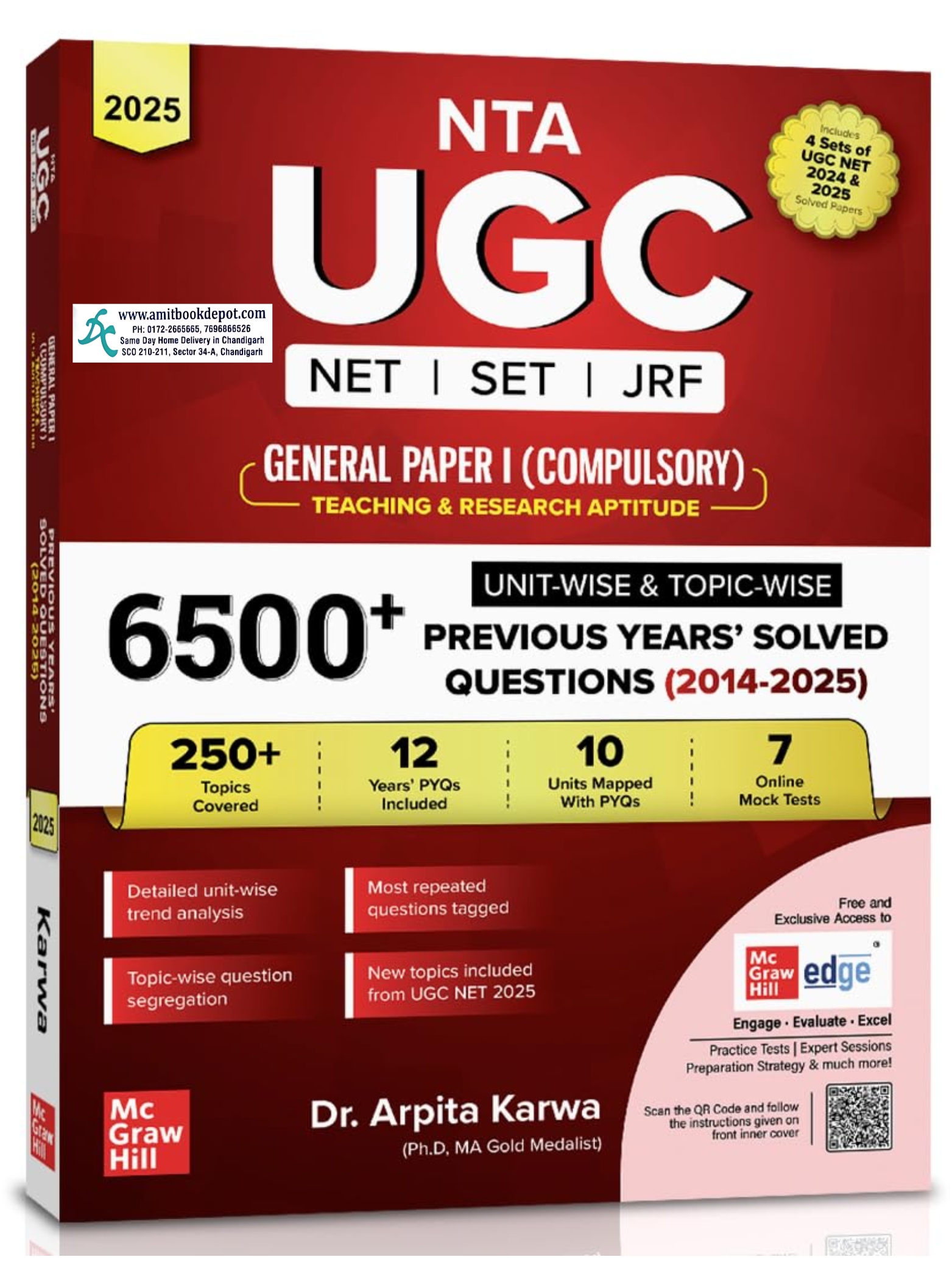
Its unique selling points are the volume of PYQs (6500+), the inclusion of very recent 2025 papers, the innovative "Trend Tracker" for strategic prep, and its holistic structure that combines detailed theory with extensive categorized and chronological practice.
Yes, the title explicitly mentions SET. As the General Paper syllabus for SET is similar to UGC NET, this book is an equally valuable resource for SET aspirants.
A recommended strategy is to study a topic from the theory chapter, then immediately solve the related topic-wise PYQs for reinforcement. Later, you can attempt the year-wise/shift-wise papers for simulated exam practice.
Yes, it is designed for all levels. The clear chapter-wise theory builds foundational concepts, while the PYQs cater to both beginners and those in the revision phase. It is a complete, self-contained resource.
No Description Added
The book includes specific, recent shifts from 2025 (e.g., January and August 2024-25 cycle), providing highly current exam patterns. It may not include every single shift but offers a comprehensive and updated representation.
The Trend Tracker provides a unit-wise graphical or tabular analysis of question frequency and marks weightage over the last five years. This allows you to identify which topics are most frequently tested and prioritize your study time accordingly.
Yes, it includes a dedicated chapter on Indian Logic (Chapter 20), covering essential concepts and PYQs related to Pramana (means of knowledge) like Anumana, Upamana, etc., as per the UGC NET syllabus.
Yes, detailed explanations and solutions are provided for the vast collection of PYQs, enabling you to understand the correct answer and the reasoning behind it.
Absolutely. Unit X on Higher Education covers the structure, policies, and recent developments, including digital initiatives relevant to the exam's current focus.
Yes, the Data Interpretation unit (Chapter 21) includes a helpful section titled "Let formulae do the magic," providing key formulas and calculation strategies to solve problems efficiently.
Its unique selling points are the volume of PYQs (6500+), the inclusion of very recent 2025 papers, the innovative "Trend Tracker" for strategic prep, and its holistic structure that combines detailed theory with extensive categorized and chronological practice.
Yes, the title explicitly mentions SET. As the General Paper syllabus for SET is similar to UGC NET, this book is an equally valuable resource for SET aspirants.
A recommended strategy is to study a topic from the theory chapter, then immediately solve the related topic-wise PYQs for reinforcement. Later, you can attempt the year-wise/shift-wise papers for simulated exam practice.
Yes, it is designed for all levels. The clear chapter-wise theory builds foundational concepts, while the PYQs cater to both beginners and those in the revision phase. It is a complete, self-contained resource.