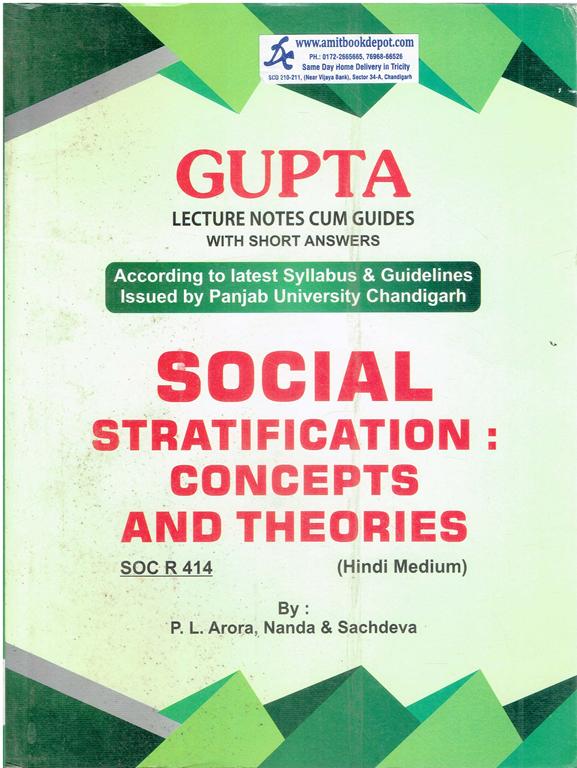
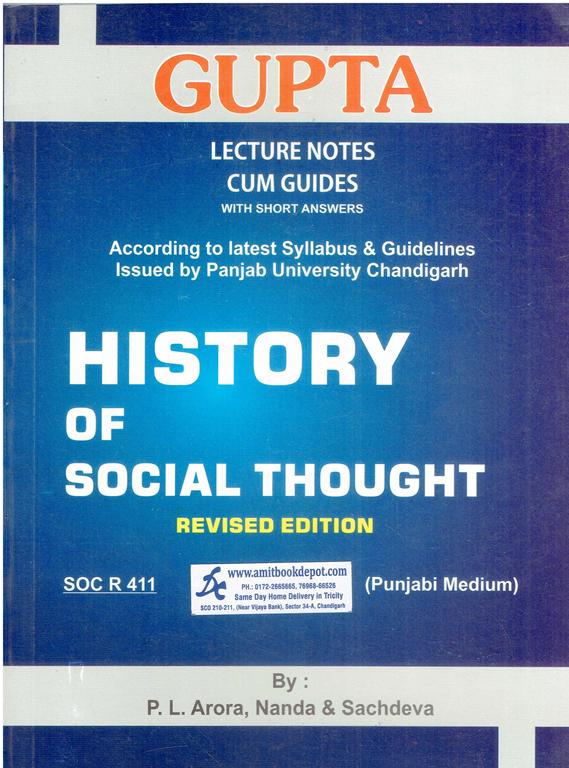
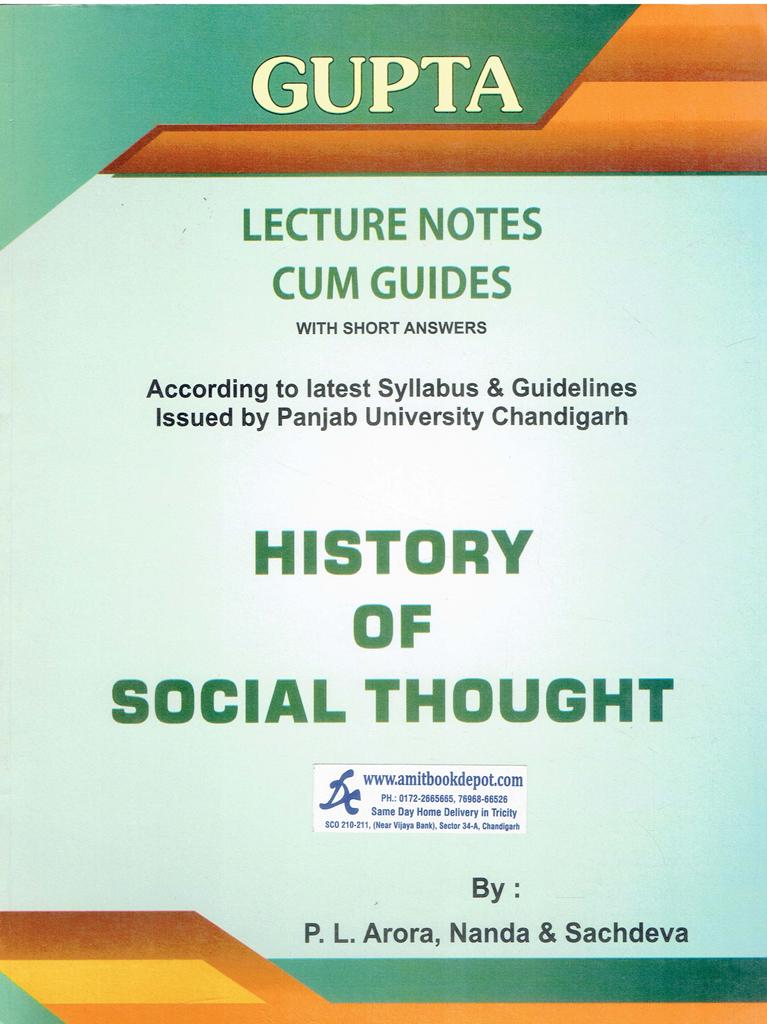
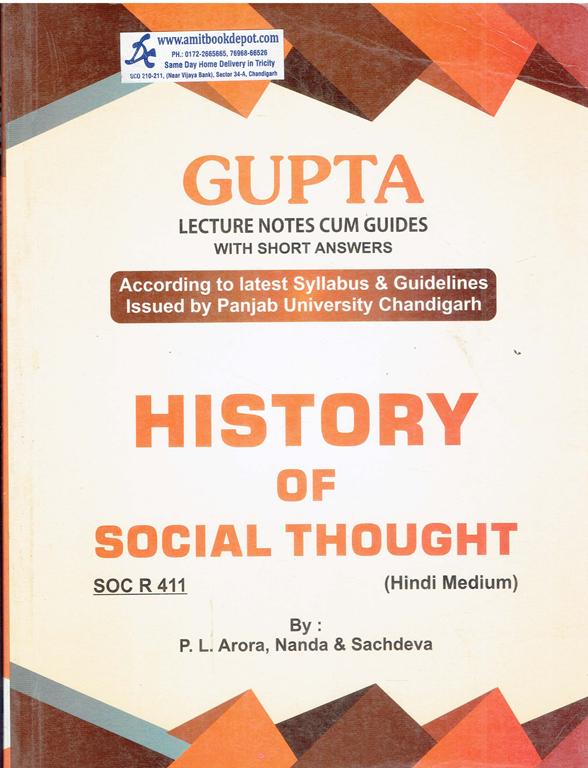
Gupta Social Stratification Concepts and Theories SOC R 414 for MA Sociology 1st Semester Panjab University Chandigarh (Hindi Medium)
Gupta Social Stratification Concepts and Theories SOC R 414 for MA Sociology 1st Semester Panjab University Chandigarh (Hindi Medium)
by Madhurima
₹450₹450.00(-/
off)
Rating & Reviews
23 Customer Review
Gupta Social Stratification: Concepts and Theories (SOC R 414) is the prescribed book for M.A. Sociology First Semester at Panjab University, Chandigarh (Hindi Medium). Written by P.L. Arora, Nanda, and Sachdeva, this book provides a comprehensive analysis of social inequality, caste and class, and functional and conflict theories. As per the latest syllabus, it includes units on the rise of the middle class, resurgence of caste, and urban-rural stratification. Useful for exams, it features a dedicated section of short answer questions. Published by Pepsu Book Depot, this book is an ideal guide for university students and competitive exam aspirants.
Gupta Social Stratification: Concepts and Theories (SOC R 414) is an essential and comprehensive book meticulously crafted according to the latest syllabus for the M.A. Sociology First Semester at Panjab University, Chandigarh. This book is specifically designed to cater to the needs of Hindi-medium students. Authored jointly by the esteemed writers P.L. Arora, Nanda, and Sachdeva, and published by Pepsu Book Depot, this volume serves as an indispensable resource for in-depth study of the subject.
This book presents the complex concepts, dimensions, and theoretical frameworks of social stratification in clear and comprehensible Hindi. Its primary objective is to sensitize students to the prevalence of social inequality, discrimination, exploitation, and hierarchy in everyday life. Simultaneously, it provides a foundational background to core sociological concepts such as caste, class, race, gender, and ethnicity.
The book's content is systematically organized into the syllabus's four units. Unit I covers the fundamental concepts, differentiation, and inequalities of social stratification, along with a brief introduction to caste, race, ethnicity, and gender. Unit II focuses on the major theoretical formulations of the subject, featuring a detailed analysis of the Functional Theory of Davis and Moore, the Conflict Theory of Karl Marx and R. Dahrendorf, and the Multidimensional Theory of Max Weber. This unit familiarizes students with different perspectives for understanding societal structure.
Unit III sheds light on the changing dimensions of social stratification, such as the emergence of the middle-class system and the new middle class. Additionally, it explains the correlates of social class—specifically occupation and education. Unit IV offers a profound study of stratification in the context of Indian society. It includes crucial topics like caste as a system of stratification, the resurgence of caste in Indian society, and social stratification in India's urban and rural societies.
A special section featuring short answer questions is provided at the end of the book, proving extremely helpful for exam preparation. This book is not only mandatory for M.A. Sociology students at Panjab University but also serves as an excellent reference guide for UGC NET, JRF, and other competitive exam aspirants, as well as researchers in social sciences. Being available in the Hindi medium, this book is a reliable medium for simplifying complex theories. Published by Pepsu Book Depot, this edition ensures excellent quality for reading and the authenticity of content. If you aim to make your preparation for SOC R 414 thorough, clear, and exam-oriented, this book will lay the cornerstone for your success.
Is this book aligned with the latest 2023-24 session syllabus for M.A. Sociology First Semester at Panjab University, Chandigarh?
A1
Yes, this book covers the latest syllabus for paper SOC R 414, encompassing all four units and every prescribed topic.
Q2
Does this book include questions for Internal Assessment?
A2
The book primarily focuses on the theoretical syllabus and long-answer questions. Specific instructions for Internal Assessment are provided by the university/college. However, the conceptual explanations given in the book are helpful in preparing internal assignments.
Q3
How useful is this book for UGC NET/JRF Sociology preparation?
A3
Social Stratification is a fundamental and important unit in the UGC NET/JRF syllabus. The clear Hindi explanation of classical theories (Marx, Weber, Davis & Moore) and the Indian context (Caste, Middle Class) in this book is extremely beneficial for competitive exam aspirants.
Q4
Does this book discuss contemporary topics like 'Khap Panchayats' and 'Affirmative Action (Reservation)'?
A4
Yes, as per the syllabus, Unit IV includes topics like "Resurgence of Caste (with special reference to Politics and Khap Panchayats)" and "Affirmative Action with regard to Scheduled Castes."
Q5
Is this book focused only on theories, or does it also provide current examples from Indian society?
A5
The book presents a coherent blend of theories and Indian context. Units III and IV specifically focus on the changing nature of class and caste in India, and topics like urban-rural stratification.
Q6
Can English medium students use this book?
A6
This book is specifically written for the Hindi medium curriculum. English medium students should check for an English version of the book by the same authors/publisher, which may be available.
Q7
Does this book explain Ralf Dahrendorf's Conflict Theory separately from Karl Marx's theory?
A7
Yes, under Conflict Theory in Unit II, the book attempts to explain and compare the theories of Karl Marx and Ralf Dahrendorf separately.
Q8
Is the distinction between the 'New Middle Class' and the 'Traditional Middle Class' clarified in this book?
A8
Yes, Chapter 6 in Unit III, "Changing Dimensions of Social Stratification - Emergence of Middle Class System and New Middle Class," explains this distinction in detail.
Q9
Will studying from this book suffice for preparing the 30-35 word short answer questions asked in the paper?
A9
Yes, the compilation of 'Short Answer Questions' at the end of the book is directly aimed at preparing for such questions. Additionally, key points from each chapter can be used to formulate short answers.
Q10
Can you tell us about the publisher 'Pepsu Book Depot'? Is it a reliable publisher for Panjab University?
A10
Pepsu Book Depot is a renowned and reliable academic book publisher and distributor based in Chandigarh, well-known specifically for books based on Panjab University and nearby colleges' curricula.
0.00
0 Overall Rating
5
0
4
0
3
0
2
0
1
0
Try this product & share your review &
thoughts
UNIT - I
1. Concepts, Differentiation, Inequalities of Social Stratification
2. A Brief Introduction to Caste, Race, Ethnicity and Gender
UNIT - II
3. Functional Theory : Davis and Moore
4. Conflict Theory of Karl Marx and R. Dahrendorff
5. Multi Dimensional Theory of Max Weber
UNIT - III
6. Changing Dimensions of Social Stratification - Emergence of Middle Class System and New Middle Class
7. Correlates of Social Class - Occupation and Education
UNIT - IV
8. Caste Concepts As a System of Stratification
9. Resurgence of Caste in Indian Society
10. Social Stratification of Urban and Rural Society in India
Short Answers for Questions
Latest Syllabus of Social Stratification Concepts and Theories SOC R 414 for MA Sociology 1st Semester Panjab University (PU) Chandigarh (Hindi Medium)
SOC R 414: SOCIAL STRATIFICATION: CONCEPTS & THEORIES
Objective
1. To sensitize students about elements of discrimination, exploitation, inequality, and the prevalence of hierarchies in everyday life.
2. To give a background of important sociological concepts.
3. To give theoretical formulations of important thinkers like Max Weber, Karl Marx, Talcott Parsons, Davis and Moore, and Ralph Dahrendorf.
4. To sensitize students in terms of understanding contemporary formulations like the emergence of the middle class and changing dimensions of caste and class.
INSTRUCTIONS FOR THE PAPER-SETTER AND THE CANDIDATES
(i) The theory question paper will be of 80 marks, and 20 marks will be for internal assessment. The duration of the paper will be 3 hours.
(ii) For private candidates, who have not been assessed earlier for internal assessment, the marks secured by them in the theory paper will proportionately be increased to the maximum marks of the paper in lieu of internal assessment.
The paper setter must put note (ii) in the question paper.
The syllabus has been divided into four units.
There shall be 9 questions in all. The first question is compulsory and shall be a short answer type containing 10 short questions spread over the whole syllabus to be answered in about 30 to 35 words each, carrying 20 marks, i.e., 2 marks each. The rest of the paper shall contain 4 units. Each unit shall have two long questions and the Candidates shall be given an internal choice of attempting one question from each unit—4 in all. Each question will carry 15 marks.
Course Outline
Unit-I
Concepts
Inequality, Differentiation, Ranking, Hierarchy, and Social Stratification
Dimensions of Social Stratification
Caste, Class, Race, Ethnicity, and Gender
Unit II
Theoretical Formulations:
i) Functional Theory: Parsons, Davis, and Moore;
ii) Conflict Theory: Karl Marx, R. Dahrendorf
iii) Multidimensional Theory: Max Weber
Unit III
Emerging Class System
Class, Middle Class, New Middle Class
Correlates of Social Class: Occupation, Education, and Income
Unit IV
Changing the Caste System
Change and Continuity in Caste in India
Resurgence of Caste (with special reference to Politics and Khap Panchayats)
Affirmative Action with regard to Scheduled Castes.
Gupta Social Stratification: Concepts and Theories (SOC R 414) is an essential and comprehensive book meticulously crafted according to the latest syllabus for the M.A. Sociology First Semester at Panjab University, Chandigarh. This book is specifically designed to cater to the needs of Hindi-medium students. Authored jointly by the esteemed writers P.L. Arora, Nanda, and Sachdeva, and published by Pepsu Book Depot, this volume serves as an indispensable resource for in-depth study of the subject.
This book presents the complex concepts, dimensions, and theoretical frameworks of social stratification in clear and comprehensible Hindi. Its primary objective is to sensitize students to the prevalence of social inequality, discrimination, exploitation, and hierarchy in everyday life. Simultaneously, it provides a foundational background to core sociological concepts such as caste, class, race, gender, and ethnicity.
The book's content is systematically organized into the syllabus's four units. Unit I covers the fundamental concepts, differentiation, and inequalities of social stratification, along with a brief introduction to caste, race, ethnicity, and gender. Unit II focuses on the major theoretical formulations of the subject, featuring a detailed analysis of the Functional Theory of Davis and Moore, the Conflict Theory of Karl Marx and R. Dahrendorf, and the Multidimensional Theory of Max Weber. This unit familiarizes students with different perspectives for understanding societal structure.
Unit III sheds light on the changing dimensions of social stratification, such as the emergence of the middle-class system and the new middle class. Additionally, it explains the correlates of social class—specifically occupation and education. Unit IV offers a profound study of stratification in the context of Indian society. It includes crucial topics like caste as a system of stratification, the resurgence of caste in Indian society, and social stratification in India's urban and rural societies.
A special section featuring short answer questions is provided at the end of the book, proving extremely helpful for exam preparation. This book is not only mandatory for M.A. Sociology students at Panjab University but also serves as an excellent reference guide for UGC NET, JRF, and other competitive exam aspirants, as well as researchers in social sciences. Being available in the Hindi medium, this book is a reliable medium for simplifying complex theories. Published by Pepsu Book Depot, this edition ensures excellent quality for reading and the authenticity of content. If you aim to make your preparation for SOC R 414 thorough, clear, and exam-oriented, this book will lay the cornerstone for your success.
UNIT - I
1. Concepts, Differentiation, Inequalities of Social Stratification
2. A Brief Introduction to Caste, Race, Ethnicity and Gender
UNIT - II
3. Functional Theory : Davis and Moore
4. Conflict Theory of Karl Marx and R. Dahrendorff
5. Multi Dimensional Theory of Max Weber
UNIT - III
6. Changing Dimensions of Social Stratification - Emergence of Middle Class System and New Middle Class
7. Correlates of Social Class - Occupation and Education
UNIT - IV
8. Caste Concepts As a System of Stratification
9. Resurgence of Caste in Indian Society
10. Social Stratification of Urban and Rural Society in India
Is this book aligned with the latest 2023-24 session syllabus for M.A. Sociology First Semester at Panjab University, Chandigarh?
A1
Yes, this book covers the latest syllabus for paper SOC R 414, encompassing all four units and every prescribed topic.
Q2
Does this book include questions for Internal Assessment?
A2
The book primarily focuses on the theoretical syllabus and long-answer questions. Specific instructions for Internal Assessment are provided by the university/college. However, the conceptual explanations given in the book are helpful in preparing internal assignments.
Q3
How useful is this book for UGC NET/JRF Sociology preparation?
A3
Social Stratification is a fundamental and important unit in the UGC NET/JRF syllabus. The clear Hindi explanation of classical theories (Marx, Weber, Davis & Moore) and the Indian context (Caste, Middle Class) in this book is extremely beneficial for competitive exam aspirants.
Q4
Does this book discuss contemporary topics like 'Khap Panchayats' and 'Affirmative Action (Reservation)'?
A4
Yes, as per the syllabus, Unit IV includes topics like "Resurgence of Caste (with special reference to Politics and Khap Panchayats)" and "Affirmative Action with regard to Scheduled Castes."
Q5
Is this book focused only on theories, or does it also provide current examples from Indian society?
A5
The book presents a coherent blend of theories and Indian context. Units III and IV specifically focus on the changing nature of class and caste in India, and topics like urban-rural stratification.
Q6
Can English medium students use this book?
A6
This book is specifically written for the Hindi medium curriculum. English medium students should check for an English version of the book by the same authors/publisher, which may be available.
Q7
Does this book explain Ralf Dahrendorf's Conflict Theory separately from Karl Marx's theory?
A7
Yes, under Conflict Theory in Unit II, the book attempts to explain and compare the theories of Karl Marx and Ralf Dahrendorf separately.
Q8
Is the distinction between the 'New Middle Class' and the 'Traditional Middle Class' clarified in this book?
A8
Yes, Chapter 6 in Unit III, "Changing Dimensions of Social Stratification - Emergence of Middle Class System and New Middle Class," explains this distinction in detail.
Q9
Will studying from this book suffice for preparing the 30-35 word short answer questions asked in the paper?
A9
Yes, the compilation of 'Short Answer Questions' at the end of the book is directly aimed at preparing for such questions. Additionally, key points from each chapter can be used to formulate short answers.
Q10
Can you tell us about the publisher 'Pepsu Book Depot'? Is it a reliable publisher for Panjab University?
A10
Pepsu Book Depot is a renowned and reliable academic book publisher and distributor based in Chandigarh, well-known specifically for books based on Panjab University and nearby colleges' curricula.
Latest Syllabus of Social Stratification Concepts and Theories SOC R 414 for MA Sociology 1st Semester Panjab University (PU) Chandigarh (Hindi Medium)
SOC R 414: SOCIAL STRATIFICATION: CONCEPTS & THEORIES
Objective
1. To sensitize students about elements of discrimination, exploitation, inequality, and the prevalence of hierarchies in everyday life.
2. To give a background of important sociological concepts.
3. To give theoretical formulations of important thinkers like Max Weber, Karl Marx, Talcott Parsons, Davis and Moore, and Ralph Dahrendorf.
4. To sensitize students in terms of understanding contemporary formulations like the emergence of the middle class and changing dimensions of caste and class.
INSTRUCTIONS FOR THE PAPER-SETTER AND THE CANDIDATES
(i) The theory question paper will be of 80 marks, and 20 marks will be for internal assessment. The duration of the paper will be 3 hours.
(ii) For private candidates, who have not been assessed earlier for internal assessment, the marks secured by them in the theory paper will proportionately be increased to the maximum marks of the paper in lieu of internal assessment.
The paper setter must put note (ii) in the question paper.
The syllabus has been divided into four units.
There shall be 9 questions in all. The first question is compulsory and shall be a short answer type containing 10 short questions spread over the whole syllabus to be answered in about 30 to 35 words each, carrying 20 marks, i.e., 2 marks each. The rest of the paper shall contain 4 units. Each unit shall have two long questions and the Candidates shall be given an internal choice of attempting one question from each unit—4 in all. Each question will carry 15 marks.
Course Outline
Unit-I
Concepts
Inequality, Differentiation, Ranking, Hierarchy, and Social Stratification
Dimensions of Social Stratification
Caste, Class, Race, Ethnicity, and Gender
Unit II
Theoretical Formulations:
i) Functional Theory: Parsons, Davis, and Moore;
ii) Conflict Theory: Karl Marx, R. Dahrendorf
iii) Multidimensional Theory: Max Weber
Unit III
Emerging Class System
Class, Middle Class, New Middle Class
Correlates of Social Class: Occupation, Education, and Income
Unit IV
Changing the Caste System
Change and Continuity in Caste in India
Resurgence of Caste (with special reference to Politics and Khap Panchayats)
Affirmative Action with regard to Scheduled Castes.
0.00
0 Overall Rating
5
0
4
0
3
0
2
0
1
0
Try this product & share your review &
thoughts
Top Trending Product
Related
Product
Related Product
Related Blog Posts
Latest Blogs
Latest Blogs
Classic Literature Reimagined: Discuss modern twists on classic novels.
Lorem ipsum dolor sit amet, consectetur adipiscing elit, sed
do
eiusmod tempor incididunt ut labore et dolore magna aliqua. Ut enim ad minim
veniam, quis nostrud exercitation ullamco Lorem ipsum dolor sit amet,
consectetur adipiscing elit, sed do eiusmod tempor incididunt ut labore et
dolore magna aliqua. Utenim ad minim veniam, quis nostrud exercitation
ullamco
Lorem ipsum dolor sit amet, consecte...
Classic Literature Reimagined: Discuss modern twists on classic novels.
Lorem ipsum dolor sit amet, consectetur adipiscing elit, sed
do
eiusmod tempor incididunt ut labore et dolore magna aliqua. Ut enim ad minim
veniam, quis nostrud exercitation ullamco Lorem ipsum dolor sit amet,
consectetur adipiscing elit, sed do eiusmod tempor incididunt ut labore et
dolore magna aliqua. Utenim ad minim veniam, quis nostrud exercitation
ullamco
Lorem ipsum dolor sit amet, consecte...
Classic Literature Reimagined: Discuss modern twists on classic novels.
Lorem ipsum dolor sit amet, consectetur adipiscing elit, sed
do
eiusmod tempor incididunt ut labore et dolore magna aliqua. Ut enim ad minim
veniam, quis nostrud exercitation ullamco Lorem ipsum dolor sit amet,
consectetur adipiscing elit, sed do eiusmod tempor incididunt ut labore et
dolore magna aliqua. Utenim ad minim veniam, quis nostrud exercitation
ullamco
Lorem ipsum dolor sit amet, consecte...









.jpg)