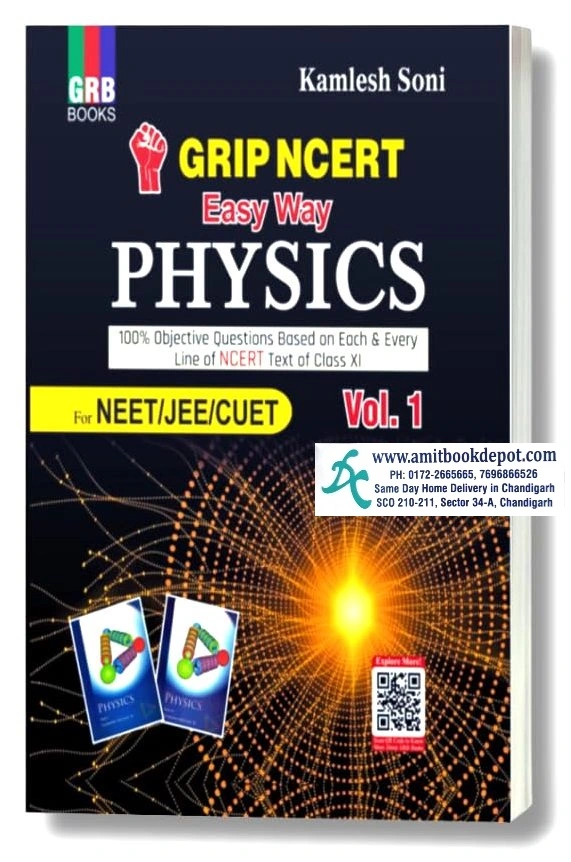
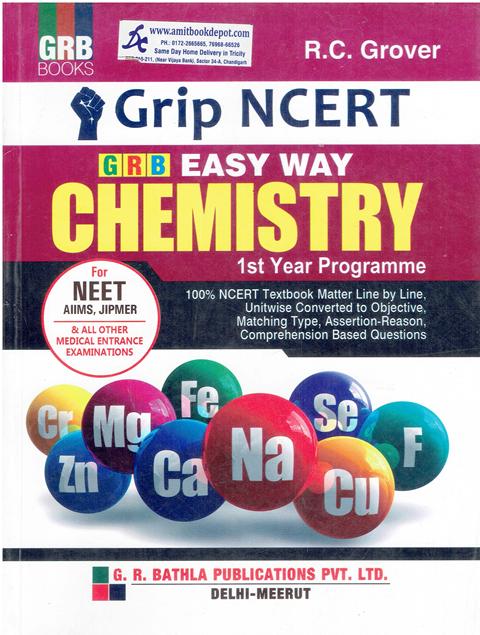
Master the fundamentals of Class 11 Physics with GRB Grip NCERT Easy Way Physics Vol. 1, authored by Kamlesh Soni and published by G. R. Bathla Publications Pvt. Ltd. This book is meticulously designed for aspirants preparing for India’s most competitive entrance examinations—NEET, JEE Main & Advanced, and CUET—while simultaneously building a rock-solid foundation in NCERT concepts.
Unlike traditional books that overwhelm students with excessive theory, this volume adopts an “Easy Way” methodology. It translates the complex language of the NCERT Physics book into a simple, lucid, and exam-focused format. The book strictly adheres to the latest CBSE and NCERT syllabus, covering all 15 chapters from “Physical World” to "Waves", ensuring that no topic is left unaddressed.
Key Features & Keywords:
- NCERT-Centric Approach: Every concept is directly mapped to NCERT lines, eliminating confusion from multiple sources. Ideal for students who struggle with the standard NCERT language.
- Conceptual Clarity & Grip: The title “Grip” signifies its purpose—to help students gain a strong hold on fundamental topics such as laws of motion, work, energy and power, systems of particles and rotational motion, and gravitation.
- Exam-Oriented Preparation: Designed specifically for NEET (National Eligibility cum Entrance Test), JEE (Joint Entrance Examination), and CUET (Common University Entrance Test). Includes a variety of objective question types: MCQs, assertion-reason, case-based, and numerical problems.
- Simplified Problem-Solving: Detailed step-by-step solutions for numerical problems in Units and Measurements, Motion in a Straight Line, and Motion in a Plane. Special emphasis on vector analysis and projectile motion.
- Thermodynamics & Waves: Dedicated chapters on Mode of Heat Transfer, Thermodynamics and Calorimetry, Kinetic Theory of Gases, and Oscillations & Waves are presented with shortcut methods and memory aids.
- Mechanical Properties: Comprehensive coverage of mechanical properties of solids and fluids, including stress-strain curves, viscosity, surface tension, and Bernoulli’s principle.
- Quick Revision Modules: At the end of each chapter, a “Grip Summary” and “NCERT Keywords” section helps in last-minute revision before exams.
Why Buy This Book?
For a Class 11 or 12 student juggling board exams and entrance tests, time is the most scarce resource. GRB Grip NCERT Easy Way Physics Vol. 1 eliminates the need to refer to bulky reference books. It bridges the gap between NCERT theory and the application-based questions asked in NEET and JEE. Whether you are learning rotational motion or the laws of thermodynamics, this book ensures you spend less time deciphering language and more time solving problems.
Table of Contents (as per syllabus):
1. Physical World
2. Units and Measurement
3. Motion in a Straight Line
4. Motion in a Plane
5. Laws of Motion
6. Work, Energy and Power
7. System of Particles and Rotational Motion
8. Gravitation
9. Mechanical Properties of Solids
10. Mechanical Properties of Fluids
11. Kinetic Theory of Gases
12. Mode of Heat Transfer
13. Thermodynamics and Calorimetry
14. Oscillations
15. Waves
Target Audience: NEET aspirants, JEE Main/Advanced candidates, CUET science stream students, and CBSE Class 11 students.




.jpg)