-
Mon-Fri: 10AM to 8PM 01722665665
-
My Account
-
-
0
Total :
₹ 0.00

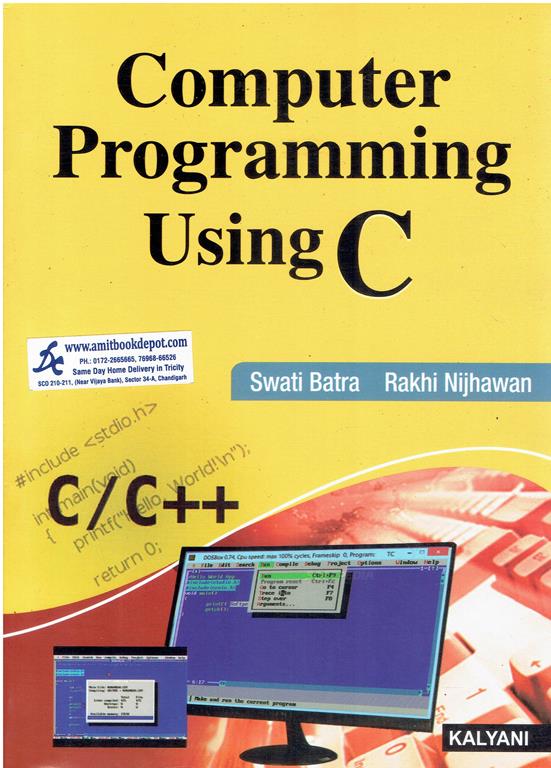


Yes, this book is meticulously designed to cover the entire PGD-1102 syllabus, including all topics from Section A to Section D as prescribed by Panjab University.
Absolutely. It begins with a dedicated chapter on problem-solving, guiding you through problem identification, algorithm development, and flowchart creation .
The book covers foundational data structures within C, including arrays (one and two-dimensional), strings, structures, unions, and pointers.
Pointers are explained in a dedicated chapter covering declaration, pointer arithmetic, passing arguments using pointers, and arrays of pointers for step-by-step understanding .
Yes, it covers all important preprocessor directives, including #define, #include, and conditional compilation directives like #ifdef and #ifndef.
The book covers the key header files mentioned in the syllabus, including stdio.h, string.h, math.h, ctype.h, and stdlib.h .
Yes, it includes a comprehensive chapter explaining the scope and lifetime of variables with storage classes like automatic, external (global), static, and register.
Yes, there is a full chapter on Input/Output Files that covers opening, reading, writing, and closing files, including troubleshooting issues like trouble in opening a file .
Yes, the book includes valuable appendices covering ASCII codes, format specifiers, escape sequences, and a list of common C library functions.
The book is divided into four sections that directly mirror the exam's section division, making it easy to study for each part and the compulsory short-answer questions.
No Description Added
Yes, this book is meticulously designed to cover the entire PGD-1102 syllabus, including all topics from Section A to Section D as prescribed by Panjab University.
Absolutely. It begins with a dedicated chapter on problem-solving, guiding you through problem identification, algorithm development, and flowchart creation .
The book covers foundational data structures within C, including arrays (one and two-dimensional), strings, structures, unions, and pointers.
Pointers are explained in a dedicated chapter covering declaration, pointer arithmetic, passing arguments using pointers, and arrays of pointers for step-by-step understanding .
Yes, it covers all important preprocessor directives, including #define, #include, and conditional compilation directives like #ifdef and #ifndef.
The book covers the key header files mentioned in the syllabus, including stdio.h, string.h, math.h, ctype.h, and stdlib.h .
Yes, it includes a comprehensive chapter explaining the scope and lifetime of variables with storage classes like automatic, external (global), static, and register.
Yes, there is a full chapter on Input/Output Files that covers opening, reading, writing, and closing files, including troubleshooting issues like trouble in opening a file .
Yes, the book includes valuable appendices covering ASCII codes, format specifiers, escape sequences, and a list of common C library functions.
The book is divided into four sections that directly mirror the exam's section division, making it easy to study for each part and the compulsory short-answer questions.