-
Mon-Fri: 10AM to 8PM 01722665665
-
My Account
-
-
0
Total :
₹ 0.00

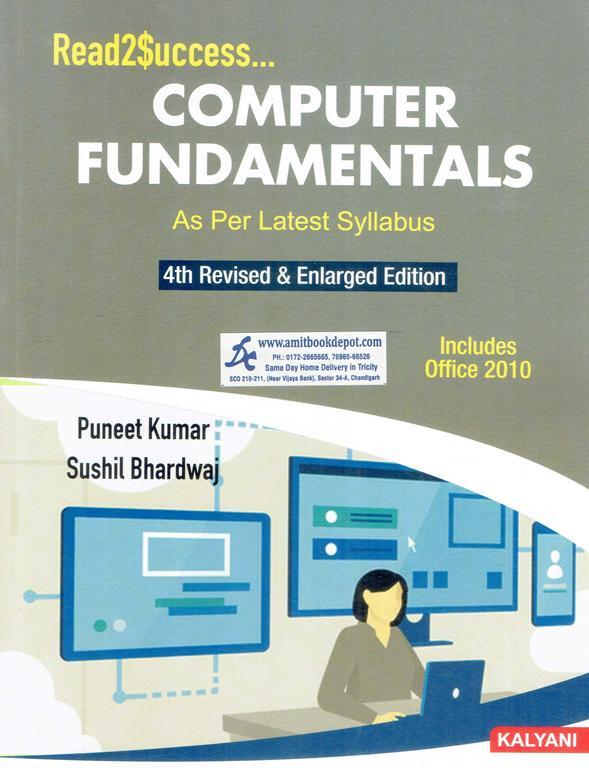




This book is specifically tailored for students enrolled in the PGDCA 1st Semester program at Panjab University, Chandigarh .
Unit-I covers computer basics, the block diagram, and types of memory including RAM, ROM, PROM, and EPROM in detail.
Yes, it provides a thorough explanation of number systems, including Binary, Octal, Decimal, Hexadecimal, and their conversions.
The book offers comprehensive coverage of three major operating systems: Disk Operating System (DOS), Windows, and Linux .
Yes, it includes a full unit on MS-Word, teaching document creation, editing, formatting, and advanced features like mail merge.
It teaches MS-Excel skills, including working with formulas, using statistical functions, and creating various charts and graphs.
It explains data organization clearly using concepts like tracks, sectors, cylinders, and seeks time for easy understanding.
Yes, it explains the booting sequence (warm and cold) and the role of critical files like CONFIG.SYS and AUTOEXEC.BAT.
Yes, building on the fundamentals, it covers entering data and using formulas for calculations with both integer and floating-point numbers.
It is designed for both, covering theoretical concepts for exams and practical tutorials for software like Windows and MS-Office .
No Description Added
This book is specifically tailored for students enrolled in the PGDCA 1st Semester program at Panjab University, Chandigarh .
Unit-I covers computer basics, the block diagram, and types of memory including RAM, ROM, PROM, and EPROM in detail.
Yes, it provides a thorough explanation of number systems, including Binary, Octal, Decimal, Hexadecimal, and their conversions.
The book offers comprehensive coverage of three major operating systems: Disk Operating System (DOS), Windows, and Linux .
Yes, it includes a full unit on MS-Word, teaching document creation, editing, formatting, and advanced features like mail merge.
It teaches MS-Excel skills, including working with formulas, using statistical functions, and creating various charts and graphs.
It explains data organization clearly using concepts like tracks, sectors, cylinders, and seeks time for easy understanding.
Yes, it explains the booting sequence (warm and cold) and the role of critical files like CONFIG.SYS and AUTOEXEC.BAT.
Yes, building on the fundamentals, it covers entering data and using formulas for calculations with both integer and floating-point numbers.
It is designed for both, covering theoretical concepts for exams and practical tutorials for software like Windows and MS-Office .