Categories
College Bookssss >
BA PU Chandigarh
BSC PU Chandigarh
MSC PU Chandigarh
BBA PU Chandigarh
MA PU Chandigarh
Medical Books
Engineering Books
Management Books
PGDCA Books
BCOM PU Chandigarh
MCOM PU Chandigarh
BCA PU Chandigarh
MCA PU Chandigarh
animate-books

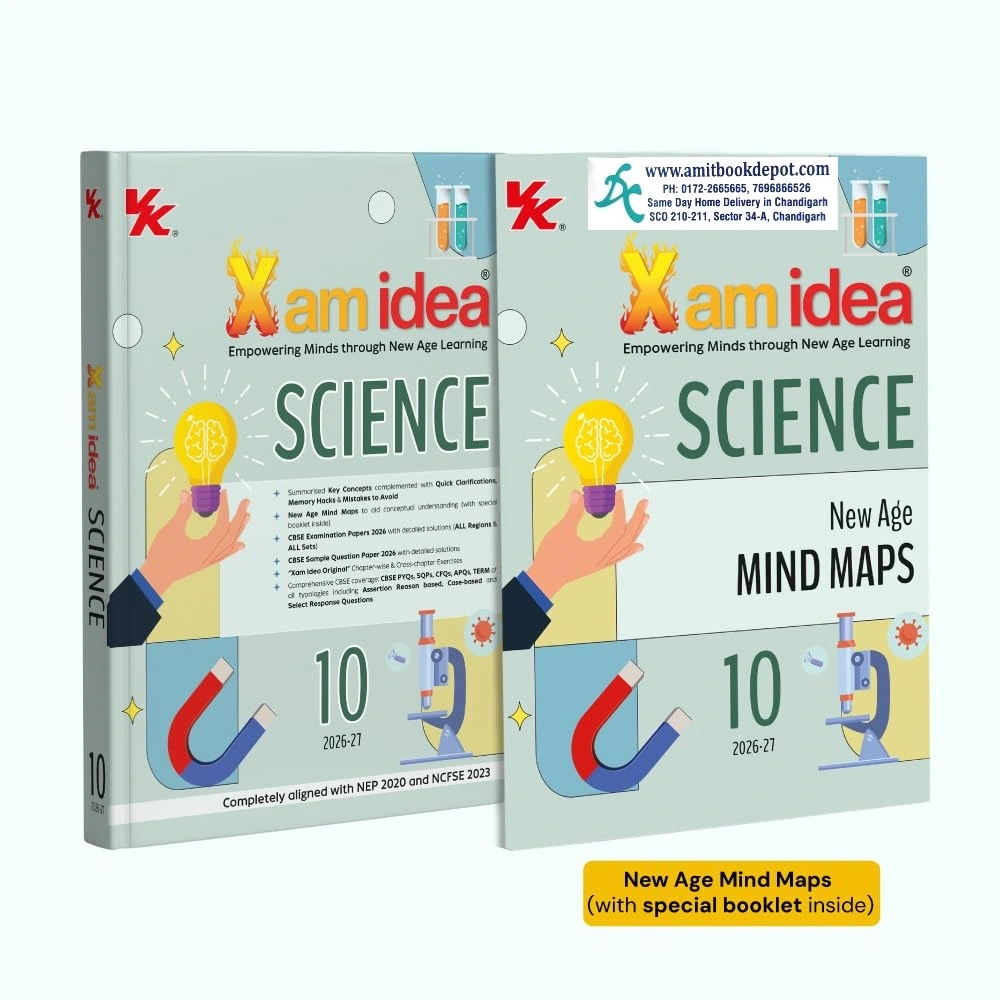
Xamidea Science for Class 10th

by Madhurima
₹756 ₹756.00(-/ off)

Rating & Reviews

23 Customer Review

Xamidea Science for Class 10th (2026 Edition) by VK Global Publications Pvt Ltd is a complete exam-ready guide featuring chapter-wise basic concepts, NCERT exercises, and a comprehensive examination corner. Covering Physics, Chemistry, and Biology—from Chemical Reactions to Magnetic Effects and Our Environment—it includes solved CBSE Examination Papers 2026 (all regions), a solved CBSE Sample Paper, practice papers, HOTS questions, case-based MCQs, and new age mind maps. This exam-oriented book ensures rapid revision, step-by-step numerical solutions, and competency-based assessment. Perfect for scoring high in the CBSE Board Exams 2026. Upgrade your preparation with Xamidea’s error-free, syllabus-complete content.

Have Doubts Regarding This Product ? Ask Your Question

  • Q1
    Which topics are covered in Part A of Xamidea Science for Class 10?
    A1

    All 13 chapters including Chemical Reactions, Acids-Bases, Metals-Nonmetals, Carbon compounds, Life Processes, Control Coordination, Heredity, Light, Human Eye, Electricity, Magnetic Effects, and Environment.

  • Q2
    Does this book include 2026 CBSE board exam papers?
    A2

    Yes. It contains CBSE Examination Papers 2026 (Region 1 Solved) plus DLRs to solved papers from all regions.

  • Q3
    What are New Age Mind Maps in this book?
    A3

    Visual flowcharts that link key concepts across Physics, Chemistry, and Biology for rapid revision before exams.

  • Q4
    Does it contain case-based and assertion-reason questions?
    A4

    Yes. Each chapter includes competency-based MCQs, assertion-reason, case study questions, and HOTS problems as per latest CBSE pattern.

  • Q5
    How many practice papers are in the examination corner?
    A5

    Part B includes multiple practice papers along with solved CBSE Sample Paper 2026 for self-assessment.

  • Q6
    Are numerical problems solved step-by-step?
    A6

    Yes. Electricity and Light chapters include complete stepwise solutions to all numerical problems with formulas and units.

  • Q7
    Does it cover practical skills and lab-based questions?
    A7

    Yes. Each chapter has practical-based MCQs and viva-voce type questions aligned with CBSE internal assessment.

  • Q8
    Does it include all three subjects—Physics, Chemistry, Biology?
    A8

    Yes. Integrated coverage: Physics (Light, Electricity, Magnetic Effects), Chemistry (Reactions, Acids, Metals, Carbon), Biology (Life, Control, Reproduction, Heredity, Environment).

  • Q9
    Does it follow the latest CBSE syllabus for 2026 exams?
    A9

    Yes. Fully updated with rationalized NCERT content and new competency-focused question typologies.

  • Q10
    Are diagrams and flow charts included for biology chapters?
    A10

    Yes. Labeled diagrams for Life Processes, Reproduction, and Human Eye with flowchart explanations.

0.00

0 Overall Rating
  • 5
    0
  • 4
    0
  • 3
    0
  • 2
    0
  • 1
    0

Try this product & share your review & thoughts

PART - A: CHAPTER-WISE BASIC CONCEPTS & EXERCISES

1. Chemical Reactions and Equations
2. Acids, Bases and Salts
3. Metals and Nonmetals
4. Carbon and its Compounds
5. Life Processes
6. Control and Coordination
7. How do Organisms Reproduce?
8. Heredity
9. Light - Reflection and Refraction
10. The Human Eye and the Colourful World
11. Electricity
12. Magnetic Effects of Electric Current
13. Our Environment

PART B: COMPREHENSIVE EXAMINATION CORNER

- CBSE Examination Papers - 2026 (Region 1 Solved)
- DLRs to Solved CBSE Examination Papers – 2026 (All Regions)
- CBSE Sample Question Paper - 2026 (Solved)
- Practice Papers
- New Age Mind Maps

COURSE STRUCTURE CLASS X (2026-27) 


Theme: Materials 

Unit I: Chemical Substances—Nature and Behavior 


Chemical Reactions and Equations: Chemical reactions, chemical equations, balanced chemical equations, types of chemical reactions: combination, decomposition, displacement, double displacement, precipitation, endothermic and exothermic reactions, oxidation, and reduction.

Acids, Bases, and Salts: Acids and Bases—definitions in terms of furnishing of H⁺ and OH⁻ ions, identification using indicators, chemical properties, examples and uses, neutralization, concept of pH scale (definition relating to logarithm not required), importance of pH in everyday life; preparation and uses of sodium hydroxide, bleaching powder, baking soda, washing soda, and plaster of Paris. 

Metals and Non-metals: Properties of metals and non-metals; reactivity series; formation and properties of ionic compounds; Basic metallurgical processes; Corrosion and its prevention. 

Carbon and Its Compounds: Covalent bonds—formation and properties of covalent compounds, Versatile nature of carbon, Hydrocarbons—saturated and unsaturated homologous series. Nomenclature of alkanes, alkenes, alkynes, and carbon compounds containing functional groups (halogens, alcohol, ketones, and aldehydes). Chemical properties of carbon compounds (combustion, oxidation, addition, and substitution reactions). Ethanol and ethanoic acid (only properties and uses), soaps, and detergents. 


Theme: The World of the Living 

Unit II: World of Living 


Life processes: ‘Living Being.’ Basic concepts of nutrition, respiration, transport, and excretion in plants and animals. 

Control and coordination in animals and plants: Tropic movements in plants; Introduction of plant hormones; Control and coordination in animals: Nervous system; Voluntary, involuntary, and reflex action; Chemical co-ordination: animal hormones. 

Reproduction: Reproduction in animals and plants (asexual and sexual) reproductive health—need and methods of family planning. Safe sex vs HIV/AIDS. Childbearing and women’s health. 

Heredity and Evolution: Heredity; Mendel’s contribution - Laws for inheritance of traits: Sex determination; brief introduction. 


Theme: Natural Phenomena 

Unit III: Natural Phenomena 


Reflection of light by curved surfaces; images formed by spherical mirrors, center of curvature, principal axis, principal focus, focal length, mirror formula (derivation not required), magnification. 

Refraction: Laws of refraction, refractive index. 

Refraction of light by spherical lenses; images formed by spherical lenses; Lens formula (derivation not required); Magnification. Power of a lens. 

Functioning of a lens in the human eye, defects of vision and their corrections, and applications of spherical mirrors and lenses. 

Refraction of light through a prism, dispersion of light, scattering of light, applications in daily life (excluding color of the sun at sunrise and sunset). 


Theme: How Things Work 

Unit IV: Effects of Current 


Electric current, potential difference, and electric current. Ohm’s law; resistance, resistivity, Factors on which the resistance of a conductor depends. Series combination of resistors, parallel combination of resistors, and their applications in daily life. Heating effect of electric current and its applications in daily life. Electric power, Interrelation between P, V, I, and R. 

Magnetic effects of current: magnetic field, field lines, field due to a current-carrying conductor, field due to a current-carrying coil or solenoid, force on a current-carrying conductor, Fleming’s Left Hand Rule, and direct current. Alternating current: frequency of AC. Advantage of AC over DC. Domestic electric circuits. 


Theme: Natural Resources 

Unit V: Natural Resources 


Our environment: Ecosystem, environmental problems, ozone depletion, waste production, and their solutions. Biodegradable and non-biodegradable substances. 


Note for the Teachers: The NCERT textbooks present information in boxes across the book. These help students to get conceptual clarity. However, the information in these boxes would not be assessed in the year-end examination. 

Product: Xamidea Science for Class 10th (2026 Edition)
Author & Publisher: VK Global Publications Pvt Ltd

Master the CBSE Class 10 science curriculum with the newly updated Xamidea Science for Class 10, a comprehensive examination-oriented resource crafted by VK Global Publications Pvt Ltd. Designed specifically for the current academic session, this book bridges the gap between basic concept understanding and high-stakes exam performance. Whether you are targeting a perfect score in the Board Exams 2026 or building a foundation for competitive exams, Xamidea delivers a structured, error-free learning experience.

The book is divided into two strategic parts. Part A provides chapter-wise basic concepts and exercises covering all 13 essential units: from Chemical Reactions and Equations, Acids, Bases and Salts, Metals and Nonmetals, to Life Processes; Control and Coordination; Heredity; Light – Reflection and Refraction; The Human Eye and the Colourful World; Electricity; Magnetic Effects of Electric Current; and Our Environment. Each chapter includes topic-wise breakdowns, important diagrams, NCERT solutions, and multiple-choice, assertion-reason, and case-based questions.

Part B is a dedicated comprehensive examination corner, making this book an ideal solution for final revision. It includes CBSE Examination Papers 2026 (Region 1 Solved), Detailed Learning Reports (DLRs) to solved CBSE papers for all regions, the official CBSE Sample Question Paper 2026 (Solved), and multiple practice papers with high-order thinking skills (HOTS) questions. A standout feature is the inclusion of New Age Mind Maps for visual recall and conceptual linking across physics, chemistry, and biology.

This Xamidea Science edition emphasises competency-based learning, aligning with the latest CBSE pattern. Key keywords integrated throughout the content include NCERT-based, exam-oriented, previous years’ solved papers, sample paper solutions, rapid revision, HOTS, multiple-choice questions, case study-based, assertion-reason, numerical problems, practical skills, diagrams, flow charts, and self-assessment.

Ideal for self-study, this book offers step-by-step solutions to every problem, ensuring clarity in topics like Carbon and its Compounds, Electricity numericals, and reproductive biology. The practice papers are designed to simulate real exam pressure, helping students manage time effectively. Whether you need concept mastery or last-month intensive revision, Xamidea Science for Class 10th is your all-in-one guide to achieving 95%+ marks.

PART - A: CHAPTER-WISE BASIC CONCEPTS & EXERCISES

1. Chemical Reactions and Equations
2. Acids, Bases and Salts
3. Metals and Nonmetals
4. Carbon and its Compounds
5. Life Processes
6. Control and Coordination
7. How do Organisms Reproduce?
8. Heredity
9. Light - Reflection and Refraction
10. The Human Eye and the Colourful World
11. Electricity
12. Magnetic Effects of Electric Current
13. Our Environment

PART B: COMPREHENSIVE EXAMINATION CORNER

- CBSE Examination Papers - 2026 (Region 1 Solved)
- DLRs to Solved CBSE Examination Papers – 2026 (All Regions)
- CBSE Sample Question Paper - 2026 (Solved)
- Practice Papers
- New Age Mind Maps

Have Doubts Regarding This Product ? Ask Your Question

  • Q1
    Which topics are covered in Part A of Xamidea Science for Class 10?
    A1

    All 13 chapters including Chemical Reactions, Acids-Bases, Metals-Nonmetals, Carbon compounds, Life Processes, Control Coordination, Heredity, Light, Human Eye, Electricity, Magnetic Effects, and Environment.

  • Q2
    Does this book include 2026 CBSE board exam papers?
    A2

    Yes. It contains CBSE Examination Papers 2026 (Region 1 Solved) plus DLRs to solved papers from all regions.

  • Q3
    What are New Age Mind Maps in this book?
    A3

    Visual flowcharts that link key concepts across Physics, Chemistry, and Biology for rapid revision before exams.

  • Q4
    Does it contain case-based and assertion-reason questions?
    A4

    Yes. Each chapter includes competency-based MCQs, assertion-reason, case study questions, and HOTS problems as per latest CBSE pattern.

  • Q5
    How many practice papers are in the examination corner?
    A5

    Part B includes multiple practice papers along with solved CBSE Sample Paper 2026 for self-assessment.

  • Q6
    Are numerical problems solved step-by-step?
    A6

    Yes. Electricity and Light chapters include complete stepwise solutions to all numerical problems with formulas and units.

  • Q7
    Does it cover practical skills and lab-based questions?
    A7

    Yes. Each chapter has practical-based MCQs and viva-voce type questions aligned with CBSE internal assessment.

  • Q8
    Does it include all three subjects—Physics, Chemistry, Biology?
    A8

    Yes. Integrated coverage: Physics (Light, Electricity, Magnetic Effects), Chemistry (Reactions, Acids, Metals, Carbon), Biology (Life, Control, Reproduction, Heredity, Environment).

  • Q9
    Does it follow the latest CBSE syllabus for 2026 exams?
    A9

    Yes. Fully updated with rationalized NCERT content and new competency-focused question typologies.

  • Q10
    Are diagrams and flow charts included for biology chapters?
    A10

    Yes. Labeled diagrams for Life Processes, Reproduction, and Human Eye with flowchart explanations.

COURSE STRUCTURE CLASS X (2026-27) 


Theme: Materials 

Unit I: Chemical Substances—Nature and Behavior 


Chemical Reactions and Equations: Chemical reactions, chemical equations, balanced chemical equations, types of chemical reactions: combination, decomposition, displacement, double displacement, precipitation, endothermic and exothermic reactions, oxidation, and reduction.

Acids, Bases, and Salts: Acids and Bases—definitions in terms of furnishing of H⁺ and OH⁻ ions, identification using indicators, chemical properties, examples and uses, neutralization, concept of pH scale (definition relating to logarithm not required), importance of pH in everyday life; preparation and uses of sodium hydroxide, bleaching powder, baking soda, washing soda, and plaster of Paris. 

Metals and Non-metals: Properties of metals and non-metals; reactivity series; formation and properties of ionic compounds; Basic metallurgical processes; Corrosion and its prevention. 

Carbon and Its Compounds: Covalent bonds—formation and properties of covalent compounds, Versatile nature of carbon, Hydrocarbons—saturated and unsaturated homologous series. Nomenclature of alkanes, alkenes, alkynes, and carbon compounds containing functional groups (halogens, alcohol, ketones, and aldehydes). Chemical properties of carbon compounds (combustion, oxidation, addition, and substitution reactions). Ethanol and ethanoic acid (only properties and uses), soaps, and detergents. 


Theme: The World of the Living 

Unit II: World of Living 


Life processes: ‘Living Being.’ Basic concepts of nutrition, respiration, transport, and excretion in plants and animals. 

Control and coordination in animals and plants: Tropic movements in plants; Introduction of plant hormones; Control and coordination in animals: Nervous system; Voluntary, involuntary, and reflex action; Chemical co-ordination: animal hormones. 

Reproduction: Reproduction in animals and plants (asexual and sexual) reproductive health—need and methods of family planning. Safe sex vs HIV/AIDS. Childbearing and women’s health. 

Heredity and Evolution: Heredity; Mendel’s contribution - Laws for inheritance of traits: Sex determination; brief introduction. 


Theme: Natural Phenomena 

Unit III: Natural Phenomena 


Reflection of light by curved surfaces; images formed by spherical mirrors, center of curvature, principal axis, principal focus, focal length, mirror formula (derivation not required), magnification. 

Refraction: Laws of refraction, refractive index. 

Refraction of light by spherical lenses; images formed by spherical lenses; Lens formula (derivation not required); Magnification. Power of a lens. 

Functioning of a lens in the human eye, defects of vision and their corrections, and applications of spherical mirrors and lenses. 

Refraction of light through a prism, dispersion of light, scattering of light, applications in daily life (excluding color of the sun at sunrise and sunset). 


Theme: How Things Work 

Unit IV: Effects of Current 


Electric current, potential difference, and electric current. Ohm’s law; resistance, resistivity, Factors on which the resistance of a conductor depends. Series combination of resistors, parallel combination of resistors, and their applications in daily life. Heating effect of electric current and its applications in daily life. Electric power, Interrelation between P, V, I, and R. 

Magnetic effects of current: magnetic field, field lines, field due to a current-carrying conductor, field due to a current-carrying coil or solenoid, force on a current-carrying conductor, Fleming’s Left Hand Rule, and direct current. Alternating current: frequency of AC. Advantage of AC over DC. Domestic electric circuits. 


Theme: Natural Resources 

Unit V: Natural Resources 


Our environment: Ecosystem, environmental problems, ozone depletion, waste production, and their solutions. Biodegradable and non-biodegradable substances. 


Note for the Teachers: The NCERT textbooks present information in boxes across the book. These help students to get conceptual clarity. However, the information in these boxes would not be assessed in the year-end examination. 

0.00

0 Overall Rating
  • 5
    0
  • 4
    0
  • 3
    0
  • 2
    0
  • 1
    0

Try this product & share your review & thoughts

Top Trending Product

Related Product

Related Product

Related Blog Posts

Latest Blogs

Latest Blogs

blog-img
Classic Literature Reimagined: Discuss modern twists on classic novels.
Lorem ipsum dolor sit amet, consectetur adipiscing elit, sed do eiusmod tempor incididunt ut labore et dolore magna aliqua. Ut enim ad minim veniam, quis nostrud exercitation ullamco Lorem ipsum dolor sit amet, consectetur adipiscing elit, sed do eiusmod tempor incididunt ut labore et dolore magna aliqua. Utenim ad minim veniam, quis nostrud exercitation ullamco Lorem ipsum dolor sit amet, consecte...
Read more
Author name | 10 jan, 2025
blog-img
Classic Literature Reimagined: Discuss modern twists on classic novels.
Lorem ipsum dolor sit amet, consectetur adipiscing elit, sed do eiusmod tempor incididunt ut labore et dolore magna aliqua. Ut enim ad minim veniam, quis nostrud exercitation ullamco Lorem ipsum dolor sit amet, consectetur adipiscing elit, sed do eiusmod tempor incididunt ut labore et dolore magna aliqua. Utenim ad minim veniam, quis nostrud exercitation ullamco Lorem ipsum dolor sit amet, consecte...
Read more
Author name | 10 jan, 2025
blog-img
Classic Literature Reimagined: Discuss modern twists on classic novels.
Lorem ipsum dolor sit amet, consectetur adipiscing elit, sed do eiusmod tempor incididunt ut labore et dolore magna aliqua. Ut enim ad minim veniam, quis nostrud exercitation ullamco Lorem ipsum dolor sit amet, consectetur adipiscing elit, sed do eiusmod tempor incididunt ut labore et dolore magna aliqua. Utenim ad minim veniam, quis nostrud exercitation ullamco Lorem ipsum dolor sit amet, consecte...
Read more
Author name | 10 jan, 2025
blog-img
Classic Literature Reimagined: Discuss modern twists on classic novels.
Lorem ipsum dolor sit amet, consectetur adipiscing elit...
Read more
Author Name | 10 Jan, 2025
blog-img
Classic Literature Reimagined: Discuss modern twists on classic novels.
Lorem ipsum dolor sit amet, consectetur adipiscing elit...
Read more
Author Name | 10 Jan, 2025
blog-img
Classic Literature Reimagined: Discuss modern twists on classic novels.
Lorem ipsum dolor sit amet, consectetur adipiscing elit...
Read more
Author Name | 10 Jan, 2025
blog-img
Classic Literature Reimagined: Discuss modern twists on classic novels.
Lorem ipsum dolor sit amet, consectetur adipiscing elit...
Read more
Author Name | 10 Jan, 2025
blog-img
Classic Literature Reimagined: Discuss modern twists on classic novels.
Lorem ipsum dolor sit amet, consectetur adipiscing elit...
Read more
Author Name | 10 Jan, 2025
blog-img
Classic Literature Reimagined: Discuss modern twists on classic novels.
Lorem ipsum dolor sit amet, consectetur adipiscing elit...
Read more
Author Name | 10 Jan, 2025
blog-img
Classic Literature Reimagined: Discuss modern twists on classic novels.
Lorem ipsum dolor sit amet, consectetur adipiscing elit...
Read more
Author Name | 10 Jan, 2025
blog-img
Classic Literature Reimagined: Discuss modern twists on classic novels.
Lorem ipsum dolor sit amet, consectetur adipiscing elit...
Read more
Author Name | 10 Jan, 2025
blog-img
Classic Literature Reimagined: Discuss modern twists on classic novels.
Lorem ipsum dolor sit amet, consectetur adipiscing elit...
Read more
Author Name | 10 Jan, 2025