Categories
College Bookssss >
BA PU Chandigarh
BSC PU Chandigarh
MSC PU Chandigarh
BBA PU Chandigarh
MA PU Chandigarh
Medical Books
Engineering Books
Management Books
PGDCA Books
BCOM PU Chandigarh
MCOM PU Chandigarh
BCA PU Chandigarh
MCA PU Chandigarh
animate-books

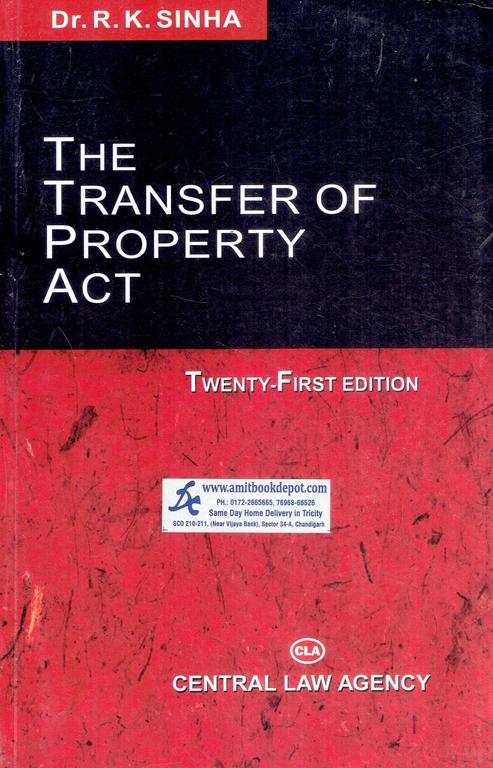
The Transfer of Property ACT

by Madhurima
₹570 ₹570.00(-/ off)

Rating & Reviews

23 Customer Review

‘The Transfer of Property Act’ by Dr R. K. Sinha (Central Law Agency) is a standard book for law students and judiciary aspirants covering the entire TPA, 1882. It systematically explains preliminary definitions, sale, mortgage, lease, exchange, gift, and actionable claims. Each chapter integrates statutory provisions with landmark case laws and exam-oriented questions. Key doctrines—like lis pendens, rule against perpetuity, and election—are simplified for clarity. Published by a trusted legal publisher, this edition is ideal for LL.B., LL.M., and judicial service exams. A must-have for mastering immovable property transfers, mortgages, charges, and lessor-lessee rights. Updated and student-friendly.
Have Doubts Regarding This Product ? Ask Your Question

  • Q1
    What is the difference between vested interest and contingent interest under the TPA?
    A1

    Vested interest takes effect immediately, not dependent on a condition. Contingent interest depends on an uncertain future event; ownership arises only upon that event occurring.

  • Q2
    Can a transferor impose a complete restraint on alienation of property?
    A2

    No. Section 10 declares that any absolute restraint on alienation is void. Partial or reasonable restraints may, however, be valid.

  • Q3
    What is the difference between a simple mortgage and a usufructuary mortgage?
    A3

    In simple mortgage, mortgagor retains possession but personally promises payment. In usufructuary mortgage, mortgagee receives rents/profits instead of interest.

  • Q4
    When does a mortgagor have a right to redeem the property?
    A4

    After the mortgage money becomes due, the mortgagor can demand back the property by repaying principal, interest, and costs, before final foreclosure or sale.

  • Q5
    What is a charge under Section 100, and how is it different from a mortgage?
    A5

    A charge is security for payment without transferring interest in property. Mortgage involves transfer of interest; charge does not, though both are enforceable via sale.

  • Q6
    What are the essential elements of a valid gift of immovable property?
    A6

    Section 122 requires transfer without consideration, acceptance by or on behalf of donee during donor’s lifetime, and registered instrument signed by donor.

  • Q7
    Can actionable claims like insurance policies be transferred?
    A7

    Yes, under Chapter 8. Transfer of actionable claims (debts, reversionary interests) must be in writing, signed by transferor, with notice to debtor.

  • Q8
    What is the difference between foreclosure and sale of mortgaged property?
    A8

    Foreclosure (Section 67) extinguishes mortgagor’s right to redeem; sale (Section 69) results in auction and surplus proceeds return to mortgagor.

  • Q9
    How is an exchange different from a sale under the TPA?
    A9

    Sale involves transfer of property for money consideration. Exchange (Section 118) is transfer of one property for another, not involving money.

  • Q10
    Under Section 53A, what is the doctrine of part performance?
    A10

    It protects a transferee who has taken possession and performed part of the contract, against transferor’s subsequent legal challenge, though no title passes.


0.00

0 Overall Rating
  • 5
    0
  • 4
    0
  • 3
    0
  • 2
    0
  • 1
    0

Try this product & share your review & thoughts

INTRODUCTION

Chapter 1. Preliminary
Chapter 2: Of Transfers of Property by Act of Parties
Chapter 3: Of Sales of Immovable Property
Chapter 4: Of Mortgages of Immovable Property and Charges
Chapter 5: Of Leases of Immovable Property
Chapter 6: Of Exchanges
Chapter 7: Of Gifts
Chapter 8: Of Transfers of Actionable Claims

This book, ‘The Transfer of Property Act’, authored by the distinguished legal scholar Dr R. K. Sinha and published by Central Law Agency, is a comprehensive and authoritative book designed for law students, legal practitioners, and judicial service aspirants. The text provides a systematic, section-wise analysis of the Transfer of Property Act, 1882, one of the most significant statutes governing immovable property transactions in India. Central Law Agency is renowned for producing high-quality legal literature, and this edition upholds that standard with clarity, precision, and academic rigour.

Key Features

- Structured Content: The book follows the exact scheme of the Act, divided into eight well-organised chapters, from preliminary definitions to the transfer of actionable claims.
- Exhaustive Coverage: Every key concept—including sale, mortgage, lease, exchange, and gift—is explained in detail with supporting case laws and illustrations.
- Student-Centric Approach: Complex legal principles (e.g., rule against perpetuity, doctrine of lis pendens, priority of charges) are broken down into logical, easy-to-revise modules.
- Updated Landmark Judgements: Includes recent Supreme Court and High Court rulings, making it relevant for both academic exams and professional litigation support.
- Exam-Oriented: Contains questions at the end of each chapter (as per syllabus pattern) to aid self-assessment.

Table of Contents Outline

- The book is structured as follows, ensuring complete syllabus coverage:
- Introduction – Historical background and foundational principles of property transfer.
- Chapter 1: Preliminary – Short title, commencement, definitions (immovable property, notice, attestation).
- Chapter 2: Of Transfers of Property by Act of Parties – Who may transfer, operation of transfer, conditions restraining alienation, vested and contingent interests, doctrine of election.
- Chapter 3: Of Sales of Immovable Property – Rights and liabilities of buyer and seller, contract for sale, and auction sales.
- Chapter 4: Of Mortgages of Immovable Property and Charges – Types of mortgages (simple, usufructuary, equitable, English, and anomalous); rights of mortgagee and mortgagor; foreclosure; redemption; and charges.
- Chapter 5: Of Leases of Immovable Property – Essential elements of a lease, duration, rights of lessor and lessee, determination of lease.
- Chapter 6: Of Exchanges – Definition and rules applicable to the exchange of property.
- Chapter 7: Of Gifts – Meaning, essential requirements (acceptance, registered instrument), universal gifts, onerous gifts.
- Chapter 8: Of Transfers of Actionable Claims – Transfer of debts, reversionary interests, insurance policies, and negotiable instruments (with limitations).

Target Audience

- LL.B. and LL.M. students (three-year and five-year integrated courses)
- Candidates preparing for judicial services (PCS J), APO, and other law competitive exams
- Practising advocates dealing with property disputes
- Law professors and academic researchers

Why Choose This Book?

Dr R. K. Sinha’s writing is known for balancing statutory interpretation with practical application. Unlike bare acts or fragmented notes, this book provides a holistic understanding of property transfers, mortgages, leases, and actionable claims. Published by Central Law Agency, the book ensures authenticity, updated content, and typographical accuracy.

Content Keywords: Transfer of Property Act, immovable property, sale of property, mortgage and charge, lease of immovable property, exchange, gift deed, actionable claims, doctrine of lis pendens, rule against perpetuity, vested interest, contingent interest, foreclosure, redemption, lessor and lessee, attestation, notice under TPA.

INTRODUCTION

Chapter 1. Preliminary
Chapter 2: Of Transfers of Property by Act of Parties
Chapter 3: Of Sales of Immovable Property
Chapter 4: Of Mortgages of Immovable Property and Charges
Chapter 5: Of Leases of Immovable Property
Chapter 6: Of Exchanges
Chapter 7: Of Gifts
Chapter 8: Of Transfers of Actionable Claims

Have Doubts Regarding This Product ? Ask Your Question

  • Q1
    What is the difference between vested interest and contingent interest under the TPA?
    A1

    Vested interest takes effect immediately, not dependent on a condition. Contingent interest depends on an uncertain future event; ownership arises only upon that event occurring.

  • Q2
    Can a transferor impose a complete restraint on alienation of property?
    A2

    No. Section 10 declares that any absolute restraint on alienation is void. Partial or reasonable restraints may, however, be valid.

  • Q3
    What is the difference between a simple mortgage and a usufructuary mortgage?
    A3

    In simple mortgage, mortgagor retains possession but personally promises payment. In usufructuary mortgage, mortgagee receives rents/profits instead of interest.

  • Q4
    When does a mortgagor have a right to redeem the property?
    A4

    After the mortgage money becomes due, the mortgagor can demand back the property by repaying principal, interest, and costs, before final foreclosure or sale.

  • Q5
    What is a charge under Section 100, and how is it different from a mortgage?
    A5

    A charge is security for payment without transferring interest in property. Mortgage involves transfer of interest; charge does not, though both are enforceable via sale.

  • Q6
    What are the essential elements of a valid gift of immovable property?
    A6

    Section 122 requires transfer without consideration, acceptance by or on behalf of donee during donor’s lifetime, and registered instrument signed by donor.

  • Q7
    Can actionable claims like insurance policies be transferred?
    A7

    Yes, under Chapter 8. Transfer of actionable claims (debts, reversionary interests) must be in writing, signed by transferor, with notice to debtor.

  • Q8
    What is the difference between foreclosure and sale of mortgaged property?
    A8

    Foreclosure (Section 67) extinguishes mortgagor’s right to redeem; sale (Section 69) results in auction and surplus proceeds return to mortgagor.

  • Q9
    How is an exchange different from a sale under the TPA?
    A9

    Sale involves transfer of property for money consideration. Exchange (Section 118) is transfer of one property for another, not involving money.

  • Q10
    Under Section 53A, what is the doctrine of part performance?
    A10

    It protects a transferee who has taken possession and performed part of the contract, against transferor’s subsequent legal challenge, though no title passes.

No Syllabus Added

0.00

0 Overall Rating
  • 5
    0
  • 4
    0
  • 3
    0
  • 2
    0
  • 1
    0

Try this product & share your review & thoughts

Top Trending Product

Related Product

Related Product

Related Blog Posts

Latest Blogs

Latest Blogs

blog-img
Classic Literature Reimagined: Discuss modern twists on classic novels.
Lorem ipsum dolor sit amet, consectetur adipiscing elit, sed do eiusmod tempor incididunt ut labore et dolore magna aliqua. Ut enim ad minim veniam, quis nostrud exercitation ullamco Lorem ipsum dolor sit amet, consectetur adipiscing elit, sed do eiusmod tempor incididunt ut labore et dolore magna aliqua. Utenim ad minim veniam, quis nostrud exercitation ullamco Lorem ipsum dolor sit amet, consecte...
Read more
Author name | 10 jan, 2025
blog-img
Classic Literature Reimagined: Discuss modern twists on classic novels.
Lorem ipsum dolor sit amet, consectetur adipiscing elit, sed do eiusmod tempor incididunt ut labore et dolore magna aliqua. Ut enim ad minim veniam, quis nostrud exercitation ullamco Lorem ipsum dolor sit amet, consectetur adipiscing elit, sed do eiusmod tempor incididunt ut labore et dolore magna aliqua. Utenim ad minim veniam, quis nostrud exercitation ullamco Lorem ipsum dolor sit amet, consecte...
Read more
Author name | 10 jan, 2025
blog-img
Classic Literature Reimagined: Discuss modern twists on classic novels.
Lorem ipsum dolor sit amet, consectetur adipiscing elit, sed do eiusmod tempor incididunt ut labore et dolore magna aliqua. Ut enim ad minim veniam, quis nostrud exercitation ullamco Lorem ipsum dolor sit amet, consectetur adipiscing elit, sed do eiusmod tempor incididunt ut labore et dolore magna aliqua. Utenim ad minim veniam, quis nostrud exercitation ullamco Lorem ipsum dolor sit amet, consecte...
Read more
Author name | 10 jan, 2025
blog-img
Classic Literature Reimagined: Discuss modern twists on classic novels.
Lorem ipsum dolor sit amet, consectetur adipiscing elit...
Read more
Author Name | 10 Jan, 2025
blog-img
Classic Literature Reimagined: Discuss modern twists on classic novels.
Lorem ipsum dolor sit amet, consectetur adipiscing elit...
Read more
Author Name | 10 Jan, 2025
blog-img
Classic Literature Reimagined: Discuss modern twists on classic novels.
Lorem ipsum dolor sit amet, consectetur adipiscing elit...
Read more
Author Name | 10 Jan, 2025
blog-img
Classic Literature Reimagined: Discuss modern twists on classic novels.
Lorem ipsum dolor sit amet, consectetur adipiscing elit...
Read more
Author Name | 10 Jan, 2025
blog-img
Classic Literature Reimagined: Discuss modern twists on classic novels.
Lorem ipsum dolor sit amet, consectetur adipiscing elit...
Read more
Author Name | 10 Jan, 2025
blog-img
Classic Literature Reimagined: Discuss modern twists on classic novels.
Lorem ipsum dolor sit amet, consectetur adipiscing elit...
Read more
Author Name | 10 Jan, 2025
blog-img
Classic Literature Reimagined: Discuss modern twists on classic novels.
Lorem ipsum dolor sit amet, consectetur adipiscing elit...
Read more
Author Name | 10 Jan, 2025
blog-img
Classic Literature Reimagined: Discuss modern twists on classic novels.
Lorem ipsum dolor sit amet, consectetur adipiscing elit...
Read more
Author Name | 10 Jan, 2025
blog-img
Classic Literature Reimagined: Discuss modern twists on classic novels.
Lorem ipsum dolor sit amet, consectetur adipiscing elit...
Read more
Author Name | 10 Jan, 2025