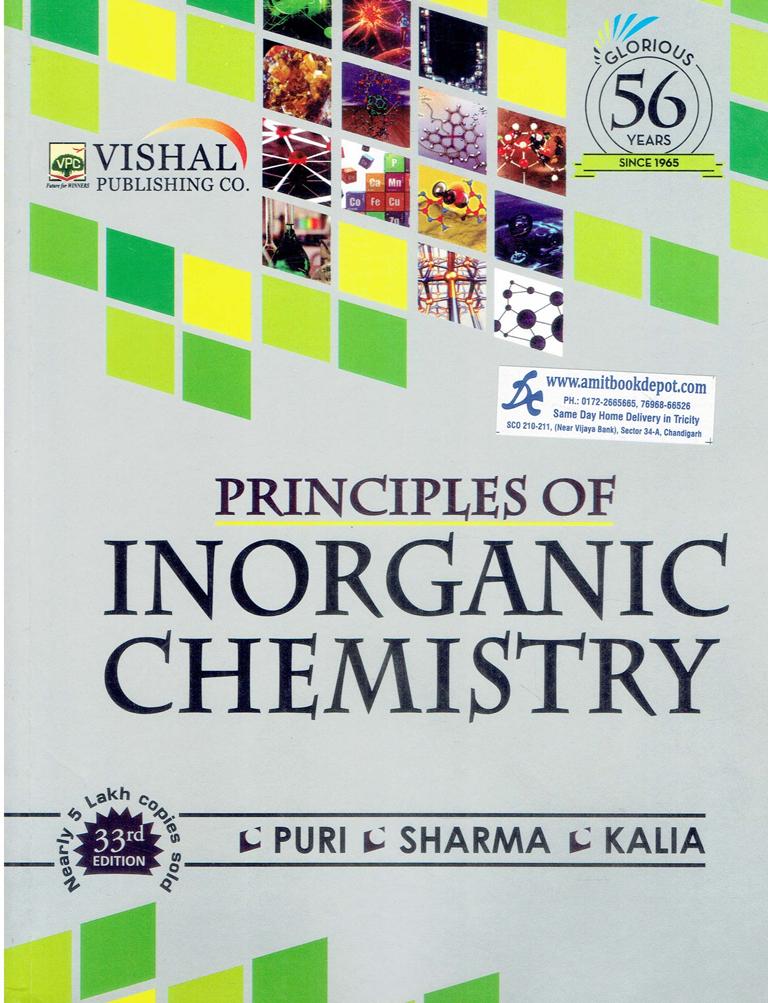
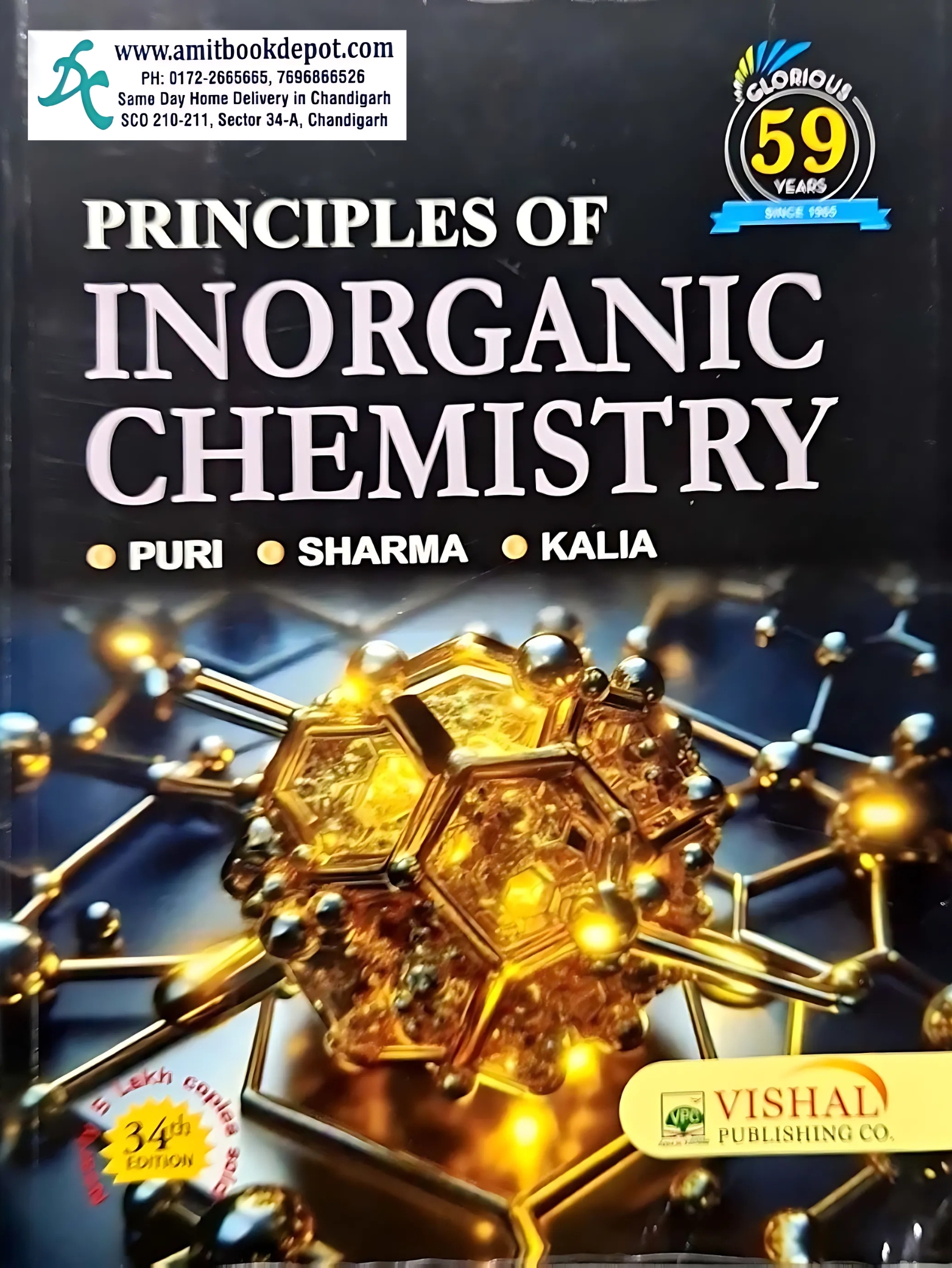
It dedicates six chapters (Parts I-VI) covering Werner’s theory, isomerism, Crystal Field Theory, Jahn-Teller effect, spectroscopy, magnetochemistry, and reaction mechanisms for BSc/MSc.
Yes, Chapter 3 on molecular symmetry and group theory explains character tables, symmetry operations, and applications in vibrational spectroscopy and chemical bonding.
Yes, Chapter 37 discusses metalloproteins, hemoglobin, myoglobin, cytochrome P450, and metal ion transport and storage in biological systems.
Chapter 38 describes atmospheric pollution, ozone depletion, greenhouse gases, heavy metal toxicity, and chemical methods for water and air analysis.
Chapters 40-41 explain evaluation of analytical data (errors, standard deviation) and volumetric titrimetry including redox, complexometric, and EDTA titrations.
Chapter 33 on metal clusters covers dinuclear and polynuclear clusters, metal-metal bonding, Wade’s rules, carbonyl clusters, and isolobal analogy.
Chapter 34 includes 18-electron rule, metal alkyls, carbenes, metallocenes, and homogeneous catalysis (hydrogenation, hydroformylation, and polymerization).
Chapter 35 covers silicones, polyphosphazenes, sulfur-nitrogen polymers, and borazine derivatives with their thermal stability and industrial applications.
Chapter 39 explains radioactive decay kinetics, nuclear fission/fusion, radiation detectors, and applications of radioisotopes in medicine and industry.
Chapter 32 is dedicated to mononuclear complexes of CO, NO, CN⁻, PR₃, and N₂, including IR spectroscopic identification and synergic bonding.
No Description Added
It dedicates six chapters (Parts I-VI) covering Werner’s theory, isomerism, Crystal Field Theory, Jahn-Teller effect, spectroscopy, magnetochemistry, and reaction mechanisms for BSc/MSc.
Yes, Chapter 3 on molecular symmetry and group theory explains character tables, symmetry operations, and applications in vibrational spectroscopy and chemical bonding.
Yes, Chapter 37 discusses metalloproteins, hemoglobin, myoglobin, cytochrome P450, and metal ion transport and storage in biological systems.
Chapter 38 describes atmospheric pollution, ozone depletion, greenhouse gases, heavy metal toxicity, and chemical methods for water and air analysis.
Chapters 40-41 explain evaluation of analytical data (errors, standard deviation) and volumetric titrimetry including redox, complexometric, and EDTA titrations.
Chapter 33 on metal clusters covers dinuclear and polynuclear clusters, metal-metal bonding, Wade’s rules, carbonyl clusters, and isolobal analogy.
Chapter 34 includes 18-electron rule, metal alkyls, carbenes, metallocenes, and homogeneous catalysis (hydrogenation, hydroformylation, and polymerization).
Chapter 35 covers silicones, polyphosphazenes, sulfur-nitrogen polymers, and borazine derivatives with their thermal stability and industrial applications.
Chapter 39 explains radioactive decay kinetics, nuclear fission/fusion, radiation detectors, and applications of radioisotopes in medicine and industry.
Chapter 32 is dedicated to mononuclear complexes of CO, NO, CN⁻, PR₃, and N₂, including IR spectroscopic identification and synergic bonding.