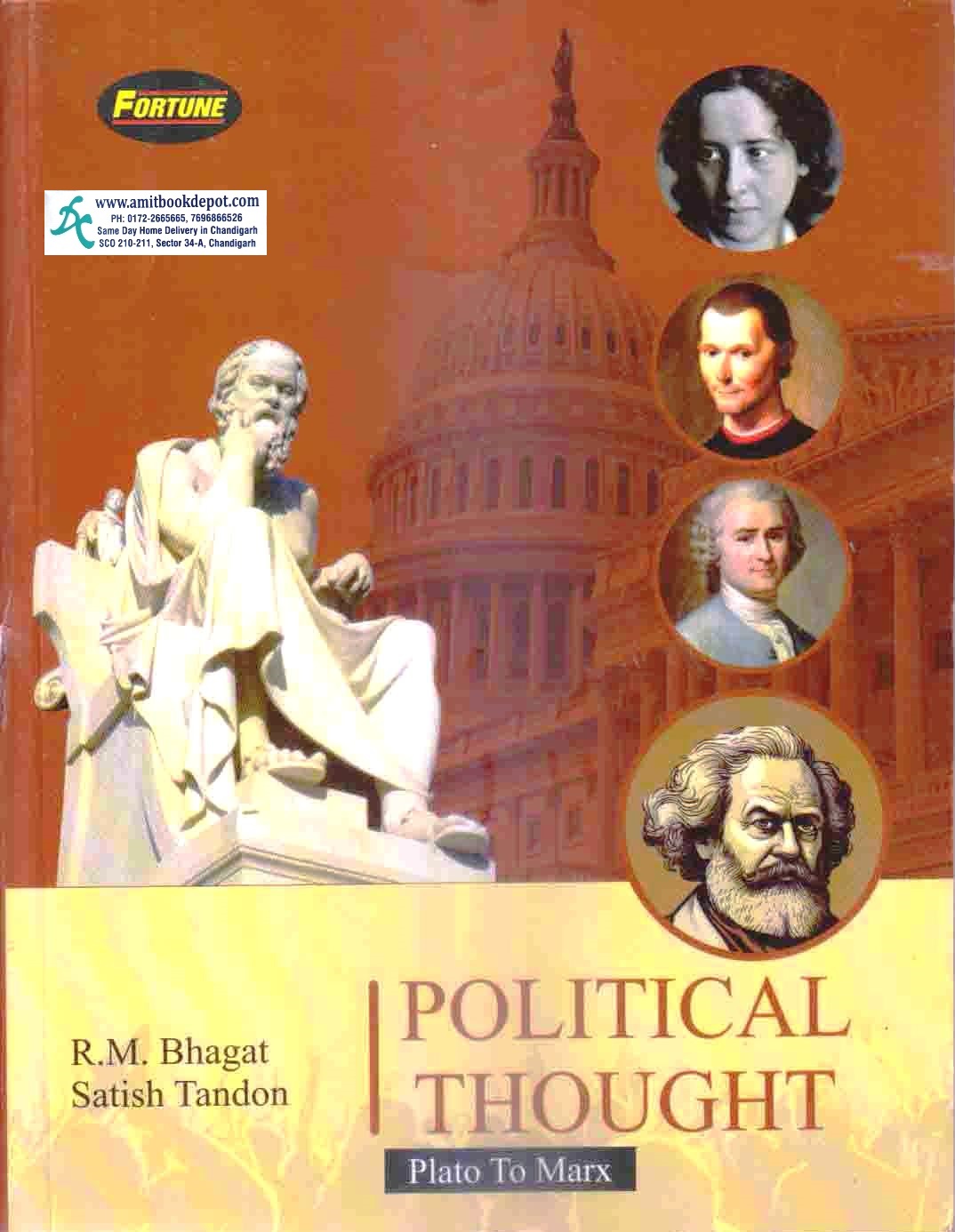
Yes, the book’s content from classical to modern political thought comprehensively covers the core thinkers and theories specified in both the UGC NET and UPSC Political Science syllabi.
This volume is focused exclusively on the Western canon, from Plato to Marx. It does not cover Indian political thought.
The authors present Hegel’s idealism and Marx’s historical materialism in a structured, simplified manner, breaking down complex concepts like dialectics and class struggle to make them accessible to students encountering them for the first time.
While academically rigorous, the book is known for its clear and explanatory prose, making it suitable for serious general readers interested in political philosophy, not just formal students.
Yes, the chronological and thematic progression naturally facilitates comparison. The analysis within chapters on individual thinkers often highlights their divergences from and reactions to preceding ideas.
The balance is syllabus-oriented. Modern thinkers from Machiavelli onward receive more detailed coverage, but medieval thought is given sufficient treatment to explain the crucial transition to modernity.
No, this book is a foundational text on the canonical Western tradition itself. It does not extend into contemporary critiques like feminism or post-colonialism, which are subjects for advanced, specialized volumes.
Absolutely. Its comprehensive range from the Greeks to Marx makes it a standard primary textbook for many undergraduate and postgraduate courses in India.
It integrates essential biographical and historical context for each thinker to ground their philosophy in their era, but the primary focus remains on the exposition and analysis of their political ideas.
New Academic Publishing Co. is known for producing affordable academic texts. The binding is typically functional for paperback textbooks, suitable for regular study use.
No Description Added
Yes, the book’s content from classical to modern political thought comprehensively covers the core thinkers and theories specified in both the UGC NET and UPSC Political Science syllabi.
This volume is focused exclusively on the Western canon, from Plato to Marx. It does not cover Indian political thought.
The authors present Hegel’s idealism and Marx’s historical materialism in a structured, simplified manner, breaking down complex concepts like dialectics and class struggle to make them accessible to students encountering them for the first time.
While academically rigorous, the book is known for its clear and explanatory prose, making it suitable for serious general readers interested in political philosophy, not just formal students.
Yes, the chronological and thematic progression naturally facilitates comparison. The analysis within chapters on individual thinkers often highlights their divergences from and reactions to preceding ideas.
The balance is syllabus-oriented. Modern thinkers from Machiavelli onward receive more detailed coverage, but medieval thought is given sufficient treatment to explain the crucial transition to modernity.
No, this book is a foundational text on the canonical Western tradition itself. It does not extend into contemporary critiques like feminism or post-colonialism, which are subjects for advanced, specialized volumes.
Absolutely. Its comprehensive range from the Greeks to Marx makes it a standard primary textbook for many undergraduate and postgraduate courses in India.
It integrates essential biographical and historical context for each thinker to ground their philosophy in their era, but the primary focus remains on the exposition and analysis of their political ideas.
New Academic Publishing Co. is known for producing affordable academic texts. The binding is typically functional for paperback textbooks, suitable for regular study use.