-
Mon-Fri: 10AM to 8PM 01722665665
-
My Account
-
-
0
Total :
₹ 0.00

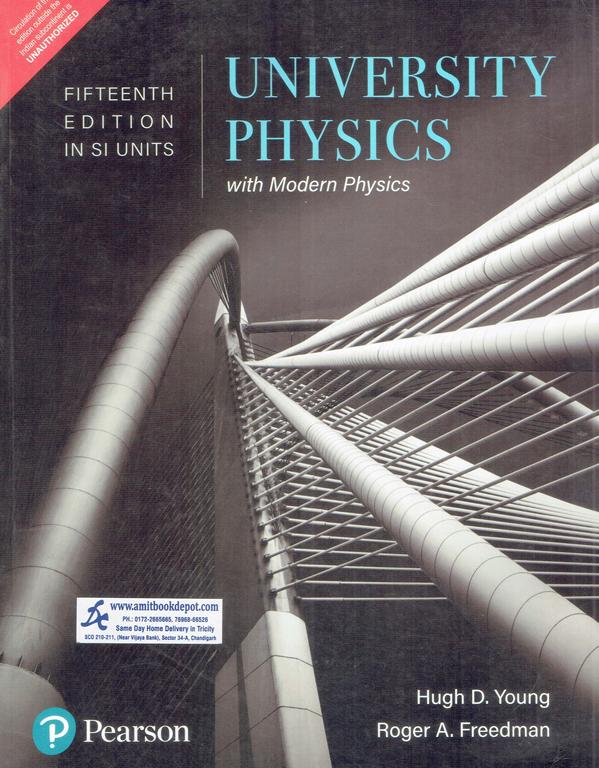


It dedicates Chapters 4 and 5 to introducing and applying Newton’s laws with step-by-step problem-solving strategies, real-world examples, and bridging problems.
Yes. Chapters 2-3 cover linear motion, while Chapters 9-10 focus on rotation of rigid bodies and rotational dynamics, including torque and angular momentum.
Yes, Chapter 12 provides a comprehensive treatment of fluid mechanics, covering pressure, buoyancy, fluid flow, and Bernoulli’s equation.
Chapters 17-20 cover temperature, heat, thermal properties, first and second laws of thermodynamics, including entropy and heat engines.
Yes. Chapters 25-26 treat current, resistance, emf, and direct-current circuits, including Kirchhoff’s rules and RC circuits.
Chapter 27 covers magnetic forces on charges and currents; Chapter 28 details sources of magnetic field via Biot-Savart and Ampère’s laws.
Yes, Chapter 29 focuses on Faraday’s law, Lenz’s law, and motional emf, supported by quantitative problem sets.
Chapters 33-36 explain light propagation, geometric optics (mirrors/lenses), interference, and diffraction with wave optics.
Yes. Chapters 40-41 introduce wave functions, quantum mechanics, and atomic structure, including the Schrödinger equation conceptually.
Chapter 44 covers particle physics and cosmology, including standard model, quarks, leptons, and early universe concepts.
No Description Added
It dedicates Chapters 4 and 5 to introducing and applying Newton’s laws with step-by-step problem-solving strategies, real-world examples, and bridging problems.
Yes. Chapters 2-3 cover linear motion, while Chapters 9-10 focus on rotation of rigid bodies and rotational dynamics, including torque and angular momentum.
Yes, Chapter 12 provides a comprehensive treatment of fluid mechanics, covering pressure, buoyancy, fluid flow, and Bernoulli’s equation.
Chapters 17-20 cover temperature, heat, thermal properties, first and second laws of thermodynamics, including entropy and heat engines.
Yes. Chapters 25-26 treat current, resistance, emf, and direct-current circuits, including Kirchhoff’s rules and RC circuits.
Chapter 27 covers magnetic forces on charges and currents; Chapter 28 details sources of magnetic field via Biot-Savart and Ampère’s laws.
Yes, Chapter 29 focuses on Faraday’s law, Lenz’s law, and motional emf, supported by quantitative problem sets.
Chapters 33-36 explain light propagation, geometric optics (mirrors/lenses), interference, and diffraction with wave optics.
Yes. Chapters 40-41 introduce wave functions, quantum mechanics, and atomic structure, including the Schrödinger equation conceptually.
Chapter 44 covers particle physics and cosmology, including standard model, quarks, leptons, and early universe concepts.