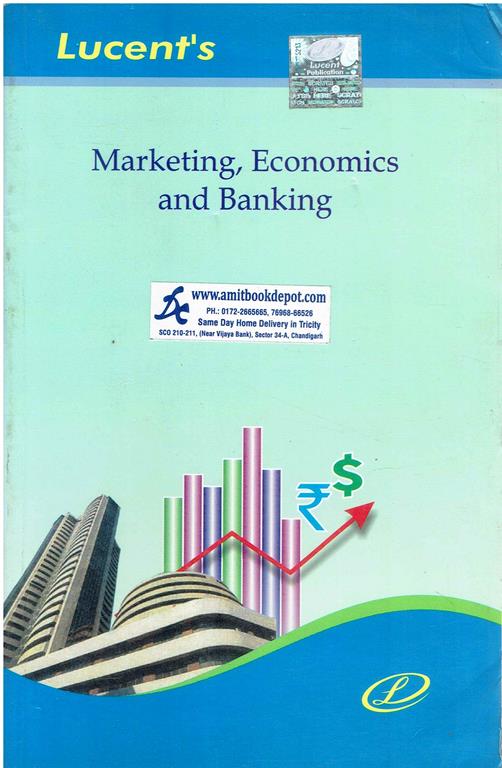
Marketing Economics and Banking by Dr. Dezy Kumari, published by Lucent Publication, is a definitive academic resource meticulously crafted to bridge the core principles of marketing management, economics, and banking operations. This comprehensive book serves as an indispensable guide for undergraduate and postgraduate students pursuing degrees in commerce, business administration (BBA, MBA), and professional courses, as well as for aspirants of competitive examinations requiring in-depth knowledge of these interconnected fields.
The book’s structured table of contents provides a logical progression from foundational marketing concepts to advanced economic theories and banking fundamentals. It begins with a thorough introduction to marketing, establishing the groundwork before delving into the critical components of the marketing mix (4Ps). Learners gain practical insights into marketing segmentation, branding and packaging, and the strategic management of the product life cycle. The exploration extends to the promotional mix, consumer behavior analysis, channels of distribution, and strategic pricing decisions, equipping readers with the tools to formulate effective market strategies. A dedicated section on marketing research and modern marketing trends ensures the content remains relevant to today’s dynamic digital marketplace.
Seamlessly transitioning, the text delves into the macroeconomic environment crucial for any business decision-maker. Key topics such as national income accounting, the structure of taxation in India, and the complexities of the balance of payments are explained with clarity. The book further examines the role of international organizations like the IMF and WTO in shaping global economic policy. Core economic concepts of money and inflation are addressed, alongside a detailed analysis of the capital market and financial institutions, providing readers with a solid understanding of the financial landscape in which businesses operate.
The final segment offers a robust foundation in banking, covering essential principles, functions, and contemporary practices of the banking sector. This integration is vital, as modern marketing and economic policies are deeply intertwined with banking mechanisms. The inclusion of an extensive economic glossary & acronyms serves as a valuable quick-reference tool, aiding in the retention and clarification of key terminologies.
Authored by the esteemed Dr. Dezy Kumari, this book is characterized by its lucid language, well-organized syllabus, and pedagogical effectiveness. Complex theories are broken down into digestible sections, supported by illustrative examples and a structured format ideal for both systematic study and last-minute revision. Published by Lucent Publication, renowned for its high-quality academic and competitive exam preparation material, this volume upholds a standard of excellence in content accuracy and presentation.
Marketing Economics and Banking is more than a book; it is a holistic reference manual designed to build a strong conceptual framework. It empowers students to understand how marketing strategies are formulated within broader economic constraints and opportunities and how banking instruments facilitate commercial activities. Whether for acing university examinations, preparing for UPSC, SSC, or banking sector entrances like IBPS and RBI, or simply for building a professional knowledge base, this book is an essential addition to any learner's library. Its comprehensive coverage, aligning with standard university curricula, makes it a trusted resource for achieving academic proficiency and professional competency in the converging domains of marketing, economics, and finance.










.jpg)