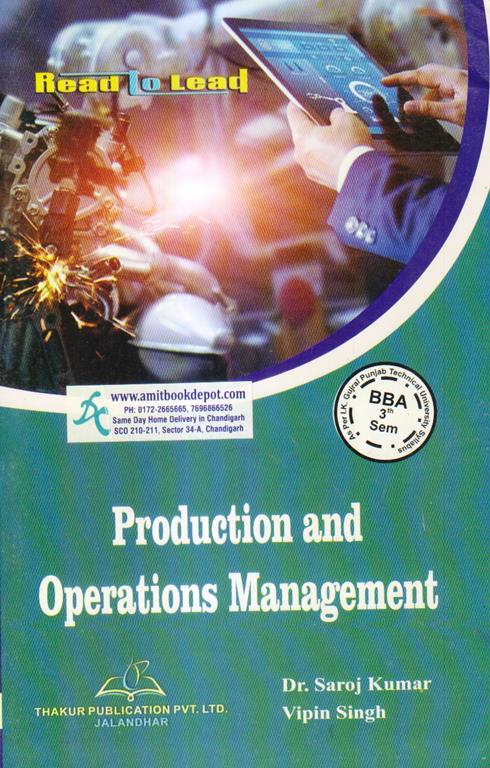
Thakur production and operations management bba 3rd sem
Thakur production and operations management bba 3rd sem
by Madhurima
₹200₹200.00(-/
off)
Rating & Reviews
23 Customer Review
Thakur's Production and Operations Management is the prescribed book for BBA 3rd semester students of Punjab Technical University (PTU). Authored by Dr. Saroj Kumar and Vipin Singh, this comprehensive guide covers the entire BBA-304 syllabus, including product design, process selection, facility location, capacity planning, and PPC. It introduces modern techniques like JIT, TQM, Six Sigma, and Kanban, and delves deep into inventory management and quality management. With chapter-end exercises, this book from Thakur Publishers is an essential resource for building a strong foundation in operations management concepts and excelling in academic examinations.
Thakur Production and Operations Management for BBA 3rd Semester (PTU) by Dr. Saroj Kumar and Vipin Singh is a meticulously crafted book designed to provide students with a comprehensive and practical understanding of the core principles and contemporary practices in the field of Production and Operations Management (POM). Published by Thakur Publishers, this book is an indispensable resource tailored specifically to the syllabus prescribed by Punjab Technical University (PTU) for its BBA 304 course.
The primary objective of this book is to equip future business managers with the knowledge and skills necessary to optimize organizational processes in both manufacturing and service sectors. It begins by establishing a solid foundation, explaining the fundamental concepts and functions of operations management and its critical role in achieving competitive advantage in today's uncertain business environment. The book systematically guides students through the entire product lifecycle, starting with product design and development, detailing the technical processes and techniques involved in bringing a concept to market.
A significant focus is placed on strategic decision-making areas such as process selection, where students learn about project, job, batch, mass, and process types of production systems. The book provides an in-depth analysis of facility location, exploring the importance, factors, and analytical techniques for optimal placement, and facility layout, covering its objectives, advantages, and basic types. Furthermore, it delves into capacity planning, discussing the concepts, affecting factors, and key decisions, and thoroughly explains the objectives and functions of production planning and control (PPC), a vital function for ensuring operational efficiency.
Staying current with modern industry trends, this book offers a robust introduction to modern productivity techniques. It includes dedicated chapters on globally recognized methodologies such as Just-in-Time (JIT), the Kanban System, Total Quality Management (TQM), and Six Sigma. These sections are crucial for students to appreciate how lean management and quality excellence are pursued in contemporary organizations. The book also covers essential functions like purchasing management, detailing its objectives, methods, and procedures, and introduces advanced concepts like value analysis for cost reduction and the innovative virtual factory concept.
The final section of the book addresses two critical pillars of operations: inventory management and control and quality management. It breaks down complex topics like the Economic Order Quantity (EOQ) Model, Reorder Level, ABC Analysis, and various inventory costs. The Quality Management chapter is particularly extensive, distinguishing between quality control, quality assurance, and total quality management. It introduces the Taguchi Philosophy, Quality Circles (QCs), Statistical Process Control (SPC), Inspection, and Acceptance Sampling, providing a holistic view of quality management systems.
Structured to align perfectly with the PTU syllabus, each chapter is reinforced with a dedicated exercise section, enabling students to test their understanding and prepare effectively for examinations. With its clear language, logical flow from concepts to applications, and coverage of both traditional and modern topics, this book is the definitive academic companion for BBA students at PTU aiming to master Production and Operations Management and develop the skills to operate competitively in the current business scenario.
Is this book strictly aligned with the latest PTU syllabus for BBA 3rd Semester, BBA-304?
A1
Yes, this book, "Thakur Production and Operations Management," is specifically written and structured to cover the entire official syllabus for BBA-304 as prescribed by Punjab Technical University (PTU).
Q2
Does the book include sections on modern productivity techniques like Six Sigma and TQM?
A2
Absolutely. Unit III of the book has dedicated chapters covering modern productivity techniques, including detailed explanations of Just-in-Time (JIT), Kanban, Total Quality Management (TQM), and Six Sigma.
Q3
I am struggling with the difference between Quality Control and Quality Assurance. Does this book clarify these concepts?
A3
Yes, Chapter 10 on Quality Management explicitly distinguishes between key concepts like Inspection, Quality Control, Quality Assurance, and Total Quality Management, making it easier for students to understand their unique roles.
Q4
Does the textbook explain quantitative models used in Inventory Management?
A4
Yes, the book covers fundamental inventory models, including the basic Economic Order Quantity (EOQ) Model, and explains concepts like Reorder Level and ABC Analysis in the Inventory Management & Control chapter.
Q5
Is the concept of a 'Virtual Factory' covered in this text?
A5
Yes, Chapter 8 includes a specific section on the "Virtual Factory" concept, introducing students to this modern and advanced operational model.
Q6
Are the topics of Facility Location and Layout covered in detail?
A6
Yes, Unit II provides a comprehensive analysis of both Facility Location (including factors and analysis techniques) and Facility Layout (including objectives and types of layouts).
Q7
Does the book cover Production Planning and Control (PPC)?
A7
Yes, Chapter 5 is dedicated to Capacity Planning & PPC, where the concepts, objectives, and functions of Production Planning and Control are explained in detail.
Q8
What types of production systems are discussed in the book?
A8
The book covers the fundamental types of production systems, including Project, Job, Batch, Mass, and Process types, in Chapter 3: Process Selection & Production System.
Q9
Is Value Analysis, a technique for cost reduction, included in the syllabus coverage?
A9
Yes, Value Analysis is covered as a key concept in Chapter 8: Value Analysis & Virtual Factory.
Q10
Does the book provide an introduction to Statistical Process Control (SPC)?
A10
Yes, Statistical Process Control (SPC) is one of the topics covered under the broad umbrella of Quality Management in Chapter 10.
0.00
0 Overall Rating
5
0
4
0
3
0
2
0
1
0
Try this product & share your review &
thoughts
UNIT - I
Chapter 1: Production and Operations Management
1. Production and Operations Management
2. Exercise
Chapter 2: Product Design & Development
1. Product Design
2. Product Development
3. Exercise
Chapter 3: Process Selection & Production System
1. Process Selection
2. Production System
3. Exercise
UNIT - II
Chapter 4: Facility Location & Layout
1. Facility Location
2. Facility Layout
3. Exercise
Chapter 5: Capacity Planning & PPC
1. Capacity Planning
2. Production Planning and Control (PPC)
3. Exercise
UNIT - III
Chapter 6: Modern Productivity Techniques
1. Just-in-Time (JIT)
2. Kanban System
3. Total Quality Management (TQM)
4. Six Sigma
5. Exercise
Chapter 7: Purchasing Management
1. Purchasing Management
2. Exercise
Chapter 8: Value Analysis & Virtual Factory
1. Value Analysis
2. Virtual Factory
3. Exercise
UNIT - IV
Chapter 9: Inventory Management & Control
1. Inventory Management
2. Inventory Control
3. Exercise
Chapter 10: Quality Management
1. Quality
2. Taguchi Philosophy
3. Quality Management
4. Quality Control
5. Quality Assurance
6. Quality Circles (QCs)
7. SPC (Statistical Process Control)
8. Inspection
9. Acceptance Sampling
10. Exercise
BBA-304 Production and Operations Management
Course objective: The course aims at developing knowledge about various steps of product design, development, plant location, storage, production planning, and control.
Course Outcomes (COs): After completion of the course, the students shall be able to:
CO1: Understand the ever-growing importance of production and operations management in an uncertain business environment.
CO₂: Gain an in-depth understanding of resource utilization of an organization.
CO3: Appreciate the unique challenges faced by firms in services and manufacturing.
CO4: Understand the subject as a crucial part of functional management.
CO5: Develop skills to operate competitively in the current business scenario.
UNIT I
Operations management: Concept, functions. Product Design and Development – Product design and its characteristics: Product development process (technical): Product development techniques. Process selection—project, job, batch, mass, and process types of Production Systems.
UNIT - II
Facility Location – Importance, Factors in Location Analysis: Location Analysis Techniques. Facility Layout – Objectives: Advantages: Basic types of layouts. Capacity Planning – Concepts: Factors Affecting Capacity Planning, Capacity Planning Decisions. Production Planning & Control (PPC)—Concepts, Objectives, and Functions.
UNIT – III
Introduction to modern productivity techniques—just in time, Kanban system. Total Quality Management & Six Sigma.
Functions of Purchasing Management – Objectives, Functions, Methods, and Procedure. Value analysis – Concepts. Stock control systems. Virtual factory concept.
UNIT – IV
Inventory Management – Concepts, Classification: Objectives: Factors Affecting Inventory Control Policy: Inventory costs: Basic EOQ Model: Reorder Level: ABC Analysis. Quality Management—Quality Concepts, Difference between Inspections, Quality Control, Quality Assurances, Total Quality Management: Control Charts: acceptance sampling.
Thakur Production and Operations Management for BBA 3rd Semester (PTU) by Dr. Saroj Kumar and Vipin Singh is a meticulously crafted book designed to provide students with a comprehensive and practical understanding of the core principles and contemporary practices in the field of Production and Operations Management (POM). Published by Thakur Publishers, this book is an indispensable resource tailored specifically to the syllabus prescribed by Punjab Technical University (PTU) for its BBA 304 course.
The primary objective of this book is to equip future business managers with the knowledge and skills necessary to optimize organizational processes in both manufacturing and service sectors. It begins by establishing a solid foundation, explaining the fundamental concepts and functions of operations management and its critical role in achieving competitive advantage in today's uncertain business environment. The book systematically guides students through the entire product lifecycle, starting with product design and development, detailing the technical processes and techniques involved in bringing a concept to market.
A significant focus is placed on strategic decision-making areas such as process selection, where students learn about project, job, batch, mass, and process types of production systems. The book provides an in-depth analysis of facility location, exploring the importance, factors, and analytical techniques for optimal placement, and facility layout, covering its objectives, advantages, and basic types. Furthermore, it delves into capacity planning, discussing the concepts, affecting factors, and key decisions, and thoroughly explains the objectives and functions of production planning and control (PPC), a vital function for ensuring operational efficiency.
Staying current with modern industry trends, this book offers a robust introduction to modern productivity techniques. It includes dedicated chapters on globally recognized methodologies such as Just-in-Time (JIT), the Kanban System, Total Quality Management (TQM), and Six Sigma. These sections are crucial for students to appreciate how lean management and quality excellence are pursued in contemporary organizations. The book also covers essential functions like purchasing management, detailing its objectives, methods, and procedures, and introduces advanced concepts like value analysis for cost reduction and the innovative virtual factory concept.
The final section of the book addresses two critical pillars of operations: inventory management and control and quality management. It breaks down complex topics like the Economic Order Quantity (EOQ) Model, Reorder Level, ABC Analysis, and various inventory costs. The Quality Management chapter is particularly extensive, distinguishing between quality control, quality assurance, and total quality management. It introduces the Taguchi Philosophy, Quality Circles (QCs), Statistical Process Control (SPC), Inspection, and Acceptance Sampling, providing a holistic view of quality management systems.
Structured to align perfectly with the PTU syllabus, each chapter is reinforced with a dedicated exercise section, enabling students to test their understanding and prepare effectively for examinations. With its clear language, logical flow from concepts to applications, and coverage of both traditional and modern topics, this book is the definitive academic companion for BBA students at PTU aiming to master Production and Operations Management and develop the skills to operate competitively in the current business scenario.
Is this book strictly aligned with the latest PTU syllabus for BBA 3rd Semester, BBA-304?
A1
Yes, this book, "Thakur Production and Operations Management," is specifically written and structured to cover the entire official syllabus for BBA-304 as prescribed by Punjab Technical University (PTU).
Q2
Does the book include sections on modern productivity techniques like Six Sigma and TQM?
A2
Absolutely. Unit III of the book has dedicated chapters covering modern productivity techniques, including detailed explanations of Just-in-Time (JIT), Kanban, Total Quality Management (TQM), and Six Sigma.
Q3
I am struggling with the difference between Quality Control and Quality Assurance. Does this book clarify these concepts?
A3
Yes, Chapter 10 on Quality Management explicitly distinguishes between key concepts like Inspection, Quality Control, Quality Assurance, and Total Quality Management, making it easier for students to understand their unique roles.
Q4
Does the textbook explain quantitative models used in Inventory Management?
A4
Yes, the book covers fundamental inventory models, including the basic Economic Order Quantity (EOQ) Model, and explains concepts like Reorder Level and ABC Analysis in the Inventory Management & Control chapter.
Q5
Is the concept of a 'Virtual Factory' covered in this text?
A5
Yes, Chapter 8 includes a specific section on the "Virtual Factory" concept, introducing students to this modern and advanced operational model.
Q6
Are the topics of Facility Location and Layout covered in detail?
A6
Yes, Unit II provides a comprehensive analysis of both Facility Location (including factors and analysis techniques) and Facility Layout (including objectives and types of layouts).
Q7
Does the book cover Production Planning and Control (PPC)?
A7
Yes, Chapter 5 is dedicated to Capacity Planning & PPC, where the concepts, objectives, and functions of Production Planning and Control are explained in detail.
Q8
What types of production systems are discussed in the book?
A8
The book covers the fundamental types of production systems, including Project, Job, Batch, Mass, and Process types, in Chapter 3: Process Selection & Production System.
Q9
Is Value Analysis, a technique for cost reduction, included in the syllabus coverage?
A9
Yes, Value Analysis is covered as a key concept in Chapter 8: Value Analysis & Virtual Factory.
Q10
Does the book provide an introduction to Statistical Process Control (SPC)?
A10
Yes, Statistical Process Control (SPC) is one of the topics covered under the broad umbrella of Quality Management in Chapter 10.
BBA-304 Production and Operations Management
Course objective: The course aims at developing knowledge about various steps of product design, development, plant location, storage, production planning, and control.
Course Outcomes (COs): After completion of the course, the students shall be able to:
CO1: Understand the ever-growing importance of production and operations management in an uncertain business environment.
CO₂: Gain an in-depth understanding of resource utilization of an organization.
CO3: Appreciate the unique challenges faced by firms in services and manufacturing.
CO4: Understand the subject as a crucial part of functional management.
CO5: Develop skills to operate competitively in the current business scenario.
UNIT I
Operations management: Concept, functions. Product Design and Development – Product design and its characteristics: Product development process (technical): Product development techniques. Process selection—project, job, batch, mass, and process types of Production Systems.
UNIT - II
Facility Location – Importance, Factors in Location Analysis: Location Analysis Techniques. Facility Layout – Objectives: Advantages: Basic types of layouts. Capacity Planning – Concepts: Factors Affecting Capacity Planning, Capacity Planning Decisions. Production Planning & Control (PPC)—Concepts, Objectives, and Functions.
UNIT – III
Introduction to modern productivity techniques—just in time, Kanban system. Total Quality Management & Six Sigma.
Functions of Purchasing Management – Objectives, Functions, Methods, and Procedure. Value analysis – Concepts. Stock control systems. Virtual factory concept.
UNIT – IV
Inventory Management – Concepts, Classification: Objectives: Factors Affecting Inventory Control Policy: Inventory costs: Basic EOQ Model: Reorder Level: ABC Analysis. Quality Management—Quality Concepts, Difference between Inspections, Quality Control, Quality Assurances, Total Quality Management: Control Charts: acceptance sampling.
Classic Literature Reimagined: Discuss modern twists on classic novels.
Lorem ipsum dolor sit amet, consectetur adipiscing elit, sed
do
eiusmod tempor incididunt ut labore et dolore magna aliqua. Ut enim ad minim
veniam, quis nostrud exercitation ullamco Lorem ipsum dolor sit amet,
consectetur adipiscing elit, sed do eiusmod tempor incididunt ut labore et
dolore magna aliqua. Utenim ad minim veniam, quis nostrud exercitation
ullamco
Lorem ipsum dolor sit amet, consecte...
Classic Literature Reimagined: Discuss modern twists on classic novels.
Lorem ipsum dolor sit amet, consectetur adipiscing elit, sed
do
eiusmod tempor incididunt ut labore et dolore magna aliqua. Ut enim ad minim
veniam, quis nostrud exercitation ullamco Lorem ipsum dolor sit amet,
consectetur adipiscing elit, sed do eiusmod tempor incididunt ut labore et
dolore magna aliqua. Utenim ad minim veniam, quis nostrud exercitation
ullamco
Lorem ipsum dolor sit amet, consecte...
Classic Literature Reimagined: Discuss modern twists on classic novels.
Lorem ipsum dolor sit amet, consectetur adipiscing elit, sed
do
eiusmod tempor incididunt ut labore et dolore magna aliqua. Ut enim ad minim
veniam, quis nostrud exercitation ullamco Lorem ipsum dolor sit amet,
consectetur adipiscing elit, sed do eiusmod tempor incididunt ut labore et
dolore magna aliqua. Utenim ad minim veniam, quis nostrud exercitation
ullamco
Lorem ipsum dolor sit amet, consecte...