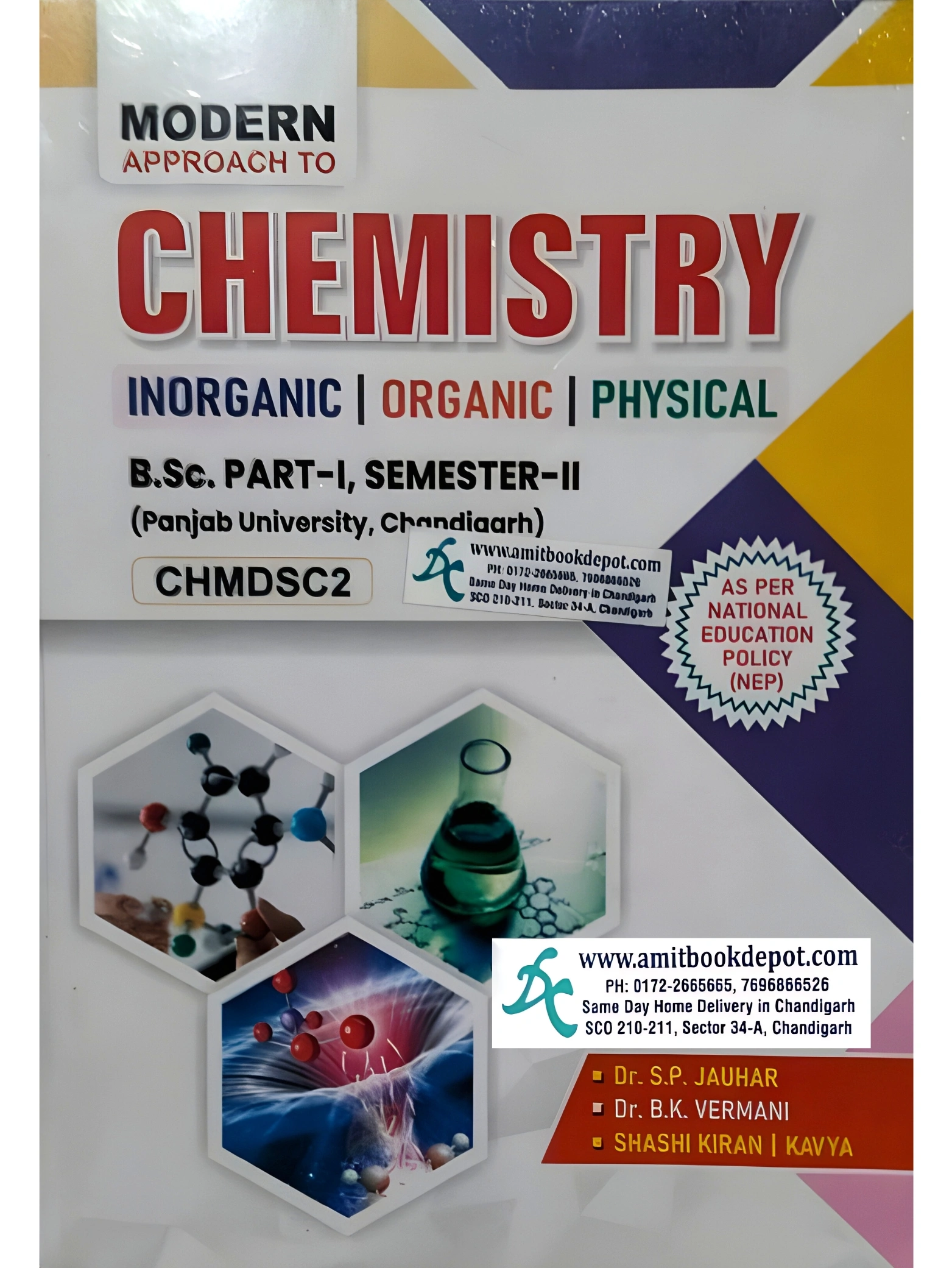

Yes, this book is meticulously crafted to align 100% with the latest syllabus prescribed for the CHMDSC2 course under the New Education Policy (NEP) by Panjab University, Chandigarh.
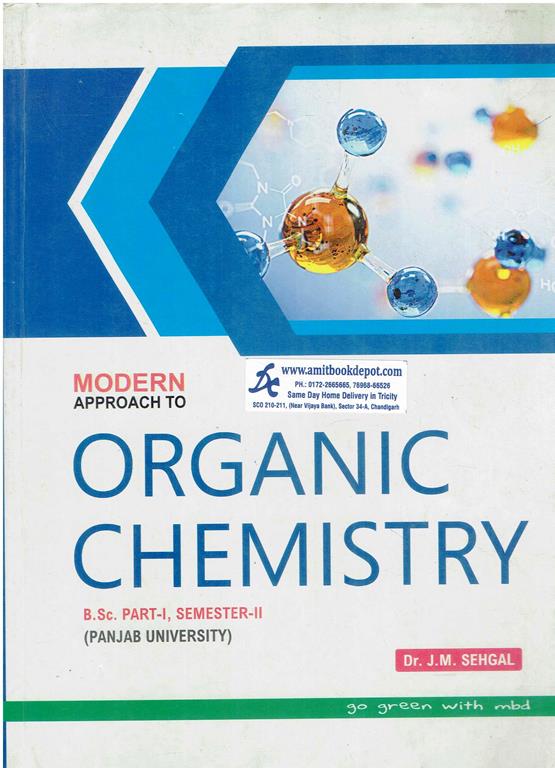
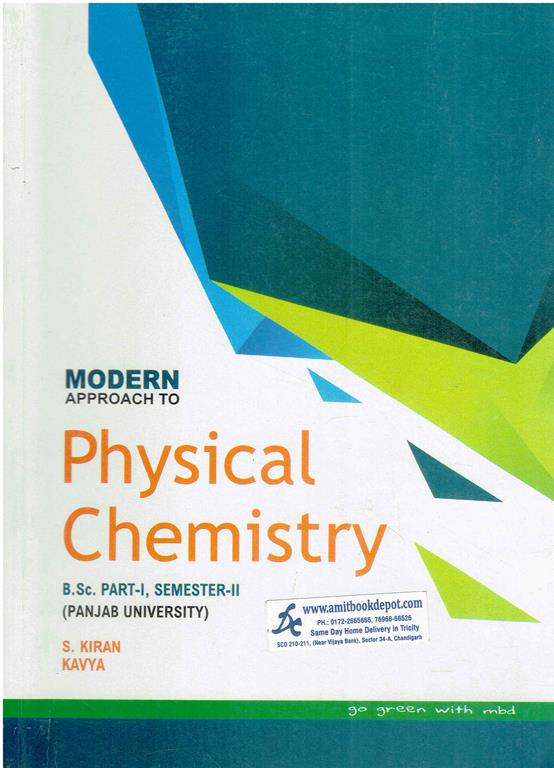
Absolutely. It provides complete coverage of the prescribed topics in Inorganic Chemistry (Chemical Bonding I & II), Organic Chemistry (Alkanes & Stereochemistry), and Physical Chemistry (Gaseous State & Thermodynamics I).
Yes, the book provides a detailed, step-by-step explanation of reaction mechanisms, including the free radical mechanism for the halogenation of alkanes, discussing reactivity and selectivity.
These topics are broken down with clear explanations, illustrative examples of molecules (like CO, CN-, ClF₃, etc.), and diagrams to help students visualize and thoroughly understand the concepts.
Yes, the book dedicates a significant portion to Stereochemistry, with dedicated sections that clearly explain and illustrate how to draw and interpret Sawhorse, Newman, Flying Edge, and Fischer Projections.
While the focus is on conceptual clarity and theory as per the syllabus, the book provides the foundational principles and formulas needed to understand and solve numerical problems related to work, heat, internal energy, and the gaseous state.
Yes, the application of the Born-Haber cycle for calculating lattice energy is explained in a structured and easy-to-understand manner in the Chemical Bonding-II chapter.
The book is written in a clear, concise, and student-friendly manner. The logical flow and simplified explanations make it an excellent resource for self-study alongside classroom learning.
The book is updated as per the latest syllabus and modern conventions, ensuring that the IUPAC nomenclature taught is current and standardized.
Yes, it comprehensively covers the behavior of real gases, the Van der Waals equation, and critical phenomena like PV isotherms and the law of corresponding states.
No Description Added
Yes, this book is meticulously crafted to align 100% with the latest syllabus prescribed for the CHMDSC2 course under the New Education Policy (NEP) by Panjab University, Chandigarh.
Absolutely. It provides complete coverage of the prescribed topics in Inorganic Chemistry (Chemical Bonding I & II), Organic Chemistry (Alkanes & Stereochemistry), and Physical Chemistry (Gaseous State & Thermodynamics I).
Yes, the book provides a detailed, step-by-step explanation of reaction mechanisms, including the free radical mechanism for the halogenation of alkanes, discussing reactivity and selectivity.
These topics are broken down with clear explanations, illustrative examples of molecules (like CO, CN-, ClF₃, etc.), and diagrams to help students visualize and thoroughly understand the concepts.
Yes, the book dedicates a significant portion to Stereochemistry, with dedicated sections that clearly explain and illustrate how to draw and interpret Sawhorse, Newman, Flying Edge, and Fischer Projections.
While the focus is on conceptual clarity and theory as per the syllabus, the book provides the foundational principles and formulas needed to understand and solve numerical problems related to work, heat, internal energy, and the gaseous state.
Yes, the application of the Born-Haber cycle for calculating lattice energy is explained in a structured and easy-to-understand manner in the Chemical Bonding-II chapter.
The book is written in a clear, concise, and student-friendly manner. The logical flow and simplified explanations make it an excellent resource for self-study alongside classroom learning.
The book is updated as per the latest syllabus and modern conventions, ensuring that the IUPAC nomenclature taught is current and standardized.
Yes, it comprehensively covers the behavior of real gases, the Van der Waals equation, and critical phenomena like PV isotherms and the law of corresponding states.