Categories
College Bookssss >
BA PU Chandigarh
BSC PU Chandigarh
MSC PU Chandigarh
BBA PU Chandigarh
MA PU Chandigarh
Medical Books
Engineering Books
Management Books
PGDCA Books
BCOM PU Chandigarh
MCOM PU Chandigarh
BCA PU Chandigarh
MCA PU Chandigarh
animate-books

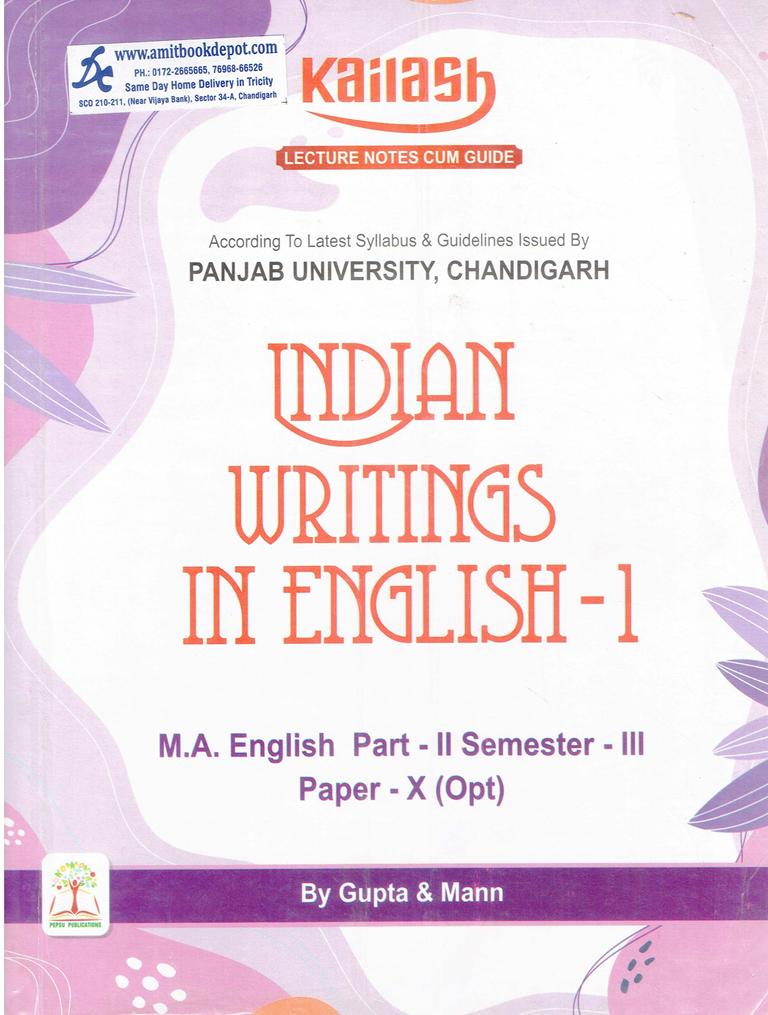
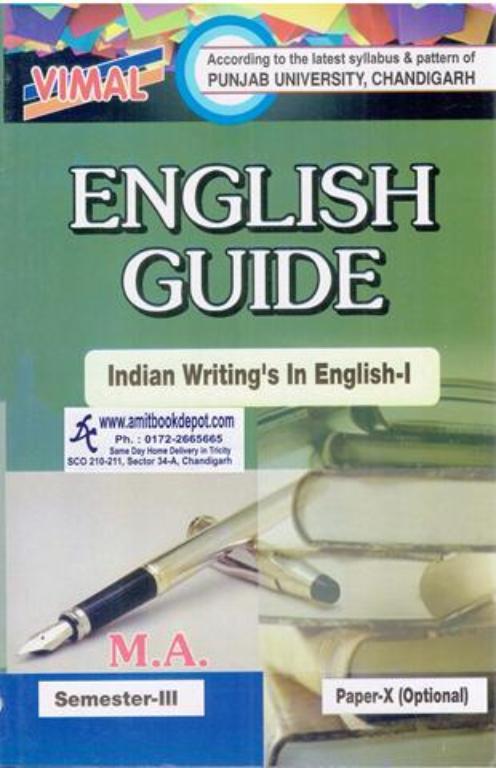
Kailash Indian Writings In English 1 For MA English Part 2 Semester 3rd Paper 10 Panjab University Chandigarh

by Madhurima
₹600 ₹600.00(-/ off)

Rating & Reviews

23 Customer Review

Kailash Indian Writings in English 1 is the prescribed academic guide for MA English Part 2, Semester 3, Paper 10 at Panjab University, Chandigarh. Authored by Gupta and Mann and published by Pepsu Book Depot, this comprehensive book provides detailed analysis of the complete syllabus. It covers Non-Fictional Prose by Tagore, Mehrotra, and Chaudhuri; Fiction by Raja Rao (Kanthapura) and Githa Hariharan (The Thousand Faces of Night); and Poetry by Ramanujan, Kolatkar, and Agha Shahid Ali. Designed for exam success, it includes summaries, critical insights, character sketches, and important questions for thorough preparation.

Have Doubts Regarding This Product ? Ask Your Question

  • Q1
    Is this book Kailash Indian Writings In English 1 the latest edition prescribed for Panjab University's MA English Semester 3, Paper 10 syllabus?
    A1

    Yes, this volume by Gupta and Mann is specifically tailored to cover the current syllabus for Panjab University's MA English Part 2, Semester 3, Paper 10 (Indian Writings in English – I).

  • Q2
    Does this guide include the complete text of novels like Kanthapura and The Thousand Faces of Night, or is it a critical analysis?
    A2

    This is a critical guide and study companion. It does not contain the full original texts but provides exhaustive summaries, detailed analysis, character sketches, thematic explorations, and exam-oriented notes for all prescribed texts, including the novels.

  • Q3
    Which poets from the syllabus are covered in the Poetry unit?
    A3

    The Poetry unit comprehensively covers A.K. Ramanujan ("Small-Scale Reflections on a Great House"), Arun Kolatkar ("Meera" and "Knucklebones" from Kala Ghoda Poems), and Agha Shahid Ali ("The Dacca Gauzes" and "Beyond English" from The Veiled Suite).

  • Q4
    Are the essays by Tagore, Mehrotra, and Amit Chaudhuri fully reproduced in this book?
    A4

    The book provides detailed explanations, critical perspectives, and analysis of these essays. For the complete original essays, students should refer to the source anthologies mentioned in the university syllabus, but this guide offers all necessary critical content for exam preparation.

  • Q5
    Does the analysis of Kanthapura discuss its narrative technique and Gandhian influence?
    A5

    Yes, in depth. The guide dedicates sections to the "Mythical Technique," its form as a Sthala-Purana (regional legend), and a detailed examination of "The Impact of Gandhi in 'Kanthapura'."

  • Q6
    What approach does the book take towards Githa Hariharan's The Thousand Faces of Night?
    A6

    It offers a strong feminist and mythological interpretation, with dedicated sections on "Female Consciousness," "Remapping Mythology," "Journey of Women Characters," and "Feminist Interpretation."

  • Q7
    Are character sketches provided for all major characters in the prescribed fiction?
    A7

    Yes. For Kanthapura, sketches for Moorthy, Ratna, Patel Range Gowda, Bhatta, and others are included. For The Thousand Faces of Night, a detailed sketch of Devi and analysis of other women characters are provided.

  • Q8
    How is the section on Arvind Krishna Mehrotra's "The Emperor Has No Clothes" structured?
    A8

    It covers his life and works, the core arguments of his essay, and its significance in debates about Indian literature, including connections to translation (Prakrit, Bhakti verse) and his critical stance.

  • Q9
    Are the poetic analyses line-by-line or thematic?
    A9

    The guide provides a balanced approach. It includes detailed explanations and summaries of selected poems (like "Small-Scale Reflections on a Great House" and "Dacca Gauzes") and also broader analyses of thematic concerns, imagery, and poetic style for each poet.

  • Q10
    Does the book cover the historical context of Indian Writing in English as outlined in the syllabus introduction?
    A10

    Yes, the overall approach and unit introductions help students understand the journey of Indian Writing in English from its origins to its contemporary status, addressing issues of language, authenticity, and nationhood.

0.00

0 Overall Rating
  • 5
    0
  • 4
    0
  • 3
    0
  • 2
    0
  • 1
    0

Try this product & share your review & thoughts

UNIT-I Non-Fictional Prose
1. Nationalism in India (Rabindranath Tagore)

Life: An Introduction
Q. What do you know about Rabindranath Tagore? Describe.

Perception of Indian Nationalism
Q. Discuss Rabindranath Tagore's perception of Indian nationalism.

Nationalism in India
Q. How can you discuss nationalism and India as a recurring theme in the works of Tagore?

Analysis
Q. Write down an analysis of the book Nationalism written by Rabindranath Tagore.

Indian Nationalism
Q. Write a detailed note on Indian nationalism.

Tagore on Nationalism
Q. What Kind of Nationalism Do We Need Today? Discuss exploring Tagore on nationalism.

Application of Nationalism
Q. What did Tagore say in 'Nationalism,' and how does it apply today? Q.

Poet and Painter
Q. Discuss Rabindranath Tagore as a poet and painter.

Political Views
Q. Describe the political views of Rabindranath Tagore.

2. The Emperor Has No Clothes (Arvind Krishna Mehrotra)

Life and Works
Q. What do you know about the life and works of Arvind Krishna Mehrotra?

Against a Certain Idea of Writing
Q. What does Arvind Krishna Mehrotra's book of essays tell us about him?

Rhyme and Treason
Q. Describe Rhyme and Treason with special regard to the writer Arvind Krishna Mehrotra.

A Professor of Poetry
Q. How can you discuss Amit Chaudhuri as a professor of poetry?

Experience of Accident and Wonder
Q: How can you say that reading Arvind Krishna Mehrotra's poetry is an experience of accident and wonder?

Love Poetry and Bhakti Verse
Q. Describe Translating Indian vernacular literature by Arvind Krishna Mehrotra's English translations of Prakrit love poetry and bhakti verse.

3. The Construction of the Indian Novel in English (Amit Chaudhuri)

Life and Works
Q. What do you know about the life and works of Amit Chaudhuri?

Cultural Sensibility
Q. Describe the Mapping of Cultural Sensibility in the Novels of Amit Chaudhuri.

The Construction of the Indian Novel in English
Q. How can you discuss the construction of the Indian novel in English in your own words?

Regional Sensibility
Q. Discuss the regional sensibility in the novels of Amit Chaudhuri.

Social Transition
Q. How can you see social transition through the representation of home by a study of Amit Chaudhuri's novels?

Style and Language
Q. How can you write about the style and language of Amit Chaudhuri's novels?

Critical Study
Q. Give a critical study of Amit Chaudhuri's selected fiction.

Role of Life
Q. Discuss the Role of Life on the Writing Skills of Amit Chaudhuri.

UNIT-II Fiction-I
4. Kanthapura (Raja Rao)

Biographical Sketch and His Works
Q. Write down the biographical sketch and works of Raja Rao.

Introduction
Q. Write down an introduction and historical perspective to the novel Kanthapura.

Preface
Q. Write down the preface to the novel 'Kanthapura.'

Detailed Summary of the Novel
Q. Give a detailed summary of the novel in your own words.

Character Sketch of Moorthy or Moorthappa
Q. Sketch the character of Moorthy, or Moorthappa, in your own words.

Character Sketch of Ratna
Q. Sketch the character of Ratna in your own words.

Character Sketch of Patel Range Gowda
Q. Sketch the character of Patel Range Gowda.

Character Sketch of Bhatta
Q. Write down the character sketch of Bhatta in your own words.

Character Sketch of Narasamma and Rangamma
Q. Sketch the character of Narasamma and Rangamma.

Impact of Gandhi in 'Kanthapura'
Q. Examine the impact of Gandhi with special reference to 'Kanthapura.'

Significance of the Title
Q. Discuss the significance of the title of the novel 'Kanthapura.'
or
'Kanthapura' is a microcosm of modern India.
or
Kanthapura" is the hero of the novel. Discuss.

Mythical Technique
Q. Discuss the mythical technique as used by Raja Rao in his novel "Kanthapura."

As a Formless Novel
Q. Discuss 'Kahthapura' as a Formless Novel.

Theme of the Novel
Q. Discuss the theme of the novel 'Kanthapura'—Gandhi and our village.
or
Depict the presentation of the Gandhian freedom struggle in the novel.

Depiction of Women in the Novel
Q. Comment on the depiction of women in the novel Kanthapura.

Art of Characterization
Q. Discuss the art of characterization of 'Kanthapura.'
or
Discuss 'Kanthapura' as a Portrait-gallery.

As a Regional Novel
Q. 'Kanthapura' is a regional novel. How?
or
Discuss Kanthapura as a 'Sthala-Purana' novel.

UNIT-III Fiction-II
5. The Thousand Faces of Night (Githa Hariharan)

Life and Works
Q. Write down about the life and works of Githa Hariharan.

Introduction
Q. Give an introduction to The Thousand Faces of Night written by Githa Hariharan.

Struggle for Survival
Q. Discuss the struggle for survival in Githa Hariharan's The Thousand Faces of Night.

Female Consciousness
Q. Discuss Female Consciousness in Githa Hariharan's The Thousand Faces of Night.

As a Replica of Indian Heritage
Q. Replica of Indian Heritage. Q. Discuss Githa Hariharan's The Thousand Faces of Night: As a

Journey of Women Characters
Q. Describe the journey of women characters in Githa Hariharan's The Thousand Faces of Night.

Character Sketch of Devi
Q. Write down a character sketch of 'Devi' as a role model in The Thousand Faces of Night.

Relationship
Q. How is The Thousand Faces of Night a reading of the relationship between Indian myths and gender stereotypes?

Epitome of Women
Q. Describe the epitome of women characters in Githa Hariharan's The Thousand Faces of Night.

Remapping Mythology
Q. Faces of Night. Q. Describe Remapping Mythology in Githa Hariharan's The Thousand

Mindset of Women Characters
Q. Discuss the mindset of women characters in Githa Hariharan's novel The Thousand Faces of Night.

Feminist Interpretation
Q. Discuss the feminist interpretation of Githa Hariharan in "The Thousand Faces of Night."

Women at Crossroads
Q. Describe Woman at Crossroads in Githa Hariharan's The Thousand Faces of Night.

UNIT-IV Poetry
6. The Collected Poems (A.K. Ramanujan)

Life and Works
Q. Describe the life and works of A.K. Ramanujan.

Summary
Q. Write down the summary of the poem Small-Scale Reflections on a Great House.

Detailed Explanation
Q. Give a detailed explanation of the poem Small-Scale Reflections on a Great House.

Poetry Analysis
Q. Write down the meaning of A.K. Ramanujan's "Small-Scale Reflections on a Great House."

Style and Narrative Technique
Q. Describe the thematic concern, style, and narrative technique of A.K. Ramanujan's poems.

Thematic Study
Q. Write the thematic study on A.K. Ramanujan's poetry.

Poetic Style
Q. Discuss Ramanujan's poetic style in your own words.

Central Metaphor: Family
Q. Is family described as a central metaphor in the poetry of A.K. Ramanujan?

Selling the Home
Q. Discuss the quest for indigenous entity and metaphors of the self and the other in A.K. Ramanujan's poetry.

A Poet's Testament
Q. How can you describe A Poet's Testament with special regard to A.K. Ramanujan?

7. Kala Ghoda Poems (Arun Kolatkar)

Life and Works
Q. What do you know about the life and works of Arun Kolatkar?

Kala Ghoda Poems
Q. Discuss Kala Ghoda Poems as Anguish Brought by Hypocrisy of Progress, written by Arun Kolatkar.

Meera
Q. Give an analysis of the poem "Meera" by Arun Kolatkar.

Arun Kolatkar: A Modernist
Q. Discuss Arun Kolatkar as a modernist.

World Under His Verse
Q. How does Arun Kolatkar show his talent in taking the wretched world under his verse?

Knucklebones
Q. Discuss Knucklebones in a very detailed manner.

Urban Spaces in the Poetry of Arun Kolatkar
Q. How can you see urban spaces in the poetry of Arun Kolatkar?

8. The Veiled Suite (Agha Shahid Ali)

Life and Works
Q. What do you know about the life and works of Agha Shahid Ali?

The Veiled Suite
Q. What do you know about The Veiled Suite: The Collected Poems?

Summary
Q. Write down the summary of the Dacca Gauzes.

Summary
Q. Discuss Beyond English as a prelude against their selves.

Shahid Ali's Poetry
Q. How can you say that Shahid Ali's poetry is a home between the worlds?

The Dacca Gauzes: Analysis
Q. Write down a detailed analysis of Dacca Gauzes.

Imagery
Q. Describe imagery in Agha Shahid Ali's poetry.

Latest Syllabus of Indian Writings In English 1 For MA English Part 2 Semester 3rd Paper 10 Panjab University (PU) Chandigarh


Paper X
(Choose any one option.)
(1) Indian Writings (in English) – I

Indian Literature in English has captured the attention of readers both at home and abroad as it transforms the art of oral Indian narrative and indigenous experience in an adopted language, giving it a new dimension. The present course aims at presenting a sweep of Indian writing in English, representative of multiple genres and voices. Indian writers took to English as a consequence of the introduction of English as the medium of instruction by the British. From raising questions against the colonial enterprise to encapsulating the disillusionment of post-Independence India and receiving a definitive fillip in the 1980s, it has negotiated a convoluted terrain. And from being ‘twice born’ to flowering into a playful, self-conscious writing, it indeed has been a long journey. The course aims at acquainting students with the diverse range of Indian writing in English. Further, the list of texts will call for a thorough contextual discussion, as the genre has grappled with contentious issues of authenticity, language, nation, identity, and idiom. The paper has 5 units. The testing pattern will include one question with internal choice from each unit. All questions will be compulsory.

Unit 1: Non-Fictional Prose

1. Rabindranath Tagore, “Nationalism in India,” Nationalism (BoD, 2018), 41-55.
2. Arvind Krishna Mehrotra, “From “The Emperor Has No Clothes,” ed. Amit Chaudhuri, The Picador Book of Modern Indian Literature (New Delhi: Picador, 2001), 456-477.
3. Amit Chaudhuri, “The Construction of the Indian Novel in English,” ed. Amit Chaudhuri, The Picador Book of Modern Indian Literature (New Delhi: Picador, 2001) xxiii–xxxi.

Unit 2 Fiction I
1. Raja Rao. Kanthapura, New Delhi: Orient, 1971

Unit 3: Fiction II
2. Githa Hariharan. The Thousand Faces of Night. New Delhi: Penguin, 2008.

Unit 4 Poetry
1. A.K. Ramanujan: “Extended Family” and “Small Scale Reflections on a Great House,” The Collected Poems of A.K. Ramanujan (Delhi: OUP, 1995)
2. Arun Kolatkar: “Meera” (26-33) and “Knucklebones” (66-69), Kala Ghoda Poems (Mumbai, Pras Prakashan, 2004) 
3. Agha Shahid Ali: “The Dacca Gauzes” and “Beyond English” from The Veiled Suite—The Collected Poems. WW Norton & Company, 2009.

Unit 5 Drama
1. Mahesh Dattani. Final Solutions. Oxford University Press, 2005.

Kailash Indian Writings In English 1 is an indispensable and comprehensive academic resource meticulously designed for students pursuing the Master of Arts (MA) in English, Part 2, Semester 3, under the syllabus of Panjab University, Chandigarh. Authored by experts Gupta and Mann and published by the reputable Pepsu Book Depot, this book serves as the definitive guide for Paper 10: Indian Writings in English – I. It provides an exhaustive, unit-wise analysis of the prescribed texts, aligning perfectly with the university's curriculum to ensure complete syllabus coverage and exam preparedness.

This critical guide delves into the rich tapestry of Indian literature composed in English, exploring its evolution from a colonial legacy to a vibrant, self-conscious literary tradition. The book is structured to facilitate a deep understanding of the genre's negotiation with complex themes such as nationalism, identity, post-colonial discourse, cultural sensibility, gender dynamics, and modernist expression. Each unit is crafted to not only present content but also to foster critical thinking and analytical skills essential for postgraduate success.

The content is systematically divided into four core units, mirroring the university syllabus. Unit I on Non-Fictional Prose offers profound insights into seminal essays. It includes a detailed exploration of Rabindranath Tagore's critique in "Nationalism in India," Arvind Krishna Mehrotra's incisive literary arguments in "The Emperor Has No Clothes," and Amit Chaudhuri's pivotal commentary on "The Construction of the Indian Novel in English." Each section provides author biographies, thematic discussions, and critical analyses, equipping students to tackle complex essay-based questions.

Unit II and Unit III focus on landmark fiction. The guide presents an in-depth study of Raja Rao's iconic novel Kanthapura, examining its narrative as a Gandhian epic, its mythical technique, and its status as a Sthala-Purana. For Githa Hariharan's The Thousand Faces of Night, the book provides a nuanced feminist interpretation, analyzing the journey of women characters, the remapping of Indian mythology, and the exploration of female consciousness within a contemporary Indian context. Character sketches, thematic explorations, and discussions on narrative style are extensively covered.

Unit IV is dedicated to poetry, offering meticulous explication of selected works from three major poets. For A.K. Ramanujan, poems like "Small-Scale Reflections on a Great House" are unpacked to reveal themes of family, memory, and tradition. Arun Kolatkar's Kala Ghoda Poems, including "Meera" and "Knucklebones," are analyzed for their modernist depiction of urban spaces and socio-political anguish. The section on Agha Shahid Ali's The Veiled Suite explores poems like "The Dacca Gauzes" and "Beyond English," focusing on themes of exile, loss, and lyrical imagery.

A key strength of this academic guide is its pedagogical design. Each chapter is reinforced with potential examination questions, detailed summaries, and analytical notes that break down complex literary concepts. This structure ensures that students are well-prepared for both long-form essays and short-note questions. The book acts as a complete, self-contained study companion, eliminating the need for multiple reference sources.

For MA English students at Panjab University, this volume is more than a book; it is a critical companion for mastering Paper 10. It bridges the gap between the prescribed syllabus and the high-level analytical responses expected in postgraduate examinations. By integrating detailed literary criticism with exam-focused content, Gupta and Mann's guide is an essential investment for achieving academic excellence in the study of Indian Writings in English.

UNIT-I Non-Fictional Prose
1. Nationalism in India (Rabindranath Tagore)

Life: An Introduction
Q. What do you know about Rabindranath Tagore? Describe.

Perception of Indian Nationalism
Q. Discuss Rabindranath Tagore's perception of Indian nationalism.

Nationalism in India
Q. How can you discuss nationalism and India as a recurring theme in the works of Tagore?

Analysis
Q. Write down an analysis of the book Nationalism written by Rabindranath Tagore.

Indian Nationalism
Q. Write a detailed note on Indian nationalism.

Tagore on Nationalism
Q. What Kind of Nationalism Do We Need Today? Discuss exploring Tagore on nationalism.

Application of Nationalism
Q. What did Tagore say in 'Nationalism,' and how does it apply today? Q.

Poet and Painter
Q. Discuss Rabindranath Tagore as a poet and painter.

Political Views
Q. Describe the political views of Rabindranath Tagore.

2. The Emperor Has No Clothes (Arvind Krishna Mehrotra)

Life and Works
Q. What do you know about the life and works of Arvind Krishna Mehrotra?

Against a Certain Idea of Writing
Q. What does Arvind Krishna Mehrotra's book of essays tell us about him?

Rhyme and Treason
Q. Describe Rhyme and Treason with special regard to the writer Arvind Krishna Mehrotra.

A Professor of Poetry
Q. How can you discuss Amit Chaudhuri as a professor of poetry?

Experience of Accident and Wonder
Q: How can you say that reading Arvind Krishna Mehrotra's poetry is an experience of accident and wonder?

Love Poetry and Bhakti Verse
Q. Describe Translating Indian vernacular literature by Arvind Krishna Mehrotra's English translations of Prakrit love poetry and bhakti verse.

3. The Construction of the Indian Novel in English (Amit Chaudhuri)

Life and Works
Q. What do you know about the life and works of Amit Chaudhuri?

Cultural Sensibility
Q. Describe the Mapping of Cultural Sensibility in the Novels of Amit Chaudhuri.

The Construction of the Indian Novel in English
Q. How can you discuss the construction of the Indian novel in English in your own words?

Regional Sensibility
Q. Discuss the regional sensibility in the novels of Amit Chaudhuri.

Social Transition
Q. How can you see social transition through the representation of home by a study of Amit Chaudhuri's novels?

Style and Language
Q. How can you write about the style and language of Amit Chaudhuri's novels?

Critical Study
Q. Give a critical study of Amit Chaudhuri's selected fiction.

Role of Life
Q. Discuss the Role of Life on the Writing Skills of Amit Chaudhuri.

UNIT-II Fiction-I
4. Kanthapura (Raja Rao)

Biographical Sketch and His Works
Q. Write down the biographical sketch and works of Raja Rao.

Introduction
Q. Write down an introduction and historical perspective to the novel Kanthapura.

Preface
Q. Write down the preface to the novel 'Kanthapura.'

Detailed Summary of the Novel
Q. Give a detailed summary of the novel in your own words.

Character Sketch of Moorthy or Moorthappa
Q. Sketch the character of Moorthy, or Moorthappa, in your own words.

Character Sketch of Ratna
Q. Sketch the character of Ratna in your own words.

Character Sketch of Patel Range Gowda
Q. Sketch the character of Patel Range Gowda.

Character Sketch of Bhatta
Q. Write down the character sketch of Bhatta in your own words.

Character Sketch of Narasamma and Rangamma
Q. Sketch the character of Narasamma and Rangamma.

Impact of Gandhi in 'Kanthapura'
Q. Examine the impact of Gandhi with special reference to 'Kanthapura.'

Significance of the Title
Q. Discuss the significance of the title of the novel 'Kanthapura.'
or
'Kanthapura' is a microcosm of modern India.
or
Kanthapura" is the hero of the novel. Discuss.

Mythical Technique
Q. Discuss the mythical technique as used by Raja Rao in his novel "Kanthapura."

As a Formless Novel
Q. Discuss 'Kahthapura' as a Formless Novel.

Theme of the Novel
Q. Discuss the theme of the novel 'Kanthapura'—Gandhi and our village.
or
Depict the presentation of the Gandhian freedom struggle in the novel.

Depiction of Women in the Novel
Q. Comment on the depiction of women in the novel Kanthapura.

Art of Characterization
Q. Discuss the art of characterization of 'Kanthapura.'
or
Discuss 'Kanthapura' as a Portrait-gallery.

As a Regional Novel
Q. 'Kanthapura' is a regional novel. How?
or
Discuss Kanthapura as a 'Sthala-Purana' novel.

UNIT-III Fiction-II
5. The Thousand Faces of Night (Githa Hariharan)

Life and Works
Q. Write down about the life and works of Githa Hariharan.

Introduction
Q. Give an introduction to The Thousand Faces of Night written by Githa Hariharan.

Struggle for Survival
Q. Discuss the struggle for survival in Githa Hariharan's The Thousand Faces of Night.

Female Consciousness
Q. Discuss Female Consciousness in Githa Hariharan's The Thousand Faces of Night.

As a Replica of Indian Heritage
Q. Replica of Indian Heritage. Q. Discuss Githa Hariharan's The Thousand Faces of Night: As a

Journey of Women Characters
Q. Describe the journey of women characters in Githa Hariharan's The Thousand Faces of Night.

Character Sketch of Devi
Q. Write down a character sketch of 'Devi' as a role model in The Thousand Faces of Night.

Relationship
Q. How is The Thousand Faces of Night a reading of the relationship between Indian myths and gender stereotypes?

Epitome of Women
Q. Describe the epitome of women characters in Githa Hariharan's The Thousand Faces of Night.

Remapping Mythology
Q. Faces of Night. Q. Describe Remapping Mythology in Githa Hariharan's The Thousand

Mindset of Women Characters
Q. Discuss the mindset of women characters in Githa Hariharan's novel The Thousand Faces of Night.

Feminist Interpretation
Q. Discuss the feminist interpretation of Githa Hariharan in "The Thousand Faces of Night."

Women at Crossroads
Q. Describe Woman at Crossroads in Githa Hariharan's The Thousand Faces of Night.

UNIT-IV Poetry
6. The Collected Poems (A.K. Ramanujan)

Life and Works
Q. Describe the life and works of A.K. Ramanujan.

Summary
Q. Write down the summary of the poem Small-Scale Reflections on a Great House.

Detailed Explanation
Q. Give a detailed explanation of the poem Small-Scale Reflections on a Great House.

Poetry Analysis
Q. Write down the meaning of A.K. Ramanujan's "Small-Scale Reflections on a Great House."

Style and Narrative Technique
Q. Describe the thematic concern, style, and narrative technique of A.K. Ramanujan's poems.

Thematic Study
Q. Write the thematic study on A.K. Ramanujan's poetry.

Poetic Style
Q. Discuss Ramanujan's poetic style in your own words.

Central Metaphor: Family
Q. Is family described as a central metaphor in the poetry of A.K. Ramanujan?

Selling the Home
Q. Discuss the quest for indigenous entity and metaphors of the self and the other in A.K. Ramanujan's poetry.

A Poet's Testament
Q. How can you describe A Poet's Testament with special regard to A.K. Ramanujan?

7. Kala Ghoda Poems (Arun Kolatkar)

Life and Works
Q. What do you know about the life and works of Arun Kolatkar?

Kala Ghoda Poems
Q. Discuss Kala Ghoda Poems as Anguish Brought by Hypocrisy of Progress, written by Arun Kolatkar.

Meera
Q. Give an analysis of the poem "Meera" by Arun Kolatkar.

Arun Kolatkar: A Modernist
Q. Discuss Arun Kolatkar as a modernist.

World Under His Verse
Q. How does Arun Kolatkar show his talent in taking the wretched world under his verse?

Knucklebones
Q. Discuss Knucklebones in a very detailed manner.

Urban Spaces in the Poetry of Arun Kolatkar
Q. How can you see urban spaces in the poetry of Arun Kolatkar?

8. The Veiled Suite (Agha Shahid Ali)

Life and Works
Q. What do you know about the life and works of Agha Shahid Ali?

The Veiled Suite
Q. What do you know about The Veiled Suite: The Collected Poems?

Summary
Q. Write down the summary of the Dacca Gauzes.

Summary
Q. Discuss Beyond English as a prelude against their selves.

Shahid Ali's Poetry
Q. How can you say that Shahid Ali's poetry is a home between the worlds?

The Dacca Gauzes: Analysis
Q. Write down a detailed analysis of Dacca Gauzes.

Imagery
Q. Describe imagery in Agha Shahid Ali's poetry.

Have Doubts Regarding This Product ? Ask Your Question

  • Q1
    Is this book Kailash Indian Writings In English 1 the latest edition prescribed for Panjab University's MA English Semester 3, Paper 10 syllabus?
    A1

    Yes, this volume by Gupta and Mann is specifically tailored to cover the current syllabus for Panjab University's MA English Part 2, Semester 3, Paper 10 (Indian Writings in English – I).

  • Q2
    Does this guide include the complete text of novels like Kanthapura and The Thousand Faces of Night, or is it a critical analysis?
    A2

    This is a critical guide and study companion. It does not contain the full original texts but provides exhaustive summaries, detailed analysis, character sketches, thematic explorations, and exam-oriented notes for all prescribed texts, including the novels.

  • Q3
    Which poets from the syllabus are covered in the Poetry unit?
    A3

    The Poetry unit comprehensively covers A.K. Ramanujan ("Small-Scale Reflections on a Great House"), Arun Kolatkar ("Meera" and "Knucklebones" from Kala Ghoda Poems), and Agha Shahid Ali ("The Dacca Gauzes" and "Beyond English" from The Veiled Suite).

  • Q4
    Are the essays by Tagore, Mehrotra, and Amit Chaudhuri fully reproduced in this book?
    A4

    The book provides detailed explanations, critical perspectives, and analysis of these essays. For the complete original essays, students should refer to the source anthologies mentioned in the university syllabus, but this guide offers all necessary critical content for exam preparation.

  • Q5
    Does the analysis of Kanthapura discuss its narrative technique and Gandhian influence?
    A5

    Yes, in depth. The guide dedicates sections to the "Mythical Technique," its form as a Sthala-Purana (regional legend), and a detailed examination of "The Impact of Gandhi in 'Kanthapura'."

  • Q6
    What approach does the book take towards Githa Hariharan's The Thousand Faces of Night?
    A6

    It offers a strong feminist and mythological interpretation, with dedicated sections on "Female Consciousness," "Remapping Mythology," "Journey of Women Characters," and "Feminist Interpretation."

  • Q7
    Are character sketches provided for all major characters in the prescribed fiction?
    A7

    Yes. For Kanthapura, sketches for Moorthy, Ratna, Patel Range Gowda, Bhatta, and others are included. For The Thousand Faces of Night, a detailed sketch of Devi and analysis of other women characters are provided.

  • Q8
    How is the section on Arvind Krishna Mehrotra's "The Emperor Has No Clothes" structured?
    A8

    It covers his life and works, the core arguments of his essay, and its significance in debates about Indian literature, including connections to translation (Prakrit, Bhakti verse) and his critical stance.
  • Q9
    Are the poetic analyses line-by-line or thematic?
    A9

    The guide provides a balanced approach. It includes detailed explanations and summaries of selected poems (like "Small-Scale Reflections on a Great House" and "Dacca Gauzes") and also broader analyses of thematic concerns, imagery, and poetic style for each poet.

  • Q10
    Does the book cover the historical context of Indian Writing in English as outlined in the syllabus introduction?
    A10

    Yes, the overall approach and unit introductions help students understand the journey of Indian Writing in English from its origins to its contemporary status, addressing issues of language, authenticity, and nationhood.

Latest Syllabus of Indian Writings In English 1 For MA English Part 2 Semester 3rd Paper 10 Panjab University (PU) Chandigarh


Paper X
(Choose any one option.)
(1) Indian Writings (in English) – I

Indian Literature in English has captured the attention of readers both at home and abroad as it transforms the art of oral Indian narrative and indigenous experience in an adopted language, giving it a new dimension. The present course aims at presenting a sweep of Indian writing in English, representative of multiple genres and voices. Indian writers took to English as a consequence of the introduction of English as the medium of instruction by the British. From raising questions against the colonial enterprise to encapsulating the disillusionment of post-Independence India and receiving a definitive fillip in the 1980s, it has negotiated a convoluted terrain. And from being ‘twice born’ to flowering into a playful, self-conscious writing, it indeed has been a long journey. The course aims at acquainting students with the diverse range of Indian writing in English. Further, the list of texts will call for a thorough contextual discussion, as the genre has grappled with contentious issues of authenticity, language, nation, identity, and idiom. The paper has 5 units. The testing pattern will include one question with internal choice from each unit. All questions will be compulsory.

Unit 1: Non-Fictional Prose

1. Rabindranath Tagore, “Nationalism in India,” Nationalism (BoD, 2018), 41-55.
2. Arvind Krishna Mehrotra, “From “The Emperor Has No Clothes,” ed. Amit Chaudhuri, The Picador Book of Modern Indian Literature (New Delhi: Picador, 2001), 456-477.
3. Amit Chaudhuri, “The Construction of the Indian Novel in English,” ed. Amit Chaudhuri, The Picador Book of Modern Indian Literature (New Delhi: Picador, 2001) xxiii–xxxi.

Unit 2 Fiction I
1. Raja Rao. Kanthapura, New Delhi: Orient, 1971

Unit 3: Fiction II
2. Githa Hariharan. The Thousand Faces of Night. New Delhi: Penguin, 2008.

Unit 4 Poetry
1. A.K. Ramanujan: “Extended Family” and “Small Scale Reflections on a Great House,” The Collected Poems of A.K. Ramanujan (Delhi: OUP, 1995)
2. Arun Kolatkar: “Meera” (26-33) and “Knucklebones” (66-69), Kala Ghoda Poems (Mumbai, Pras Prakashan, 2004) 
3. Agha Shahid Ali: “The Dacca Gauzes” and “Beyond English” from The Veiled Suite—The Collected Poems. WW Norton & Company, 2009.

Unit 5 Drama
1. Mahesh Dattani. Final Solutions. Oxford University Press, 2005.

0.00

0 Overall Rating
  • 5
    0
  • 4
    0
  • 3
    0
  • 2
    0
  • 1
    0

Try this product & share your review & thoughts

Top Trending Product

Related Product

Related Product

Related Blog Posts

Latest Blogs

Latest Blogs

blog-img
Classic Literature Reimagined: Discuss modern twists on classic novels.
Lorem ipsum dolor sit amet, consectetur adipiscing elit, sed do eiusmod tempor incididunt ut labore et dolore magna aliqua. Ut enim ad minim veniam, quis nostrud exercitation ullamco Lorem ipsum dolor sit amet, consectetur adipiscing elit, sed do eiusmod tempor incididunt ut labore et dolore magna aliqua. Utenim ad minim veniam, quis nostrud exercitation ullamco Lorem ipsum dolor sit amet, consecte...
Read more
Author name | 10 jan, 2025
blog-img
Classic Literature Reimagined: Discuss modern twists on classic novels.
Lorem ipsum dolor sit amet, consectetur adipiscing elit, sed do eiusmod tempor incididunt ut labore et dolore magna aliqua. Ut enim ad minim veniam, quis nostrud exercitation ullamco Lorem ipsum dolor sit amet, consectetur adipiscing elit, sed do eiusmod tempor incididunt ut labore et dolore magna aliqua. Utenim ad minim veniam, quis nostrud exercitation ullamco Lorem ipsum dolor sit amet, consecte...
Read more
Author name | 10 jan, 2025
blog-img
Classic Literature Reimagined: Discuss modern twists on classic novels.
Lorem ipsum dolor sit amet, consectetur adipiscing elit, sed do eiusmod tempor incididunt ut labore et dolore magna aliqua. Ut enim ad minim veniam, quis nostrud exercitation ullamco Lorem ipsum dolor sit amet, consectetur adipiscing elit, sed do eiusmod tempor incididunt ut labore et dolore magna aliqua. Utenim ad minim veniam, quis nostrud exercitation ullamco Lorem ipsum dolor sit amet, consecte...
Read more
Author name | 10 jan, 2025
blog-img
Classic Literature Reimagined: Discuss modern twists on classic novels.
Lorem ipsum dolor sit amet, consectetur adipiscing elit...
Read more
Author Name | 10 Jan, 2025
blog-img
Classic Literature Reimagined: Discuss modern twists on classic novels.
Lorem ipsum dolor sit amet, consectetur adipiscing elit...
Read more
Author Name | 10 Jan, 2025
blog-img
Classic Literature Reimagined: Discuss modern twists on classic novels.
Lorem ipsum dolor sit amet, consectetur adipiscing elit...
Read more
Author Name | 10 Jan, 2025
blog-img
Classic Literature Reimagined: Discuss modern twists on classic novels.
Lorem ipsum dolor sit amet, consectetur adipiscing elit...
Read more
Author Name | 10 Jan, 2025
blog-img
Classic Literature Reimagined: Discuss modern twists on classic novels.
Lorem ipsum dolor sit amet, consectetur adipiscing elit...
Read more
Author Name | 10 Jan, 2025
blog-img
Classic Literature Reimagined: Discuss modern twists on classic novels.
Lorem ipsum dolor sit amet, consectetur adipiscing elit...
Read more
Author Name | 10 Jan, 2025
blog-img
Classic Literature Reimagined: Discuss modern twists on classic novels.
Lorem ipsum dolor sit amet, consectetur adipiscing elit...
Read more
Author Name | 10 Jan, 2025
blog-img
Classic Literature Reimagined: Discuss modern twists on classic novels.
Lorem ipsum dolor sit amet, consectetur adipiscing elit...
Read more
Author Name | 10 Jan, 2025
blog-img
Classic Literature Reimagined: Discuss modern twists on classic novels.
Lorem ipsum dolor sit amet, consectetur adipiscing elit...
Read more
Author Name | 10 Jan, 2025