-
Mon-Fri: 10AM to 8PM 01722665665
-
My Account
-
-
0
Total :
₹ 0.00

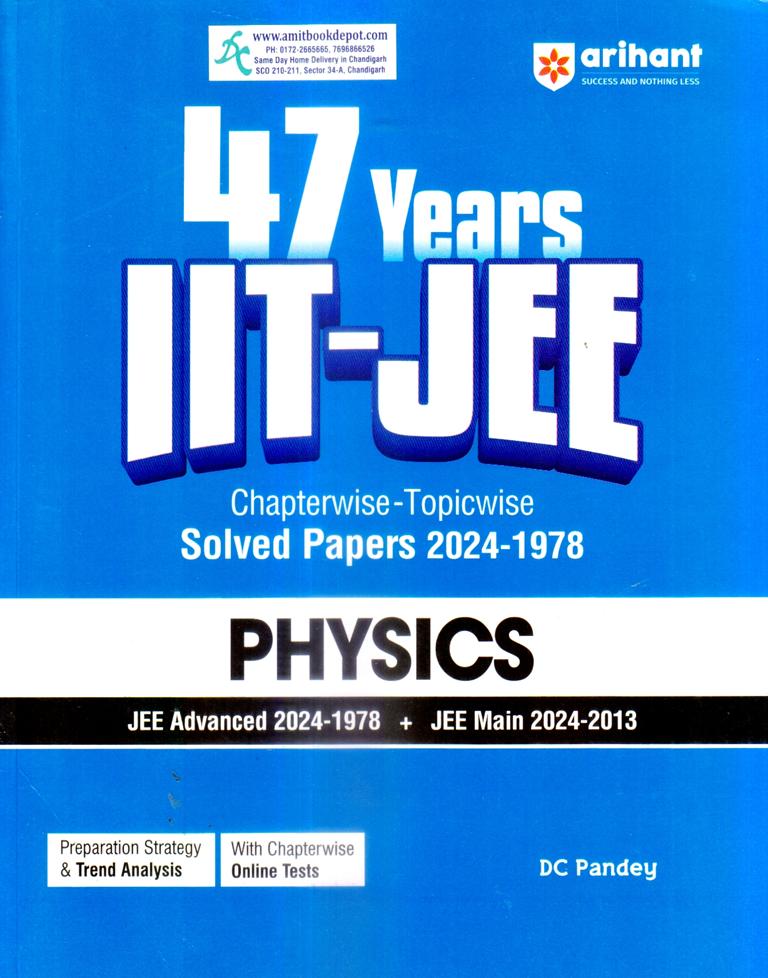
Yes, it covers solved papers from 2017 to 2024, including both January and April attempts of 2024, providing the most recent exam pattern.
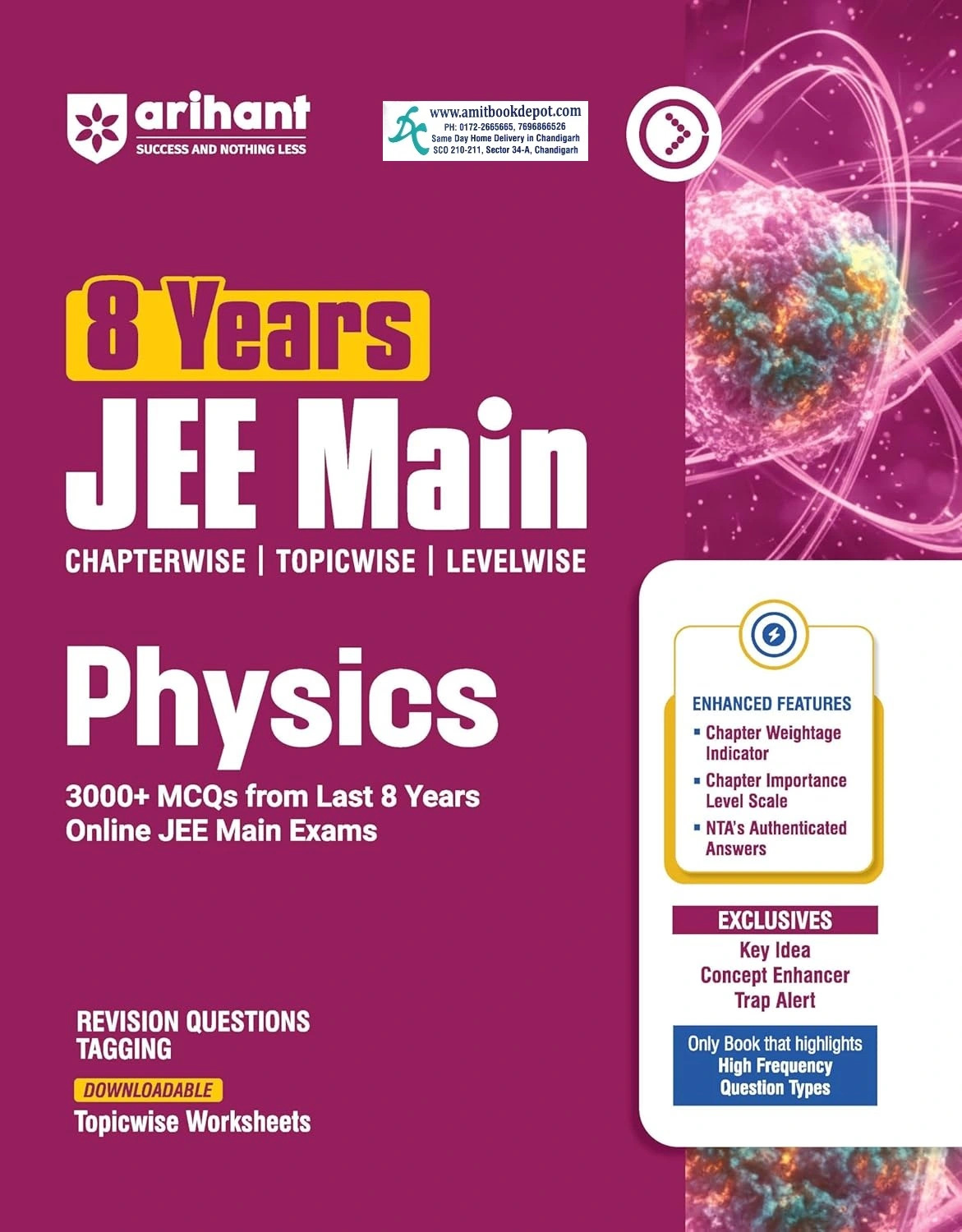
It is strictly chapterwise topicwise. Each chapter is split into subtopics like Ohm’s Law, Lens Formula, etc., for focused, concept-based practice.
Yes, every numerical problem includes a step-by-step solution with formula derivation, unit analysis, and logical reasoning to ensure complete understanding.
Yes, Chapter 29 is dedicated to Experimental Physics, covering vernier calipers, screw gauge, and other practical-based questions asked in JEE MAIN.
Absolutely. The topicwise segregation helps droppers quickly identify weak topics and practice 8 years of questions without wasting time.
Yes. Chapters 22 and 28 are fully covered, including questions on Maxwell’s equations, logic gates, diodes, and transistors.
Questions are arranged by year and topic, not explicit difficulty. However, 8-year progression naturally shows increasing complexity.
Yes. Chapter 23 (Ray Optics) covers mirrors, lenses, and refraction. Chapter 24 (Wave Optics) covers interference, diffraction, and polarization.
Yes. Questions reflect the latest JEE MAIN syllabus on Bohr’s model, radioactivity, nuclear fission/fusion, and binding energy.
Yes. Chapter 21 (Alternating Current) covers LC oscillations, power factor, transformers, and phasor diagram-based problems.
No Description Added
Yes, it covers solved papers from 2017 to 2024, including both January and April attempts of 2024, providing the most recent exam pattern.
It is strictly chapterwise topicwise. Each chapter is split into subtopics like Ohm’s Law, Lens Formula, etc., for focused, concept-based practice.
Yes, every numerical problem includes a step-by-step solution with formula derivation, unit analysis, and logical reasoning to ensure complete understanding.
Yes, Chapter 29 is dedicated to Experimental Physics, covering vernier calipers, screw gauge, and other practical-based questions asked in JEE MAIN.
Absolutely. The topicwise segregation helps droppers quickly identify weak topics and practice 8 years of questions without wasting time.
Yes. Chapters 22 and 28 are fully covered, including questions on Maxwell’s equations, logic gates, diodes, and transistors.
Questions are arranged by year and topic, not explicit difficulty. However, 8-year progression naturally shows increasing complexity.
Yes. Chapter 23 (Ray Optics) covers mirrors, lenses, and refraction. Chapter 24 (Wave Optics) covers interference, diffraction, and polarization.
Yes. Questions reflect the latest JEE MAIN syllabus on Bohr’s model, radioactivity, nuclear fission/fusion, and binding energy.
Yes. Chapter 21 (Alternating Current) covers LC oscillations, power factor, transformers, and phasor diagram-based problems.