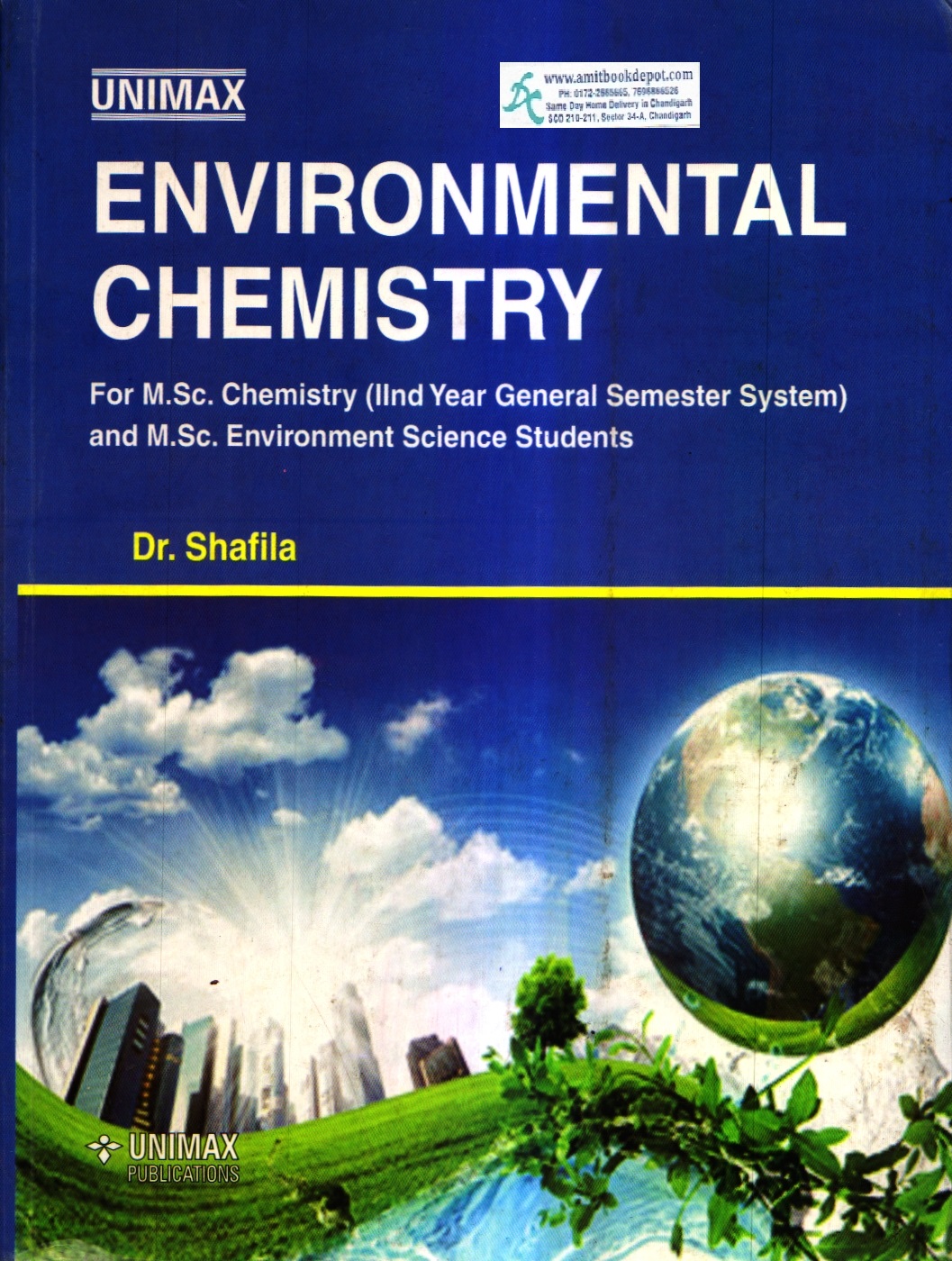
UNIMAX Environmental Chemistry for m. sc chemistry
UNIMAX Environmental Chemistry for m. sc chemistry
by Madhurima
₹290₹290.00(-/
off)
Rating & Reviews
23 Customer Review
UNIMAX Environmental Chemistry for M.Sc. Chemistry by Dr Shafila is the definitive book for postgraduate students, meticulously aligned with the Panjab University and UGC module syllabus. This comprehensive guide delves into the core principles of the environment, biogeochemical cycles, and environmental toxicology. It offers in-depth coverage of industrial pollution, soil chemistry, the hydrosphere, and atmospheric chemistry, including critical issues like ozone depletion, the greenhouse effect, and acid rain. Emphasising practical skills, the book details analytical methods for measuring water and air quality parameters. An indispensable resource for mastering environmental chemistry and achieving exam success.
UNIMAX Environmental Chemistry for M.Sc. Chemistry by Dr Shafila
Navigate the complexities of our planet’s chemical systems with UNIMAX Environmental Chemistry, a definitive book meticulously crafted for postgraduate students. Authored by Dr. Shafila and published by Unimax Publications, this book serves as an essential guide for M.Sc. Chemistry (2nd Year, Semester System) students, aligning perfectly with the updated UGC module and the academic standards of Panjab University, Chandigarh, and its affiliated colleges. It is a comprehensive resource designed not just for exam success, but for building a robust foundation in the intellectual and practical skills required in this critical field.
This volume provides a structured and in-depth exploration of environmental chemistry, systematically broken down into four key units. The content seamlessly integrates theoretical principles with real-world applications, ensuring students grasp the chemical processes governing our environment and the challenges it faces.
Unit I: Foundations and Toxicology establishes the core concepts. It begins with a detailed examination of the environment, including the composition and vertical temperature profile of the atmosphere, the Earth’s heat budget, and atmospheric stability. The crucial biogeochemical cycles of carbon, nitrogen, phosphorus, sulphur, and oxygen are explained, alongside the biodistribution of elements. The unit then transitions into environmental toxicology, discussing chemical solutions to environmental problems, the principles of biodegradability and decomposition, and a critical analysis of major industrial disasters like the Bhopal gas tragedy, Chernobyl, and Three Mile Island, providing poignant lessons on the consequences of industrial mismanagement.
Unit II: Industrial Pollution and Soil Chemistry tackles the pressing issue of waste and land contamination. It offers a thorough analysis of industrial pollution from key sectors, including cement, sugar, distilleries, drugs, paper, thermal and nuclear power plants, and metallurgy. The unit covers radionuclide analysis, waste disposal and management strategies, and a study of the Minamata disaster. Furthermore, it delves into the chemistry of soils, covering their composition, the role of micro- and macronutrients, and the critical topic of soil pollution from fertilisers, pesticides, plastics, and metals, alongside methods for waste treatment.
Unit III: The Hydrosphere is dedicated to the chemistry of water. It begins by detailing the chemical composition of various water bodies—lakes, streams, rivers, and wetlands—and the hydrological cycle. A significant portion is devoted to aquatic pollution, covering inorganic and organic pollutants, pesticides, agricultural and industrial runoff, sewage, detergents, and oil spills. The unit is particularly strong on practical applications, providing a detailed guide to water quality parameters such as dissolved oxygen (DO), biochemical oxygen demand (BOD), and the presence of metals, chloride, sulphate, phosphate, and nitrate. It concludes with essential water quality standards and analytical methods for measuring BOD, COD, fluoride, oils, and heavy metals (like As, Cd, Cr, Hg, Pb, and Se), as well as water purification and treatment processes.
Unit IV: The Atmosphere focuses on the gaseous envelope that sustains life. It explores the chemical composition of the atmosphere, including the formation and role of particles, ions, and radicals. Students will gain a deep understanding of chemical and photochemical reactions, the formation of smog, and the behaviour of oxides of nitrogen and sulphur. The unit provides a thorough scientific explanation of some of the most pressing global issues: the role of chlorofluorocarbons (CFCs) in ozone depletion, the mechanisms behind the greenhouse effect and global warming, and the chemistry of acid rain. It concludes with a practical overview of air pollution control technologies and the analytical methods and continuous monitoring instruments used to measure air pollutants.
With its unit-wise arrangement, focus on both conceptual clarity and practical analytical methods, and direct alignment with the latest syllabus, UNIMAX Environmental Chemistry is an indispensable companion for any M.Sc. Chemistry student aiming to excel in their examinations and contribute meaningfully to the field of environmental science.
What foundational concepts are covered in the unit on the Environment?
A1
It covers the atmosphere's composition, vertical temperature profile, heat budget, and the crucial biogeochemical cycles of C, N, P, S, and O.
Q2
Which major industrial disasters are analyzed to teach environmental toxicology?
A2
The book provides critical analysis of the Bhopal gas tragedy, Chernobyl, Three Mile Island, and Seveso incidents.
Q3
What aspects of soil chemistry are explored in this textbook?
A3
It examines soil composition, the role of micro- and macronutrients, and pollution from fertilisers, pesticides, plastics, and metals.
Q4
What does the unit on Hydrosphere teach about water bodies?
A4
It details the chemical composition of lakes, rivers, and wetlands, and explains the complete hydrological cycle.
Q5
What analytical methods for water quality are detailed in the book?
A5
It details methods for measuring BOD, COD, fluoride, oil, and heavy metals like Arsenic (As), Cadmium (Cd), and Mercury (Hg).
Q6
How does the book explain the composition and chemistry of the atmosphere?
A6
It covers the atmosphere's chemical composition, including the formation of particles, ions, radicals, and various photochemical reactions.
Q7
How are global environmental issues like acid rain and smog addressed?
A7
The book details the chemistry behind the formation of smog and acid rain, including the roles of oxides of nitrogen and sulphur.
Q8
Does the textbook cover the mechanisms behind the greenhouse effect?
A8
Yes, it thoroughly explains the greenhouse effect, its contribution to global warming, and the chemistry of the gases involved.
Q9
How does the book relate chemical principles to the concept of biodegradability?
A9
It explains the principles of decomposition and biodegradability as chemical solutions to environmental problems caused by pollutants.
Q10
What types of waste treatment and management strategies are discussed?
A10
The book covers the disposal and management of wastes from various sources, including nuclear, industrial, and municipal origins.
0.00
0 Overall Rating
5
0
4
0
3
0
2
0
1
0
Try this product & share your review &
thoughts
UNIT - I
1. Environment
2. Environmental Toxicology
UNIT - II
3. Industrial Pollution
4. Soils
UNIT - III
5. Hydrosphere
UNIT - IV
6. Atmosphere
ENVIRONMENTAL CHEMISTRY
Paper: (IV) CH - 514
To teach the fundamental concepts of chemistry and their applications. The syllabus pertaining to M.Sc. (2nd Year, General, Semester System) in the subject of Chemistry has been upgraded as per the provision of the UGC module and demand of the academic environment. The course contents have been revised from time to time as per suggestions of the teachers of chemistry working at Panjab University, Chandigarh, and affiliated colleges. The syllabus contents are duly arranged unit-wise, and contents are included in such a manner so that due importance is given to requisite intellectual and laboratory skills.
Time: 3 hours
Max Marks: 80+20
(4 hrs/week) 60 hrs)
UNIT 1
- Environment
Introduction, Composition of atmosphere, vertical temperature, heat budget of the Earth atmosphere system, vertical stability atmosphere. Biogeochemical cycles of C, N, P, S and O. Biodistribution of elements.
- Environmental Toxicology
Chemical solutions to environmental problems, biodegradability, principles of decomposition, better industrial processes, the Bhopal gas tragedy, Chernobyl, Three Mile Island, and Sewozo.
UNIT 2
- Industrial Pollution
Cement, sugar, distilleries, drugs, paper, thermal power plants, nuclear power plants, metallurgy, polymers, drugs, etc., radionuclide analysis, disposal of wastes and their management and Minamata disasters.
- Soils
Composition, micro- and macronutrients, pollution – fertilisers, pesticides, plastic and metals. Waste treatment.
UNIT 3
- Hydrosphere
Chemical composition of water bodies – lakes, streams, rivers, wetlands, etc. Hydrological cycle. Aquatic pollution – inorganic, organic, pesticide, agricultural, industrial and sewage, detergents, oil spills and oil pollutants. Water quality parameters – dissolved oxygen, biochemical oxygen demand, solids, metals, and content of chloride, sulphate, phosphate, nitrate and micro-organisms. Water quality standards, analytical methods for measuring BOD, DO, COD, F, oils, metals (As, Cd, Cr, Hg, Pb, Se, etc.), residual chloride and chlorine demand, and purification and treatment of water.
UNIT 4
- Atmosphere
Chemical composition of the atmosphere – particles, ions and radicals and their formation, Chemical and photochemical reactions in the atmosphere, smog formation, oxides of chlorofluorohydrocarbons, ozone depletion, global warming, the greenhouse effect, acid rain, air pollution controls and their chemistry. Analytical methods for measuring air pollutants and continuous monitoring instruments.
- Instructions for Paper Setters and Candidates:
I. The examiner will set a total of NINE questions comprising TWO questions from each unit and ONE compulsory question of the short-answer type covering the whole syllabus.
II. The students are required to attempt FIVE questions in all. ONE question from each unit and the compulsory question.
UNIMAX Environmental Chemistry for M.Sc. Chemistry by Dr Shafila
Navigate the complexities of our planet’s chemical systems with UNIMAX Environmental Chemistry, a definitive book meticulously crafted for postgraduate students. Authored by Dr. Shafila and published by Unimax Publications, this book serves as an essential guide for M.Sc. Chemistry (2nd Year, Semester System) students, aligning perfectly with the updated UGC module and the academic standards of Panjab University, Chandigarh, and its affiliated colleges. It is a comprehensive resource designed not just for exam success, but for building a robust foundation in the intellectual and practical skills required in this critical field.
This volume provides a structured and in-depth exploration of environmental chemistry, systematically broken down into four key units. The content seamlessly integrates theoretical principles with real-world applications, ensuring students grasp the chemical processes governing our environment and the challenges it faces.
Unit I: Foundations and Toxicology establishes the core concepts. It begins with a detailed examination of the environment, including the composition and vertical temperature profile of the atmosphere, the Earth’s heat budget, and atmospheric stability. The crucial biogeochemical cycles of carbon, nitrogen, phosphorus, sulphur, and oxygen are explained, alongside the biodistribution of elements. The unit then transitions into environmental toxicology, discussing chemical solutions to environmental problems, the principles of biodegradability and decomposition, and a critical analysis of major industrial disasters like the Bhopal gas tragedy, Chernobyl, and Three Mile Island, providing poignant lessons on the consequences of industrial mismanagement.
Unit II: Industrial Pollution and Soil Chemistry tackles the pressing issue of waste and land contamination. It offers a thorough analysis of industrial pollution from key sectors, including cement, sugar, distilleries, drugs, paper, thermal and nuclear power plants, and metallurgy. The unit covers radionuclide analysis, waste disposal and management strategies, and a study of the Minamata disaster. Furthermore, it delves into the chemistry of soils, covering their composition, the role of micro- and macronutrients, and the critical topic of soil pollution from fertilisers, pesticides, plastics, and metals, alongside methods for waste treatment.
Unit III: The Hydrosphere is dedicated to the chemistry of water. It begins by detailing the chemical composition of various water bodies—lakes, streams, rivers, and wetlands—and the hydrological cycle. A significant portion is devoted to aquatic pollution, covering inorganic and organic pollutants, pesticides, agricultural and industrial runoff, sewage, detergents, and oil spills. The unit is particularly strong on practical applications, providing a detailed guide to water quality parameters such as dissolved oxygen (DO), biochemical oxygen demand (BOD), and the presence of metals, chloride, sulphate, phosphate, and nitrate. It concludes with essential water quality standards and analytical methods for measuring BOD, COD, fluoride, oils, and heavy metals (like As, Cd, Cr, Hg, Pb, and Se), as well as water purification and treatment processes.
Unit IV: The Atmosphere focuses on the gaseous envelope that sustains life. It explores the chemical composition of the atmosphere, including the formation and role of particles, ions, and radicals. Students will gain a deep understanding of chemical and photochemical reactions, the formation of smog, and the behaviour of oxides of nitrogen and sulphur. The unit provides a thorough scientific explanation of some of the most pressing global issues: the role of chlorofluorocarbons (CFCs) in ozone depletion, the mechanisms behind the greenhouse effect and global warming, and the chemistry of acid rain. It concludes with a practical overview of air pollution control technologies and the analytical methods and continuous monitoring instruments used to measure air pollutants.
With its unit-wise arrangement, focus on both conceptual clarity and practical analytical methods, and direct alignment with the latest syllabus, UNIMAX Environmental Chemistry is an indispensable companion for any M.Sc. Chemistry student aiming to excel in their examinations and contribute meaningfully to the field of environmental science.
What foundational concepts are covered in the unit on the Environment?
A1
It covers the atmosphere's composition, vertical temperature profile, heat budget, and the crucial biogeochemical cycles of C, N, P, S, and O.
Q2
Which major industrial disasters are analyzed to teach environmental toxicology?
A2
The book provides critical analysis of the Bhopal gas tragedy, Chernobyl, Three Mile Island, and Seveso incidents.
Q3
What aspects of soil chemistry are explored in this textbook?
A3
It examines soil composition, the role of micro- and macronutrients, and pollution from fertilisers, pesticides, plastics, and metals.
Q4
What does the unit on Hydrosphere teach about water bodies?
A4
It details the chemical composition of lakes, rivers, and wetlands, and explains the complete hydrological cycle.
Q5
What analytical methods for water quality are detailed in the book?
A5
It details methods for measuring BOD, COD, fluoride, oil, and heavy metals like Arsenic (As), Cadmium (Cd), and Mercury (Hg).
Q6
How does the book explain the composition and chemistry of the atmosphere?
A6
It covers the atmosphere's chemical composition, including the formation of particles, ions, radicals, and various photochemical reactions.
Q7
How are global environmental issues like acid rain and smog addressed?
A7
The book details the chemistry behind the formation of smog and acid rain, including the roles of oxides of nitrogen and sulphur.
Q8
Does the textbook cover the mechanisms behind the greenhouse effect?
A8
Yes, it thoroughly explains the greenhouse effect, its contribution to global warming, and the chemistry of the gases involved.
Q9
How does the book relate chemical principles to the concept of biodegradability?
A9
It explains the principles of decomposition and biodegradability as chemical solutions to environmental problems caused by pollutants.
Q10
What types of waste treatment and management strategies are discussed?
A10
The book covers the disposal and management of wastes from various sources, including nuclear, industrial, and municipal origins.
ENVIRONMENTAL CHEMISTRY
Paper: (IV) CH - 514
To teach the fundamental concepts of chemistry and their applications. The syllabus pertaining to M.Sc. (2nd Year, General, Semester System) in the subject of Chemistry has been upgraded as per the provision of the UGC module and demand of the academic environment. The course contents have been revised from time to time as per suggestions of the teachers of chemistry working at Panjab University, Chandigarh, and affiliated colleges. The syllabus contents are duly arranged unit-wise, and contents are included in such a manner so that due importance is given to requisite intellectual and laboratory skills.
Time: 3 hours
Max Marks: 80+20
(4 hrs/week) 60 hrs)
UNIT 1
- Environment
Introduction, Composition of atmosphere, vertical temperature, heat budget of the Earth atmosphere system, vertical stability atmosphere. Biogeochemical cycles of C, N, P, S and O. Biodistribution of elements.
- Environmental Toxicology
Chemical solutions to environmental problems, biodegradability, principles of decomposition, better industrial processes, the Bhopal gas tragedy, Chernobyl, Three Mile Island, and Sewozo.
UNIT 2
- Industrial Pollution
Cement, sugar, distilleries, drugs, paper, thermal power plants, nuclear power plants, metallurgy, polymers, drugs, etc., radionuclide analysis, disposal of wastes and their management and Minamata disasters.
- Soils
Composition, micro- and macronutrients, pollution – fertilisers, pesticides, plastic and metals. Waste treatment.
UNIT 3
- Hydrosphere
Chemical composition of water bodies – lakes, streams, rivers, wetlands, etc. Hydrological cycle. Aquatic pollution – inorganic, organic, pesticide, agricultural, industrial and sewage, detergents, oil spills and oil pollutants. Water quality parameters – dissolved oxygen, biochemical oxygen demand, solids, metals, and content of chloride, sulphate, phosphate, nitrate and micro-organisms. Water quality standards, analytical methods for measuring BOD, DO, COD, F, oils, metals (As, Cd, Cr, Hg, Pb, Se, etc.), residual chloride and chlorine demand, and purification and treatment of water.
UNIT 4
- Atmosphere
Chemical composition of the atmosphere – particles, ions and radicals and their formation, Chemical and photochemical reactions in the atmosphere, smog formation, oxides of chlorofluorohydrocarbons, ozone depletion, global warming, the greenhouse effect, acid rain, air pollution controls and their chemistry. Analytical methods for measuring air pollutants and continuous monitoring instruments.
- Instructions for Paper Setters and Candidates:
I. The examiner will set a total of NINE questions comprising TWO questions from each unit and ONE compulsory question of the short-answer type covering the whole syllabus.
II. The students are required to attempt FIVE questions in all. ONE question from each unit and the compulsory question.
III. All questions carry equal marks.
0.00
0 Overall Rating
5
0
4
0
3
0
2
0
1
0
Try this product & share your review &
thoughts
Top Trending Product
Related
Product
Related Product
Related Blog Posts
Latest Blogs
Latest Blogs
Classic Literature Reimagined: Discuss modern twists on classic novels.
Lorem ipsum dolor sit amet, consectetur adipiscing elit, sed
do
eiusmod tempor incididunt ut labore et dolore magna aliqua. Ut enim ad minim
veniam, quis nostrud exercitation ullamco Lorem ipsum dolor sit amet,
consectetur adipiscing elit, sed do eiusmod tempor incididunt ut labore et
dolore magna aliqua. Utenim ad minim veniam, quis nostrud exercitation
ullamco
Lorem ipsum dolor sit amet, consecte...
Classic Literature Reimagined: Discuss modern twists on classic novels.
Lorem ipsum dolor sit amet, consectetur adipiscing elit, sed
do
eiusmod tempor incididunt ut labore et dolore magna aliqua. Ut enim ad minim
veniam, quis nostrud exercitation ullamco Lorem ipsum dolor sit amet,
consectetur adipiscing elit, sed do eiusmod tempor incididunt ut labore et
dolore magna aliqua. Utenim ad minim veniam, quis nostrud exercitation
ullamco
Lorem ipsum dolor sit amet, consecte...
Classic Literature Reimagined: Discuss modern twists on classic novels.
Lorem ipsum dolor sit amet, consectetur adipiscing elit, sed
do
eiusmod tempor incididunt ut labore et dolore magna aliqua. Ut enim ad minim
veniam, quis nostrud exercitation ullamco Lorem ipsum dolor sit amet,
consectetur adipiscing elit, sed do eiusmod tempor incididunt ut labore et
dolore magna aliqua. Utenim ad minim veniam, quis nostrud exercitation
ullamco
Lorem ipsum dolor sit amet, consecte...



.jpg)