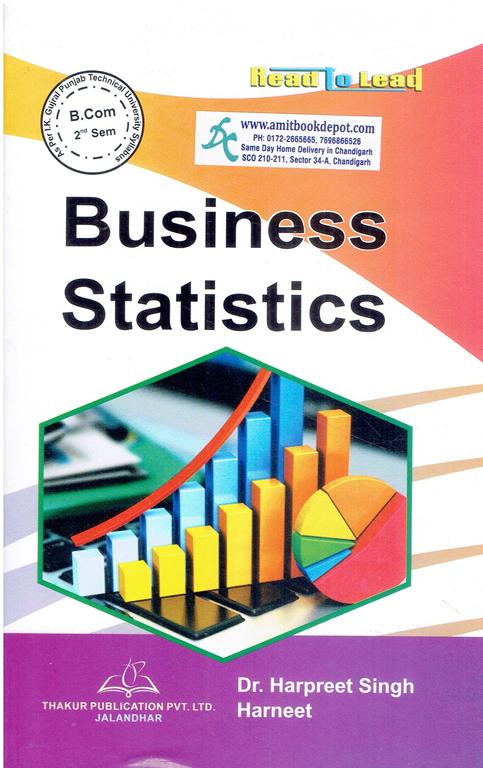
Thakur Business Statistics for B.Com 2nd Semester, PTU by Harpreet Singh , Ms. Harneet , is a syllabus-specific book designed for Punjab Technical University students. This comprehensive guide covers all essential topics, including data collection, sampling concepts, measures of central tendency, dispersion, correlation, regression analysis, and probability theory. With clear explanations, solved examples, and end-of-chapter exercises, it effectively builds foundational knowledge in business statistics for quantitative decision-making. Keywords: Business Statistics, B.Com PTU, Sampling, Correlation, Regression, Probability, Measures of Central Tendency, Standard Deviation, Thakur Publishers.
Thakur Business Statistics for B.Com 2nd Semester, PTU by Harpreet Singh , Ms. Harneet , is a meticulously crafted academic resource, designed explicitly for the Bachelor of Commerce students at Punjab Technical University. This comprehensive book aligns perfectly with the prescribed PTU syllabus, serving as an indispensable guide for mastering the fundamental statistical tools essential for modern business decision-making.
The book begins with a robust introduction to statistics and sampling concepts (Unit I), laying a solid foundation for the subject. It meticulously covers the meaning, definitions, and scope of business statistics, while also addressing its practical limitations. A significant focus is placed on data collection methods, differentiating between primary and secondary data sources. The unit delves deep into sampling concepts, a critical area for students, by explaining population and sample, parameters and statistics, and the various probability and non-probability sampling methods like simple random sampling, stratified sampling, and systematic sampling. The presentation of data through frequency distribution is also thoroughly explained, ensuring students can organize raw data effectively.
Unit II provides an in-depth exploration of measures of central tendency and variation. It offers a detailed analysis of mathematical averages, including the arithmetic mean, geometric mean, and harmonic mean, alongside their properties and real-world applications. The unit equally emphasizes positional averages like median, mode, quartiles, deciles, and percentiles. To complement these concepts, the book extensively covers measures of dispersion, such as range, quartile deviation, mean deviation, standard deviation, and variance, including their coefficients. This unit is vital for understanding data variability and includes a crucial section on sampling distribution, introducing students to the formulation of sampling distributions for mean and standard deviation, a key concept for inferential statistics.
The third unit, Simple Correlation and Regression Analysis (Unit III), is dedicated to understanding relationships between variables. It clearly distinguishes between correlation and causation, guiding students through various methods of computing correlation, including Pearson’s correlation coefficient and rank correlation. The regression analysis section is built on the principle of least squares, enabling students to calculate regression coefficients and understand their properties. The intrinsic relationship between correlation and regression coefficients is demystified, providing a holistic view of how these two analyses interconnect.
Finally, Unit IV introduces the theory of probability, a cornerstone of statistical inference. It covers the basic meaning of probability and different approaches to its calculation. The unit methodically explains the calculation of event probabilities using the fundamental rules of counting, the addition and multiplication laws, and conditional probability. A dedicated section on Bayes’ Theorem and theoretical probability distributions equips students with the advanced concepts needed to model real-world uncertainties.
Structured with the student's learning journey in mind, this PTU-specific book features clear, lucid language, numerous solved examples categorized as "Miscellaneous Examples," and a comprehensive exercise at the end of each unit. These exercises are tailored to help students prepare effectively for university examinations. Published by Thakur Publishers, this book is not just a book but a complete learning package for any B.Com second-semester student aiming to build a strong, application-oriented understanding of business statistics.
Is this book strictly aligned with the latest B.Com 2nd Semester syllabus for Business Statistics at PTU?
A1
Yes, this book is meticulously crafted to cover 100% of the latest prescribed syllabus for Business Statistics at Punjab Technical University (PTU) for the B.Com 2nd Semester program.
Q2
Does the book include solutions to the exercises provided at the end of each unit?
A2
The book contains a wide range of exercises for practice, which are essential for exam preparation. However, it provides answers/solutions for the solved examples within the chapters, while the end-of-unit exercises are primarily for self-assessment.
Q3
How does this book explain complex topics like Sampling Distribution and Bayes' Theorem?
A3
The author uses a step-by-step approach with clearly defined formulae and practical, miscellaneous examples to break down complex topics like Sampling Distribution and Bayes' Theorem, making them easier for undergraduate students to grasp.
Q4
Are the methods of probability sampling, like stratified and systematic, explained with examples?
A4
Yes, Unit I provides dedicated sections on various probability and non-probability sampling methods, including Simple Random, Stratified, and Systematic Sampling, often accompanied by illustrative examples for better understanding.
Q5
Does the text cover both the mathematical and positional measures of central tendency?
A5
Absolutely. Unit II offers comprehensive coverage of both mathematical averages (Arithmetic Mean, Geometric Mean, Harmonic Mean) and positional averages (Median, Mode, Quartiles, Deciles, Percentiles).
Q6
Is the relationship between Arithmetic Mean, Geometric Mean, and Harmonic Mean discussed?
A6
Yes, the book dedicates a specific section to explaining the relationship between A.M., G.M., and H.M., which is a key conceptual differentiator.
Q7
Are the properties of Standard Deviation and Regression Coefficients covered in detail?
A7
Yes, the book not only explains how to calculate these metrics but also elaborates on their important properties, which is crucial for interpreting statistical results correctly.
Q8
Does the book include a section on the graphical representation of data and measures of central tendency?
A8
Yes, the book covers the presentation of data, including frequency distribution and graphical representation of measures of central tendency and dispersion, as per the syllabus.
Q9
Is Rank Correlation covered along with Pearson’s Correlation Coefficient?
A9
Yes, the book covers both Pearson’s Correlation Coefficient (for quantitative data) and Rank Correlation (for ordinal data), providing a broader understanding of correlation analysis.
Q10
Is this book suitable for self-study without classroom guidance?
A10
Yes, with its structured content, clear language, and numerous solved examples, this book is an excellent resource for self-study, allowing students to learn and revise at their own pace.
0.00
0 Overall Rating
5
0
4
0
3
0
2
0
1
0
Try this product & share your review &
thoughts
Unit I: Introduction to Statistics and Sampling Concepts
1. Statistics
2. Data Collection
3. Frequency
4. Presentation of Data
5. Sampling Concepts
6. Exercise
Unit II: Measures of Central Tendency & Variation and Sampling Distribution
1. Measures of Central Tendency
2. Mean/Arithmetic Mean
3. Geometric Mean (G.M.)
4. Harmonic Mean (H.M.)
5. Relationship between A.M., G.M., and H.M.
6. Median
7. Mode
8. Quartiles
9. Deciles
10. Percentile
11. Relation between Mean, Median, and Mode
12. Comparison of Mean, Median, and Mode
13. Graphical Representation of Measures of Central Tendency and Dispersion
14. Measures of Variation/Measures of Dispersion
15. Range
16. Interquartile Range
17. Quartile Deviation
18. Mean Deviation/Mean Absolute Deviation (M.D.)
19. Standard Deviation (S.D.)
20. Variance
21. Coefficient of Variation (CV)
22. Sampling Distribution
23. Miscellaneous Examples
24. Exercise
Unit III: Simple Correlation and Regression Analysis
1. Correlation Analysis
2. Methods of Computing Correlation
3. Regression Analysis
4. Relationship between Correlation & Regression Coefficients
5. Miscellaneous Examples
6. Exercise
Unit IV: Theory of Probability
1. Probability
2. Probability Theory/Approaches to the Calculation of Probability
3. Fundamental Rules of Counting
4. Basic Concepts
5. Laws of Probability
6. Conditional Probability
7. Bayes’ Theorem
8. Theoretical Probability Distribution
9. Important Terms
10. Types of Probability Distribution
11. Calculation of Probabilities
12. Exercise
BUSINESS STATISTICS
Course Objective: The course aims to familiarize students with the basic statistical tools used to summarize and analyze quantitative information for decision-making. Analysis of numbers is required for taking decisions related to every aspect of business.
UNIT - I
Introduction to Statistics: Meaning. Definitions, Features of Statistics, Importance, Functions, Scope, and Limitations of Statistics.
Data Collection: Sources of Primary and Secondary Data. Presentation of Data.
Frequency distribution.
Sampling Concepts: Meaning of Population and Sample, Parameters and Statistics, Descriptive and Inferential Statistics, Probability and Non-Probability Sampling Methods, including Simple Random Sample, Stratified Sampling, Systematic Sampling, Judgement Sampling, and Convenience Sampling.
UNIT - II
Measures of Central Tendency: Mathematical averages including arithmetic mean, geometric mean, and harmonic mean, properties, and applications. Positional Averages: Mode and median (and other partition values including quartiles, deciles, and percentiles). Graphic presentation of measures of central tendency.
Measures of Variation: Absolute and relative measures. Range, quartile deviation, mean deviation, standard deviation, and their coefficients. Properties of Standard Deviation and Variance.
Sampling Distribution: Concept of Sampling Distribution, Formulation of Sampling Distribution of Mean, and Sampling Distribution of Standard Deviation/Variance.
UNIT - III
Simple Correlation Analysis: Meaning of Correlation, Simple, Multiple, and Partial; Linear and Nonlinear Correlation; Correlation and Causation; Scatter Diagram; Pearson’s Correlation Coefficient; and Rank Correlation.
Simple Regression Analysis: Meaning of Regression, Principle of least squares and regression analysis, Calculation of regression coefficient, properties of regression coefficient, Relationship between correlation and regression coefficients.
UNIT - IV
Theory of Probability: Meaning of Probability, Approaches to the Calculation of Probability, Calculation of Event Probabilities, Addition and Multiplication, Laws of
Thakur Business Statistics for B.Com 2nd Semester, PTU by Harpreet Singh , Ms. Harneet , is a meticulously crafted academic resource, designed explicitly for the Bachelor of Commerce students at Punjab Technical University. This comprehensive book aligns perfectly with the prescribed PTU syllabus, serving as an indispensable guide for mastering the fundamental statistical tools essential for modern business decision-making.
The book begins with a robust introduction to statistics and sampling concepts (Unit I), laying a solid foundation for the subject. It meticulously covers the meaning, definitions, and scope of business statistics, while also addressing its practical limitations. A significant focus is placed on data collection methods, differentiating between primary and secondary data sources. The unit delves deep into sampling concepts, a critical area for students, by explaining population and sample, parameters and statistics, and the various probability and non-probability sampling methods like simple random sampling, stratified sampling, and systematic sampling. The presentation of data through frequency distribution is also thoroughly explained, ensuring students can organize raw data effectively.
Unit II provides an in-depth exploration of measures of central tendency and variation. It offers a detailed analysis of mathematical averages, including the arithmetic mean, geometric mean, and harmonic mean, alongside their properties and real-world applications. The unit equally emphasizes positional averages like median, mode, quartiles, deciles, and percentiles. To complement these concepts, the book extensively covers measures of dispersion, such as range, quartile deviation, mean deviation, standard deviation, and variance, including their coefficients. This unit is vital for understanding data variability and includes a crucial section on sampling distribution, introducing students to the formulation of sampling distributions for mean and standard deviation, a key concept for inferential statistics.
The third unit, Simple Correlation and Regression Analysis (Unit III), is dedicated to understanding relationships between variables. It clearly distinguishes between correlation and causation, guiding students through various methods of computing correlation, including Pearson’s correlation coefficient and rank correlation. The regression analysis section is built on the principle of least squares, enabling students to calculate regression coefficients and understand their properties. The intrinsic relationship between correlation and regression coefficients is demystified, providing a holistic view of how these two analyses interconnect.
Finally, Unit IV introduces the theory of probability, a cornerstone of statistical inference. It covers the basic meaning of probability and different approaches to its calculation. The unit methodically explains the calculation of event probabilities using the fundamental rules of counting, the addition and multiplication laws, and conditional probability. A dedicated section on Bayes’ Theorem and theoretical probability distributions equips students with the advanced concepts needed to model real-world uncertainties.
Structured with the student's learning journey in mind, this PTU-specific book features clear, lucid language, numerous solved examples categorized as "Miscellaneous Examples," and a comprehensive exercise at the end of each unit. These exercises are tailored to help students prepare effectively for university examinations. Published by Thakur Publishers, this book is not just a book but a complete learning package for any B.Com second-semester student aiming to build a strong, application-oriented understanding of business statistics.
Unit I: Introduction to Statistics and Sampling Concepts
1. Statistics
2. Data Collection
3. Frequency
4. Presentation of Data
5. Sampling Concepts
6. Exercise
Unit II: Measures of Central Tendency & Variation and Sampling Distribution
1. Measures of Central Tendency
2. Mean/Arithmetic Mean
3. Geometric Mean (G.M.)
4. Harmonic Mean (H.M.)
5. Relationship between A.M., G.M., and H.M.
6. Median
7. Mode
8. Quartiles
9. Deciles
10. Percentile
11. Relation between Mean, Median, and Mode
12. Comparison of Mean, Median, and Mode
13. Graphical Representation of Measures of Central Tendency and Dispersion
14. Measures of Variation/Measures of Dispersion
15. Range
16. Interquartile Range
17. Quartile Deviation
18. Mean Deviation/Mean Absolute Deviation (M.D.)
19. Standard Deviation (S.D.)
20. Variance
21. Coefficient of Variation (CV)
22. Sampling Distribution
23. Miscellaneous Examples
24. Exercise
Unit III: Simple Correlation and Regression Analysis
1. Correlation Analysis
2. Methods of Computing Correlation
3. Regression Analysis
4. Relationship between Correlation & Regression Coefficients
5. Miscellaneous Examples
6. Exercise
Unit IV: Theory of Probability
1. Probability
2. Probability Theory/Approaches to the Calculation of Probability
Is this book strictly aligned with the latest B.Com 2nd Semester syllabus for Business Statistics at PTU?
A1
Yes, this book is meticulously crafted to cover 100% of the latest prescribed syllabus for Business Statistics at Punjab Technical University (PTU) for the B.Com 2nd Semester program.
Q2
Does the book include solutions to the exercises provided at the end of each unit?
A2
The book contains a wide range of exercises for practice, which are essential for exam preparation. However, it provides answers/solutions for the solved examples within the chapters, while the end-of-unit exercises are primarily for self-assessment.
Q3
How does this book explain complex topics like Sampling Distribution and Bayes' Theorem?
A3
The author uses a step-by-step approach with clearly defined formulae and practical, miscellaneous examples to break down complex topics like Sampling Distribution and Bayes' Theorem, making them easier for undergraduate students to grasp.
Q4
Are the methods of probability sampling, like stratified and systematic, explained with examples?
A4
Yes, Unit I provides dedicated sections on various probability and non-probability sampling methods, including Simple Random, Stratified, and Systematic Sampling, often accompanied by illustrative examples for better understanding.
Q5
Does the text cover both the mathematical and positional measures of central tendency?
A5
Absolutely. Unit II offers comprehensive coverage of both mathematical averages (Arithmetic Mean, Geometric Mean, Harmonic Mean) and positional averages (Median, Mode, Quartiles, Deciles, Percentiles).
Q6
Is the relationship between Arithmetic Mean, Geometric Mean, and Harmonic Mean discussed?
A6
Yes, the book dedicates a specific section to explaining the relationship between A.M., G.M., and H.M., which is a key conceptual differentiator.
Q7
Are the properties of Standard Deviation and Regression Coefficients covered in detail?
A7
Yes, the book not only explains how to calculate these metrics but also elaborates on their important properties, which is crucial for interpreting statistical results correctly.
Q8
Does the book include a section on the graphical representation of data and measures of central tendency?
A8
Yes, the book covers the presentation of data, including frequency distribution and graphical representation of measures of central tendency and dispersion, as per the syllabus.
Q9
Is Rank Correlation covered along with Pearson’s Correlation Coefficient?
A9
Yes, the book covers both Pearson’s Correlation Coefficient (for quantitative data) and Rank Correlation (for ordinal data), providing a broader understanding of correlation analysis.
Q10
Is this book suitable for self-study without classroom guidance?
A10
Yes, with its structured content, clear language, and numerous solved examples, this book is an excellent resource for self-study, allowing students to learn and revise at their own pace.
BUSINESS STATISTICS
Course Objective: The course aims to familiarize students with the basic statistical tools used to summarize and analyze quantitative information for decision-making. Analysis of numbers is required for taking decisions related to every aspect of business.
UNIT - I
Introduction to Statistics: Meaning. Definitions, Features of Statistics, Importance, Functions, Scope, and Limitations of Statistics.
Data Collection: Sources of Primary and Secondary Data. Presentation of Data.
Frequency distribution.
Sampling Concepts: Meaning of Population and Sample, Parameters and Statistics, Descriptive and Inferential Statistics, Probability and Non-Probability Sampling Methods, including Simple Random Sample, Stratified Sampling, Systematic Sampling, Judgement Sampling, and Convenience Sampling.
UNIT - II
Measures of Central Tendency: Mathematical averages including arithmetic mean, geometric mean, and harmonic mean, properties, and applications. Positional Averages: Mode and median (and other partition values including quartiles, deciles, and percentiles). Graphic presentation of measures of central tendency.
Measures of Variation: Absolute and relative measures. Range, quartile deviation, mean deviation, standard deviation, and their coefficients. Properties of Standard Deviation and Variance.
Sampling Distribution: Concept of Sampling Distribution, Formulation of Sampling Distribution of Mean, and Sampling Distribution of Standard Deviation/Variance.
UNIT - III
Simple Correlation Analysis: Meaning of Correlation, Simple, Multiple, and Partial; Linear and Nonlinear Correlation; Correlation and Causation; Scatter Diagram; Pearson’s Correlation Coefficient; and Rank Correlation.
Simple Regression Analysis: Meaning of Regression, Principle of least squares and regression analysis, Calculation of regression coefficient, properties of regression coefficient, Relationship between correlation and regression coefficients.
UNIT - IV
Theory of Probability: Meaning of Probability, Approaches to the Calculation of Probability, Calculation of Event Probabilities, Addition and Multiplication, Laws of
Classic Literature Reimagined: Discuss modern twists on classic novels.
Lorem ipsum dolor sit amet, consectetur adipiscing elit, sed
do
eiusmod tempor incididunt ut labore et dolore magna aliqua. Ut enim ad minim
veniam, quis nostrud exercitation ullamco Lorem ipsum dolor sit amet,
consectetur adipiscing elit, sed do eiusmod tempor incididunt ut labore et
dolore magna aliqua. Utenim ad minim veniam, quis nostrud exercitation
ullamco
Lorem ipsum dolor sit amet, consecte...
Classic Literature Reimagined: Discuss modern twists on classic novels.
Lorem ipsum dolor sit amet, consectetur adipiscing elit, sed
do
eiusmod tempor incididunt ut labore et dolore magna aliqua. Ut enim ad minim
veniam, quis nostrud exercitation ullamco Lorem ipsum dolor sit amet,
consectetur adipiscing elit, sed do eiusmod tempor incididunt ut labore et
dolore magna aliqua. Utenim ad minim veniam, quis nostrud exercitation
ullamco
Lorem ipsum dolor sit amet, consecte...
Classic Literature Reimagined: Discuss modern twists on classic novels.
Lorem ipsum dolor sit amet, consectetur adipiscing elit, sed
do
eiusmod tempor incididunt ut labore et dolore magna aliqua. Ut enim ad minim
veniam, quis nostrud exercitation ullamco Lorem ipsum dolor sit amet,
consectetur adipiscing elit, sed do eiusmod tempor incididunt ut labore et
dolore magna aliqua. Utenim ad minim veniam, quis nostrud exercitation
ullamco
Lorem ipsum dolor sit amet, consecte...