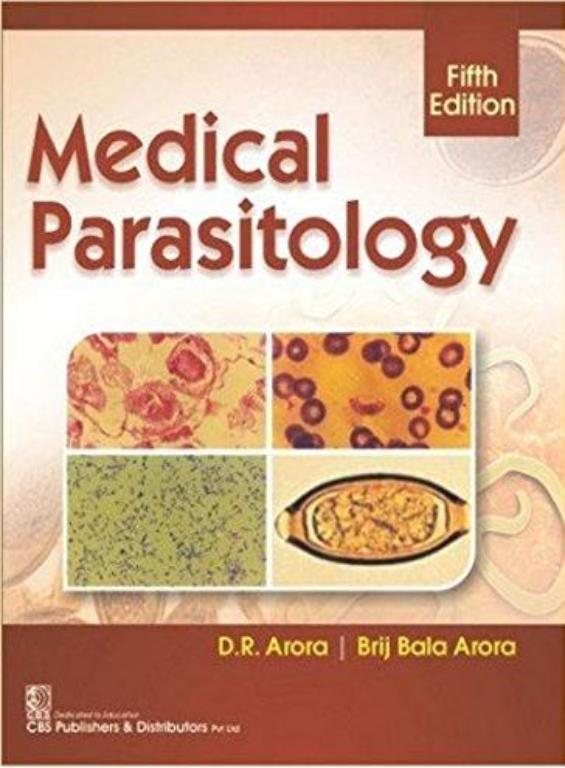
Medical Parasitology, Fifth Edition, by the renowned authors D.R. Arora and Brij Bala Arora, stands as a definitive and meticulously updated resource in the field of parasitology. Published by CBS Publishers and Distributors Pvt Ltd, this latest edition continues its legacy of providing a comprehensive, student-friendly, and clinically relevant exploration of parasitic diseases. Designed for undergraduate and postgraduate medical students, as well as professionals in laboratory medicine, this book serves as an essential guide for understanding the complex interplay between parasites and their human hosts.
The book is systematically structured into four key sections, beginning with Section 1: General Parasitology, which lays a robust foundation by covering the fundamental concepts and host-parasite relationships. Section 2: Protozoology delves into unicellular parasites, offering detailed chapters on pathogenic amoebae like Entamoeba histolytica, Naegleria fowleri, and various flagellates, sporozoa, and ciliates such as Balantidium coli. The inclusion of a chapter on microsporidia reflects the text's commitment to covering both common and emerging pathogens. This section provides in-depth knowledge on the morphology, life cycles, and pathogenesis of these microscopic entities.
The subsequent section, Section 3: Helminthology, provides a thorough classification of multicellular worms, with dedicated chapters on cestodes (tapeworms), trematodes (flukes), and nematodes (roundworms). Each chapter elucidates the structural anatomy, transmission dynamics, and clinical manifestations of helminthic infections, enabling students to differentiate between various species based on their unique characteristics. The text is further enhanced with illustrative content, including detailed diagrams showing the relative sizes of morphological forms of various protozoa and the relative sizes of helminth eggs, which are critical for accurate microscopic identification.
Recognising the evolving landscape of infectious diseases, Section 4: Applied Parasitology, Diagnostic Procedures and Overview addresses the most pressing contemporary issues. A dedicated chapter on Parasitic Opportunistic Infections in AIDS Cases and Nosocomial Parasitic Infections underscores the critical importance of parasitology in immunocompromised patients. This section also provides a practical guide to diagnostic procedures, detailing the latest techniques in specimen collection, staining, and molecular methods. The inclusion of chapters on medically important arthropods bridges the gap between parasitology and entomology, crucial for understanding disease vectors.
Beyond the core scientific content, this edition emphasises the operational aspects of a diagnostic laboratory. The chapter on quality assurance in parasitology equips readers with the protocols necessary to maintain accuracy and reliability in testing, while the chapter on ethics in laboratory medicine instils the professional integrity required in clinical practice. The final overview of medical parasitology ties all concepts together, providing a holistic summary of the subject. A comprehensive index at the end allows for quick reference of specific terms, making this book an indispensable companion for exam preparation and clinical practice. With its authoritative content, logical flow, and focus on applied knowledge, this fifth edition remains the gold standard book for mastering the intricacies of human parasitology.