Categories
College Bookssss >
BA PU Chandigarh
BSC PU Chandigarh
MSC PU Chandigarh
BBA PU Chandigarh
MA PU Chandigarh
Medical Books
Engineering Books
Management Books
PGDCA Books
BCOM PU Chandigarh
MCOM PU Chandigarh
BCA PU Chandigarh
MCA PU Chandigarh
animate-books

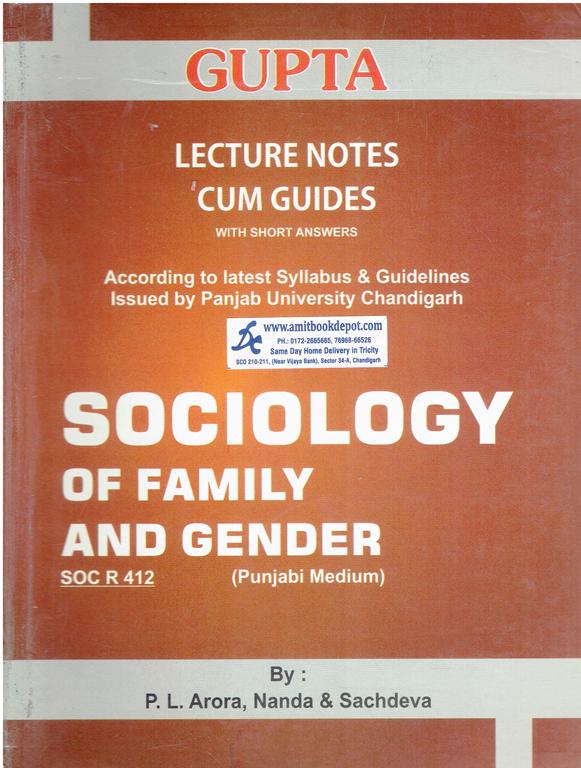
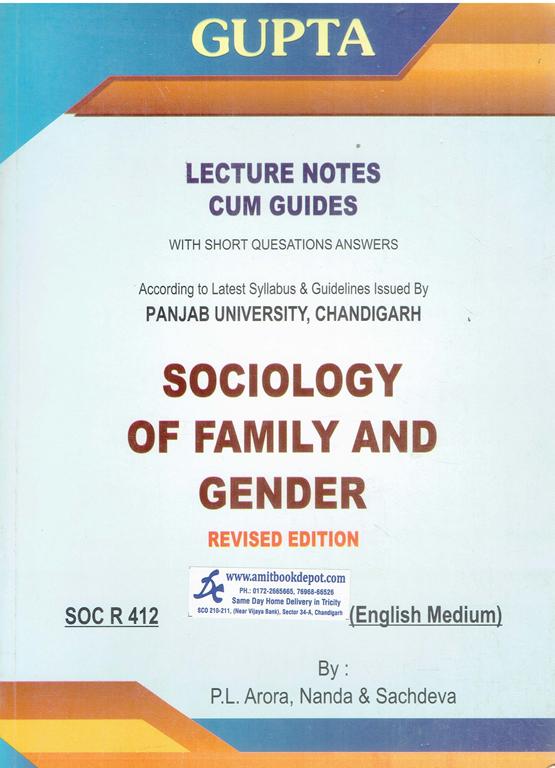
Gupta Sociology of Family and Gender SOC R 412 for MA Sociology 1st Semester Panjab University Chandigarh (Punjabi Medium)

by Madhurima
₹450 ₹450.00(-/ off)

Rating & Reviews

23 Customer Review

Gupta, Sociology of Family and Gender SOC R 412 is the prescribed Punjabi medium book for MA Sociology 1st Semester at Panjab University, Chandigarh. Authored by P.L. Arora, Nanda, and Sachdeva, and published by Pepsu Book Depot, it provides complete syllabus coverage. The book explores concepts and approaches to family, the social construction of gender, feminist theories (liberal, radical, socialist-Marxist, and postmodernist), and gender inequality legislation in India (PNDT Act and Dowry Prohibition Act). Including short answer questions, it is an essential guide for mastering SOC R 412 and excelling in university examinations.

Have Doubts Regarding This Product ? Ask Your Question

  • Q1
    Is this book the latest edition and perfectly aligned with the current Panjab University MA Sociology 1st Semester syllabus for SOC R 412?
    A1

    Yes, this book is specifically compiled and published to match the latest prescribed syllabus for SOC R 412: Sociology of Family and Gender at Panjab University, Chandigarh.

  • Q2
    Does the book cover all four units as per the Panjab University course outline, including the legislative acts?
    A2

    Absolutely. The book is divided into four units covering Concepts and Approaches to Family, Construction of Gender, Approaches to Gender (Feminism), and Gender Equality through Legislation, including detailed notes on acts like the PNDT Act and the Domestic Violence Act.

  • Q3
    Is the content solely in Punjabi, including the sociological terminology and theories?
    A3

    Yes, this book is entirely in Punjabi Medium, making complex theories by thinkers like Marxists and Postmodernist feminists accessible and easier to understand for students comfortable in Punjabi.

  • Q4
    I am a private candidate. Is this book sufficient for my preparation without internal assessment guidance?
    A4

    Yes, this textbook covers the complete theory syllabus as mandated by the university. Private candidates are evaluated solely on the theory paper, for which this book provides comprehensive coverage.

  • Q5
    Does the book explain different feminist approaches like Socialist-Marxist and Postmodernist Feminism in detail?
    A5

    Yes, Unit III of the book is dedicated to explaining the meaning and various approaches of Feminism, including Liberal, Radical, Socialist-Marxist, and Postmodernist perspectives, as required by the syllabus.

  • Q6
    Are contemporary issues like female feticide and domestic violence addressed from a sociological perspective?
    A6

    Yes, Unit IV provides a sociological analysis of specific problems like female feticide, bride burning, and domestic violence, linking them to gender inequality and relevant Indian laws.

  • Q7
    Does the book contain the instructions for paper-setters and candidates mentioned in the syllabus?
    A7

    The book is structured according to the syllabus instructions, including the division of units and the pattern of questions (9 questions total, with a compulsory short answer section), helping students understand the exam format.

  • Q8
    Are concepts like 'patriarchy', 'masculinity', and 'gender socialization' explained with examples?
    A8

    Yes, Unit II comprehensively covers these core concepts, explaining patriarchy, masculinity, femininity, and the process of gender socialization through institutions like family, education, and media.

  • Q9
    Is the content presented in a simple, student-friendly manner despite dealing with complex theories?
    A9

    The Punjabi Medium presentation is designed to simplify complex sociological concepts, making them more digestible for students while maintaining academic rigor.

  • Q10
    Is this book useful for students other than those from Panjab University?
    A10

    While it is specifically designed for Panjab University's SOC R 412 paper, students of sociology from other universities studying family and gender in Punjabi may find the content theoretically valuable.
0.00

0 Overall Rating
  • 5
    0
  • 4
    0
  • 3
    0
  • 2
    0
  • 1
    0

Try this product & share your review & thoughts

UNIT - I

1. Domestic Function, Concept, and Nature of Family
2. Structure—Functional Approaches
3. Family Conflict
4. Symbolic Interactionism

UNIT - II

5. Role of Concept and Identity of Gender
6. Gender Relations and Socialization
7. Gender Education Through Family
8. Work and Religion

UNIT - III

9. Society, Radical and Deep Ecology
10. Socialist - Marxism
11. Postmodernism of Feminism
12. Gender Inequality and Violence
13. Gender Inequality – Gender, Work, Income, and Empowerment
14. Gender - Culture Development
15. Female Feticide
16. Domestic Violence and Dowry Prohibition Act 

Short Answer Type Questions

Latest Syllabus of Sociology of Family and Gender SOC R 412 for MA Sociology 1st Semester Panjab University Chandigarh (Punjabi Medium)


SOC R 412: SOCIOLOGY OF FAMILY AND GENDER

Objective

This course is aimed at sensitizing the students regarding the basic concepts and approaches used for explaining and understanding family and gender. It also aims at sensitizing students about the process of gender socialization within the framework of family. Finally, it exposes the student to specific problems and legal provisions made available to counter these problems relating to gender inequality in the Indian context.

INSTRUCTIONS FOR THE PAPER-SETTER AND THE CANDIDATES

(i) The theory question paper will be of 80 marks, and 20 marks will be for internal assessment. The duration of the paper will be 3 hours.
(ii) For private candidates, who have not been assessed earlier for internal assessment, the marks secured by them in the theory paper will proportionately be increased to the maximum marks of the paper in lieu of internal assessment.

The paper setter must put note (ii) in the question paper.

The syllabus has been divided into four units.
There shall be 9 questions in all. The first question is compulsory and shall be a short answer type containing 10 short questions spread over the whole syllabus to be answered in about 30 to 35 words each, carrying 20 marks, i.e., 2 marks each. The rest of the paper shall contain 4 units. Each unit shall have two long questions and the Candidates shall be given an internal choice of attempting one question from each unit—4 in all. Each question will carry 15 marks. 

Course Outline
Unit-I

Concepts and Approaches to Family
Concepts—Family, Household, and Domestic Function;
Approaches—Structural Functional, Conflict, Symbolic Interactionist,

Unit II

Concept and Construction of Gender
i) Concepts—Sex, Gender, Gender Identity, and Gender Roles
ii) Basic understanding of patriarchy, masculinity and femininity, gender socialization, and gender stereotyping through the institutions of family, education, work, media, and religion.

Unit III

Approaches to Gender
Feminism: Meaning; Liberal, Radical, Socialist-Marxist, and Postmodernist Feminism

Unit IV

Gender Equality through Legislation (in the Indian Context)
i) Dimensions of Gender Inequality: Female Foeticide, Neglect of Girl Child, Bride Burning, and Status of Elderly Women.
ii) Brief introduction to the PNDT Act, the Dowry Prohibition Act, the Domestic Violence Act, and the Sexual Harassment of Women at Workplace (Prevention, Prohibition, and Redressal) Act.

Gupta Sociology of Family and Gender SOC R 412 for MA Sociology 1st Semester (Punjabi Medium) is the definitive and prescribed book meticulously crafted for students pursuing the Master of Arts in Sociology from Panjab University, Chandigarh. Authored by the esteemed academicians P. L. Arora, Nanda, and Sachdeva, and published by Pepsu Book Depot, this comprehensive volume is an indispensable resource that aligns precisely with the latest university syllabus. The book is expertly structured in the Punjabi medium, ensuring accessibility and conceptual clarity for students, facilitating an in-depth exploration of the complex interplay between family structures and gender dynamics in society.

This book is systematically organized into four cohesive units, each designed to fulfill the course objectives as outlined by Panjab University. Unit I delves into the foundational concepts and approaches to family, providing a thorough examination of the domestic function, nature of the family, and household. It critically engages with seminal sociological perspectives, including the structural-functional approach, conflict theory, and symbolic interactionism, offering students a robust theoretical framework to analyze familial institutions. Unit II shifts focus to the concept and construction of gender, elucidating crucial distinctions between sex and gender, gender identity, and gender roles. It explores the processes of gender socialization and gender stereotyping perpetuated through key institutions such as the family, education, work, media, and religion, with a specific emphasis on understanding patriarchy, masculinity, and femininity.

Progressing further, Unit III introduces students to the major approaches to gender, with a concentrated study on various strands of feminist thought. It provides a clear and concise meaning of feminism and its evolution through liberal, radical, socialist-Marxist, and postmodernist frameworks, including discussions on society, radical and deep ecology. This unit equips students with the analytical tools to critically assess gender relations from multiple ideological standpoints. Unit IV addresses the pressing issue of gender equality through legislation in the Indian context. It provides a stark analysis of the dimensions of gender inequality, including female infanticide, neglect of the girl child, bride burning, and the status of elderly women. Most importantly, it offers a vital introduction to key legislative measures such as the PNDT Act, Dowry Prohibition Act, Domestic Violence Act, and the Sexual Harassment of Women at Workplace Act, linking sociological theory to real-world application and social policy.

A distinctive feature of this book is its pedagogical design tailored for exam success. It includes a dedicated section of short answer type questions that help students prepare for the compulsory first question in the university exam pattern. The content meticulously follows the Panjab University MA Sociology 1st Semester syllabus for paper SOC R 412, ensuring no topic is left uncovered. The Punjabi Medium presentation ensures that complex sociological terminologies and theories are comprehended with ease, promoting better retention and understanding. Published by Pepsu Book Depot, a trusted name in academic publishing, this book is not merely a book but a complete guide for mastering the sociology of family and gender. It is an essential purchase for every MA Sociology student at Panjab University, Chandigarh, aiming to achieve academic excellence while developing a sensitized and critical perspective on some of society's most fundamental institutions and inequalities.

UNIT - I

1. Domestic Function, Concept, and Nature of Family
2. Structure—Functional Approaches
3. Family Conflict
4. Symbolic Interactionism

UNIT - II

5. Role of Concept and Identity of Gender
6. Gender Relations and Socialization
7. Gender Education Through Family
8. Work and Religion

UNIT - III

9. Society, Radical and Deep Ecology
10. Socialist - Marxism
11. Postmodernism of Feminism
12. Gender Inequality and Violence
13. Gender Inequality – Gender, Work, Income, and Empowerment
14. Gender - Culture Development
15. Female Feticide
16. Domestic Violence and Dowry Prohibition Act 

Short Answer Type Questions

Have Doubts Regarding This Product ? Ask Your Question

  • Q1
    Is this book the latest edition and perfectly aligned with the current Panjab University MA Sociology 1st Semester syllabus for SOC R 412?
    A1

    Yes, this book is specifically compiled and published to match the latest prescribed syllabus for SOC R 412: Sociology of Family and Gender at Panjab University, Chandigarh.

  • Q2
    Does the book cover all four units as per the Panjab University course outline, including the legislative acts?
    A2

    Absolutely. The book is divided into four units covering Concepts and Approaches to Family, Construction of Gender, Approaches to Gender (Feminism), and Gender Equality through Legislation, including detailed notes on acts like the PNDT Act and the Domestic Violence Act.

  • Q3
    Is the content solely in Punjabi, including the sociological terminology and theories?
    A3

    Yes, this book is entirely in Punjabi Medium, making complex theories by thinkers like Marxists and Postmodernist feminists accessible and easier to understand for students comfortable in Punjabi.

  • Q4
    I am a private candidate. Is this book sufficient for my preparation without internal assessment guidance?
    A4

    Yes, this textbook covers the complete theory syllabus as mandated by the university. Private candidates are evaluated solely on the theory paper, for which this book provides comprehensive coverage.

  • Q5
    Does the book explain different feminist approaches like Socialist-Marxist and Postmodernist Feminism in detail?
    A5

    Yes, Unit III of the book is dedicated to explaining the meaning and various approaches of Feminism, including Liberal, Radical, Socialist-Marxist, and Postmodernist perspectives, as required by the syllabus.

  • Q6
    Are contemporary issues like female feticide and domestic violence addressed from a sociological perspective?
    A6

    Yes, Unit IV provides a sociological analysis of specific problems like female feticide, bride burning, and domestic violence, linking them to gender inequality and relevant Indian laws.

  • Q7
    Does the book contain the instructions for paper-setters and candidates mentioned in the syllabus?
    A7

    The book is structured according to the syllabus instructions, including the division of units and the pattern of questions (9 questions total, with a compulsory short answer section), helping students understand the exam format.

  • Q8
    Are concepts like 'patriarchy', 'masculinity', and 'gender socialization' explained with examples?
    A8

    Yes, Unit II comprehensively covers these core concepts, explaining patriarchy, masculinity, femininity, and the process of gender socialization through institutions like family, education, and media.

  • Q9
    Is the content presented in a simple, student-friendly manner despite dealing with complex theories?
    A9

    The Punjabi Medium presentation is designed to simplify complex sociological concepts, making them more digestible for students while maintaining academic rigor.

  • Q10
    Is this book useful for students other than those from Panjab University?
    A10

    While it is specifically designed for Panjab University's SOC R 412 paper, students of sociology from other universities studying family and gender in Punjabi may find the content theoretically valuable.

Latest Syllabus of Sociology of Family and Gender SOC R 412 for MA Sociology 1st Semester Panjab University Chandigarh (Punjabi Medium)


SOC R 412: SOCIOLOGY OF FAMILY AND GENDER

Objective

This course is aimed at sensitizing the students regarding the basic concepts and approaches used for explaining and understanding family and gender. It also aims at sensitizing students about the process of gender socialization within the framework of family. Finally, it exposes the student to specific problems and legal provisions made available to counter these problems relating to gender inequality in the Indian context.

INSTRUCTIONS FOR THE PAPER-SETTER AND THE CANDIDATES

(i) The theory question paper will be of 80 marks, and 20 marks will be for internal assessment. The duration of the paper will be 3 hours.
(ii) For private candidates, who have not been assessed earlier for internal assessment, the marks secured by them in the theory paper will proportionately be increased to the maximum marks of the paper in lieu of internal assessment.

The paper setter must put note (ii) in the question paper.

The syllabus has been divided into four units.
There shall be 9 questions in all. The first question is compulsory and shall be a short answer type containing 10 short questions spread over the whole syllabus to be answered in about 30 to 35 words each, carrying 20 marks, i.e., 2 marks each. The rest of the paper shall contain 4 units. Each unit shall have two long questions and the Candidates shall be given an internal choice of attempting one question from each unit—4 in all. Each question will carry 15 marks. 

Course Outline
Unit-I

Concepts and Approaches to Family
Concepts—Family, Household, and Domestic Function;
Approaches—Structural Functional, Conflict, Symbolic Interactionist,

Unit II

Concept and Construction of Gender
i) Concepts—Sex, Gender, Gender Identity, and Gender Roles
ii) Basic understanding of patriarchy, masculinity and femininity, gender socialization, and gender stereotyping through the institutions of family, education, work, media, and religion.

Unit III

Approaches to Gender
Feminism: Meaning; Liberal, Radical, Socialist-Marxist, and Postmodernist Feminism

Unit IV

Gender Equality through Legislation (in the Indian Context)
i) Dimensions of Gender Inequality: Female Foeticide, Neglect of Girl Child, Bride Burning, and Status of Elderly Women.
ii) Brief introduction to the PNDT Act, the Dowry Prohibition Act, the Domestic Violence Act, and the Sexual Harassment of Women at Workplace (Prevention, Prohibition, and Redressal) Act.

0.00

0 Overall Rating
  • 5
    0
  • 4
    0
  • 3
    0
  • 2
    0
  • 1
    0

Try this product & share your review & thoughts

Top Trending Product

Related Product

Related Product

Related Blog Posts

Latest Blogs

Latest Blogs

blog-img
Classic Literature Reimagined: Discuss modern twists on classic novels.
Lorem ipsum dolor sit amet, consectetur adipiscing elit, sed do eiusmod tempor incididunt ut labore et dolore magna aliqua. Ut enim ad minim veniam, quis nostrud exercitation ullamco Lorem ipsum dolor sit amet, consectetur adipiscing elit, sed do eiusmod tempor incididunt ut labore et dolore magna aliqua. Utenim ad minim veniam, quis nostrud exercitation ullamco Lorem ipsum dolor sit amet, consecte...
Read more
Author name | 10 jan, 2025
blog-img
Classic Literature Reimagined: Discuss modern twists on classic novels.
Lorem ipsum dolor sit amet, consectetur adipiscing elit, sed do eiusmod tempor incididunt ut labore et dolore magna aliqua. Ut enim ad minim veniam, quis nostrud exercitation ullamco Lorem ipsum dolor sit amet, consectetur adipiscing elit, sed do eiusmod tempor incididunt ut labore et dolore magna aliqua. Utenim ad minim veniam, quis nostrud exercitation ullamco Lorem ipsum dolor sit amet, consecte...
Read more
Author name | 10 jan, 2025
blog-img
Classic Literature Reimagined: Discuss modern twists on classic novels.
Lorem ipsum dolor sit amet, consectetur adipiscing elit, sed do eiusmod tempor incididunt ut labore et dolore magna aliqua. Ut enim ad minim veniam, quis nostrud exercitation ullamco Lorem ipsum dolor sit amet, consectetur adipiscing elit, sed do eiusmod tempor incididunt ut labore et dolore magna aliqua. Utenim ad minim veniam, quis nostrud exercitation ullamco Lorem ipsum dolor sit amet, consecte...
Read more
Author name | 10 jan, 2025
blog-img
Classic Literature Reimagined: Discuss modern twists on classic novels.
Lorem ipsum dolor sit amet, consectetur adipiscing elit...
Read more
Author Name | 10 Jan, 2025
blog-img
Classic Literature Reimagined: Discuss modern twists on classic novels.
Lorem ipsum dolor sit amet, consectetur adipiscing elit...
Read more
Author Name | 10 Jan, 2025
blog-img
Classic Literature Reimagined: Discuss modern twists on classic novels.
Lorem ipsum dolor sit amet, consectetur adipiscing elit...
Read more
Author Name | 10 Jan, 2025
blog-img
Classic Literature Reimagined: Discuss modern twists on classic novels.
Lorem ipsum dolor sit amet, consectetur adipiscing elit...
Read more
Author Name | 10 Jan, 2025
blog-img
Classic Literature Reimagined: Discuss modern twists on classic novels.
Lorem ipsum dolor sit amet, consectetur adipiscing elit...
Read more
Author Name | 10 Jan, 2025
blog-img
Classic Literature Reimagined: Discuss modern twists on classic novels.
Lorem ipsum dolor sit amet, consectetur adipiscing elit...
Read more
Author Name | 10 Jan, 2025
blog-img
Classic Literature Reimagined: Discuss modern twists on classic novels.
Lorem ipsum dolor sit amet, consectetur adipiscing elit...
Read more
Author Name | 10 Jan, 2025
blog-img
Classic Literature Reimagined: Discuss modern twists on classic novels.
Lorem ipsum dolor sit amet, consectetur adipiscing elit...
Read more
Author Name | 10 Jan, 2025
blog-img
Classic Literature Reimagined: Discuss modern twists on classic novels.
Lorem ipsum dolor sit amet, consectetur adipiscing elit...
Read more
Author Name | 10 Jan, 2025