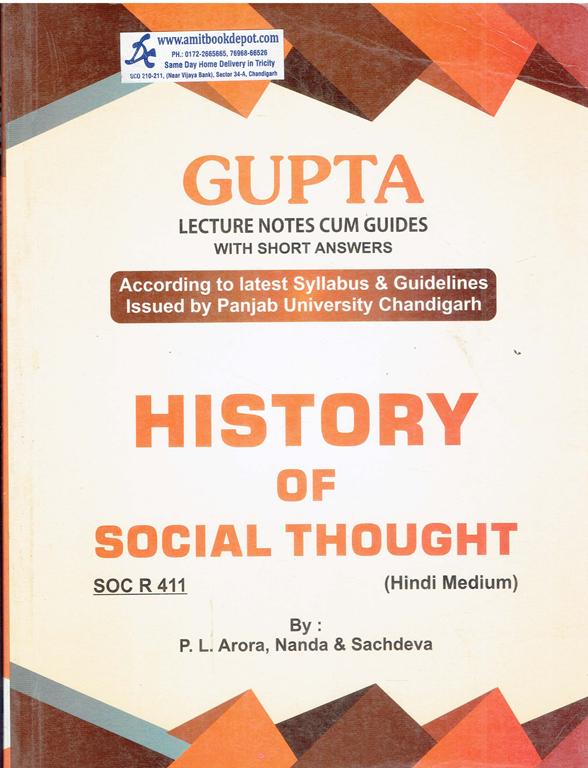
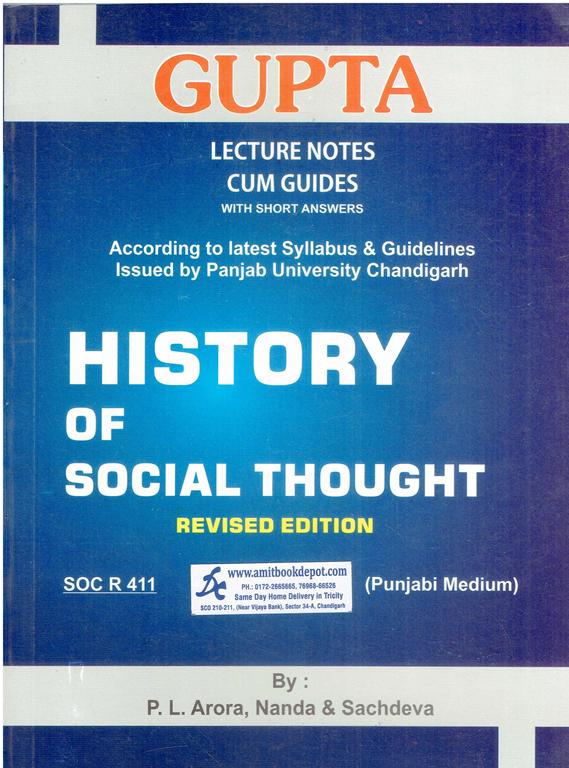
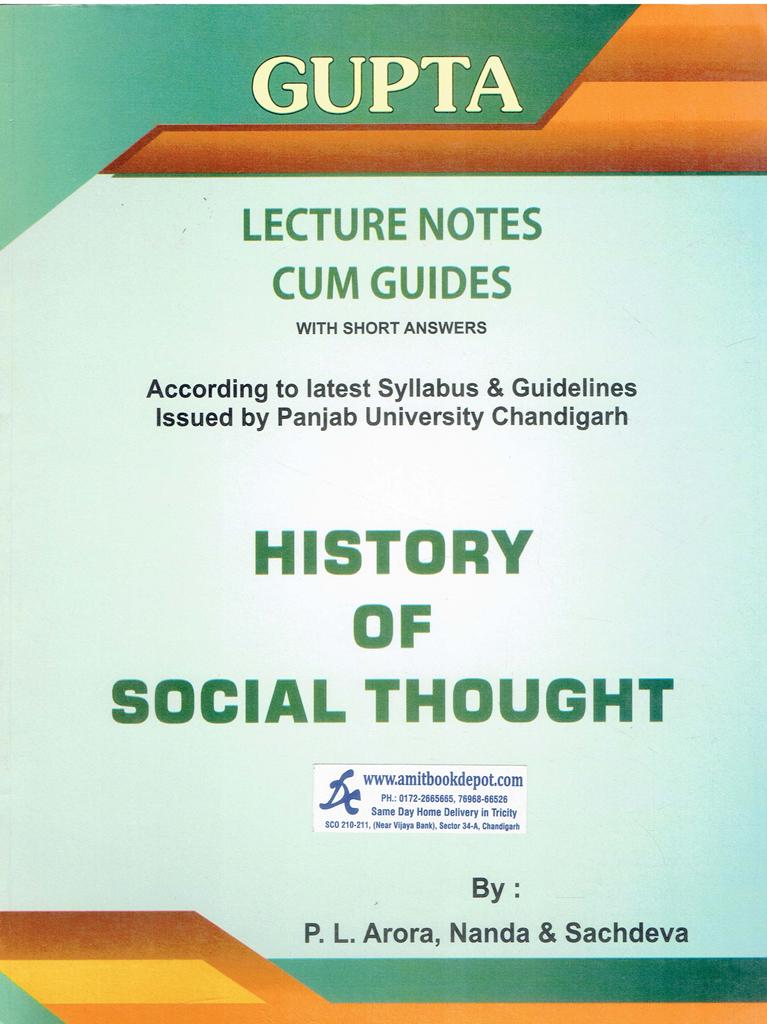
Gupta History of Social Thought SOC R 411 for MA Sociology 1st Semester Panjab University Chandigarh (Hindi Medium)
Gupta History of Social Thought SOC R 411 for MA Sociology 1st Semester Panjab University Chandigarh (Hindi Medium)
by Madhurima
₹450₹450.00(-/
off)
Rating & Reviews
23 Customer Review
The "Gupta History of Social Thought (SOC R 411)" is the prescribed Hindi medium book for MA Sociology, First Semester, at Panjab University, Chandigarh. Authored by P.L. Arora, Nanda, and Sachdeva, this Pepsu Book Depot publication offers a complete, syllabus-specific analysis of classical sociological thinkers—Karl Marx, Max Weber, and Emile Durkheim. It covers all units, from Enlightenment thought to detailed theories of capitalism, social action, and solidarity. Designed for the university's exam pattern, it includes essential short-answer practice. This book is an indispensable guide for mastering foundational sociological theory and excelling in academic examinations.
"Gupta History of Social Thought (SOC R 411)" is the prescribed and authoritative book for students pursuing the Master of Arts (MA) in Sociology, First Semester, at Panjab University, Chandigarh, specifically for the Hindi medium curriculum. Meticulously crafted by the esteemed authors P. L. Arora, Nanda, and Sachdeva, and published by Pepsu Book Depot, this volume is an indispensable academic resource designed to provide a comprehensive and syllabus-aligned exploration of the foundational thinkers in sociological theory.
This book serves as a complete guide for the paper SOC R 411: History of Social Thought. Its primary objective is to introduce students to the historical evolution of sociological ideas and facilitate a detailed, critical study of the classical sociological canon. The content is structured to not only explain complex theories but also to sensitize students to their relevance and application in analyzing contemporary social issues. The book is tailored to meet the specific requirements of Panjab University's examination pattern, making it an essential tool for both comprehensive understanding and effective exam preparation.
The content is systematically organized into four distinct units, each corresponding precisely to the university's syllabus. Unit I begins with a foundational review, covering Enlightenment Thought with reference to Rousseau, the Conservative Reaction, and a dedicated analysis of Auguste Comte, including his pivotal concept of the Hierarchy of Sciences. This unit sets the stage for the emergence of sociology as a discipline.
Unit II offers an in-depth examination of Karl Marx. It delves into his methodological approaches, including historical materialism and dialectical materialism. Key concepts such as totality, human praxis, means and relations of production, base and superstructure, alienation, and exploitation are elucidated clearly. The unit extensively covers Marx's theory of capitalism, his analysis of social development epochs, and the central theme of class conflict. A comparative perspective is provided through a discussion on social stratification as viewed by both Marx and Max Weber.
Unit III is dedicated to Max Weber. It breaks down his sophisticated methodology, explaining crucial ideas like Verstehen (interpretive understanding), value-neutrality, objectivity, and the construction of ideal types. The unit clarifies Weber's basic concepts, including his typology of social action, social relationships, power, domination, and legitimate order. A significant focus is placed on his seminal work, "The Protestant Ethic and the Spirit of Capitalism," alongside detailed discussions on bureaucracy, rationalization, and his theory of social stratification and power distribution.
Unit IV provides a thorough presentation of Emile Durkheim's contributions. It starts with his sociological methodology, centered on the treatment of social facts. Core concepts such as collective conscience, social solidarity (mechanical and organic), and anomie are explained with clarity. The book includes detailed chapters on his seminal theories, notably the Theory of Suicide as a social fact and his Theory of Religion, analyzing the dichotomy between the Sacred and the Profane. The transition from mechanical to organic solidarity through social division of labor is also covered comprehensively.
To aid in revision and self-assessment, the book features a dedicated section for short answers, crucial for tackling the compulsory first question in the university exam, which consists of 10 short-answer questions worth 20 marks. The structure of the book directly mirrors the question paper format, with long, analytical chapters corresponding to the four units from which students must attempt one essay-type question each.
As a Hindi medium publication from Pepsu Book Depot, this book ensures that complex sociological theories are accessible in the students' preferred language of instruction, enhancing comprehension and retention. For any MA Sociology student at Panjab University, Chandigarh, mastering "Gupta History of Social Thought (SOC R 411)" is synonymous with building a strong foundation in classical theory and achieving academic success in the first semester.
Is this book the latest edition and fully aligned with the current syllabus of Panjab University's MA Sociology 1st Semester (SOC R 411)?
A1
Yes, this book is published as per the latest syllabus for SOC R 411 at Panjab University, Chandigarh, and is regularly updated to reflect any curricular changes.
Q2
Does this book cover all four units of the syllabus, including the section on Enlightenment thought (Rousseau) and St. Simon?
A2
Absolutely. The book is structured into four precise units, beginning with a review of Enlightenment Thought with reference to Rousseau and the Conservative Reaction, including St. Simon and Comte, before moving to Marx, Weber, and Durkheim.
Q3
Are the complex methodologies of thinkers like Weber (Verstehen, Ideal Type) and Durkheim (Social Facts) explained in simple Hindi?
A3
Yes, as a Hindi medium publication, it prioritizes clear and accessible explanations of complex sociological concepts and methodologies in Hindi, making them easier to understand for students.
Q4
Is the comparison between Marx and Weber on social stratification included?
A4
Yes, Unit II includes a specific chapter titled "Social Stratification: Max Weber and Karl Marx," which provides a comparative analysis of their perspectives.
Q5
Does the book include discussion on Marx's concepts of Alienation and Praxis as mentioned in the syllabus?
A5
Yes, the chapters on Karl Marx comprehensively cover all basic concepts from the syllabus, including Human Praxis, Alienation, Exploitation, Base and Superstructure, and the Epochs of social development.
Q6
Are Durkheim's theories of Suicide and Religion covered as separate, detailed chapters?
A6
Yes, Unit IV contains individual chapters for the "Theory of Suicide" and the "Theory of Religion," analyzing them as social facts in line with Durkheim's methodology.
Q7
Is this book suitable for private candidates who don't have internal assessment?
A7
Yes, the book covers the entire theory syllabus, which constitutes the 80-mark written exam. Private candidates' marks are proportionately calculated based on their performance in this theory paper, for which this book is the complete guide.
Q8
Does the content structure help in answering the long essay-type questions from each unit?
A8
Yes, the detailed chapters within each unit are structured to provide in-depth analysis, arguments, and critiques, equipping students to formulate comprehensive answers for the 15-mark essay questions.
Q9
Beyond exam preparation, is this book useful for building a strong foundation in sociological theory?
A9
Definitely. While exam-focused, it provides a rigorous foundation in classical sociological thought, which is essential for advanced study, research, and applying sociological perspectives to real-world issues.
Q10
Is the chapter on Auguste Comte limited to positivism or does it include the Hierarchy of Sciences?
A10
It includes both. The review of Comte covers his foundational ideas and specifically includes a chapter on the "Hierarchy of Sciences," a key concept in his philosophy.
0.00
0 Overall Rating
5
0
4
0
3
0
2
0
1
0
Try this product & share your review &
thoughts
History of Social Thought
UNIT - I
1. A Brief Review of Auguste Comte
2. Hierarchy of Sciences
UNIT - II
3. Karl Marx: Methodology, Historical Determinism, and Dialectical Materialism
4. Karl Marx: Theory of Capitalism
5. Marx: Class Conflict or Class Struggle
6. Social Stratification: Max Weber and Karl Marx
UNIT - III
7. Max Weber: Methodology, Objectivity, Bureaucracy, and Positions
8. Max Weber’s Theory of Social Action
9. Max Weber’s Modern Capitalism
UNIT - IV
10. Emile Durkheim: Sociological Methodology and Division of Labor
11. Theory of Suicide
12. Theory of Religion
Short Answers
Latest Syllabus of History of Social Thought SOC R 411 for MA Sociology 1st Semester Panjab University Chandigarh (Hindi Medium)
SEMESTER-I
SOC R 411: HISTORY OF SOCIAL THOUGHT
Objective:
1. To introduce students to the historical evolution of sociological thought.
2. To sensitize students to a detailed study of classical sociologists, i.e., Karl Marx, Max Weber, and Emile Durkheim.
3. To apply the formulation of these thinkers to contemporary issues.
INSTRUCTIONS FOR THE PAPER-SETTER AND THE CANDIDATES
(i) The theory question paper will be of 80 marks, and 20 marks will be for internal assessment. The duration of the paper will be 3 hours.
(ii) For private candidates, who have not been assessed earlier for internal assessment, the marks secured by them in the theory paper will proportionately be increased to the maximum marks of the paper in lieu of internal assessment.
The paper setter must put note (ii) in the question paper.
The syllabus has been divided into four units.
There shall be 9 questions in all. The first question is compulsory and shall be a short answer type containing 10 short questions spread over the whole syllabus to be answered in about 30 to 35 words each, carrying 20 marks, i.e., 2 marks each. The rest of the paper shall contain 4 units. Each unit shall have two long questions and the Candidates shall be given an internal choice of attempting one question from each unit—4 in all. Each question will carry 15 marks.
Course Outline:
Unit-I
A brief review of Enlightenment Thought with special reference to Rousseau and of the Conservative Reaction to It, with Special Reference to St. Simon and Auguste Comte.
Unit II
Karl Marx: Methodology—the concepts of Totality: Historical Materialism, Human Praxis.
Basic Concepts: Means, Relations, and Modes of Production: Base and Superstructure; Contradiction, exploitation, and alienation.
Epochs of social development with special reference to capitalism; classes and class Conflict.
Unit III
Max Weber: Methodology—Verstehen, Value-Neutrality and Objectivity, Generality and the Ideal Type;
Basic concepts: social action and its types, social relationships, power, domination, and Legitimate Order.
Protestant Ethic and the Spirit of Capitalism; the rationalization process, bureaucracy, distribution of power and social stratification.
Unit IV
Emile Durkheim: Methodology—the nature of social facts and their causation.
Basic concepts: Individual and collective conscience, social solidarity, and anomie; the Sacred and Profane, the Nature of Religion, and Suicide as a Social Fact.
Mechanical to organic solidarity, differentiation, and social division of labor.
"Gupta History of Social Thought (SOC R 411)" is the prescribed and authoritative book for students pursuing the Master of Arts (MA) in Sociology, First Semester, at Panjab University, Chandigarh, specifically for the Hindi medium curriculum. Meticulously crafted by the esteemed authors P. L. Arora, Nanda, and Sachdeva, and published by Pepsu Book Depot, this volume is an indispensable academic resource designed to provide a comprehensive and syllabus-aligned exploration of the foundational thinkers in sociological theory.
This book serves as a complete guide for the paper SOC R 411: History of Social Thought. Its primary objective is to introduce students to the historical evolution of sociological ideas and facilitate a detailed, critical study of the classical sociological canon. The content is structured to not only explain complex theories but also to sensitize students to their relevance and application in analyzing contemporary social issues. The book is tailored to meet the specific requirements of Panjab University's examination pattern, making it an essential tool for both comprehensive understanding and effective exam preparation.
The content is systematically organized into four distinct units, each corresponding precisely to the university's syllabus. Unit I begins with a foundational review, covering Enlightenment Thought with reference to Rousseau, the Conservative Reaction, and a dedicated analysis of Auguste Comte, including his pivotal concept of the Hierarchy of Sciences. This unit sets the stage for the emergence of sociology as a discipline.
Unit II offers an in-depth examination of Karl Marx. It delves into his methodological approaches, including historical materialism and dialectical materialism. Key concepts such as totality, human praxis, means and relations of production, base and superstructure, alienation, and exploitation are elucidated clearly. The unit extensively covers Marx's theory of capitalism, his analysis of social development epochs, and the central theme of class conflict. A comparative perspective is provided through a discussion on social stratification as viewed by both Marx and Max Weber.
Unit III is dedicated to Max Weber. It breaks down his sophisticated methodology, explaining crucial ideas like Verstehen (interpretive understanding), value-neutrality, objectivity, and the construction of ideal types. The unit clarifies Weber's basic concepts, including his typology of social action, social relationships, power, domination, and legitimate order. A significant focus is placed on his seminal work, "The Protestant Ethic and the Spirit of Capitalism," alongside detailed discussions on bureaucracy, rationalization, and his theory of social stratification and power distribution.
Unit IV provides a thorough presentation of Emile Durkheim's contributions. It starts with his sociological methodology, centered on the treatment of social facts. Core concepts such as collective conscience, social solidarity (mechanical and organic), and anomie are explained with clarity. The book includes detailed chapters on his seminal theories, notably the Theory of Suicide as a social fact and his Theory of Religion, analyzing the dichotomy between the Sacred and the Profane. The transition from mechanical to organic solidarity through social division of labor is also covered comprehensively.
To aid in revision and self-assessment, the book features a dedicated section for short answers, crucial for tackling the compulsory first question in the university exam, which consists of 10 short-answer questions worth 20 marks. The structure of the book directly mirrors the question paper format, with long, analytical chapters corresponding to the four units from which students must attempt one essay-type question each.
As a Hindi medium publication from Pepsu Book Depot, this book ensures that complex sociological theories are accessible in the students' preferred language of instruction, enhancing comprehension and retention. For any MA Sociology student at Panjab University, Chandigarh, mastering "Gupta History of Social Thought (SOC R 411)" is synonymous with building a strong foundation in classical theory and achieving academic success in the first semester.
History of Social Thought
UNIT - I
1. A Brief Review of Auguste Comte
2. Hierarchy of Sciences
UNIT - II
3. Karl Marx: Methodology, Historical Determinism, and Dialectical Materialism
4. Karl Marx: Theory of Capitalism
5. Marx: Class Conflict or Class Struggle
6. Social Stratification: Max Weber and Karl Marx
UNIT - III
7. Max Weber: Methodology, Objectivity, Bureaucracy, and Positions
8. Max Weber’s Theory of Social Action
9. Max Weber’s Modern Capitalism
UNIT - IV
10. Emile Durkheim: Sociological Methodology and Division of Labor
Is this book the latest edition and fully aligned with the current syllabus of Panjab University's MA Sociology 1st Semester (SOC R 411)?
A1
Yes, this book is published as per the latest syllabus for SOC R 411 at Panjab University, Chandigarh, and is regularly updated to reflect any curricular changes.
Q2
Does this book cover all four units of the syllabus, including the section on Enlightenment thought (Rousseau) and St. Simon?
A2
Absolutely. The book is structured into four precise units, beginning with a review of Enlightenment Thought with reference to Rousseau and the Conservative Reaction, including St. Simon and Comte, before moving to Marx, Weber, and Durkheim.
Q3
Are the complex methodologies of thinkers like Weber (Verstehen, Ideal Type) and Durkheim (Social Facts) explained in simple Hindi?
A3
Yes, as a Hindi medium publication, it prioritizes clear and accessible explanations of complex sociological concepts and methodologies in Hindi, making them easier to understand for students.
Q4
Is the comparison between Marx and Weber on social stratification included?
A4
Yes, Unit II includes a specific chapter titled "Social Stratification: Max Weber and Karl Marx," which provides a comparative analysis of their perspectives.
Q5
Does the book include discussion on Marx's concepts of Alienation and Praxis as mentioned in the syllabus?
A5
Yes, the chapters on Karl Marx comprehensively cover all basic concepts from the syllabus, including Human Praxis, Alienation, Exploitation, Base and Superstructure, and the Epochs of social development.
Q6
Are Durkheim's theories of Suicide and Religion covered as separate, detailed chapters?
A6
Yes, Unit IV contains individual chapters for the "Theory of Suicide" and the "Theory of Religion," analyzing them as social facts in line with Durkheim's methodology.
Q7
Is this book suitable for private candidates who don't have internal assessment?
A7
Yes, the book covers the entire theory syllabus, which constitutes the 80-mark written exam. Private candidates' marks are proportionately calculated based on their performance in this theory paper, for which this book is the complete guide.
Q8
Does the content structure help in answering the long essay-type questions from each unit?
A8
Yes, the detailed chapters within each unit are structured to provide in-depth analysis, arguments, and critiques, equipping students to formulate comprehensive answers for the 15-mark essay questions.
Q9
Beyond exam preparation, is this book useful for building a strong foundation in sociological theory?
A9
Definitely. While exam-focused, it provides a rigorous foundation in classical sociological thought, which is essential for advanced study, research, and applying sociological perspectives to real-world issues.
Q10
Is the chapter on Auguste Comte limited to positivism or does it include the Hierarchy of Sciences?
A10
It includes both. The review of Comte covers his foundational ideas and specifically includes a chapter on the "Hierarchy of Sciences," a key concept in his philosophy.
Latest Syllabus of History of Social Thought SOC R 411 for MA Sociology 1st Semester Panjab University Chandigarh (Hindi Medium)
SEMESTER-I
SOC R 411: HISTORY OF SOCIAL THOUGHT
Objective:
1. To introduce students to the historical evolution of sociological thought.
2. To sensitize students to a detailed study of classical sociologists, i.e., Karl Marx, Max Weber, and Emile Durkheim.
3. To apply the formulation of these thinkers to contemporary issues.
INSTRUCTIONS FOR THE PAPER-SETTER AND THE CANDIDATES
(i) The theory question paper will be of 80 marks, and 20 marks will be for internal assessment. The duration of the paper will be 3 hours.
(ii) For private candidates, who have not been assessed earlier for internal assessment, the marks secured by them in the theory paper will proportionately be increased to the maximum marks of the paper in lieu of internal assessment.
The paper setter must put note (ii) in the question paper.
The syllabus has been divided into four units.
There shall be 9 questions in all. The first question is compulsory and shall be a short answer type containing 10 short questions spread over the whole syllabus to be answered in about 30 to 35 words each, carrying 20 marks, i.e., 2 marks each. The rest of the paper shall contain 4 units. Each unit shall have two long questions and the Candidates shall be given an internal choice of attempting one question from each unit—4 in all. Each question will carry 15 marks.
Course Outline:
Unit-I
A brief review of Enlightenment Thought with special reference to Rousseau and of the Conservative Reaction to It, with Special Reference to St. Simon and Auguste Comte.
Unit II
Karl Marx: Methodology—the concepts of Totality: Historical Materialism, Human Praxis.
Basic Concepts: Means, Relations, and Modes of Production: Base and Superstructure; Contradiction, exploitation, and alienation.
Epochs of social development with special reference to capitalism; classes and class Conflict.
Unit III
Max Weber: Methodology—Verstehen, Value-Neutrality and Objectivity, Generality and the Ideal Type;
Basic concepts: social action and its types, social relationships, power, domination, and Legitimate Order.
Protestant Ethic and the Spirit of Capitalism; the rationalization process, bureaucracy, distribution of power and social stratification.
Unit IV
Emile Durkheim: Methodology—the nature of social facts and their causation.
Basic concepts: Individual and collective conscience, social solidarity, and anomie; the Sacred and Profane, the Nature of Religion, and Suicide as a Social Fact.
Mechanical to organic solidarity, differentiation, and social division of labor.
0.00
0 Overall Rating
5
0
4
0
3
0
2
0
1
0
Try this product & share your review &
thoughts
Top Trending Product
Related
Product
Related Product
Related Blog Posts
Latest Blogs
Latest Blogs
Classic Literature Reimagined: Discuss modern twists on classic novels.
Lorem ipsum dolor sit amet, consectetur adipiscing elit, sed
do
eiusmod tempor incididunt ut labore et dolore magna aliqua. Ut enim ad minim
veniam, quis nostrud exercitation ullamco Lorem ipsum dolor sit amet,
consectetur adipiscing elit, sed do eiusmod tempor incididunt ut labore et
dolore magna aliqua. Utenim ad minim veniam, quis nostrud exercitation
ullamco
Lorem ipsum dolor sit amet, consecte...
Classic Literature Reimagined: Discuss modern twists on classic novels.
Lorem ipsum dolor sit amet, consectetur adipiscing elit, sed
do
eiusmod tempor incididunt ut labore et dolore magna aliqua. Ut enim ad minim
veniam, quis nostrud exercitation ullamco Lorem ipsum dolor sit amet,
consectetur adipiscing elit, sed do eiusmod tempor incididunt ut labore et
dolore magna aliqua. Utenim ad minim veniam, quis nostrud exercitation
ullamco
Lorem ipsum dolor sit amet, consecte...
Classic Literature Reimagined: Discuss modern twists on classic novels.
Lorem ipsum dolor sit amet, consectetur adipiscing elit, sed
do
eiusmod tempor incididunt ut labore et dolore magna aliqua. Ut enim ad minim
veniam, quis nostrud exercitation ullamco Lorem ipsum dolor sit amet,
consectetur adipiscing elit, sed do eiusmod tempor incididunt ut labore et
dolore magna aliqua. Utenim ad minim veniam, quis nostrud exercitation
ullamco
Lorem ipsum dolor sit amet, consecte...