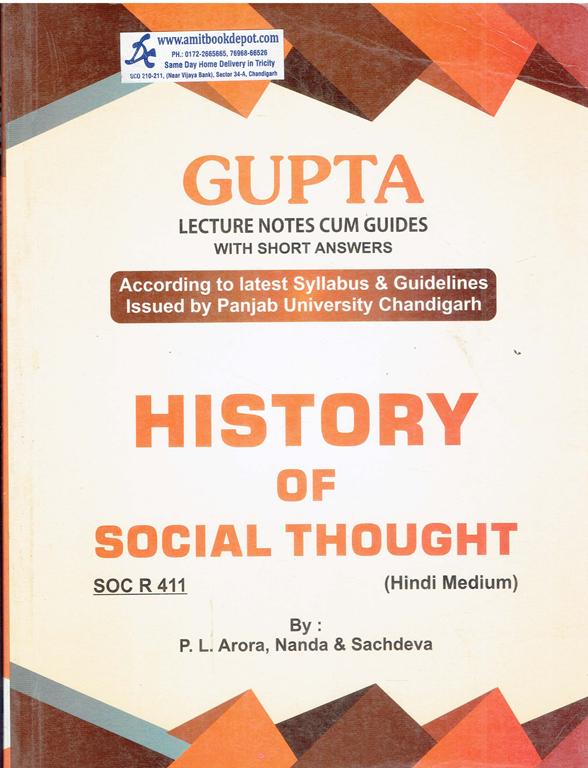
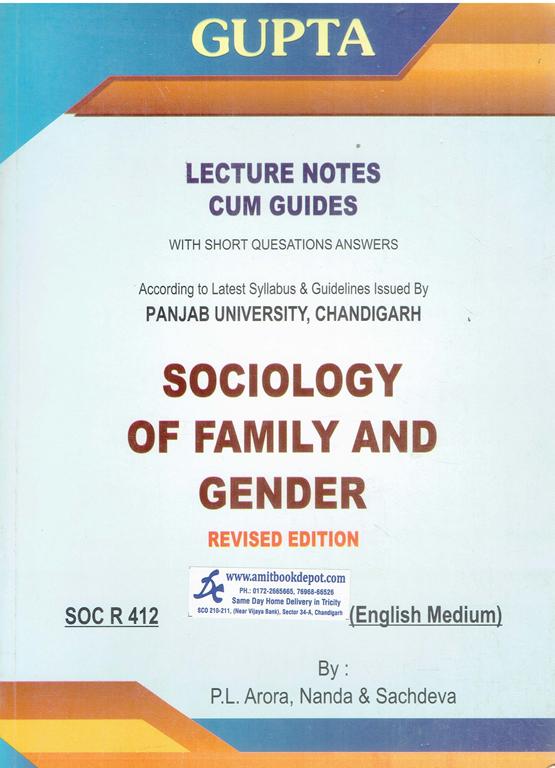
Gupta Sociology of Family and Gender SOC R 412 for MA Sociology 1st Semester Panjab University Chandigarh (Hindi Medium)
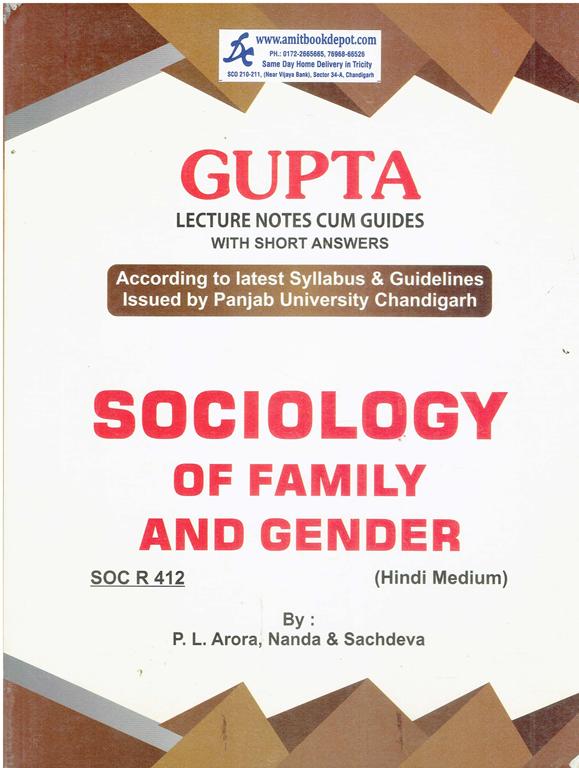
Gupta Sociology of Family and Gender SOC R 412 for MA Sociology 1st Semester Panjab University Chandigarh (Hindi Medium)
by Madhurima
₹450₹450.00(-/
off)
Rating & Reviews
23 Customer Review
Gupta's Sociology of Family and Gender (SOC R 412) is the prescribed Hindi medium book for MA Sociology 1st Semester at Panjab University, Chandigarh. Authored by P.L. Arora, Nanda, and Sachdeva and published by Pepsu Book Depot, it comprehensively covers the latest syllabus. The book provides in-depth analysis of family structures, theoretical approaches, gender construction, feminist theories, and critical issues like gender inequality and related Indian legislation such as the Dowry Prohibition Act and Domestic Violence Act. Including short answer questions, it is an essential, exam-focused resource for mastering the paper on family and gender sociology.
Gupta Sociology of Family and Gender (SOC R 412) for MA Sociology 1st Semester, Panjab University, Chandigarh (Hindi Medium) by P. L. Arora, Nanda, and Sachdeva is the prescribed and comprehensive book meticulously designed for postgraduate students of sociology. Published by Pepsu Book Depot, this authoritative volume aligns perfectly with the latest syllabus prescribed by Panjab University, Chandigarh, ensuring complete coverage of all mandated topics and examination patterns.
This book delves into the core sociological study of two fundamental institutions: the family and the construct of gender. The primary objective of this course, as outlined in the syllabus, is to sensitize students to the basic concepts, theoretical approaches, and contemporary issues surrounding family dynamics and gender relations. This book serves as an essential guide to achieve that objective, providing a structured and in-depth exploration in clear, accessible Hindi.
The content is systematically organized into four units, mirroring the university syllabus. Unit I establishes a strong foundation by exploring the concepts and approaches to family. It begins with clarifying key concepts like family, household, and domestic functions. It then provides a critical examination of major sociological perspectives, including the structural functional approach, the conflict perspective, and symbolic interactionism, enabling students to analyze the family as an institution from multiple theoretical angles.
Unit II shifts focus to the concept and construction of gender. It meticulously distinguishes between sex and gender, explaining crucial terms like gender identity, gender roles, patriarchy, masculinity, and femininity. This unit is vital for understanding the process of gender socialization, demonstrating how institutions like the family, education, work, media, and religion perpetuate gender stereotypes and shape gender relations.
Unit III is dedicated to the major approaches to gender, with a central focus on feminist thought. It provides a clear understanding of feminism and its various strands, including liberal feminism, radical feminism, socialist-Marxist feminism, and postmodernist feminism. This theoretical grounding equips students with the analytical tools to critically engage with debates on gender inequality.
Unit IV addresses pressing real-world issues by focusing on gender equality through legislation in the Indian context. It examines critical dimensions of gender inequality such as female infanticide, neglect of the girl child, and violence against women. Importantly, it provides a concise introduction to key Indian legislations like the PNDT Act, the Dowry Prohibition Act, the Domestic Violence Act, and the Sexual Harassment at Workplace Act, linking sociological theory to legal provisions and social action.
Beyond the detailed theoretical and issue-based chapters, this book includes a dedicated section of short answer type questions. This feature is specifically tailored to help students prepare for the compulsory first question in the university examination, which consists of short-answer questions spread across the entire syllabus.
The book is meticulously crafted to adhere to the university's examination format. The syllabus clearly states that the theory paper is of 80 marks with 20 marks for internal assessment, and the question paper pattern includes one compulsory short-answer question and four long-answer questions with internal choice from each unit. This book’s structure and content directly facilitate preparation for this exact pattern, making it an indispensable resource for scoring high marks.
For students pursuing an MA in Sociology in the 1st semester from Panjab University, Chandigarh, this Hindi-medium book is not just recommended but essential. It is the definitive guide for mastering Sociology of Family and Gender (SOC R 412), offering a perfect blend of theoretical depth, contemporary relevance, and exam-focused preparation. Keywords: MA Sociology, Panjab University, Sociology of Family and Gender, SOC R 412, Hindi Medium, P. L. Arora, Gender Socialization, Feminism, Patriarchy, Gender Inequality, Domestic Violence Act, Dowry Prohibition Act, Structural Functionalism, Symbolic Interactionism, Pepsu Book Depot, MA 1st Semester, Sociology Book.
Is this book the latest edition and perfectly aligned with the current syllabus of SOC R 412 for Panjab University?
A1
Yes, this book is specifically compiled and updated to match the latest prescribed syllabus for MA Sociology (1st Semester) SOC R 412 at Panjab University, Chandigarh.
Q2
Does the book cover all four units as per the Panjab University syllabus, including the section on Indian legislations?
A2
Absolutely. The book is divided into four precise units: Concepts and Approaches to Family, Construction of Gender, Approaches to Gender (Feminism), and Gender Equality through Legislation in the Indian context, including acts like PNDT, Dowry Prohibition, and Domestic Violence Act.
Q3
Are the theoretical approaches like Structural Functionalism, Conflict, and Symbolic Interactionism explained in the context of the family?
A3
Yes, Unit I is dedicated to explaining these core sociological approaches specifically as they apply to the analysis of the institution of the family.
Q4
Does it explain the difference between sex and gender, and concepts like patriarchy and gender socialization?
A4
Yes, Unit II thoroughly clarifies foundational concepts including sex vs. gender, gender identity, patriarchy, and the process of gender socialization through various institutions.
Q5
Which schools of feminist thought are covered in this textbook?
A5
Unit III provides a detailed explanation of Liberal, Radical, Socialist-Marxist, and Postmodernist Feminism, as required by the syllabus.
Q6
Is the content on gender inequality focused on the Indian context?
A6
Yes, Unit IV specifically addresses dimensions of gender inequality like female feticide and domestic violence within the Indian context and discusses relevant Indian laws.
Q7
I am a private candidate. Does the book's content and question pattern account for the full 100-mark paper?
A7
The book covers the entire 80-mark theory syllabus comprehensively. Private candidates should note that their theory marks are proportionately increased, as per the university's note in the syllabus, which is reflected in the book's focus.
Q8
Is the language simple and easy to understand for Hindi medium students?
A8
Yes, the book is written in clear, academic Hindi to cater specifically to Hindi medium students, making complex sociological concepts accessible.
Q9
Does it include topics like the sociology of work and religion in relation to gender?
A9
Yes, as part of Unit II on gender construction, it covers the role of institutions like work and religion in gender socialization and stereotyping.
Q10
Is this book useful only for exam preparation, or does it also provide conceptual clarity for research?
A10
While it is meticulously designed for exam success, it also offers deep conceptual clarity on family and gender sociology, serving as a valuable foundation for students interested in future research in these areas.
0.00
0 Overall Rating
5
0
4
0
3
0
2
0
1
0
Try this product & share your review &
thoughts
UNIT - I
1. Domestic Function, Concept, and Nature of Family
2. Structure—Functional Approaches
3. Family Conflict
4. Symbolic Interactionism
UNIT - II
5. Role of Concept and Identity of Gender
6. Gender Relations and Socialization
7. Gender Education Through Family
8. Work and Religion
UNIT - III
9. Society, Radical and Deep Ecology
10. Socialist - Marxism
11. Postmodernism of Feminism
12. Gender Inequality and Violence
13. Gender Inequality – Gender, Work, Income, and Empowerment
14. Gender - Culture Development
15. Female Feticide
16. Domestic Violence and Dowry Prohibition Act
Short Answer Type Questions
Latest Syllabus of Sociology of Family and Gender SOC R 412 for MA Sociology 1st Semester Panjab University Chandigarh (Hindi Medium)
SOC R 412: SOCIOLOGY OF FAMILY AND GENDER
Objective
This course is aimed at sensitizing the students regarding the basic concepts and approaches used for explaining and understanding family and gender. It also aims at sensitizing students about the process of gender socialization within the framework of family. Finally, it exposes the student to specific problems and legal provisions made available to counter these problems relating to gender inequality in the Indian context.
INSTRUCTIONS FOR THE PAPER-SETTER AND THE CANDIDATES
(i) The theory question paper will be of 80 marks, and 20 marks will be for internal assessment. The duration of the paper will be 3 hours.
(ii) For private candidates, who have not been assessed earlier for internal assessment, the marks secured by them in the theory paper will proportionately be increased to the maximum marks of the paper in lieu of internal assessment.
The paper setter must put note (ii) in the question paper.
The syllabus has been divided into four units.
There shall be 9 questions in all. The first question is compulsory and shall be a short answer type containing 10 short questions spread over the whole syllabus to be answered in about 30 to 35 words each, carrying 20 marks, i.e., 2 marks each. The rest of the paper shall contain 4 units. Each unit shall have two long questions and the Candidates shall be given an internal choice of attempting one question from each unit—4 in all. Each question will carry 15 marks.
Course Outline
Unit-I
Concepts and Approaches to Family
Concepts—Family, Household, and Domestic Function;
i) Concepts—Sex, Gender, Gender Identity, and Gender Roles
ii) Basic understanding of patriarchy, masculinity and femininity, gender socialization, and gender stereotyping through the institutions of family, education, work, media, and religion.
Unit III
Approaches to Gender
Feminism: Meaning; Liberal, Radical, Socialist-Marxist, and Postmodernist Feminism
Unit IV
Gender Equality through Legislation (in the Indian Context)
i) Dimensions of Gender Inequality: Female Foeticide, Neglect of Girl Child, Bride Burning, and Status of Elderly Women.
ii) Brief introduction to the PNDT Act, the Dowry Prohibition Act, the Domestic Violence Act, and the Sexual Harassment of Women at Workplace (Prevention, Prohibition, and Redressal) Act.
Gupta Sociology of Family and Gender (SOC R 412) for MA Sociology 1st Semester, Panjab University, Chandigarh (Hindi Medium) by P. L. Arora, Nanda, and Sachdeva is the prescribed and comprehensive book meticulously designed for postgraduate students of sociology. Published by Pepsu Book Depot, this authoritative volume aligns perfectly with the latest syllabus prescribed by Panjab University, Chandigarh, ensuring complete coverage of all mandated topics and examination patterns.
This book delves into the core sociological study of two fundamental institutions: the family and the construct of gender. The primary objective of this course, as outlined in the syllabus, is to sensitize students to the basic concepts, theoretical approaches, and contemporary issues surrounding family dynamics and gender relations. This book serves as an essential guide to achieve that objective, providing a structured and in-depth exploration in clear, accessible Hindi.
The content is systematically organized into four units, mirroring the university syllabus. Unit I establishes a strong foundation by exploring the concepts and approaches to family. It begins with clarifying key concepts like family, household, and domestic functions. It then provides a critical examination of major sociological perspectives, including the structural functional approach, the conflict perspective, and symbolic interactionism, enabling students to analyze the family as an institution from multiple theoretical angles.
Unit II shifts focus to the concept and construction of gender. It meticulously distinguishes between sex and gender, explaining crucial terms like gender identity, gender roles, patriarchy, masculinity, and femininity. This unit is vital for understanding the process of gender socialization, demonstrating how institutions like the family, education, work, media, and religion perpetuate gender stereotypes and shape gender relations.
Unit III is dedicated to the major approaches to gender, with a central focus on feminist thought. It provides a clear understanding of feminism and its various strands, including liberal feminism, radical feminism, socialist-Marxist feminism, and postmodernist feminism. This theoretical grounding equips students with the analytical tools to critically engage with debates on gender inequality.
Unit IV addresses pressing real-world issues by focusing on gender equality through legislation in the Indian context. It examines critical dimensions of gender inequality such as female infanticide, neglect of the girl child, and violence against women. Importantly, it provides a concise introduction to key Indian legislations like the PNDT Act, the Dowry Prohibition Act, the Domestic Violence Act, and the Sexual Harassment at Workplace Act, linking sociological theory to legal provisions and social action.
Beyond the detailed theoretical and issue-based chapters, this book includes a dedicated section of short answer type questions. This feature is specifically tailored to help students prepare for the compulsory first question in the university examination, which consists of short-answer questions spread across the entire syllabus.
The book is meticulously crafted to adhere to the university's examination format. The syllabus clearly states that the theory paper is of 80 marks with 20 marks for internal assessment, and the question paper pattern includes one compulsory short-answer question and four long-answer questions with internal choice from each unit. This book’s structure and content directly facilitate preparation for this exact pattern, making it an indispensable resource for scoring high marks.
For students pursuing an MA in Sociology in the 1st semester from Panjab University, Chandigarh, this Hindi-medium book is not just recommended but essential. It is the definitive guide for mastering Sociology of Family and Gender (SOC R 412), offering a perfect blend of theoretical depth, contemporary relevance, and exam-focused preparation. Keywords: MA Sociology, Panjab University, Sociology of Family and Gender, SOC R 412, Hindi Medium, P. L. Arora, Gender Socialization, Feminism, Patriarchy, Gender Inequality, Domestic Violence Act, Dowry Prohibition Act, Structural Functionalism, Symbolic Interactionism, Pepsu Book Depot, MA 1st Semester, Sociology Book.
UNIT - I
1. Domestic Function, Concept, and Nature of Family
2. Structure—Functional Approaches
3. Family Conflict
4. Symbolic Interactionism
UNIT - II
5. Role of Concept and Identity of Gender
6. Gender Relations and Socialization
7. Gender Education Through Family
8. Work and Religion
UNIT - III
9. Society, Radical and Deep Ecology
10. Socialist - Marxism
11. Postmodernism of Feminism
12. Gender Inequality and Violence
13. Gender Inequality – Gender, Work, Income, and Empowerment
Is this book the latest edition and perfectly aligned with the current syllabus of SOC R 412 for Panjab University?
A1
Yes, this book is specifically compiled and updated to match the latest prescribed syllabus for MA Sociology (1st Semester) SOC R 412 at Panjab University, Chandigarh.
Q2
Does the book cover all four units as per the Panjab University syllabus, including the section on Indian legislations?
A2
Absolutely. The book is divided into four precise units: Concepts and Approaches to Family, Construction of Gender, Approaches to Gender (Feminism), and Gender Equality through Legislation in the Indian context, including acts like PNDT, Dowry Prohibition, and Domestic Violence Act.
Q3
Are the theoretical approaches like Structural Functionalism, Conflict, and Symbolic Interactionism explained in the context of the family?
A3
Yes, Unit I is dedicated to explaining these core sociological approaches specifically as they apply to the analysis of the institution of the family.
Q4
Does it explain the difference between sex and gender, and concepts like patriarchy and gender socialization?
A4
Yes, Unit II thoroughly clarifies foundational concepts including sex vs. gender, gender identity, patriarchy, and the process of gender socialization through various institutions.
Q5
Which schools of feminist thought are covered in this textbook?
A5
Unit III provides a detailed explanation of Liberal, Radical, Socialist-Marxist, and Postmodernist Feminism, as required by the syllabus.
Q6
Is the content on gender inequality focused on the Indian context?
A6
Yes, Unit IV specifically addresses dimensions of gender inequality like female feticide and domestic violence within the Indian context and discusses relevant Indian laws.
Q7
I am a private candidate. Does the book's content and question pattern account for the full 100-mark paper?
A7
The book covers the entire 80-mark theory syllabus comprehensively. Private candidates should note that their theory marks are proportionately increased, as per the university's note in the syllabus, which is reflected in the book's focus.
Q8
Is the language simple and easy to understand for Hindi medium students?
A8
Yes, the book is written in clear, academic Hindi to cater specifically to Hindi medium students, making complex sociological concepts accessible.
Q9
Does it include topics like the sociology of work and religion in relation to gender?
A9
Yes, as part of Unit II on gender construction, it covers the role of institutions like work and religion in gender socialization and stereotyping.
Q10
Is this book useful only for exam preparation, or does it also provide conceptual clarity for research?
A10
While it is meticulously designed for exam success, it also offers deep conceptual clarity on family and gender sociology, serving as a valuable foundation for students interested in future research in these areas.
Latest Syllabus of Sociology of Family and Gender SOC R 412 for MA Sociology 1st Semester Panjab University Chandigarh (Hindi Medium)
SOC R 412: SOCIOLOGY OF FAMILY AND GENDER
Objective
This course is aimed at sensitizing the students regarding the basic concepts and approaches used for explaining and understanding family and gender. It also aims at sensitizing students about the process of gender socialization within the framework of family. Finally, it exposes the student to specific problems and legal provisions made available to counter these problems relating to gender inequality in the Indian context.
INSTRUCTIONS FOR THE PAPER-SETTER AND THE CANDIDATES
(i) The theory question paper will be of 80 marks, and 20 marks will be for internal assessment. The duration of the paper will be 3 hours.
(ii) For private candidates, who have not been assessed earlier for internal assessment, the marks secured by them in the theory paper will proportionately be increased to the maximum marks of the paper in lieu of internal assessment.
The paper setter must put note (ii) in the question paper.
The syllabus has been divided into four units.
There shall be 9 questions in all. The first question is compulsory and shall be a short answer type containing 10 short questions spread over the whole syllabus to be answered in about 30 to 35 words each, carrying 20 marks, i.e., 2 marks each. The rest of the paper shall contain 4 units. Each unit shall have two long questions and the Candidates shall be given an internal choice of attempting one question from each unit—4 in all. Each question will carry 15 marks.
Course Outline
Unit-I
Concepts and Approaches to Family
Concepts—Family, Household, and Domestic Function;
i) Concepts—Sex, Gender, Gender Identity, and Gender Roles
ii) Basic understanding of patriarchy, masculinity and femininity, gender socialization, and gender stereotyping through the institutions of family, education, work, media, and religion.
Unit III
Approaches to Gender
Feminism: Meaning; Liberal, Radical, Socialist-Marxist, and Postmodernist Feminism
Unit IV
Gender Equality through Legislation (in the Indian Context)
i) Dimensions of Gender Inequality: Female Foeticide, Neglect of Girl Child, Bride Burning, and Status of Elderly Women.
ii) Brief introduction to the PNDT Act, the Dowry Prohibition Act, the Domestic Violence Act, and the Sexual Harassment of Women at Workplace (Prevention, Prohibition, and Redressal) Act.
0.00
0 Overall Rating
5
0
4
0
3
0
2
0
1
0
Try this product & share your review &
thoughts
Top Trending Product
Related
Product
Related Product
Related Blog Posts
Latest Blogs
Latest Blogs
Classic Literature Reimagined: Discuss modern twists on classic novels.
Lorem ipsum dolor sit amet, consectetur adipiscing elit, sed
do
eiusmod tempor incididunt ut labore et dolore magna aliqua. Ut enim ad minim
veniam, quis nostrud exercitation ullamco Lorem ipsum dolor sit amet,
consectetur adipiscing elit, sed do eiusmod tempor incididunt ut labore et
dolore magna aliqua. Utenim ad minim veniam, quis nostrud exercitation
ullamco
Lorem ipsum dolor sit amet, consecte...
Classic Literature Reimagined: Discuss modern twists on classic novels.
Lorem ipsum dolor sit amet, consectetur adipiscing elit, sed
do
eiusmod tempor incididunt ut labore et dolore magna aliqua. Ut enim ad minim
veniam, quis nostrud exercitation ullamco Lorem ipsum dolor sit amet,
consectetur adipiscing elit, sed do eiusmod tempor incididunt ut labore et
dolore magna aliqua. Utenim ad minim veniam, quis nostrud exercitation
ullamco
Lorem ipsum dolor sit amet, consecte...
Classic Literature Reimagined: Discuss modern twists on classic novels.
Lorem ipsum dolor sit amet, consectetur adipiscing elit, sed
do
eiusmod tempor incididunt ut labore et dolore magna aliqua. Ut enim ad minim
veniam, quis nostrud exercitation ullamco Lorem ipsum dolor sit amet,
consectetur adipiscing elit, sed do eiusmod tempor incididunt ut labore et
dolore magna aliqua. Utenim ad minim veniam, quis nostrud exercitation
ullamco
Lorem ipsum dolor sit amet, consecte...