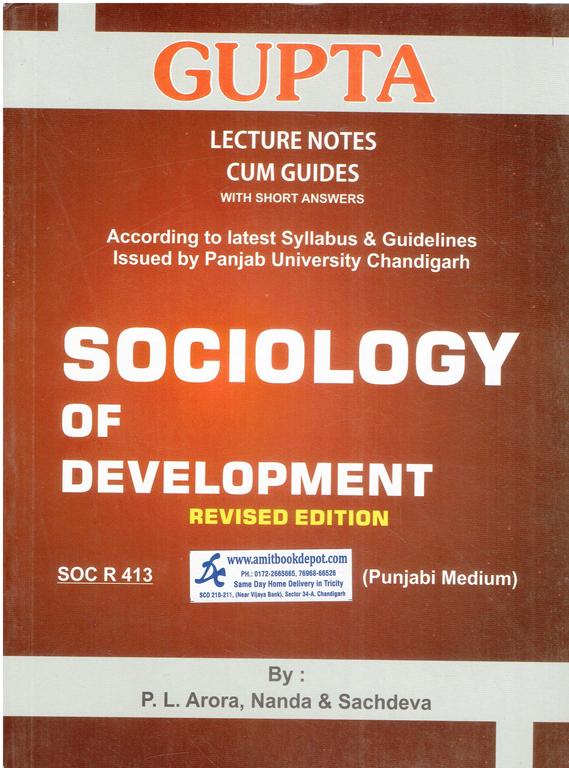
Gupta Sociology of Development For MA Sociology All Semester Panjab University Chandigarh (Punjabi Medium)
Gupta Sociology of Development For MA Sociology All Semester Panjab University Chandigarh (Punjabi Medium)
by Madhurima
₹450₹450.00(-/
off)
Rating & Reviews
23 Customer Review
Gupta's Sociology of Development is the essential Punjabi-medium book for MA Sociology all semester students at Panjab University, Chandigarh. Authored by P. L. Arora, Nanda, and Sachdeva and published by Pepsu Book Depot, it comprehensively covers the entire prescribed syllabus for paper SOC R 413. The book provides in-depth analysis of development concepts, modernization theories (Myrdal, Rostow, Smelser), theories of underdevelopment (Frank, Wallerstein), and paths of development. Tailored to the university's exam pattern, it includes short answer-type questions, making it an indispensable guide for mastering the subject and excelling in examinations.
Gupta Sociology of Development is the definitive academic book, meticulously crafted for MA Sociology and all Semester students of Panjab University, Chandigarh, following the official syllabus in Punjabi medium. Authored by the esteemed academics P. L. Arora, Nanda, and Sachdeva, and published by Pepsu Book Depot, this volume is an indispensable resource tailored for the specific curriculum and examination patterns of Panjab University. Designed for the paper SOC R 413: Sociology of Development, this book provides a comprehensive and critical exploration of one of sociology's most dynamic fields, directly aligning with the university's latest prescribed syllabus.
The book is structured into four systematic units, each mirroring the university's course outline to facilitate seamless study and revision. Unit I begins with a foundational analysis of the concept of development, unpacking its changing connotations from both liberal and socialist perspectives. It provides a clear understanding of the indicators and indices of development, including crucial operational indicators used to measure societal progress. This unit establishes the essential conceptual framework upon which the rest of the course is built.
Unit II offers an in-depth examination of modernization theories, a core component of the syllabus. It systematically covers the economic modernization theory of thinkers like Gunnar Myrdal and W.W. Rostow. It further delves into sociological modernization theory through the works of Neil J. Smelser and Daniel Lerner and explores social-psychological theories from David McClelland and Everett E. Hagen. The unit also analyzes political theories of modernization by Gabriel Almond and James Samuel Coleman, concluding with a balanced critical assessment of modernization theories as required by the syllabus.
In Unit III, the focus shifts to the influential critiques of modernization, namely the Theories of Underdevelopment. This section is vital for students to understand alternative paradigms, including the center-periphery model as articulated by A.G. Frank and Samir Amin. It comprehensively explains the Unequal Exchange Theory associated with Paul Baran and provides a detailed study of Immanuel Wallerstein's World-System theory. A critical assessment of these perspectives ensures students develop a nuanced understanding of global inequalities.
Unit IV concludes the theoretical journey by exploring the practical paths of development. It compares and contrasts capitalist, socialist, and mixed paths to development, enabling students to evaluate different national models. Finally, it engages with the contemporary reality of globalization as a strategy of development, a topic of significant relevance in today's interconnected world. To aid in exam preparation, the book includes a dedicated section of Short Answer Type Questions, which is crucial for tackling the compulsory first question of the university exam paper.
This book is explicitly designed with the Panjab University examination pattern in mind. It adheres to the instruction that the theory question paper is of 80 marks with 20 marks for internal assessment. The content division and depth are perfectly aligned to help students answer both the compulsory short-answer section and the long, essay-type questions from each unit. For private candidates, understanding the marking scheme outlined in the book is particularly beneficial. As the primary text for Punjabi medium instruction, it ensures that language is not a barrier to mastering complex sociological concepts. For any student pursuing an MA in Sociology or an UG semester course in Sociology of Development at Panjab University, Gupta Sociology of Development is not just a recommended text but an essential academic companion for mastering the syllabus, achieving conceptual clarity, and succeeding in examinations.
Is this book the latest edition and fully aligned with the current Panjab University MA Sociology syllabus?
A1
Yes, this book is meticulously crafted to cover the latest prescribed syllabus for SOC R 413: Sociology of Development for MA at Panjab University, Chandigarh.
Q2
I am a Punjabi Medium student. Is the language and terminology in this book suitable for me?
A2
Absolutely. This book is specifically published in Punjabi Medium, ensuring all complex sociological concepts and theories are explained clearly in Punjabi, making it ideal for your medium of instruction.
Q3
Does the book cover both Modernization and Underdevelopment theories as per the syllabus?
A3
Yes, it provides comprehensive coverage. Unit II details Economic, Sociological, Social-Psychological, and Political Modernization theories, while Unit III is dedicated to Underdevelopment theories like the Centre-Periphery model and World-System theory.
Q4
Are thinkers like Gunnar Myrdal, A.G. Frank, and Immanuel Wallerstein explained in separate chapters?
A4
Yes, the book includes dedicated sections for key theorists as per the syllabus, including Myrdal, Rostow, Smelser, Lerner, McClelland, Hagen, Almond, Coleman, Frank, Amin, Baran, and Wallerstein.
Q5
Is the section on "Globalization as a Strategy of Development" included?
A5
Yes, this is a key part of Unit IV (Paths of Development), providing analysis of globalization as a contemporary development strategy, as required by the syllabus.
Q6
I am a private candidate. Does the book explain the marking scheme for the theory paper and internal assessment?
A6
The book includes the official instructions, noting that the theory paper is 80 marks with 20 marks for internal assessment, and explains the provision for private candidates regarding mark calculation.
Q7
Is this book useful for (PG) semester students of Sociology at Panjab University?
A7
Yes, the title and syllabus coverage indicate it is designed for "All Semester" students taking the Sociology of Development paper, in addition to MA students.
Q8
Does the book provide a critical assessment of the theories, or just descriptive content?
A8
Each major theoretical section, such as on Modernization Theories and Underdevelopment Theories, concludes with a critical assessment, encouraging analytical thinking as expected in postgraduate studies.
Q9
Are the "Operational Indicators" of development covered in detail?
A9
Yes, Unit I concludes with a detailed explanation of the indicators and indices of development, focusing specifically on operational indicators used in measurement.
Q10
Is the book relevant for students outside Panjab University if they are studying Sociology of Development in Punjabi?
A10
While specifically tailored for Panjab University's syllabus, students from other universities with similar curricula and Punjabi medium instruction may find the theoretical explanations and Punjabi language content highly beneficial.
0.00
0 Overall Rating
5
0
4
0
3
0
2
0
1
0
Try this product & share your review &
thoughts
UNIT - I
1. Development
2. The Concept and Its Changing Connotations
3. Liberal Connotations
4. Socialist Connotations
5. The Indicators and Indices of Development
6. Operational Indicators
UNIT - II
7. Modernization Theories
8. Change, Modernization, and Development
9. Economic Modernization Theory
10. Gunnar Myrdal
11. W.W. Rostow
12. Sociological Modernization Theory
13. Neil J. Smelser
14. Daniel Lerner
15. Social-Psychological Theories of Modernization: David McClelland
16. Hagen, Everett E.
17. Political Theories of Modernization
18. Gabriel Almond
19. James Samuel Coleman
20. Critical Assessment of Modernization Theories
UNIT - III
21. Theories of Underdevelopment
22. Center-Periphery Model
23. A.G. Frank’s Theory
24. Samir Amin
25. Unequal Exchange Theory
26. Paul Baran
27. World-System: Immanuel Wallerstein
UNIT - IV
28. Paths of Development
29. Capitalist, Socialist, and Mixed Paths to Development
30. Models of Development
31. Globalization as a Strategy of Development
Short Answer Type Questions
Latest Syllabus of Sociology of Development For MA Sociology All Semester Panjab University Chandigarh (Punjabi Medium)
SOC R 413: SOCIOLOGY OF DEVELOPMENT
Objective
Keeping in view the relevance of the theme of development, especially in the less developed societies, this course aims (a) to familiarize the students with the various ways that development has been conceptualized; (b) to critically evaluate the modernization theory in its economic, sociological, social-psychological, and political forms; (c) to provide a review of the underdevelopment theory given by the Latin American political economists; and (d) to reassess the various paths to development.
INSTRUCTIONS FOR THE PAPER-SETTER AND THE CANDIDATES
(i) The theory question paper will be of 80 marks, and 20 marks will be for internal assessment. The duration of the paper will be 3 hours.
(ii) For private candidates, who have not been assessed earlier for internal assessment, the marks secured by them in the theory paper will proportionately be increased to the maximum marks of the paper in lieu of internal assessment.
The paper setter must put note (ii) in the question paper.
The syllabus has been divided into four units.
There shall be 9 questions in all. The first question is compulsory and shall be a short answer type containing 10 short questions spread over the whole syllabus to be answered in about 30 to 35 words each, carrying 20 marks, i.e., 2 marks each. The rest of the paper shall contain 4 units. Each unit shall have two long questions and the Candidates shall be given an internal choice of attempting one question from each unit—4 in all. Each question will carry 15 marks.
Course Outline
Unit-I
Development: The concept and its changing connotations (liberal and socialist);
Operational Indicators.
Unit-II
Modernization Theories:
Economic (Gunnar Myrdal, W. W. Rostow);
Sociological (Neil J. Smelser, Daniel Lerner,
Social-Psychological (David C. McClelland, Everett E. Hagen);
Political (Gabriel A. Almond & James S. Coleman);
Their Critical Assessment
Unit III
Theories of Underdevelopment: Centre-Periphery (A. G. Frank, Samir Amin);
Unequal exchange (Paul Baran); world system (Immanuel Wallerstein);
Gupta Sociology of Development is the definitive academic book, meticulously crafted for MA Sociology and all Semester students of Panjab University, Chandigarh, following the official syllabus in Punjabi medium. Authored by the esteemed academics P. L. Arora, Nanda, and Sachdeva, and published by Pepsu Book Depot, this volume is an indispensable resource tailored for the specific curriculum and examination patterns of Panjab University. Designed for the paper SOC R 413: Sociology of Development, this book provides a comprehensive and critical exploration of one of sociology's most dynamic fields, directly aligning with the university's latest prescribed syllabus.
The book is structured into four systematic units, each mirroring the university's course outline to facilitate seamless study and revision. Unit I begins with a foundational analysis of the concept of development, unpacking its changing connotations from both liberal and socialist perspectives. It provides a clear understanding of the indicators and indices of development, including crucial operational indicators used to measure societal progress. This unit establishes the essential conceptual framework upon which the rest of the course is built.
Unit II offers an in-depth examination of modernization theories, a core component of the syllabus. It systematically covers the economic modernization theory of thinkers like Gunnar Myrdal and W.W. Rostow. It further delves into sociological modernization theory through the works of Neil J. Smelser and Daniel Lerner and explores social-psychological theories from David McClelland and Everett E. Hagen. The unit also analyzes political theories of modernization by Gabriel Almond and James Samuel Coleman, concluding with a balanced critical assessment of modernization theories as required by the syllabus.
In Unit III, the focus shifts to the influential critiques of modernization, namely the Theories of Underdevelopment. This section is vital for students to understand alternative paradigms, including the center-periphery model as articulated by A.G. Frank and Samir Amin. It comprehensively explains the Unequal Exchange Theory associated with Paul Baran and provides a detailed study of Immanuel Wallerstein's World-System theory. A critical assessment of these perspectives ensures students develop a nuanced understanding of global inequalities.
Unit IV concludes the theoretical journey by exploring the practical paths of development. It compares and contrasts capitalist, socialist, and mixed paths to development, enabling students to evaluate different national models. Finally, it engages with the contemporary reality of globalization as a strategy of development, a topic of significant relevance in today's interconnected world. To aid in exam preparation, the book includes a dedicated section of Short Answer Type Questions, which is crucial for tackling the compulsory first question of the university exam paper.
This book is explicitly designed with the Panjab University examination pattern in mind. It adheres to the instruction that the theory question paper is of 80 marks with 20 marks for internal assessment. The content division and depth are perfectly aligned to help students answer both the compulsory short-answer section and the long, essay-type questions from each unit. For private candidates, understanding the marking scheme outlined in the book is particularly beneficial. As the primary text for Punjabi medium instruction, it ensures that language is not a barrier to mastering complex sociological concepts. For any student pursuing an MA in Sociology or an UG semester course in Sociology of Development at Panjab University, Gupta Sociology of Development is not just a recommended text but an essential academic companion for mastering the syllabus, achieving conceptual clarity, and succeeding in examinations.
UNIT - I
1. Development
2. The Concept and Its Changing Connotations
3. Liberal Connotations
4. Socialist Connotations
5. The Indicators and Indices of Development
6. Operational Indicators
UNIT - II
7. Modernization Theories
8. Change, Modernization, and Development
9. Economic Modernization Theory
10. Gunnar Myrdal
11. W.W. Rostow
12. Sociological Modernization Theory
13. Neil J. Smelser
14. Daniel Lerner
15. Social-Psychological Theories of Modernization: David McClelland
16. Hagen, Everett E.
17. Political Theories of Modernization
18. Gabriel Almond
19. James Samuel Coleman
20. Critical Assessment of Modernization Theories
UNIT - III
21. Theories of Underdevelopment
22. Center-Periphery Model
23. A.G. Frank’s Theory
24. Samir Amin
25. Unequal Exchange Theory
26. Paul Baran
27. World-System: Immanuel Wallerstein
UNIT - IV
28. Paths of Development
29. Capitalist, Socialist, and Mixed Paths to Development
Is this book the latest edition and fully aligned with the current Panjab University MA Sociology syllabus?
A1
Yes, this book is meticulously crafted to cover the latest prescribed syllabus for SOC R 413: Sociology of Development for MA at Panjab University, Chandigarh.
Q2
I am a Punjabi Medium student. Is the language and terminology in this book suitable for me?
A2
Absolutely. This book is specifically published in Punjabi Medium, ensuring all complex sociological concepts and theories are explained clearly in Punjabi, making it ideal for your medium of instruction.
Q3
Does the book cover both Modernization and Underdevelopment theories as per the syllabus?
A3
Yes, it provides comprehensive coverage. Unit II details Economic, Sociological, Social-Psychological, and Political Modernization theories, while Unit III is dedicated to Underdevelopment theories like the Centre-Periphery model and World-System theory.
Q4
Are thinkers like Gunnar Myrdal, A.G. Frank, and Immanuel Wallerstein explained in separate chapters?
A4
Yes, the book includes dedicated sections for key theorists as per the syllabus, including Myrdal, Rostow, Smelser, Lerner, McClelland, Hagen, Almond, Coleman, Frank, Amin, Baran, and Wallerstein.
Q5
Is the section on "Globalization as a Strategy of Development" included?
A5
Yes, this is a key part of Unit IV (Paths of Development), providing analysis of globalization as a contemporary development strategy, as required by the syllabus.
Q6
I am a private candidate. Does the book explain the marking scheme for the theory paper and internal assessment?
A6
The book includes the official instructions, noting that the theory paper is 80 marks with 20 marks for internal assessment, and explains the provision for private candidates regarding mark calculation.
Q7
Is this book useful for (PG) semester students of Sociology at Panjab University?
A7
Yes, the title and syllabus coverage indicate it is designed for "All Semester" students taking the Sociology of Development paper, in addition to MA students.
Q8
Does the book provide a critical assessment of the theories, or just descriptive content?
A8
Each major theoretical section, such as on Modernization Theories and Underdevelopment Theories, concludes with a critical assessment, encouraging analytical thinking as expected in postgraduate studies.
Q9
Are the "Operational Indicators" of development covered in detail?
A9
Yes, Unit I concludes with a detailed explanation of the indicators and indices of development, focusing specifically on operational indicators used in measurement.
Q10
Is the book relevant for students outside Panjab University if they are studying Sociology of Development in Punjabi?
A10
While specifically tailored for Panjab University's syllabus, students from other universities with similar curricula and Punjabi medium instruction may find the theoretical explanations and Punjabi language content highly beneficial.
Latest Syllabus of Sociology of Development For MA Sociology All Semester Panjab University Chandigarh (Punjabi Medium)
SOC R 413: SOCIOLOGY OF DEVELOPMENT
Objective
Keeping in view the relevance of the theme of development, especially in the less developed societies, this course aims (a) to familiarize the students with the various ways that development has been conceptualized; (b) to critically evaluate the modernization theory in its economic, sociological, social-psychological, and political forms; (c) to provide a review of the underdevelopment theory given by the Latin American political economists; and (d) to reassess the various paths to development.
INSTRUCTIONS FOR THE PAPER-SETTER AND THE CANDIDATES
(i) The theory question paper will be of 80 marks, and 20 marks will be for internal assessment. The duration of the paper will be 3 hours.
(ii) For private candidates, who have not been assessed earlier for internal assessment, the marks secured by them in the theory paper will proportionately be increased to the maximum marks of the paper in lieu of internal assessment.
The paper setter must put note (ii) in the question paper.
The syllabus has been divided into four units.
There shall be 9 questions in all. The first question is compulsory and shall be a short answer type containing 10 short questions spread over the whole syllabus to be answered in about 30 to 35 words each, carrying 20 marks, i.e., 2 marks each. The rest of the paper shall contain 4 units. Each unit shall have two long questions and the Candidates shall be given an internal choice of attempting one question from each unit—4 in all. Each question will carry 15 marks.
Course Outline
Unit-I
Development: The concept and its changing connotations (liberal and socialist);
Operational Indicators.
Unit-II
Modernization Theories:
Economic (Gunnar Myrdal, W. W. Rostow);
Sociological (Neil J. Smelser, Daniel Lerner,
Social-Psychological (David C. McClelland, Everett E. Hagen);
Political (Gabriel A. Almond & James S. Coleman);
Their Critical Assessment
Unit III
Theories of Underdevelopment: Centre-Periphery (A. G. Frank, Samir Amin);
Unequal exchange (Paul Baran); world system (Immanuel Wallerstein);
Their Critical Assessment
Unit IV
Paths of Development:
Capitalist, Socialist, Mixed;
Globalization as a Strategy of Development.
0.00
0 Overall Rating
5
0
4
0
3
0
2
0
1
0
Try this product & share your review &
thoughts
Top Trending Product
Related
Product
Related Product
Related Blog Posts
Latest Blogs
Latest Blogs
Classic Literature Reimagined: Discuss modern twists on classic novels.
Lorem ipsum dolor sit amet, consectetur adipiscing elit, sed
do
eiusmod tempor incididunt ut labore et dolore magna aliqua. Ut enim ad minim
veniam, quis nostrud exercitation ullamco Lorem ipsum dolor sit amet,
consectetur adipiscing elit, sed do eiusmod tempor incididunt ut labore et
dolore magna aliqua. Utenim ad minim veniam, quis nostrud exercitation
ullamco
Lorem ipsum dolor sit amet, consecte...
Classic Literature Reimagined: Discuss modern twists on classic novels.
Lorem ipsum dolor sit amet, consectetur adipiscing elit, sed
do
eiusmod tempor incididunt ut labore et dolore magna aliqua. Ut enim ad minim
veniam, quis nostrud exercitation ullamco Lorem ipsum dolor sit amet,
consectetur adipiscing elit, sed do eiusmod tempor incididunt ut labore et
dolore magna aliqua. Utenim ad minim veniam, quis nostrud exercitation
ullamco
Lorem ipsum dolor sit amet, consecte...
Classic Literature Reimagined: Discuss modern twists on classic novels.
Lorem ipsum dolor sit amet, consectetur adipiscing elit, sed
do
eiusmod tempor incididunt ut labore et dolore magna aliqua. Ut enim ad minim
veniam, quis nostrud exercitation ullamco Lorem ipsum dolor sit amet,
consectetur adipiscing elit, sed do eiusmod tempor incididunt ut labore et
dolore magna aliqua. Utenim ad minim veniam, quis nostrud exercitation
ullamco
Lorem ipsum dolor sit amet, consecte...