-
Mon-Fri: 10AM to 8PM 01722665665
-
My Account
-
-
0
Total :
₹ 0.00

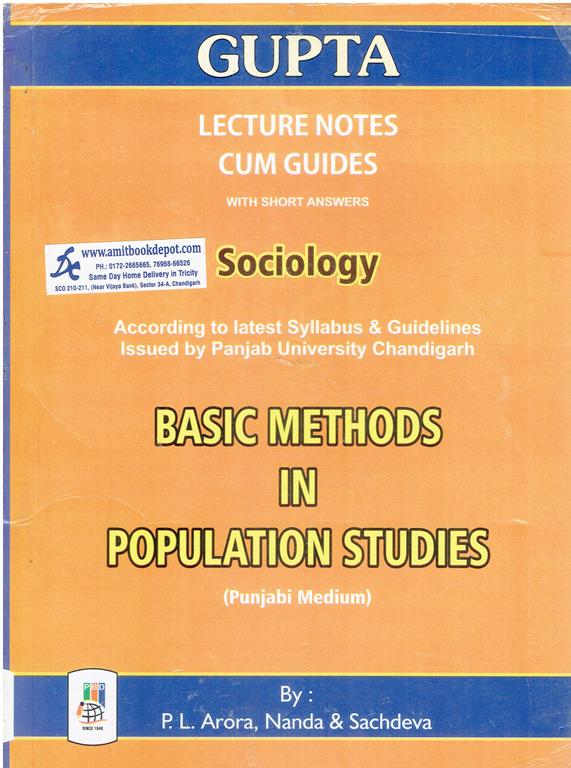
"Gupta Basic Methods in Population Studies" is the essential Punjabi medium book for MA Sociology all semesters of Panjab University, Chandigarh. Authored by P.L. Arora, Nanda, and Sachdeva, and published by Pepsu Book Depot, it comprehensively covers the prescribed syllabus (SOC O 532). The book provides a detailed exploration of demographic data sources, population change, age-sex structure, mortality (life tables), fertility measures, and marriage theories. Designed to match the exact exam pattern, it includes short- and long-answer question formats. This guide is indispensable for mastering basic demographic methods and achieving success in university examinations.

Yes. This book, "Gupta Basic Methods in Population Studies," is meticulously crafted to cover the complete prescribed syllabus (SOC O 532) for MA Sociology all semesters at Panjab University, Chandigarh. Its structure and content align precisely with the university's unit-wise course outline and examination pattern.
This book is published in the Punjabi medium. It is designed to cater specifically to students who require academic resources in Punjabi for their studies at Panjab University.
Absolutely. The book is structured with full awareness of the exam pattern. It addresses the 80-mark theory paper with a 20-mark internal assessment component. It specifically aids preparation for the compulsory short-answer section (10 questions of 2 marks each) and provides comprehensive material for the long-answer questions (15 marks each) from all four units.
Yes. The book dedicates entire chapters to Life Tables and Change in Population Size. It breaks down complex demographic methods, such as constructing life tables and calculating Linear, Geometric, and Exponential Growth Rates, into step-by-step explanations with clear methodologies, making them accessible for students.
Yes. Specific chapters like "Death Rate in India" and "Birth Rate and Fertility in India" focus on the Indian context. The book uses relevant data and examples to help students understand national and regional demographic trends, which is essential for both exams and practical understanding.
Comprehensively. The book details the computation of all key measures: Crude Birth/Death Rate, Age-Specific Rates, Total Fertility Rate (TFR), Gross/Net Reproduction Rate (GRR/NRR), and Infant Mortality Rate (IMR) including its perinatal, neonatal, and post-neonatal components, as outlined in the syllabus.
Yes. A distinct chapter on "Divorce and Widow Remarriage" is included, addressing the sociological aspects of demographic studies as required by the Panjab University syllabus. This ensures complete coverage of all prescribed topics.
Yes. The book contains a full chapter on "Theories of Demographic Change," which provides the theoretical foundation needed to understand and analyze population transitions, linking theory to the practical demographic measures discussed elsewhere.
Yes. As per the syllabus in Unit IV, the book explains the computation of demographic measures related to marriage, including the Crude Marriage Rate, Divorce Rate, and Mean Age at Marriage derived from census and survey data.
The book is logically divided into Units (I-IV) that mirror the university syllabus. Each unit contains focused chapters (e.g., Sources of Data, Mortality, Fertility) and is structured to facilitate systematic learning and direct revision for exams.
Yes. This book, "Gupta Basic Methods in Population Studies," is meticulously crafted to cover the complete prescribed syllabus (SOC O 532) for MA Sociology all semesters at Panjab University, Chandigarh. Its structure and content align precisely with the university's unit-wise course outline and examination pattern.
This book is published in the Punjabi medium. It is designed to cater specifically to students who require academic resources in Punjabi for their studies at Panjab University.
Absolutely. The book is structured with full awareness of the exam pattern. It addresses the 80-mark theory paper with a 20-mark internal assessment component. It specifically aids preparation for the compulsory short-answer section (10 questions of 2 marks each) and provides comprehensive material for the long-answer questions (15 marks each) from all four units.
Yes. The book dedicates entire chapters to Life Tables and Change in Population Size. It breaks down complex demographic methods, such as constructing life tables and calculating Linear, Geometric, and Exponential Growth Rates, into step-by-step explanations with clear methodologies, making them accessible for students.
Yes. Specific chapters like "Death Rate in India" and "Birth Rate and Fertility in India" focus on the Indian context. The book uses relevant data and examples to help students understand national and regional demographic trends, which is essential for both exams and practical understanding.
Comprehensively. The book details the computation of all key measures: Crude Birth/Death Rate, Age-Specific Rates, Total Fertility Rate (TFR), Gross/Net Reproduction Rate (GRR/NRR), and Infant Mortality Rate (IMR) including its perinatal, neonatal, and post-neonatal components, as outlined in the syllabus.
Yes. A distinct chapter on "Divorce and Widow Remarriage" is included, addressing the sociological aspects of demographic studies as required by the Panjab University syllabus. This ensures complete coverage of all prescribed topics.
Yes. The book contains a full chapter on "Theories of Demographic Change," which provides the theoretical foundation needed to understand and analyze population transitions, linking theory to the practical demographic measures discussed elsewhere.
Yes. As per the syllabus in Unit IV, the book explains the computation of demographic measures related to marriage, including the Crude Marriage Rate, Divorce Rate, and Mean Age at Marriage derived from census and survey data.
The book is logically divided into Units (I-IV) that mirror the university syllabus. Each unit contains focused chapters (e.g., Sources of Data, Mortality, Fertility) and is structured to facilitate systematic learning and direct revision for exams.