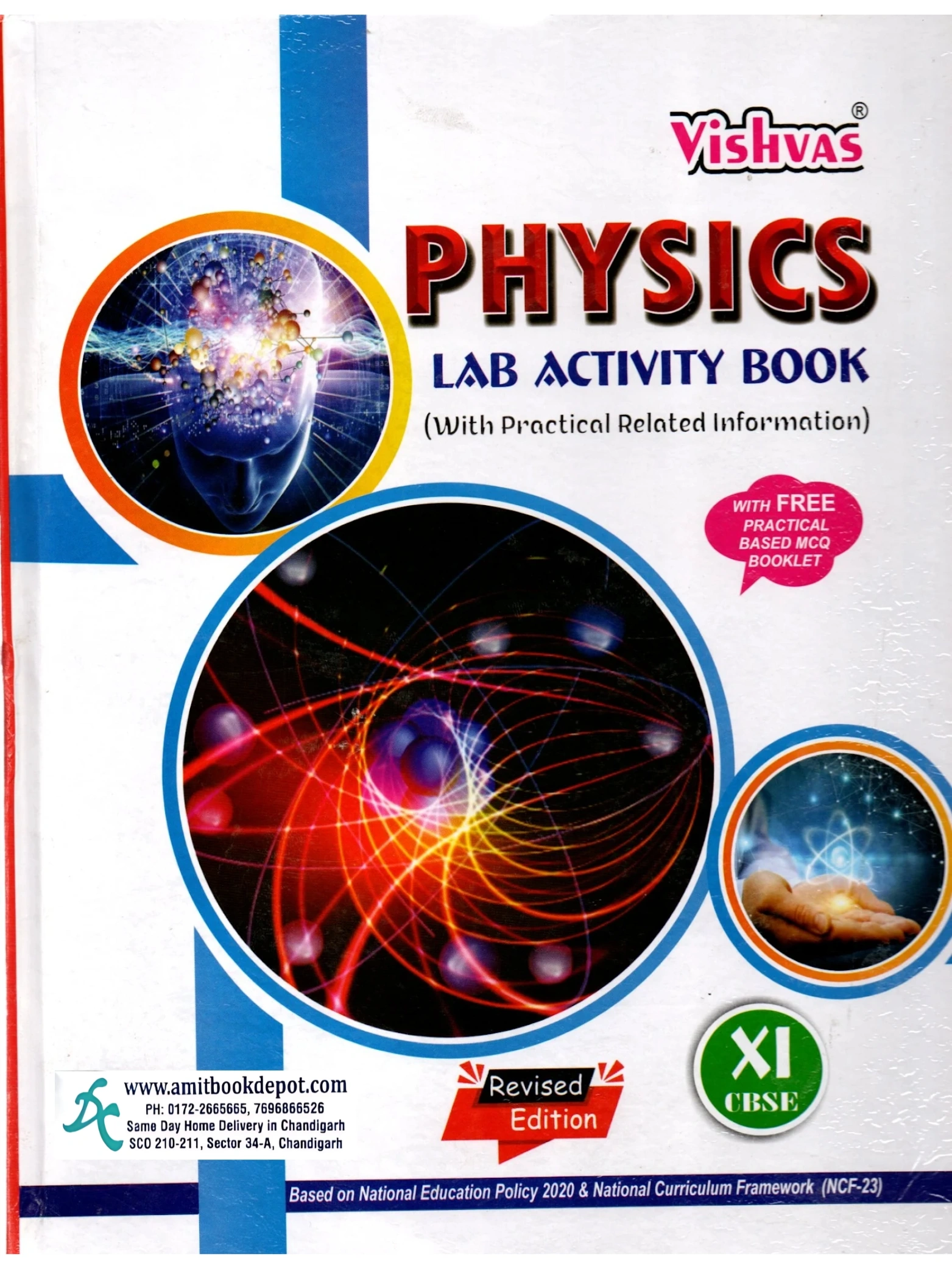
Vishvas Physics Lab Activity Book With Practical Related Information Class 11th
Vishvas Physics Lab Activity Book With Practical Related Information Class 11th
by Madhurima
₹350₹390.00(-/
off)
Rating & Reviews
23 Customer Review
The Vishvas Physics Lab Activity Book With Practical Related Information Class 11th by Savinder Singh and Narinder Singh is a comprehensive practical companion for CBSE Class 11 students. Published by Vishvas Publications Pvt Ltd, this activity book systematically covers Section A and B experiments, including vernier calipers, screw gauge, simple pendulum, Young’s modulus, sonometer, and viscosity. It includes demonstration-based activities, graphs for L-T plots, cooling curves, and essential logarithm & antilogarithm tables. Designed for accuracy in least count, error analysis, and unit determination, this lab manual bridges theoretical physics with hands-on practical skills, ensuring exam-ready preparation for all core experiments.
The Vishvas Physics Lab Activity Book With Practical Related Information for Class 11th is a structured, curriculum-aligned laboratory manual developed by experienced authors Savinder Singh and Narinder Singh. Published by Vishvas Publications Pvt. Ltd., this book is designed to fulfill the complete practical examination requirements for Class 11 Physics. Unlike generic guides, this volume integrates experimental procedures, demonstration activities, and practical-related information such as logarithmic tables, error analysis, and graphical plotting techniques.
Systematic Coverage of Experiments
The book is divided into Section A and Section B, covering all NCERT-mandated experiments.
- Section A focuses on mechanics and properties of matter. Students learn to measure the diameter of a spherical/cylindrical body using vernier calipers and calculate the density of a regular body. Detailed steps are provided to measure the internal diameter and depth of a beaker/calorimeter using vernier calipers. Experiments with screw gauge allow measurement of wire diameter and thickness of a sheet. A dedicated experiment determines the volume of an irregular lamina using a screw gauge. The spherometer experiment teaches the determination of the radius of curvature of a spherical surface. Practicals on beam balance (mass determination), parallelogram law of vectors (weight calculation), and simple pendulum (L-T graph and seconds pendulum) are included. The book also covers limiting friction, coefficient of friction, and inclined plane experiments plotting force against sin θ.
- Section B covers properties of matter and heat. Key experiments include determining Young’s modulus of elasticity, force constant of a helical spring (load-extension graph), and Boyle’s law (P-V and P vs. 1/V plots). Surface tension via capillary rise, coefficient of viscosity using terminal velocity, and specific heat capacity by method of mixtures are methodically explained. Sonometer experiments for frequency-length and length-tension relations, plus a resonance tube for speed of sound, are provided with observation tables. A cooling curve experiment establishes the relationship between the temperature of a hot body and time.
Demonstration Activities
The book includes separate activities for demonstration purposes, enhancing conceptual clarity:
- Making a paper scale with a given least count (0.2 cm or 0.5 cm)
- Determining mass using a meter scale (principle of moments)
- Graphical plotting with error bars
- Limiting friction for rolling motion
- Projectile range vs. angle of projection
- Conservation of energy on a double inclined plane
- Dissipation of energy of a simple pendulum (amplitude² vs. time graph)
- Cooling curve for molten wax, effect on bimetallic strip, thermal expansion of liquids
- Detergent effect on surface tension
- Load depression on a meter scale
- Bernoulli’s principle demonstration (pressure decrease with velocity increase)
Practical Related Information & Reference Tools
A standout feature is the inclusion of logarithm and antilogarithm tables at the end, enabling students to perform calculations without external calculators during practical exams. The book emphasizes least count determination, zero error correction, significant figures, and graph plotting (choosing scales, error bars, and slope interpretation).
Exam-Oriented Layout
Each experiment follows a uniform structure: aim, apparatus required, theory, diagram, procedure, observations, calculations, result, precautions, and sources of error. Viva-voce questions are embedded within practical-related information sections, preparing students for external examinations.
Why This Book?
Authored by Savinder Singh and Narinder Singh and published by Vishvas Publications Pvt Ltd, this lab activity book replaces multiple reference materials. It serves as a complete practical notebook, viva guide, and calculation handbook in one volume. Ideal for CBSE Class 11 students, teachers, and lab instructors seeking a reliable, error-free, and board-exam-focused physics practical resource.
What is the least count of a vernier calliper used in this book?
A1
The least count is 0.01 cm or 0.1 mm, calculated as 1 MSD – 1 VSD, typically with 10 divisions on the vernier scale.
Q2
How does the book determine density of a regular body?
A2
Mass is measured using a beam balance, volume via vernier callipers (length, breadth, height), then density = mass/volume is calculated.
Q3
Which instrument measures the radius of curvature of a spherical surface?
A3
A spherometer is used. It measures sagitta and uses the relation R = (l²/6h) + (h/2).
Q4
How is the force constant of a helical spring determined?
A4
By plotting a graph between load and extension. The slope of the linear portion gives the spring constant (k = F/x).
Q5
What is plotted in the simple pendulum experiment to find seconds pendulum length?
A5
An L-T² graph is plotted. Effective length corresponding to T = 2 seconds is read from the graph.
Q6
How does the parallelogram law of vectors find weight of a body?
A6
By balancing the unknown weight with two known forces, completing a parallelogram, and measuring the diagonal.
Q7
How is coefficient of viscosity determined from terminal velocity?
A7
Using Stokes’ law: η = (2r² (ρ – σ) g) / (9v), where v is terminal velocity of spherical body in liquid.
Q8
What graph is plotted for Boyle’s law verification?
A8
Pressure (P) versus reciprocal of volume (1/V) gives a straight line through the origin, confirming P ∝ 1/V.
Q9
How does the sonometer experiment relate frequency and length?
A9
For constant tension, frequency ∝ 1/length. Graph of frequency vs 1/length is a straight line.
Q10
How does the book demonstrate conservation of energy?
A10
Using a double inclined plane: a ball rolling down one side rises to the same height on the other side.
0.00
0 Overall Rating
5
0
4
0
3
0
2
0
1
0
Try this product & share your review &
thoughts
EXPERIMENTS
SECTION A
1. (i) To measure the diameter of a small spherical/cylindrical body using vernier callipers.
(ii) To measure the dimensions of the given regular body of known mass and hence find its density.
(iii) To measure the internal diameter and depth of a given beaker/calorimeter and hence find its volume using vernier calipers.
2. (i) To measure the diameter of a given wire using a screw gauge.
(ii) To measure the thickness of a given sheet by using a screw gauge.
3. To determine the volume of an irregular lamina using a screw gauge.
4. To determine the radius of curvature of a given spherical surface by using a spherometer.
5. To determine the mass of two different objects using a beam balance.
6. To find the weight of a given body using the parallelogram law of vectors.
7. Using a simple pendulum, plot its L-T graph and use it to find the effective length of a second's pendulum.
8. To study variation of time period of a simple pendulum of a given length by taking bobs of the same size but different names and interpret the result.
9. To study the relationship between the force of limiting friction and normal reaction and to find the coefficient of friction between a block and a horizontal surface.
10. To find the downward force along an inclined plane acting on a roller due to the gravitational pull of the earth and study its relationship with the angle of inclination 6 by plotting a graph between force and sin 0.
ACTIVITIES (For the purpose of demonstration only)
1. To make a paper scale of a given least count, e.g., 0.2 cm or 0.5 cm.
2. To determine the mass of a given body using a meter scale by the principle of moments.
3. To plot a graph for a given set of data with a proper choice of scales and error bars.
4. To measure the force of limiting friction for the rolling of a roller on a horizontal plane.
5. To study the variation in range of a projectile with angle of projection.
6. To study the conservation of energy of a ball rolling down on an inclined plane (using a double inclined plane).
7. To study dissipation of energy of a simple pendulum by plotting a graph between the square of amplitude and time.
SECTION B
1. To determine the Young's modulus of elasticity of the material of a given wire.
2. to find the force constant of a helical spring by plotting a graph between load and extension
3. to study the variation in volume with pressure for a sample of air at constant temperature by plotting graphs between P and V and between P and 1/V.
4. To determine the surface tension of water by the capillary rise method.
5. To determine the coefficient of viscosity of a given viscous liquid by measuring the terminal velocity of a given spherical body.
6. To study the relationship between the temperature of a hot body and time by plotting a cooling curve.
7. To determine the specific heat capacity of a given solid by the method of mixtures.
8. To study the relation between frequency and length of a given wire under constant tension using a sonometer
9. To study the relation between the length of a given wire and tension for constant frequency using a sonometer
10. To find the speed of sound in air at room temperature using a resonance tube with two resonance positions.
ACTIVITIES
1. To observe change of state and plot a cooling curve for molten wax.
2. To observe and explain the effect of heating on a bimetallic strip.
3. To note the change in level of liquid in a container on heating and interpret the observations
4. To study the effect of detergent on the surface tension of water by observing capillary rise.
5. To study the factors affecting the rate of loss of heat of a liquid.
6. To study the effect of load on depression of a suitably clamped meter scale loaded at (i) its end in the middle.
7. To observe the decrease in pressure with the increase in velocity of a fluid.
The Vishvas Physics Lab Activity Book With Practical Related Information for Class 11th is a structured, curriculum-aligned laboratory manual developed by experienced authors Savinder Singh and Narinder Singh. Published by Vishvas Publications Pvt. Ltd., this book is designed to fulfill the complete practical examination requirements for Class 11 Physics. Unlike generic guides, this volume integrates experimental procedures, demonstration activities, and practical-related information such as logarithmic tables, error analysis, and graphical plotting techniques.
Systematic Coverage of Experiments
The book is divided into Section A and Section B, covering all NCERT-mandated experiments.
- Section A focuses on mechanics and properties of matter. Students learn to measure the diameter of a spherical/cylindrical body using vernier calipers and calculate the density of a regular body. Detailed steps are provided to measure the internal diameter and depth of a beaker/calorimeter using vernier calipers. Experiments with screw gauge allow measurement of wire diameter and thickness of a sheet. A dedicated experiment determines the volume of an irregular lamina using a screw gauge. The spherometer experiment teaches the determination of the radius of curvature of a spherical surface. Practicals on beam balance (mass determination), parallelogram law of vectors (weight calculation), and simple pendulum (L-T graph and seconds pendulum) are included. The book also covers limiting friction, coefficient of friction, and inclined plane experiments plotting force against sin θ.
- Section B covers properties of matter and heat. Key experiments include determining Young’s modulus of elasticity, force constant of a helical spring (load-extension graph), and Boyle’s law (P-V and P vs. 1/V plots). Surface tension via capillary rise, coefficient of viscosity using terminal velocity, and specific heat capacity by method of mixtures are methodically explained. Sonometer experiments for frequency-length and length-tension relations, plus a resonance tube for speed of sound, are provided with observation tables. A cooling curve experiment establishes the relationship between the temperature of a hot body and time.
Demonstration Activities
The book includes separate activities for demonstration purposes, enhancing conceptual clarity:
- Making a paper scale with a given least count (0.2 cm or 0.5 cm)
- Determining mass using a meter scale (principle of moments)
- Graphical plotting with error bars
- Limiting friction for rolling motion
- Projectile range vs. angle of projection
- Conservation of energy on a double inclined plane
- Dissipation of energy of a simple pendulum (amplitude² vs. time graph)
- Cooling curve for molten wax, effect on bimetallic strip, thermal expansion of liquids
- Detergent effect on surface tension
- Load depression on a meter scale
- Bernoulli’s principle demonstration (pressure decrease with velocity increase)
Practical Related Information & Reference Tools
A standout feature is the inclusion of logarithm and antilogarithm tables at the end, enabling students to perform calculations without external calculators during practical exams. The book emphasizes least count determination, zero error correction, significant figures, and graph plotting (choosing scales, error bars, and slope interpretation).
Exam-Oriented Layout
Each experiment follows a uniform structure: aim, apparatus required, theory, diagram, procedure, observations, calculations, result, precautions, and sources of error. Viva-voce questions are embedded within practical-related information sections, preparing students for external examinations.
Why This Book?
Authored by Savinder Singh and Narinder Singh and published by Vishvas Publications Pvt Ltd, this lab activity book replaces multiple reference materials. It serves as a complete practical notebook, viva guide, and calculation handbook in one volume. Ideal for CBSE Class 11 students, teachers, and lab instructors seeking a reliable, error-free, and board-exam-focused physics practical resource.
EXPERIMENTS
SECTION A
1. (i) To measure the diameter of a small spherical/cylindrical body using vernier callipers.
(ii) To measure the dimensions of the given regular body of known mass and hence find its density.
(iii) To measure the internal diameter and depth of a given beaker/calorimeter and hence find its volume using vernier calipers.
2. (i) To measure the diameter of a given wire using a screw gauge.
(ii) To measure the thickness of a given sheet by using a screw gauge.
3. To determine the volume of an irregular lamina using a screw gauge.
4. To determine the radius of curvature of a given spherical surface by using a spherometer.
5. To determine the mass of two different objects using a beam balance.
6. To find the weight of a given body using the parallelogram law of vectors.
7. Using a simple pendulum, plot its L-T graph and use it to find the effective length of a second's pendulum.
8. To study variation of time period of a simple pendulum of a given length by taking bobs of the same size but different names and interpret the result.
9. To study the relationship between the force of limiting friction and normal reaction and to find the coefficient of friction between a block and a horizontal surface.
10. To find the downward force along an inclined plane acting on a roller due to the gravitational pull of the earth and study its relationship with the angle of inclination 6 by plotting a graph between force and sin 0.
ACTIVITIES (For the purpose of demonstration only)
1. To make a paper scale of a given least count, e.g., 0.2 cm or 0.5 cm.
2. To determine the mass of a given body using a meter scale by the principle of moments.
3. To plot a graph for a given set of data with a proper choice of scales and error bars.
4. To measure the force of limiting friction for the rolling of a roller on a horizontal plane.
5. To study the variation in range of a projectile with angle of projection.
6. To study the conservation of energy of a ball rolling down on an inclined plane (using a double inclined plane).
7. To study dissipation of energy of a simple pendulum by plotting a graph between the square of amplitude and time.
SECTION B
1. To determine the Young's modulus of elasticity of the material of a given wire.
2. to find the force constant of a helical spring by plotting a graph between load and extension
3. to study the variation in volume with pressure for a sample of air at constant temperature by plotting graphs between P and V and between P and 1/V.
4. To determine the surface tension of water by the capillary rise method.
5. To determine the coefficient of viscosity of a given viscous liquid by measuring the terminal velocity of a given spherical body.
6. To study the relationship between the temperature of a hot body and time by plotting a cooling curve.
7. To determine the specific heat capacity of a given solid by the method of mixtures.
8. To study the relation between frequency and length of a given wire under constant tension using a sonometer
9. To study the relation between the length of a given wire and tension for constant frequency using a sonometer
10. To find the speed of sound in air at room temperature using a resonance tube with two resonance positions.
ACTIVITIES
1. To observe change of state and plot a cooling curve for molten wax.
2. To observe and explain the effect of heating on a bimetallic strip.
3. To note the change in level of liquid in a container on heating and interpret the observations
4. To study the effect of detergent on the surface tension of water by observing capillary rise.
5. To study the factors affecting the rate of loss of heat of a liquid.
6. To study the effect of load on depression of a suitably clamped meter scale loaded at (i) its end in the middle.
7. To observe the decrease in pressure with the increase in velocity of a fluid.
What is the least count of a vernier calliper used in this book?
A1
The least count is 0.01 cm or 0.1 mm, calculated as 1 MSD – 1 VSD, typically with 10 divisions on the vernier scale.
Q2
How does the book determine density of a regular body?
A2
Mass is measured using a beam balance, volume via vernier callipers (length, breadth, height), then density = mass/volume is calculated.
Q3
Which instrument measures the radius of curvature of a spherical surface?
A3
A spherometer is used. It measures sagitta and uses the relation R = (l²/6h) + (h/2).
Q4
How is the force constant of a helical spring determined?
A4
By plotting a graph between load and extension. The slope of the linear portion gives the spring constant (k = F/x).
Q5
What is plotted in the simple pendulum experiment to find seconds pendulum length?
A5
An L-T² graph is plotted. Effective length corresponding to T = 2 seconds is read from the graph.
Q6
How does the parallelogram law of vectors find weight of a body?
A6
By balancing the unknown weight with two known forces, completing a parallelogram, and measuring the diagonal.
Q7
How is coefficient of viscosity determined from terminal velocity?
A7
Using Stokes’ law: η = (2r² (ρ – σ) g) / (9v), where v is terminal velocity of spherical body in liquid.
Q8
What graph is plotted for Boyle’s law verification?
A8
Pressure (P) versus reciprocal of volume (1/V) gives a straight line through the origin, confirming P ∝ 1/V.
Q9
How does the sonometer experiment relate frequency and length?
A9
For constant tension, frequency ∝ 1/length. Graph of frequency vs 1/length is a straight line.
Q10
How does the book demonstrate conservation of energy?
A10
Using a double inclined plane: a ball rolling down one side rises to the same height on the other side.
No Syllabus Added
0.00
0 Overall Rating
5
0
4
0
3
0
2
0
1
0
Try this product & share your review &
thoughts
Top Trending Product
Related
Product
Related Product
Related Blog Posts
Latest Blogs
Latest Blogs
Classic Literature Reimagined: Discuss modern twists on classic novels.
Lorem ipsum dolor sit amet, consectetur adipiscing elit, sed
do
eiusmod tempor incididunt ut labore et dolore magna aliqua. Ut enim ad minim
veniam, quis nostrud exercitation ullamco Lorem ipsum dolor sit amet,
consectetur adipiscing elit, sed do eiusmod tempor incididunt ut labore et
dolore magna aliqua. Utenim ad minim veniam, quis nostrud exercitation
ullamco
Lorem ipsum dolor sit amet, consecte...
Classic Literature Reimagined: Discuss modern twists on classic novels.
Lorem ipsum dolor sit amet, consectetur adipiscing elit, sed
do
eiusmod tempor incididunt ut labore et dolore magna aliqua. Ut enim ad minim
veniam, quis nostrud exercitation ullamco Lorem ipsum dolor sit amet,
consectetur adipiscing elit, sed do eiusmod tempor incididunt ut labore et
dolore magna aliqua. Utenim ad minim veniam, quis nostrud exercitation
ullamco
Lorem ipsum dolor sit amet, consecte...
Classic Literature Reimagined: Discuss modern twists on classic novels.
Lorem ipsum dolor sit amet, consectetur adipiscing elit, sed
do
eiusmod tempor incididunt ut labore et dolore magna aliqua. Ut enim ad minim
veniam, quis nostrud exercitation ullamco Lorem ipsum dolor sit amet,
consectetur adipiscing elit, sed do eiusmod tempor incididunt ut labore et
dolore magna aliqua. Utenim ad minim veniam, quis nostrud exercitation
ullamco
Lorem ipsum dolor sit amet, consecte...