-
Mon-Fri: 10AM to 8PM 01722665665
-
My Account
-
-
0
Total :
₹ 0.00

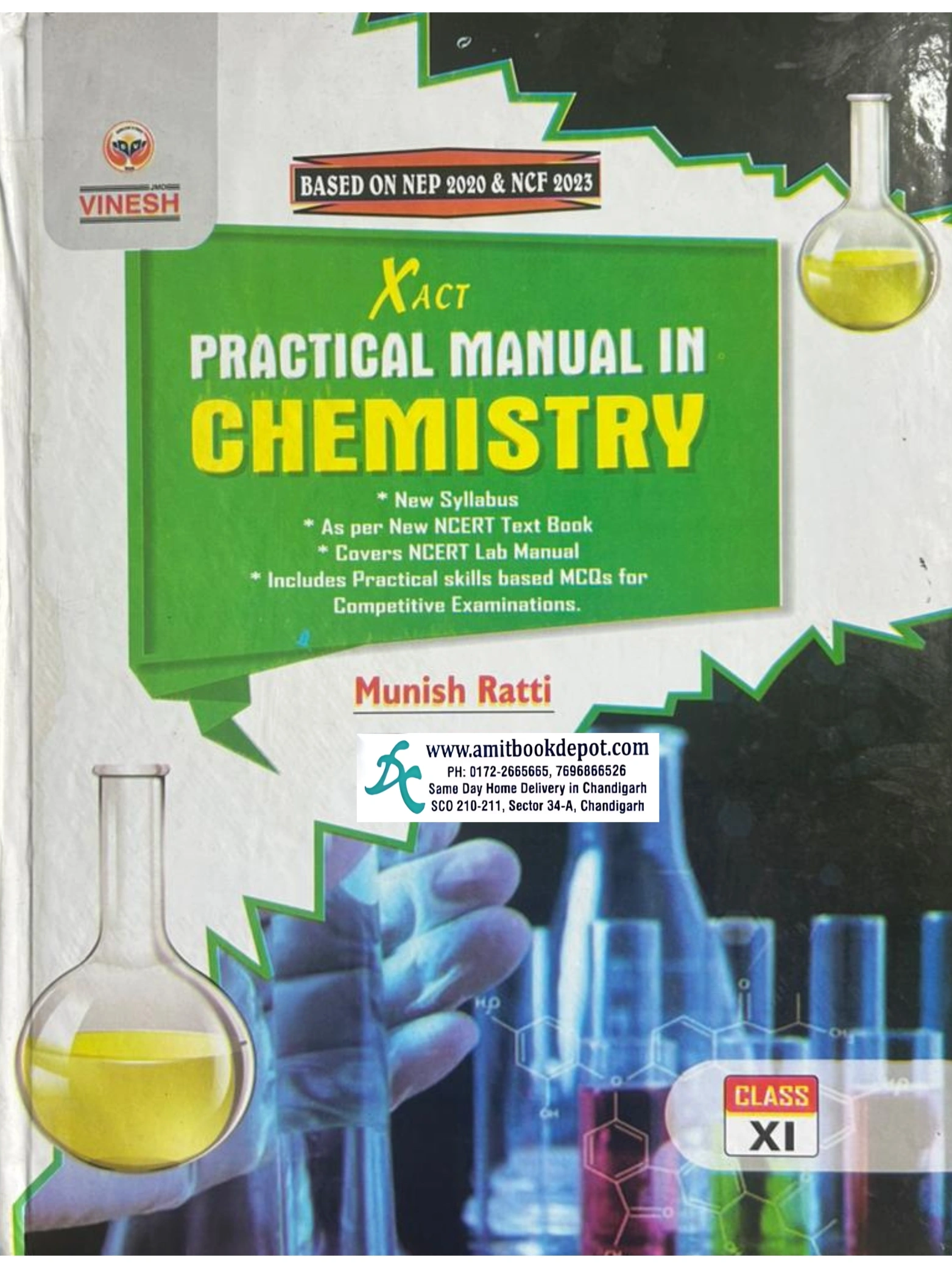



Yes, it comprehensively covers every topic and experiment outlined in the official CBSE syllabus, including sections on Basic Laboratory Techniques, Characterization, pH, Equilibrium, Quantitative Estimation, and Qualitative Analysis.
Absolutely. The manual provides structured guidance for numerous suggested projects, including objectives, methodologies, and expected analysis, enabling students to undertake them with minimal supervision.
It includes a dedicated section with Multiple Choice Questions (MCQs) compiled from various competitive exams, complete with hints and explanations, linking practical concepts to objective-type question patterns.
Yes, it includes the latest prescribed list of cations (like Pb²⁺, Al³⁺, Zn²⁺, NH₄⁺) and anions (like CO₃²⁻, SO₄²⁻, Cl⁻, NO₃⁻), along with systematic analytical charts.
While the manual focuses on standard laboratory procedures, it emphasizes principles that are applicable and encourages efficient use of chemicals, aligning with the syllabus's suggestion for micro-methods where possible.
The manual provides a clear format for recording aims, apparatus, procedures, observations, and results, which students can directly emulate to maintain a neat and accurate lab record.
Yes, the book begins with important chapters on 'Laboratory Discipline' and 'Important Safety Precautions' to ensure students understand and follow safe laboratory practices.
The manual includes well-illustrated and labelled diagrams of laboratory equipment and setup to help students visualize and assemble apparatus correctly.
Yes, it is covered in detail. The manual also clearly notes that the detection of Bromine and Iodine, while explained, is not part of the current CBSE syllabus, as per the latest guidelines.
The projects are listed with clear aims and approaches. While it guides the experimental work, students are encouraged to structure their formal report with an introduction, method, result, and conclusion as per their teacher's instructions.
Yes, it comprehensively covers every topic and experiment outlined in the official CBSE syllabus, including sections on Basic Laboratory Techniques, Characterization, pH, Equilibrium, Quantitative Estimation, and Qualitative Analysis.
Absolutely. The manual provides structured guidance for numerous suggested projects, including objectives, methodologies, and expected analysis, enabling students to undertake them with minimal supervision.
It includes a dedicated section with Multiple Choice Questions (MCQs) compiled from various competitive exams, complete with hints and explanations, linking practical concepts to objective-type question patterns.
Yes, it includes the latest prescribed list of cations (like Pb²⁺, Al³⁺, Zn²⁺, NH₄⁺) and anions (like CO₃²⁻, SO₄²⁻, Cl⁻, NO₃⁻), along with systematic analytical charts.
While the manual focuses on standard laboratory procedures, it emphasizes principles that are applicable and encourages efficient use of chemicals, aligning with the syllabus's suggestion for micro-methods where possible.
The manual provides a clear format for recording aims, apparatus, procedures, observations, and results, which students can directly emulate to maintain a neat and accurate lab record.
Yes, the book begins with important chapters on 'Laboratory Discipline' and 'Important Safety Precautions' to ensure students understand and follow safe laboratory practices.
The manual includes well-illustrated and labelled diagrams of laboratory equipment and setup to help students visualize and assemble apparatus correctly.
Yes, it is covered in detail. The manual also clearly notes that the detection of Bromine and Iodine, while explained, is not part of the current CBSE syllabus, as per the latest guidelines.
The projects are listed with clear aims and approaches. While it guides the experimental work, students are encouraged to structure their formal report with an introduction, method, result, and conclusion as per their teacher's instructions.