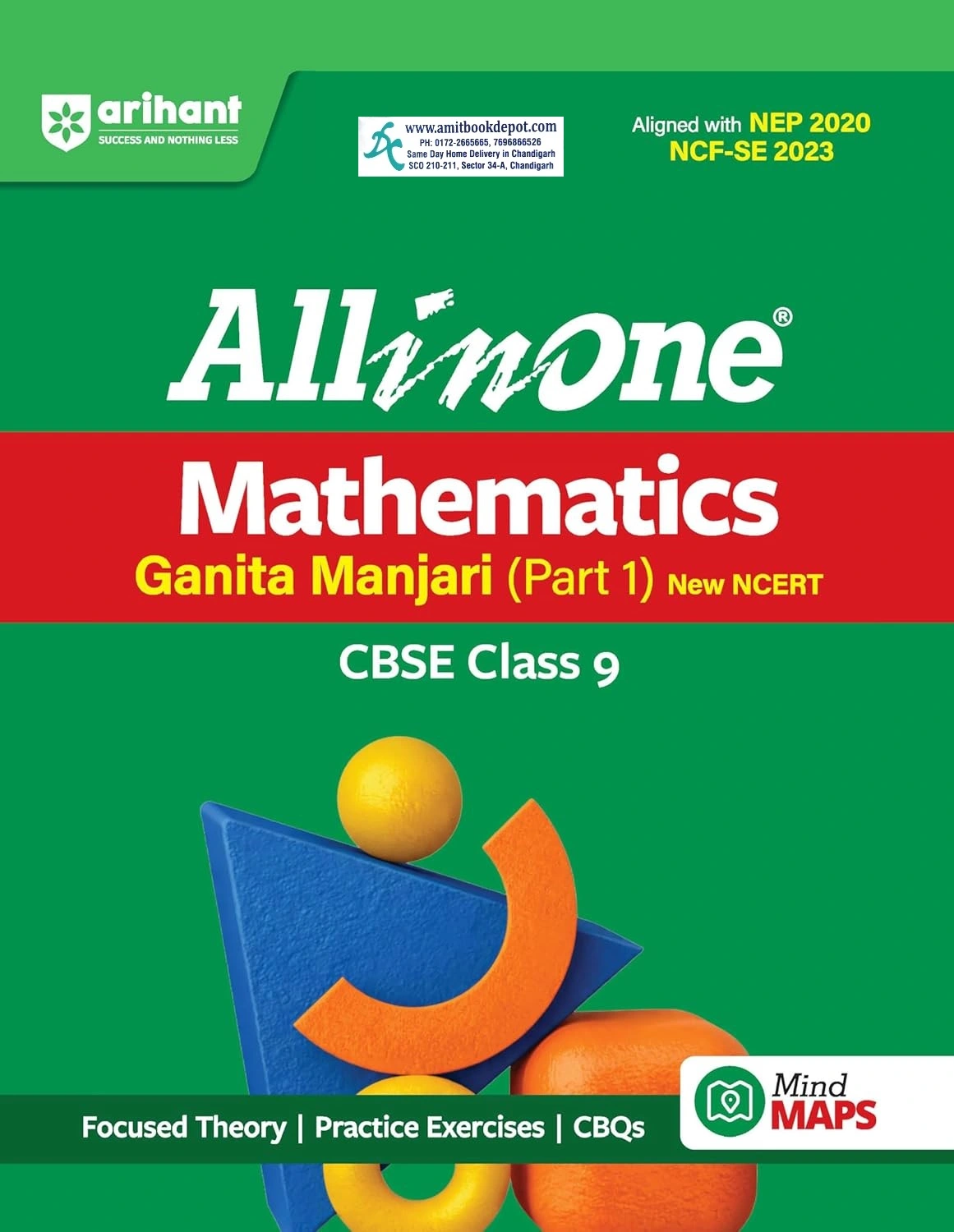
Product Name: All in One Mathematics CBSE Class 9th
Authors: Rakesh Pandey, Mandvi Agarwal, Neha Dixit, Aditya Shukla
Publisher: Arihant Prakashan
Overview
The All-in-One Mathematics CBSE Class 9 is a meticulously crafted resource designed exclusively for students following the Central Board of Secondary Education (CBSE) curriculum. This edition, penned by experienced authors Rakesh Pandey, Mandvi Agarwal, Neha Dixit, and Aditya Shukla, transforms the often-intimidating landscape of Class 9 mathematics into a structured, learner-friendly journey. The book aligns perfectly with the latest CBSE syllabus and serves as both a primary text and a revision guide, ensuring conceptual clarity and exam readiness.
Comprehensive Coverage of Core Topics
The book systematically covers all key mathematical domains. It begins with Orienting Yourself: The Use of Coordinates, introducing the Cartesian system, distance between two points, and midpoints. The section on Introduction to Linear Polynomials delves into linear equations in two variables, slope, y-intercepts, and visualising linear relationships, including linear growth and decay models.
In The World of Numbers, students explore rational and irrational numbers, the density of rational numbers, and decimal expressions. Exploring Algebraic Identities covers factorisation of polynomials and standard identities essential for higher algebra. Geometry is addressed in I’m Up and Down and Round and Round, focusing on the circumcircle of a triangle, chords, angles subtended by arcs, and cyclic quadrilaterals.
Advanced Concepts Made Accessible
The title progresses to practical geometry and measurement with Measuring Space: Perimeter and Area, covering triangles, quadrilaterals, Brahmagupta’s formula for cyclic quadrilaterals, circle circumference, sectors, and segments. Foundational probability is introduced in The Mathematics of May: Introduction to Probability, explaining the likelihood of an event, the experimental approach, and theoretical probability definitions.
A unique feature is Predicting What Comes Next: Exploring Sequences and Progressions, which covers arithmetic progressions (AP), nth terms, geometric progressions (GP), and even fractals through GP—a rare inclusion at this level that stimulates analytical thinking.
Pedagogical Structure – NCERT Folder & Exam Style Questions
Each chapter is organised with a clear, predictable structure. The NCERT folder provides precise solutions to NCERT book exercises, ensuring students meet board requirements. Exam-style questions include very short answer (VSA), short answer (SA), long answer (LA), and case-study-based questions as per the latest CBSE pattern. Periodic tests are interspersed to simulate exam conditions and track progress.
Visual Learning with Mind Maps
Every chapter concludes with a mind map – a visual summary that connects key concepts (e.g., chord properties, probability likelihood, GP nth term) in a single diagram. This feature is invaluable for last-minute revision and for visual learners.
Practical Application – Maths Activities
The book includes a dedicated maths activities section with hands-on exercises to verify geometric properties, algebraic identities, and probability experiments. These activities align with CBSE internal assessment requirements.
Exam-Oriented Features
- Slope and y-intercepts of a line explained with graphs.
- Modelling Linear Growth and Linear Decay through real-life scenarios.
- Density of rational numbers and irrational numbers: distinction with examples.
- Chords and Their Distances from the Centre – theorem-based questions.
- Circumcircle and circumcentre construction and proof questions.
Why This Book?
Unlike ordinary guides, the All in One Mathematics CBSE Class 9th integrates concept teaching with exam practice. Whether preparing for school unit tests, half-yearly exams, or the annual CBSE examination, students benefit from the spiral approach: theory → NCERT solutions → exam-style practice → mind map → periodic test. The authors – Rakesh Pandey, Mandvi Agarwal, Neha Dixit, and Aditya Shukla – bring classroom experience and exam paper analysis into every chapter.
Target Audience
- CBSE Class 9 students seeking a single-volume solution for mathematics.
- Teachers looking for a structured question bank.
- Parents wanting a self-study guide for their children.
Conclusion
Invest in All in One Mathematics CBSE Class 9 to master the Cartesian System, Linear Polynomials, Algebraic Identities, Circle Geometry, Probability, and Arithmetic Progressions with confidence. The combination of NCERT Folder, exam-style questions, maths activities, periodic tests, and mind maps ensures no aspect of the syllabus is left unprepared.