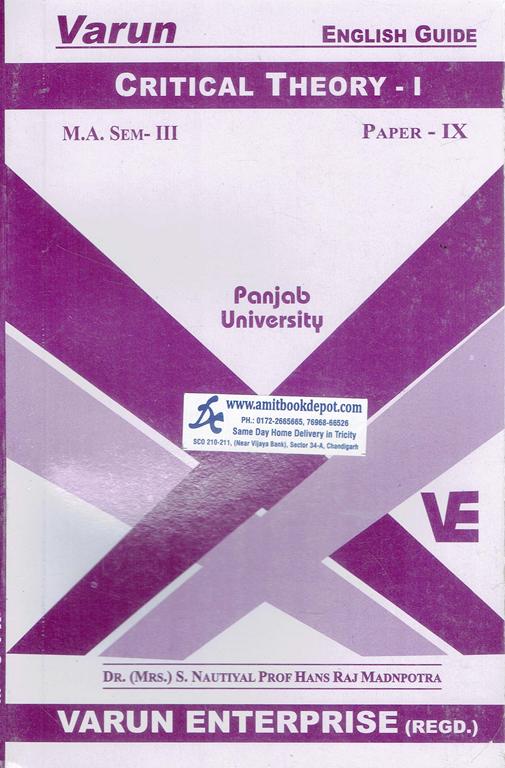
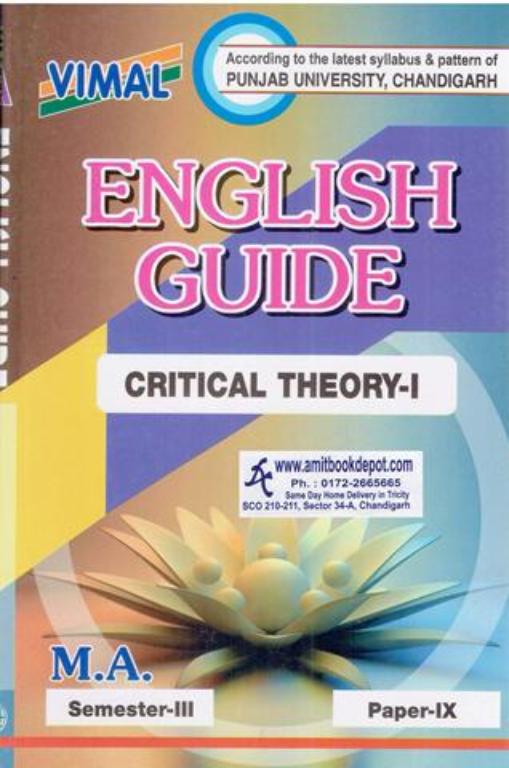
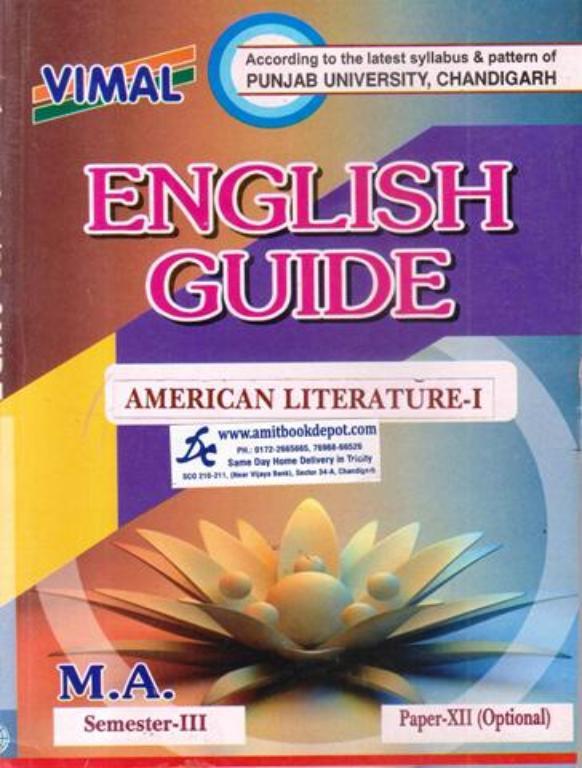
Varun English Guide Critical Theory 1 For MA 3rd Semester Paper 9 Panjab University Chandigarh
Varun English Guide Critical Theory 1 For MA 3rd Semester Paper 9 Panjab University Chandigarh
by Madhurima
₹350₹350.00(-/
off)
Rating & Reviews
23 Customer Review
The Varun English Guide: Critical Theory – I is the definitive study companion for Panjab University’s M.A. English Semester III, Paper 9. Authored by Dr. S. Nautiyal, this comprehensive guide covers the entire syllabus, from M.H. Abrams to Jean Baudrillard. It provides detailed explanations of complex theorists like Barthes, Derrida, Foucault, and Lyotard, breaking down key concepts such as deconstruction, postmodernism, panopticism, and simulacra. Designed for exam preparation, it offers chapter summaries, critical analysis, and important question pointers. This Varun Enterprises publication is an essential resource for mastering literary theory and achieving academic success.
The Varun English Guide: Critical Theory – I for M.A. (Semester III), Paper 9 is an authoritative and meticulously structured academic resource, specifically crafted to align with the syllabus of Panjab University, Chandigarh. Authored by Dr. S. Nautiyal and published by Varun Enterprises, this guide serves as an indispensable companion for postgraduate students navigating the complex and seminal texts of modern literary and critical theory. It is designed to bridge the gap between dense theoretical primary readings and the student’s need for clear comprehension, contextualization, and examination readiness.
This comprehensive MA English guide systematically addresses all five units prescribed in the Panjab University syllabus. The course itself marks a pivotal shift in literary studies, moving beyond traditional analysis to engage with interdisciplinary methodologies from fields such as philosophy, history, sociology, and linguistics. This guide effectively mirrors that intent, providing students with a structured pathway through a challenging curriculum that traces the historical and ideological progression of literary theory. Beginning with M.H. Abrams's foundational inquiry into the utility of theorizing about the arts, the book progresses through key movements and thinkers that have redefined textual analysis.
The second unit delves into structuralist and post-structuralist thought with Roman Jakobson’s linguistic functions and Roland Barthes’s revolutionary essay, "The Death of the Author," a cornerstone of critical theory. Unit III introduces students to the complexities of postmodernism and deconstruction, featuring Jacques Derrida’s elucidative "Letter to a Japanese Friend" on différance and Jean-François Lyotard’s definitive explanation of the postmodern condition. These chapters are crucial for understanding the dismantling of grand narratives and stable meanings.
Unit IV shifts focus to power, surveillance, and control, covering Michel Foucault’s seminal concept of panopticism from Discipline and Punish and Gilles Deleuze’s "Postscript on the Societies of Control," which updates Foucault’s analysis for contemporary digital and networked societies. Finally, Unit V engages with the provocative work of Jean Baudrillard, exploring "The System of Objects" and the pivotal theory of Simulacra and Simulations, essential for analyzing contemporary hyperreal culture.
Each chapter in this Varun Enterprises publication is designed to facilitate deep learning. It typically includes a clear introduction to the theorist and their place in the theoretical framework, a detailed summary and explanation of the prescribed essay or extract, a discussion of key concepts and critical terminology, and an analysis of the text’s significance for literary studies. The guide emphasizes exam preparation by highlighting potential questions, important quotations, and recurring themes. It acts not just as a summary but as a critical companion that deciphers complex arguments, connects theories across units, and demonstrates their application to literary texts.
For students of Panjab University MA English Semester 3, this guide is more than a book; it is a strategic academic tool. It transforms daunting primary theory readings into accessible, exam-focused material without oversimplifying the intellectual rigor required at the postgraduate level. By consolidating the essential readings from Abrams to Baudrillard into a single, coherent volume, Dr. S. Nautiyal’s guide ensures that students are well-equipped to tackle Paper 9 with confidence, fostering both conceptual understanding and the ability to articulate sophisticated theoretical analyses in their examinations.
Is this guide an exact replacement for the original theoretical texts, or should it be used alongside them?
A1
It is designed as a critical companion to be used alongside the original prescribed texts. It explains, contextualizes, and simplifies complex arguments but does not replace the primary source material required for in-depth study.
Q2
Does the guide include solved previous years' question papers from Panjab University for Paper 9?
A2
While the guide is meticulously structured for exam preparation and highlights important questions, it typically focuses on concept clarification and analysis. For a repository of solved papers, you may need to check the publisher's other specific products.
Q3
How does this guide help in understanding the connection between different theorists, like Foucault and Deleuze?
A3
The guide provides contextual introductions and conceptual analysis that often draw explicit connections between units, such as explaining how Deleuze's "Societies of Control" builds upon and updates Foucault's "Panopticism."
Q4
Are difficult critical terminology and jargon like différance, simulacra, and panopticon clearly defined and explained?
A4
Yes, a key feature of this guide is breaking down complex theoretical frameworks and defining essential critical terminology within the context of each theorist's work, making them easier to understand and apply.
Q5
Is the content of this guide applicable only to Panjab University students, or can students from other universities use it?
A5
While it is perfectly tailored to the Panjab University syllabus, students from any university whose Critical Theory course covers these core thinkers (Abrams, Jakobson, Barthes, Derrida, Lyotard, Foucault, Deleuze, Baudrillard) will find it immensely valuable.
Q6
How is the guide updated to reflect any changes in the Panjab University MA English syllabus?
A6
Varun Enterprises generally updates its guides upon official syllabus revisions. It is advisable to check the publication date or contact the seller to confirm this edition's alignment with the current academic year's syllabus.
Q7
Are there any notes on how to apply these theories (e.g., Deconstruction, Postmodernism) to actual literary texts in exams?
A7
Yes, the guide often includes sections on the "application" or "significance for literary studies," suggesting how these theories can be used as tools for analyzing novels, poems, or plays, which is crucial for answering essay questions.
Q8
Is the language used in the guide accessible for students who are encountering literary theory for the first time?
A8
Absolutely. One of the primary objectives of this Varun English Guide is to act as a bridge, translating dense theoretical prose into clear, student-friendly language while maintaining academic rigor.
Q9
Does the book contain a bibliography or suggestions for further reading on these theorists?
A9
Typically, such guides include a select bibliography or recommendations for key secondary sources that students can consult for deeper exploration of specific theorists.
Q10
For self-study students without classroom instruction, is this guide sufficient to grasp the subject?
A10
It is an excellent resource for self-study as it provides structured explanations, context, and analysis that effectively simulate guided learning, making it highly suitable for distance learners.
0.00
0 Overall Rating
5
0
4
0
3
0
2
0
1
0
Try this product & share your review &
thoughts
UNIT - I
1. M.H. Abrams: What’s the Use of Theorizing about the Arts?
UNIT - II
1. Roman Jakobson: Two Aspects of Language
2. Roland Barthes: The Death of the Author
UNIT - III
1. Jacques Derrida: Letter to a Japanese Friend
2. Jean-François Lyotard: Answer to the Question “What is postmodern?”
UNIT - IV
1. Michel Foucault: Panopticism and the Birth of the Prison
2. Gilles Deleuze: Postscript on the Societies of Control
UNIT - V
1. Jean Baudrillard: The System of Objects & Simulacra and Simulations
Latest Syllabus of English Guide Critical Theory 1 For MA 3rd Semester Paper 9 Panjab University (PU) Chandigarh
M.A. II (Semester III)
Compulsory Paper
Paper IX
Critical Theory – I
Time: 3 Hrs.
M.M.: 80
With the changing contours of power dynamics and a sustained emphasis on representational politics, a reassessment of the methodology of the literature classroom has been effected. Not only is the canon spilling outside the erstwhile ambit of “Wulf to Woolf,” but the tools of analysis have, likewise, witnessed a shift.
From literary benchmarks to extra-literary ones to progressively borrowing from diverse fields, viz., economics to psychology, history to sociology, and theory, it represents a wide spectrum. Today this eclectic field is thoroughly aligned to the purposes of the study of literature and collected under the rubric of “theory.” The effect of literary theory on the study of literature has clearly transcended the original impulse of text analysis and is witnessing a more integral role, with theory asserting a tangible influence on the production of literature itself. The course is designed with the intent of introducing an MA classroom to core texts representing a range of literary theory. The selected texts represent a historical progression of literature analysis as well as the ideological impulses that have modified the practice of literary studies.
Unit I
1. M.H. Abrams, “What's the Use of Theorizing about the Arts? ”Doing Things with Texts (London & New York: Norton Paperback, 1991) 31-72.
Unit II
1. Roman Jakobson, “Two Aspects of Language,” Literary Theory: An Anthology, eds. Julie Rivkin and Michael Ryan (Blackwell, 2004, 2nd Ed.) 76-80.
2. Roland Barthes, “The Death of the Author,” Image/Music/Text. Trans. Stephen Heath (Hill and Wang, 1977) 142-147.
Unit III
1. Jacques Derrida, “Letter to a Japanese Friend,” Derrida and Differance. Eds. David Wood and Robert Bernasconi (Evanston, III: Northwestern University Press, 1988), 1-6.
2. Jean Francois Lyotard, “Answer to the Question, What is the Postmodern? ” (1-16) & “Note on the Post- in Postmodern” (75-80), The Postmodern Explained:
Correspondence 1982-85 (Minnesota & London: University of Minnesota Press, 1992)
Unit IV
1. Michel Foucault, "Panopticism" from "Discipline & Punish: The Birth of the Prison," Race/Ethnicity: Multidisciplinary Global Contexts, Vol. 2, No. 1, The Dynamics of Race and Incarceration: Social Integration, Social Welfare, and Social Control (Autumn, 2008), 1-12.
2. Giles Deleuze, “Postscript on the Societies of Control,” October, Vol. 59 (Winter, 1992), 3-7.
Unit V
1. Jean Baudrillard, “The System of Objects” (10-28) & “Simulacra and Simulations” (166-184), Jean Baudrillard: Selected Writings, ed. Mark Poster (Stanford: Stanford University Press, 1988)
The Varun English Guide: Critical Theory – I for M.A. (Semester III), Paper 9 is an authoritative and meticulously structured academic resource, specifically crafted to align with the syllabus of Panjab University, Chandigarh. Authored by Dr. S. Nautiyal and published by Varun Enterprises, this guide serves as an indispensable companion for postgraduate students navigating the complex and seminal texts of modern literary and critical theory. It is designed to bridge the gap between dense theoretical primary readings and the student’s need for clear comprehension, contextualization, and examination readiness.
This comprehensive MA English guide systematically addresses all five units prescribed in the Panjab University syllabus. The course itself marks a pivotal shift in literary studies, moving beyond traditional analysis to engage with interdisciplinary methodologies from fields such as philosophy, history, sociology, and linguistics. This guide effectively mirrors that intent, providing students with a structured pathway through a challenging curriculum that traces the historical and ideological progression of literary theory. Beginning with M.H. Abrams's foundational inquiry into the utility of theorizing about the arts, the book progresses through key movements and thinkers that have redefined textual analysis.
The second unit delves into structuralist and post-structuralist thought with Roman Jakobson’s linguistic functions and Roland Barthes’s revolutionary essay, "The Death of the Author," a cornerstone of critical theory. Unit III introduces students to the complexities of postmodernism and deconstruction, featuring Jacques Derrida’s elucidative "Letter to a Japanese Friend" on différance and Jean-François Lyotard’s definitive explanation of the postmodern condition. These chapters are crucial for understanding the dismantling of grand narratives and stable meanings.
Unit IV shifts focus to power, surveillance, and control, covering Michel Foucault’s seminal concept of panopticism from Discipline and Punish and Gilles Deleuze’s "Postscript on the Societies of Control," which updates Foucault’s analysis for contemporary digital and networked societies. Finally, Unit V engages with the provocative work of Jean Baudrillard, exploring "The System of Objects" and the pivotal theory of Simulacra and Simulations, essential for analyzing contemporary hyperreal culture.
Each chapter in this Varun Enterprises publication is designed to facilitate deep learning. It typically includes a clear introduction to the theorist and their place in the theoretical framework, a detailed summary and explanation of the prescribed essay or extract, a discussion of key concepts and critical terminology, and an analysis of the text’s significance for literary studies. The guide emphasizes exam preparation by highlighting potential questions, important quotations, and recurring themes. It acts not just as a summary but as a critical companion that deciphers complex arguments, connects theories across units, and demonstrates their application to literary texts.
For students of Panjab University MA English Semester 3, this guide is more than a book; it is a strategic academic tool. It transforms daunting primary theory readings into accessible, exam-focused material without oversimplifying the intellectual rigor required at the postgraduate level. By consolidating the essential readings from Abrams to Baudrillard into a single, coherent volume, Dr. S. Nautiyal’s guide ensures that students are well-equipped to tackle Paper 9 with confidence, fostering both conceptual understanding and the ability to articulate sophisticated theoretical analyses in their examinations.
UNIT - I
1. M.H. Abrams: What’s the Use of Theorizing about the Arts?
UNIT - II
1. Roman Jakobson: Two Aspects of Language
2. Roland Barthes: The Death of the Author
UNIT - III
1. Jacques Derrida: Letter to a Japanese Friend
2. Jean-François Lyotard: Answer to the Question “What is postmodern?”
UNIT - IV
1. Michel Foucault: Panopticism and the Birth of the Prison
2. Gilles Deleuze: Postscript on the Societies of Control
UNIT - V
1. Jean Baudrillard: The System of Objects & Simulacra and Simulations
Is this guide an exact replacement for the original theoretical texts, or should it be used alongside them?
A1
It is designed as a critical companion to be used alongside the original prescribed texts. It explains, contextualizes, and simplifies complex arguments but does not replace the primary source material required for in-depth study.
Q2
Does the guide include solved previous years' question papers from Panjab University for Paper 9?
A2
While the guide is meticulously structured for exam preparation and highlights important questions, it typically focuses on concept clarification and analysis. For a repository of solved papers, you may need to check the publisher's other specific products.
Q3
How does this guide help in understanding the connection between different theorists, like Foucault and Deleuze?
A3
The guide provides contextual introductions and conceptual analysis that often draw explicit connections between units, such as explaining how Deleuze's "Societies of Control" builds upon and updates Foucault's "Panopticism."
Q4
Are difficult critical terminology and jargon like différance, simulacra, and panopticon clearly defined and explained?
A4
Yes, a key feature of this guide is breaking down complex theoretical frameworks and defining essential critical terminology within the context of each theorist's work, making them easier to understand and apply.
Q5
Is the content of this guide applicable only to Panjab University students, or can students from other universities use it?
A5
While it is perfectly tailored to the Panjab University syllabus, students from any university whose Critical Theory course covers these core thinkers (Abrams, Jakobson, Barthes, Derrida, Lyotard, Foucault, Deleuze, Baudrillard) will find it immensely valuable.
Q6
How is the guide updated to reflect any changes in the Panjab University MA English syllabus?
A6
Varun Enterprises generally updates its guides upon official syllabus revisions. It is advisable to check the publication date or contact the seller to confirm this edition's alignment with the current academic year's syllabus.
Q7
Are there any notes on how to apply these theories (e.g., Deconstruction, Postmodernism) to actual literary texts in exams?
A7
Yes, the guide often includes sections on the "application" or "significance for literary studies," suggesting how these theories can be used as tools for analyzing novels, poems, or plays, which is crucial for answering essay questions.
Q8
Is the language used in the guide accessible for students who are encountering literary theory for the first time?
A8
Absolutely. One of the primary objectives of this Varun English Guide is to act as a bridge, translating dense theoretical prose into clear, student-friendly language while maintaining academic rigor.
Q9
Does the book contain a bibliography or suggestions for further reading on these theorists?
A9
Typically, such guides include a select bibliography or recommendations for key secondary sources that students can consult for deeper exploration of specific theorists.
Q10
For self-study students without classroom instruction, is this guide sufficient to grasp the subject?
A10
It is an excellent resource for self-study as it provides structured explanations, context, and analysis that effectively simulate guided learning, making it highly suitable for distance learners.
Latest Syllabus of English Guide Critical Theory 1 For MA 3rd Semester Paper 9 Panjab University (PU) Chandigarh
M.A. II (Semester III)
Compulsory Paper
Paper IX
Critical Theory – I
Time: 3 Hrs.
M.M.: 80
With the changing contours of power dynamics and a sustained emphasis on representational politics, a reassessment of the methodology of the literature classroom has been effected. Not only is the canon spilling outside the erstwhile ambit of “Wulf to Woolf,” but the tools of analysis have, likewise, witnessed a shift.
From literary benchmarks to extra-literary ones to progressively borrowing from diverse fields, viz., economics to psychology, history to sociology, and theory, it represents a wide spectrum. Today this eclectic field is thoroughly aligned to the purposes of the study of literature and collected under the rubric of “theory.” The effect of literary theory on the study of literature has clearly transcended the original impulse of text analysis and is witnessing a more integral role, with theory asserting a tangible influence on the production of literature itself. The course is designed with the intent of introducing an MA classroom to core texts representing a range of literary theory. The selected texts represent a historical progression of literature analysis as well as the ideological impulses that have modified the practice of literary studies.
Unit I
1. M.H. Abrams, “What's the Use of Theorizing about the Arts? ”Doing Things with Texts (London & New York: Norton Paperback, 1991) 31-72.
Unit II
1. Roman Jakobson, “Two Aspects of Language,” Literary Theory: An Anthology, eds. Julie Rivkin and Michael Ryan (Blackwell, 2004, 2nd Ed.) 76-80.
2. Roland Barthes, “The Death of the Author,” Image/Music/Text. Trans. Stephen Heath (Hill and Wang, 1977) 142-147.
Unit III
1. Jacques Derrida, “Letter to a Japanese Friend,” Derrida and Differance. Eds. David Wood and Robert Bernasconi (Evanston, III: Northwestern University Press, 1988), 1-6.
2. Jean Francois Lyotard, “Answer to the Question, What is the Postmodern? ” (1-16) & “Note on the Post- in Postmodern” (75-80), The Postmodern Explained:
Correspondence 1982-85 (Minnesota & London: University of Minnesota Press, 1992)
Unit IV
1. Michel Foucault, "Panopticism" from "Discipline & Punish: The Birth of the Prison," Race/Ethnicity: Multidisciplinary Global Contexts, Vol. 2, No. 1, The Dynamics of Race and Incarceration: Social Integration, Social Welfare, and Social Control (Autumn, 2008), 1-12.
2. Giles Deleuze, “Postscript on the Societies of Control,” October, Vol. 59 (Winter, 1992), 3-7.
Unit V
1. Jean Baudrillard, “The System of Objects” (10-28) & “Simulacra and Simulations” (166-184), Jean Baudrillard: Selected Writings, ed. Mark Poster (Stanford: Stanford University Press, 1988)
0.00
0 Overall Rating
5
0
4
0
3
0
2
0
1
0
Try this product & share your review &
thoughts
Top Trending Product
Related
Product
Related Product
Related Blog Posts
Latest Blogs
Latest Blogs
Classic Literature Reimagined: Discuss modern twists on classic novels.
Lorem ipsum dolor sit amet, consectetur adipiscing elit, sed
do
eiusmod tempor incididunt ut labore et dolore magna aliqua. Ut enim ad minim
veniam, quis nostrud exercitation ullamco Lorem ipsum dolor sit amet,
consectetur adipiscing elit, sed do eiusmod tempor incididunt ut labore et
dolore magna aliqua. Utenim ad minim veniam, quis nostrud exercitation
ullamco
Lorem ipsum dolor sit amet, consecte...
Classic Literature Reimagined: Discuss modern twists on classic novels.
Lorem ipsum dolor sit amet, consectetur adipiscing elit, sed
do
eiusmod tempor incididunt ut labore et dolore magna aliqua. Ut enim ad minim
veniam, quis nostrud exercitation ullamco Lorem ipsum dolor sit amet,
consectetur adipiscing elit, sed do eiusmod tempor incididunt ut labore et
dolore magna aliqua. Utenim ad minim veniam, quis nostrud exercitation
ullamco
Lorem ipsum dolor sit amet, consecte...
Classic Literature Reimagined: Discuss modern twists on classic novels.
Lorem ipsum dolor sit amet, consectetur adipiscing elit, sed
do
eiusmod tempor incididunt ut labore et dolore magna aliqua. Ut enim ad minim
veniam, quis nostrud exercitation ullamco Lorem ipsum dolor sit amet,
consectetur adipiscing elit, sed do eiusmod tempor incididunt ut labore et
dolore magna aliqua. Utenim ad minim veniam, quis nostrud exercitation
ullamco
Lorem ipsum dolor sit amet, consecte...



.jpg)