Categories
College Bookssss >
BA PU Chandigarh
BSC PU Chandigarh
MSC PU Chandigarh
BBA PU Chandigarh
MA PU Chandigarh
Medical Books
Engineering Books
Management Books
PGDCA Books
BCOM PU Chandigarh
MCOM PU Chandigarh
BCA PU Chandigarh
MCA PU Chandigarh
animate-books

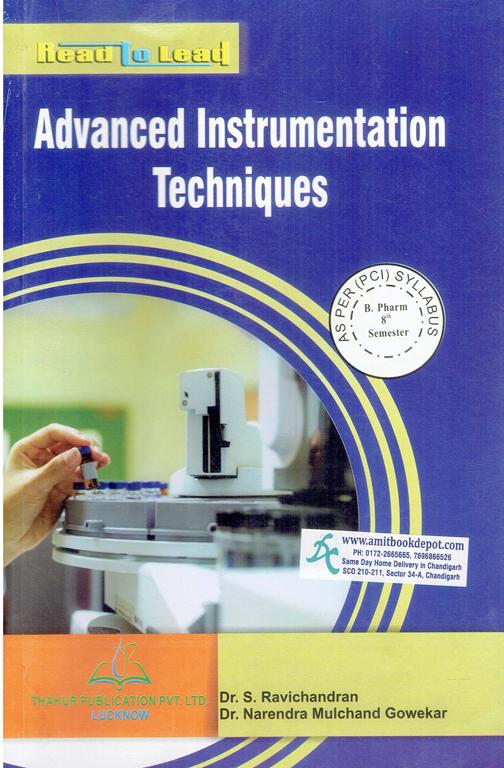
Thakur Advanced Instrumentation Techniques For B. Pharm 8th Semester PTU

by Madhurima
₹160 ₹160.00(-/ off)

Rating & Reviews

23 Customer Review

Thakur Advanced Instrumentation Techniques is the essential PTU-prescribed book for B. Pharm 8th Semester (BP 811 ET). Authored by Dr. S. Ravichandran and Dr. Narendra Mulchand Gowekar, this comprehensive guide covers the entire syllabus in detail. It includes NMR spectroscopy, mass spectrometry, thermal methods (TGA, DTA, DSC), X-ray diffraction, calibration & validation per ICH/USFDA guidelines, radioimmunoassay, extraction techniques, and modern hyphenated techniques (LC-MS/MS, GC-MS/MS). Designed for clarity and depth, it features chapter summaries and exercises. This book is an indispensable resource for mastering pharmaceutical analysis and advanced instrumentation for academic and professional success.

Have Doubts Regarding This Product ? Ask Your Question

  • Q1
    Is this book strictly aligned with the latest PTU syllabus for B. Pharm 8th Semester?
    A1

    Yes, this book is meticulously structured according to the latest PTU syllabus for the subject "Advanced Instrumentation Techniques" (BP 811 ET). The five modules correspond directly to the five units prescribed by the university.

  • Q2
    Does it cover both the theoretical principles and practical instrumentation details of techniques like NMR and Mass Spectrometry?
    A2

    Absolutely. Each technique, including NMR and Mass Spectrometry, is explained starting from core principles and theory, progressing through detailed instrumentation components, and concluding with practical applications in drug analysis.

  • Q3
    Are modern ionization techniques for Mass Spectrometry, such as MALDI and ESI, included?
    A3

    Yes, the book provides detailed coverage of various ionization techniques, including Electron Impact (EI), Chemical Ionization (CI), Matrix-Assisted Laser Desorption/Ionization (MALDI), Fast Atom Bombardment (FAB), and Electrospray Ionization (ESI).

  • Q4
    How does the book explain the difference between TGA, DTA, and DSC?
    A4

    The book dedicates a full chapter to Thermal Methods, providing separate, detailed sections on Thermogravimetric Analysis (TGA), Differential Thermal Analysis (DTA), and Differential Scanning Calorimetry (DSC), explaining their distinct principles, instrumentation, output curves, and specific applications.

  • Q5
    Is the calibration and validation content based on current ICH and USFDA guidelines?
    A5

    Yes, Module 3 is entirely focused on Calibration and Validation as per the latest ICH (International Council for Harmonisation) and USFDA (United States Food and Drug Administration) guidelines, covering all key validation parameters like specificity, accuracy, and precision.

  • Q6
    Does it provide practical steps for calibrating common lab instruments like HPLC and UV-Vis Spectrophotometer?
    A6

    Yes, a dedicated chapter (Chapter 6) provides clear guidance on the calibration procedure for specific instruments, including HPLC, GC, UV-Visible Spectrophotometer, IR Spectrophotometer, Electronic Balance, Flame Photometer, and Fluorimeter.

  • Q7
    Is Radioimmunoassay (RIA) explained in a way that is relevant to pharmaceutical analysis?
    A7

    Yes, the chapter on Radioimmunoassay covers its principle, components, and procedure, with a strong emphasis on its importance, limitations, and applications specifically in the field of pharmaceutical sciences and drug testing.

  • Q8
    What extraction techniques are covered in the book?
    A8

    The book covers both Solid Phase Extraction (SPE)—detailing its types like Normal Phase, Reverse Phase, and Ion Exchange—and various methods of Liquid-Liquid Extraction, including the choice of solvents.

  • Q9
    Are the concepts of chemical shift and coupling constant in NMR explained with factors and rules?
    A9

    Yes, the NMR chapter thoroughly explains chemical shift, including factors affecting it and the concepts of shielding and deshielding. It also details coupling constants (J-coupling), spin-spin splitting theory, and the rules for proton coupling.

  • Q10
    Does the X-Ray Diffraction section help in understanding crystal structure elucidation?
    A10

    Yes, it covers the origin of X-rays, basic aspects of crystals, and methods like powder and single crystal diffraction, specifically linking them to the process of structural elucidation, which is vital in pharmaceutical analysis for polymorph identification.

0.00

0 Overall Rating
  • 5
    0
  • 4
    0
  • 3
    0
  • 2
    0
  • 1
    0

Try this product & share your review & thoughts

Module-1
Chapter 1: Nuclear Magnetic Resonance Spectroscopy

1.1. Nuclear Magnetic Resonance Spectroscopy
1.1.1. Introduction
1.1.2. Advantages and Disadvantages
1.1.3. Principles
1.1.3.1. Nuclear Spin
1.1.3.2. Magnetic Moment
1.1.4. Principles of H-NMR and C-NMR
1.1.4.1. Magnetic Properties of Nuclei
1.1.4.2. Resonance Condition

1.2. Chemical Shift
1.2.1. Causes of Chemical Shift
1.2.2. Factors Affecting Chemical Shift
1.2.3. Shift Reagents
1.2.4. Shielding Effect
1.2.5. De-shielding Effect

1.3. Coupling Constants
1.3.1. J-Coupling
1.3.2. Spin-Spin Coupling—Splitting of Signals
1.3.2.1. Theory of Spin-Spin Splitting
1.3.2.2. Causes of Splitting
1.3.2.3. Rules/Restrictions for Proton Coupling

1.4. Relaxation in NMR
1.4.1. Range of Relaxation Time
1.4.2. Types of Relaxation
1.4.2.1. T₁ Relaxation (Spin-Lattice Relaxation)
1.4.2.2. T2 Relaxation (Spin-Spin Relaxation)
1.4.3. Relaxation Mechanism
1.4.3.1. Dipole-Dipole Induced Relaxation
1.4.3.2. Chemical Shift Anisotropy (CSA)
1.4.3.3. Spin Rotation (SR)
1.4.3.4. Quadrupolar Relaxation (QR)
1.4.3.5. Scalar Relaxation (SC)

1.5. Instrumentation
1.5.1. Introduction
1.5.2. Sample Holder
1.5.3. Permanent Magnet
1.5.4. Magnetic Coils
1.5.5. Sweep Generator
1.5.6. Radio Frequency Generator
1.5.7. Radio Frequency Receiver
1.5.8. Read-Out System
1.6. Applications
1.7. Summary
1.8. Exercise

Chapter 2: Mass Spectrometry

2.1. Mass Spectrometry
2.1.1. Introduction
2.1.2. Advantages and Disadvantages
2.1.3. Principles
2.1.3.1. Fragmentation
2.1.3.2. McLafferty Rearrangement

2.2. Instrumentation
2.2.1. Introduction
2.2.2. Sample Inlet
2.2.3. Ion Source
2.2.4. Ionization Techniques
2.2.4.1. Electron-Impact Ionization
2.2.4.2. Chemical Ionization
2.2.4.3. Matrix Assisted Laser Desorption Ionization (MALDI)
2.2.4.4. Fast Atom Bombardment (FAB) and Secondary Ion Mass Spectrometry (SIMS)
2.2.4.5. Electrospray Ionization (ESI)
2.2.4.6. Atmospheric Pressure Chemical Ionization (APCI)
2.2.5. Mass Analyzers
2.2.5.1. Time-of-Flight Mass Analyzer
2.2.5.2. Quadrupole Mass Analyzer
2.2.5.3. Quadrupole Ion Trap Mass Analyzer
2.2.5.4. Magnetic Sector/Single Focusing Mass Analyzer
2.2.5.5. Electric Sector/Double Focusing Mass Analyzer
2.2.6. Detectors
2.2.7. Vacuum System
2.2.8. Data System

2.3. Applications
2.3.1. Qualitative Applications
2.3.2. Quantitative Applications
2.4. Summary
2.5. Exercise

Module-2
Chapter 3: Thermal Methods of Analysis

3.1. Thermal Analysis
3.2. Thermogravimetric Analysis (TGA)
3.2.1. Introduction
3.2.2. Principle
3.2.2.1. TGA Curve
3.2.2.2. Factors Affecting TGA Curve
3.2.3. Instrumentation
3.2.3.1. Balance
3.2.3.2. Sample Holder
3.2.3.3. Furnace
3.2.3.4. Unit for Temperature Measurement and Control
3.2.3.5. Recorder
3.2.4. Applications
3.2.5. Advantages and Disadvantages

3.3. Differential Thermal Analysis (DTA)
3.3.1. Introduction
3.3.2. Principle
3.3.2.1. DTA Curve
3.3.2.2. Factors Affecting DTA Curve
3.3.3. Instrumentation
3.3.3.1. Furnace
3.3.3.2. Sample Holder
3.3.3.3. Temperature Controller and Recorder
3.3.3.4. Temperature Sensor (Thermocouples)
3.3.4. Applications
3.3.5. Advantages and Disadvantages

3.4. Differential Scanning Calorimetry (DSC)
3.4.1. Introduction
3.4.2. Principle
3.4.2.1. DSC Curve
3.4.2.2. Factors Affecting DSC Curve
3.4.3. Types of DSC
3.4.4. Instrumentation
3.4.5. Applications
3.4.6. Advantages and Disadvantages
3.5. Summary
3.6. Exercise

Chapter 4: X-Ray Diffraction Methods

4.1. X-Ray Diffraction
4.1.1. Introduction
4.1.2. Principle
4.1.3. Origin of X-Rays
4.1.4. Basic Aspects of Crystals

4.2. X-Ray Crystallography
4.2.1. Introduction
4.2.2. Principle
4.2.3. Instrumentation
4.2.3.1. X-ray Tube
4.2.3.2. Wavelength Selector
4.2.3.3. Collimator
4.2.3.4. Sample Holder
4.2.3.5. Detector
4.2.4. Procedure
4.2.5. Applications
4.2.6. Advantages and Disadvantages

4.3. X-Ray Diffraction Methods
4.3.1. Introduction
4.3.2. Rotating Crystal Technique
4.3.3. Single Crystal Diffraction
4.3.4. Powder Diffraction
4.4. Structure Elucidation and Applications of X-Ray Diffraction Methods
4.5. Summary
4.6. Exercise

Module-3
Chapter 5: Calibration and Validation as per ICH and USFDA Guidelines

5.1. Calibration
5.1.1. Definition
5.1.2. Objective
5.1.3. Need for Calibration
5.1.4. Importance
5.1.5. Advantages
5.1.6. ICH Guidelines
5.1.7. USFDA Guidelines

5.2. Validation
5.2.1. Definition
5.2.2. Objective
5.2.3. Need for Validation
5.2.4. Importance
5.2.5. Advantages
5.2.6. Principle
5.2.7. ICH Guidelines
5.2.8. Analytical Procedures to Be Validated
5.2.9. Validation Parameters as per ICH Guideline
5.2.9.1. Specificity
5.2.9.2. Linearity
5.2.9.3. Range
5.2.9.4. Accuracy
5.2.9.5. Precision
5.2.9.6. Detection Limit
5.2.9.7. Quantitation Limit
5.2.9.8. Robustness
5.2.9.9. System Suitability Testing
5.2.10. USFDA Guidelines—Process Validation
5.2.10.1. Stages of Process Validation
5.2.10.2. Types of Process Validation
5.2.10.3. Validation Master Plan (VMP)
5.2.10.4. Validation Protocol
5.2.11. Difference between Calibration and Validation
5.3. Summary
5.4. Exercise

Chapter 6: Calibration of Instruments

6.1. Calibration of Instruments
6.1.1. Electronic Balance
6.1.2. UV-Visible Spectrophotometer
6.1.3. IR Spectrophotometer
6.1.4. Fluorimeter
6.1.5. Flame Photometer
6.1.6. High Performance Liquid Chromatography (HPLC)
6.1.7. Gas Chromatography (GC)
6.2. Summary
6.3. Exercise

Module-4
Chapter 7: Radioimmunoassay

7.1. Radioimmunoassay
7.1.1. Introduction
7.1.2. Principle
7.1.2.1. Immune Reaction
7.1.2.2. Competitive Binding or Competitive Displacement Reaction
7.1.2.3. Measurement of Radio Emission
7.1.3. Importance
7.1.4. Components
7.1.5. Procedure
7.1.6. Different Methods/Types
7.1.7. Advantages
7.1.8. Limitations
7.1.9. Applications
7.2. Summary
7.3. Exercise

Chapter 8: Extraction Techniques

8.1. Solid Phase Extraction (SPE)
8.1.1. Introduction
8.1.2. Principle
8.1.3. Types
8.1.3.1. Adsorption (Normal Phase)
8.1.3.2. Adsorption (Reverse Phase)
8.1.3.3. Ion Exchange (Cation/Anion) 
8.1.3.4. Mixed Mode 
8.1.4. Instrumentation 
8.1.5. Procedure 
8.1.6. Advantages and Disadvantages
8.1.7. Applications

8.2. Liquid-Liquid Extraction
8.2.1. Introduction
8.2.2. Principle
8.2.3. Types
8.2.3.1. Single Extraction
8.2.3.2. Batch Extraction
8.2.3.3. Continuous Liquid-Liquid Extraction
8.2.3.4. Multiple or Countercurrent Liquid-Liquid Extraction
8.2.4. Choice of Solvents
8.2.5. Instrumentation
8.2.6. Procedure
8.2.7. Advantages
8.2.8. Applications
8.3. Summary
8.4. Exercise

Module-5
Chapter 9: Hyphenated Techniques

9.1. Hyphenated Techniques
9.1.1. Introduction
9.1.2. Types
9.1.3. Advantages

9.2. LC-MS/MS
9.2.1. Introduction
9.2.2. Instrumentation and Working
9.2.3. Interface
9.2.4. Advantages
9.2.5. Applications

9.3. GC-MS/MS
9.3.1. Introduction
9.3.2. Instrumentation and Working
9.3.3. Interface
9.3.4. Advantages and Disadvantages
9.3.5. Applications

9.4. HPTLC-MS

9.4.1. Introduction
9.4.2. Instrumentation
9.4.3. Working
9.4.4. Advantages
9.4.5. Applications
9.5 Summary
9.6. Exercise

Latest Syllabus of Advanced Instrumentation Techniques For B. Pharm 8th Semester PTU


BP 811 ET. ADVANCED INSTRUMENTATION TECHNIQUES (45 Hours)

Scope: This subject deals with the application of instrumental methods in the qualitative and quantitative analysis of drugs. This subject is designed to impart advanced knowledge on the principles and instrumentation of spectroscopic and chromatographic hyphenated techniques. This also emphasizes theoretical and practical knowledge of modern analytical instruments that are used for drug testing. 

Objectives: Upon completion of the course, the student shall be able to
- understand the advanced instruments used and their applications in drug analysis 
- understand the chromatographic separation and analysis of drugs. 
- understand the calibration of various analytical instruments 
- Know analysis of drugs using various analytical instruments.

Course Content:
UNIT-I (10 Hours)
- Nuclear Magnetic Resonance spectroscopy 
Principles of H-NMR and C-NMR, chemical shift, factors affecting chemical shift, coupling constant, spin-spin coupling, relaxation, instrumentation, and applications
- Mass Spectrometry- Principles, Fragmentation, Ionization techniques – Electron impact, chemical ionization, MALDI, FAB, Analyzers-Time of flight and Quadrupole, instrumentation, applications

UNIT-II (10 Hours)
- Thermal Methods of Analysis: Principles, instrumentation, and applications of Thermogravimetric Analysis (TGA), Differential Thermal Analysis (DTA), and Differential Scanning Calorimetry (DSC)
- X-Ray Diffraction Methods: Origin of X-rays, basic aspects of crystals, X-ray crystallography, rotating crystal technique, single crystal diffraction, powder diffraction, structural elucidation, and applications. 

UNIT-III (10 Hours)
- Calibration and validation as per ICH and USFDA guidelines
- Calibration of the following instruments
Electronic balance, UV-visible spectrophotometer, IR spectrophotometer, fluorimeter, flame photometer, HPLC, and GC

UNIT-IV (08 Hours)
- Radioimmunoassay: Importance, various components, principle, different methods, limitations, and applications of radioimmunoassay
- Extraction techniques: General principle and procedure involved in the solid-phase extraction and liquid-liquid extraction

UNIT-V (07 Hours)
Hyphenated techniques—LC-MS/MS, GC-MS/MS, HPTLC-MS. 

Thakur Advanced Instrumentation Techniques for B. Pharm 8th Semester PTU is the definitive and comprehensive book meticulously designed for the Bachelor of Pharmacy curriculum of Punjab Technical University (PTU). Authored by the experienced academicians Dr. S. Ravichandran and Dr. Narendra Mulchand Gowekar, this publication from Thakur Publications provides an in-depth, structured, and syllabus-aligned exploration of sophisticated analytical methodologies critical for modern pharmaceutical analysis. This book serves as an essential resource for mastering the Advanced Instrumentation Techniques prescribed in the latest PTU syllabus (BP 811 ET), equipping students with both the theoretical foundation and practical insights necessary for academic excellence and professional application.

The content is systematically organized into five modules, corresponding directly to the five units of the PTU syllabus, ensuring seamless and efficient study. Module 1 delves into core spectroscopic techniques, beginning with a detailed chapter on Nuclear Magnetic Resonance (NMR) Spectroscopy. It covers fundamental principles, including chemical shift, coupling constants (J-coupling), spin-spin splitting, and relaxation mechanisms (T₁ and T₂), along with comprehensive instrumentation and applications. The subsequent chapter on mass spectrometry provides a thorough understanding of principles like fragmentation and the McLafferty rearrangement, alongside modern ionization techniques such as electrospray ionization (ESI), matrix-assisted laser desorption/ionization (MALDI), and chemical ionization (CI), and various mass analyzers, including quadrupole and time-of-flight.

Module 2 focuses on thermal methods of analysis and X-ray diffraction methods. It offers comparative and detailed studies of Thermogravimetric Analysis (TGA), Differential Thermal Analysis (DTA), and Differential Scanning Calorimetry (DSC), explaining their principles and instrumentation and interpreting TGA and DSC curves. The X-ray diffraction section explains the origin of X-rays, basic crystallography, and techniques like powder diffraction and single crystal diffraction for structure elucidation.

Module 3 addresses the crucial regulatory and practical aspects of pharmaceutical analysis with chapters on calibration and validation as per ICH and USFDA guidelines. It clearly defines key concepts, outlines all validation parameters such as specificity, accuracy, precision, linearity, and robustness, and distinguishes between calibration and validation. This module is exceptionally practical, providing step-by-step guidance on the calibration of instruments, including UV-Visible Spectrophotometer, IR Spectrophotometer, HPLC, Gas Chromatography (GC), Electronic Balance, Flame Photometer, and Fluorimeter.

Module 4 explores specialized bioanalytical and preparative techniques. The chapter on Radioimmunoassay (RIA) explains its principle, components, procedure, and applications in drug analysis. The Extraction Techniques chapter provides a solid foundation in Solid Phase Extraction (SPE)—covering normal phase, reverse phase, and ion exchange types—and Liquid-Liquid Extraction methods, detailing solvent choice and procedures.

Finally, Module 5 is dedicated to modern hyphenated techniques, which are indispensable in contemporary pharmaceutical research and quality control. It covers the integration, instrumentation, and applications of LC-MS/MS, GC-MS/MS, and HPTLC-MS, explaining how these techniques combine separation and detection for superior analytical power.

Each chapter concludes with a summary and exercise section to aid in revision and self-assessment. This book is not merely a book; it is a vital tool for B. Pharm students seeking to build a strong career in pharmaceutical sciences, quality control, research and development, and regulatory affairs. With its clear explanations, syllabus-specific focus, and emphasis on both instrumentation and pharmaceutical applications, Thakur Advanced Instrumentation Techniques is the perfect companion for mastering the challenges of the PTU 8th semester and beyond.

Module-1
Chapter 1: Nuclear Magnetic Resonance Spectroscopy

1.1. Nuclear Magnetic Resonance Spectroscopy
1.1.1. Introduction
1.1.2. Advantages and Disadvantages
1.1.3. Principles
1.1.3.1. Nuclear Spin
1.1.3.2. Magnetic Moment
1.1.4. Principles of H-NMR and C-NMR
1.1.4.1. Magnetic Properties of Nuclei
1.1.4.2. Resonance Condition

1.2. Chemical Shift
1.2.1. Causes of Chemical Shift
1.2.2. Factors Affecting Chemical Shift
1.2.3. Shift Reagents
1.2.4. Shielding Effect
1.2.5. De-shielding Effect

1.3. Coupling Constants
1.3.1. J-Coupling
1.3.2. Spin-Spin Coupling—Splitting of Signals
1.3.2.1. Theory of Spin-Spin Splitting
1.3.2.2. Causes of Splitting
1.3.2.3. Rules/Restrictions for Proton Coupling

1.4. Relaxation in NMR
1.4.1. Range of Relaxation Time
1.4.2. Types of Relaxation
1.4.2.1. T₁ Relaxation (Spin-Lattice Relaxation)
1.4.2.2. T2 Relaxation (Spin-Spin Relaxation)
1.4.3. Relaxation Mechanism
1.4.3.1. Dipole-Dipole Induced Relaxation
1.4.3.2. Chemical Shift Anisotropy (CSA)
1.4.3.3. Spin Rotation (SR)
1.4.3.4. Quadrupolar Relaxation (QR)
1.4.3.5. Scalar Relaxation (SC)

1.5. Instrumentation
1.5.1. Introduction
1.5.2. Sample Holder
1.5.3. Permanent Magnet
1.5.4. Magnetic Coils
1.5.5. Sweep Generator
1.5.6. Radio Frequency Generator
1.5.7. Radio Frequency Receiver
1.5.8. Read-Out System
1.6. Applications
1.7. Summary
1.8. Exercise

Chapter 2: Mass Spectrometry

2.1. Mass Spectrometry
2.1.1. Introduction
2.1.2. Advantages and Disadvantages
2.1.3. Principles
2.1.3.1. Fragmentation
2.1.3.2. McLafferty Rearrangement

2.2. Instrumentation
2.2.1. Introduction
2.2.2. Sample Inlet
2.2.3. Ion Source
2.2.4. Ionization Techniques
2.2.4.1. Electron-Impact Ionization
2.2.4.2. Chemical Ionization
2.2.4.3. Matrix Assisted Laser Desorption Ionization (MALDI)
2.2.4.4. Fast Atom Bombardment (FAB) and Secondary Ion Mass Spectrometry (SIMS)
2.2.4.5. Electrospray Ionization (ESI)
2.2.4.6. Atmospheric Pressure Chemical Ionization (APCI)
2.2.5. Mass Analyzers
2.2.5.1. Time-of-Flight Mass Analyzer
2.2.5.2. Quadrupole Mass Analyzer
2.2.5.3. Quadrupole Ion Trap Mass Analyzer
2.2.5.4. Magnetic Sector/Single Focusing Mass Analyzer
2.2.5.5. Electric Sector/Double Focusing Mass Analyzer
2.2.6. Detectors
2.2.7. Vacuum System
2.2.8. Data System

2.3. Applications
2.3.1. Qualitative Applications
2.3.2. Quantitative Applications
2.4. Summary
2.5. Exercise

Module-2
Chapter 3: Thermal Methods of Analysis

3.1. Thermal Analysis
3.2. Thermogravimetric Analysis (TGA)
3.2.1. Introduction
3.2.2. Principle
3.2.2.1. TGA Curve
3.2.2.2. Factors Affecting TGA Curve
3.2.3. Instrumentation
3.2.3.1. Balance
3.2.3.2. Sample Holder
3.2.3.3. Furnace
3.2.3.4. Unit for Temperature Measurement and Control
3.2.3.5. Recorder
3.2.4. Applications
3.2.5. Advantages and Disadvantages

3.3. Differential Thermal Analysis (DTA)
3.3.1. Introduction
3.3.2. Principle
3.3.2.1. DTA Curve
3.3.2.2. Factors Affecting DTA Curve
3.3.3. Instrumentation
3.3.3.1. Furnace
3.3.3.2. Sample Holder
3.3.3.3. Temperature Controller and Recorder
3.3.3.4. Temperature Sensor (Thermocouples)
3.3.4. Applications
3.3.5. Advantages and Disadvantages

3.4. Differential Scanning Calorimetry (DSC)
3.4.1. Introduction
3.4.2. Principle
3.4.2.1. DSC Curve
3.4.2.2. Factors Affecting DSC Curve
3.4.3. Types of DSC
3.4.4. Instrumentation
3.4.5. Applications
3.4.6. Advantages and Disadvantages
3.5. Summary
3.6. Exercise

Chapter 4: X-Ray Diffraction Methods

4.1. X-Ray Diffraction
4.1.1. Introduction
4.1.2. Principle
4.1.3. Origin of X-Rays
4.1.4. Basic Aspects of Crystals

4.2. X-Ray Crystallography
4.2.1. Introduction
4.2.2. Principle
4.2.3. Instrumentation
4.2.3.1. X-ray Tube
4.2.3.2. Wavelength Selector
4.2.3.3. Collimator
4.2.3.4. Sample Holder
4.2.3.5. Detector
4.2.4. Procedure
4.2.5. Applications
4.2.6. Advantages and Disadvantages

4.3. X-Ray Diffraction Methods
4.3.1. Introduction
4.3.2. Rotating Crystal Technique
4.3.3. Single Crystal Diffraction
4.3.4. Powder Diffraction
4.4. Structure Elucidation and Applications of X-Ray Diffraction Methods
4.5. Summary
4.6. Exercise

Module-3
Chapter 5: Calibration and Validation as per ICH and USFDA Guidelines

5.1. Calibration
5.1.1. Definition
5.1.2. Objective
5.1.3. Need for Calibration
5.1.4. Importance
5.1.5. Advantages
5.1.6. ICH Guidelines
5.1.7. USFDA Guidelines

5.2. Validation
5.2.1. Definition
5.2.2. Objective
5.2.3. Need for Validation
5.2.4. Importance
5.2.5. Advantages
5.2.6. Principle
5.2.7. ICH Guidelines
5.2.8. Analytical Procedures to Be Validated
5.2.9. Validation Parameters as per ICH Guideline
5.2.9.1. Specificity
5.2.9.2. Linearity
5.2.9.3. Range
5.2.9.4. Accuracy
5.2.9.5. Precision
5.2.9.6. Detection Limit
5.2.9.7. Quantitation Limit
5.2.9.8. Robustness
5.2.9.9. System Suitability Testing
5.2.10. USFDA Guidelines—Process Validation
5.2.10.1. Stages of Process Validation
5.2.10.2. Types of Process Validation
5.2.10.3. Validation Master Plan (VMP)
5.2.10.4. Validation Protocol
5.2.11. Difference between Calibration and Validation
5.3. Summary
5.4. Exercise

Chapter 6: Calibration of Instruments

6.1. Calibration of Instruments
6.1.1. Electronic Balance
6.1.2. UV-Visible Spectrophotometer
6.1.3. IR Spectrophotometer
6.1.4. Fluorimeter
6.1.5. Flame Photometer
6.1.6. High Performance Liquid Chromatography (HPLC)
6.1.7. Gas Chromatography (GC)
6.2. Summary
6.3. Exercise

Module-4
Chapter 7: Radioimmunoassay

7.1. Radioimmunoassay
7.1.1. Introduction
7.1.2. Principle
7.1.2.1. Immune Reaction
7.1.2.2. Competitive Binding or Competitive Displacement Reaction
7.1.2.3. Measurement of Radio Emission
7.1.3. Importance
7.1.4. Components
7.1.5. Procedure
7.1.6. Different Methods/Types
7.1.7. Advantages
7.1.8. Limitations
7.1.9. Applications
7.2. Summary
7.3. Exercise

Chapter 8: Extraction Techniques

8.1. Solid Phase Extraction (SPE)
8.1.1. Introduction
8.1.2. Principle
8.1.3. Types
8.1.3.1. Adsorption (Normal Phase)
8.1.3.2. Adsorption (Reverse Phase)
8.1.3.3. Ion Exchange (Cation/Anion) 
8.1.3.4. Mixed Mode 
8.1.4. Instrumentation 
8.1.5. Procedure 
8.1.6. Advantages and Disadvantages
8.1.7. Applications

8.2. Liquid-Liquid Extraction
8.2.1. Introduction
8.2.2. Principle
8.2.3. Types
8.2.3.1. Single Extraction
8.2.3.2. Batch Extraction
8.2.3.3. Continuous Liquid-Liquid Extraction
8.2.3.4. Multiple or Countercurrent Liquid-Liquid Extraction
8.2.4. Choice of Solvents
8.2.5. Instrumentation
8.2.6. Procedure
8.2.7. Advantages
8.2.8. Applications
8.3. Summary
8.4. Exercise

Module-5
Chapter 9: Hyphenated Techniques

9.1. Hyphenated Techniques
9.1.1. Introduction
9.1.2. Types
9.1.3. Advantages

9.2. LC-MS/MS
9.2.1. Introduction
9.2.2. Instrumentation and Working
9.2.3. Interface
9.2.4. Advantages
9.2.5. Applications

9.3. GC-MS/MS
9.3.1. Introduction
9.3.2. Instrumentation and Working
9.3.3. Interface
9.3.4. Advantages and Disadvantages
9.3.5. Applications

9.4. HPTLC-MS

9.4.1. Introduction
9.4.2. Instrumentation
9.4.3. Working
9.4.4. Advantages
9.4.5. Applications
9.5 Summary
9.6. Exercise
Have Doubts Regarding This Product ? Ask Your Question

  • Q1
    Is this book strictly aligned with the latest PTU syllabus for B. Pharm 8th Semester?
    A1

    Yes, this book is meticulously structured according to the latest PTU syllabus for the subject "Advanced Instrumentation Techniques" (BP 811 ET). The five modules correspond directly to the five units prescribed by the university.

  • Q2
    Does it cover both the theoretical principles and practical instrumentation details of techniques like NMR and Mass Spectrometry?
    A2

    Absolutely. Each technique, including NMR and Mass Spectrometry, is explained starting from core principles and theory, progressing through detailed instrumentation components, and concluding with practical applications in drug analysis.

  • Q3
    Are modern ionization techniques for Mass Spectrometry, such as MALDI and ESI, included?
    A3

    Yes, the book provides detailed coverage of various ionization techniques, including Electron Impact (EI), Chemical Ionization (CI), Matrix-Assisted Laser Desorption/Ionization (MALDI), Fast Atom Bombardment (FAB), and Electrospray Ionization (ESI).

  • Q4
    How does the book explain the difference between TGA, DTA, and DSC?
    A4

    The book dedicates a full chapter to Thermal Methods, providing separate, detailed sections on Thermogravimetric Analysis (TGA), Differential Thermal Analysis (DTA), and Differential Scanning Calorimetry (DSC), explaining their distinct principles, instrumentation, output curves, and specific applications.

  • Q5
    Is the calibration and validation content based on current ICH and USFDA guidelines?
    A5

    Yes, Module 3 is entirely focused on Calibration and Validation as per the latest ICH (International Council for Harmonisation) and USFDA (United States Food and Drug Administration) guidelines, covering all key validation parameters like specificity, accuracy, and precision.
  • Q6
    Does it provide practical steps for calibrating common lab instruments like HPLC and UV-Vis Spectrophotometer?
    A6

    Yes, a dedicated chapter (Chapter 6) provides clear guidance on the calibration procedure for specific instruments, including HPLC, GC, UV-Visible Spectrophotometer, IR Spectrophotometer, Electronic Balance, Flame Photometer, and Fluorimeter.

  • Q7
    Is Radioimmunoassay (RIA) explained in a way that is relevant to pharmaceutical analysis?
    A7

    Yes, the chapter on Radioimmunoassay covers its principle, components, and procedure, with a strong emphasis on its importance, limitations, and applications specifically in the field of pharmaceutical sciences and drug testing.

  • Q8
    What extraction techniques are covered in the book?
    A8

    The book covers both Solid Phase Extraction (SPE)—detailing its types like Normal Phase, Reverse Phase, and Ion Exchange—and various methods of Liquid-Liquid Extraction, including the choice of solvents.

  • Q9
    Are the concepts of chemical shift and coupling constant in NMR explained with factors and rules?
    A9

    Yes, the NMR chapter thoroughly explains chemical shift, including factors affecting it and the concepts of shielding and deshielding. It also details coupling constants (J-coupling), spin-spin splitting theory, and the rules for proton coupling.

  • Q10
    Does the X-Ray Diffraction section help in understanding crystal structure elucidation?
    A10

    Yes, it covers the origin of X-rays, basic aspects of crystals, and methods like powder and single crystal diffraction, specifically linking them to the process of structural elucidation, which is vital in pharmaceutical analysis for polymorph identification.

Latest Syllabus of Advanced Instrumentation Techniques For B. Pharm 8th Semester PTU


BP 811 ET. ADVANCED INSTRUMENTATION TECHNIQUES (45 Hours)

Scope: This subject deals with the application of instrumental methods in the qualitative and quantitative analysis of drugs. This subject is designed to impart advanced knowledge on the principles and instrumentation of spectroscopic and chromatographic hyphenated techniques. This also emphasizes theoretical and practical knowledge of modern analytical instruments that are used for drug testing. 

Objectives: Upon completion of the course, the student shall be able to
- understand the advanced instruments used and their applications in drug analysis 
- understand the chromatographic separation and analysis of drugs. 
- understand the calibration of various analytical instruments 
- Know analysis of drugs using various analytical instruments.

Course Content:
UNIT-I (10 Hours)
- Nuclear Magnetic Resonance spectroscopy 
Principles of H-NMR and C-NMR, chemical shift, factors affecting chemical shift, coupling constant, spin-spin coupling, relaxation, instrumentation, and applications
- Mass Spectrometry- Principles, Fragmentation, Ionization techniques – Electron impact, chemical ionization, MALDI, FAB, Analyzers-Time of flight and Quadrupole, instrumentation, applications

UNIT-II (10 Hours)
- Thermal Methods of Analysis: Principles, instrumentation, and applications of Thermogravimetric Analysis (TGA), Differential Thermal Analysis (DTA), and Differential Scanning Calorimetry (DSC)
- X-Ray Diffraction Methods: Origin of X-rays, basic aspects of crystals, X-ray crystallography, rotating crystal technique, single crystal diffraction, powder diffraction, structural elucidation, and applications. 

UNIT-III (10 Hours)
- Calibration and validation as per ICH and USFDA guidelines
- Calibration of the following instruments
Electronic balance, UV-visible spectrophotometer, IR spectrophotometer, fluorimeter, flame photometer, HPLC, and GC

UNIT-IV (08 Hours)
- Radioimmunoassay: Importance, various components, principle, different methods, limitations, and applications of radioimmunoassay
- Extraction techniques: General principle and procedure involved in the solid-phase extraction and liquid-liquid extraction

UNIT-V (07 Hours)
Hyphenated techniques—LC-MS/MS, GC-MS/MS, HPTLC-MS. 

0.00

0 Overall Rating
  • 5
    0
  • 4
    0
  • 3
    0
  • 2
    0
  • 1
    0

Try this product & share your review & thoughts

Top Trending Product

Related Product

Related Product

Related Blog Posts

Latest Blogs

Latest Blogs

blog-img
Classic Literature Reimagined: Discuss modern twists on classic novels.
Lorem ipsum dolor sit amet, consectetur adipiscing elit, sed do eiusmod tempor incididunt ut labore et dolore magna aliqua. Ut enim ad minim veniam, quis nostrud exercitation ullamco Lorem ipsum dolor sit amet, consectetur adipiscing elit, sed do eiusmod tempor incididunt ut labore et dolore magna aliqua. Utenim ad minim veniam, quis nostrud exercitation ullamco Lorem ipsum dolor sit amet, consecte...
Read more
Author name | 10 jan, 2025
blog-img
Classic Literature Reimagined: Discuss modern twists on classic novels.
Lorem ipsum dolor sit amet, consectetur adipiscing elit, sed do eiusmod tempor incididunt ut labore et dolore magna aliqua. Ut enim ad minim veniam, quis nostrud exercitation ullamco Lorem ipsum dolor sit amet, consectetur adipiscing elit, sed do eiusmod tempor incididunt ut labore et dolore magna aliqua. Utenim ad minim veniam, quis nostrud exercitation ullamco Lorem ipsum dolor sit amet, consecte...
Read more
Author name | 10 jan, 2025
blog-img
Classic Literature Reimagined: Discuss modern twists on classic novels.
Lorem ipsum dolor sit amet, consectetur adipiscing elit, sed do eiusmod tempor incididunt ut labore et dolore magna aliqua. Ut enim ad minim veniam, quis nostrud exercitation ullamco Lorem ipsum dolor sit amet, consectetur adipiscing elit, sed do eiusmod tempor incididunt ut labore et dolore magna aliqua. Utenim ad minim veniam, quis nostrud exercitation ullamco Lorem ipsum dolor sit amet, consecte...
Read more
Author name | 10 jan, 2025
blog-img
Classic Literature Reimagined: Discuss modern twists on classic novels.
Lorem ipsum dolor sit amet, consectetur adipiscing elit...
Read more
Author Name | 10 Jan, 2025
blog-img
Classic Literature Reimagined: Discuss modern twists on classic novels.
Lorem ipsum dolor sit amet, consectetur adipiscing elit...
Read more
Author Name | 10 Jan, 2025
blog-img
Classic Literature Reimagined: Discuss modern twists on classic novels.
Lorem ipsum dolor sit amet, consectetur adipiscing elit...
Read more
Author Name | 10 Jan, 2025
blog-img
Classic Literature Reimagined: Discuss modern twists on classic novels.
Lorem ipsum dolor sit amet, consectetur adipiscing elit...
Read more
Author Name | 10 Jan, 2025
blog-img
Classic Literature Reimagined: Discuss modern twists on classic novels.
Lorem ipsum dolor sit amet, consectetur adipiscing elit...
Read more
Author Name | 10 Jan, 2025
blog-img
Classic Literature Reimagined: Discuss modern twists on classic novels.
Lorem ipsum dolor sit amet, consectetur adipiscing elit...
Read more
Author Name | 10 Jan, 2025
blog-img
Classic Literature Reimagined: Discuss modern twists on classic novels.
Lorem ipsum dolor sit amet, consectetur adipiscing elit...
Read more
Author Name | 10 Jan, 2025
blog-img
Classic Literature Reimagined: Discuss modern twists on classic novels.
Lorem ipsum dolor sit amet, consectetur adipiscing elit...
Read more
Author Name | 10 Jan, 2025
blog-img
Classic Literature Reimagined: Discuss modern twists on classic novels.
Lorem ipsum dolor sit amet, consectetur adipiscing elit...
Read more
Author Name | 10 Jan, 2025