-
Mon-Fri: 10AM to 8PM 01722665665
-
My Account
-
-
0
Total :
₹ 0.00

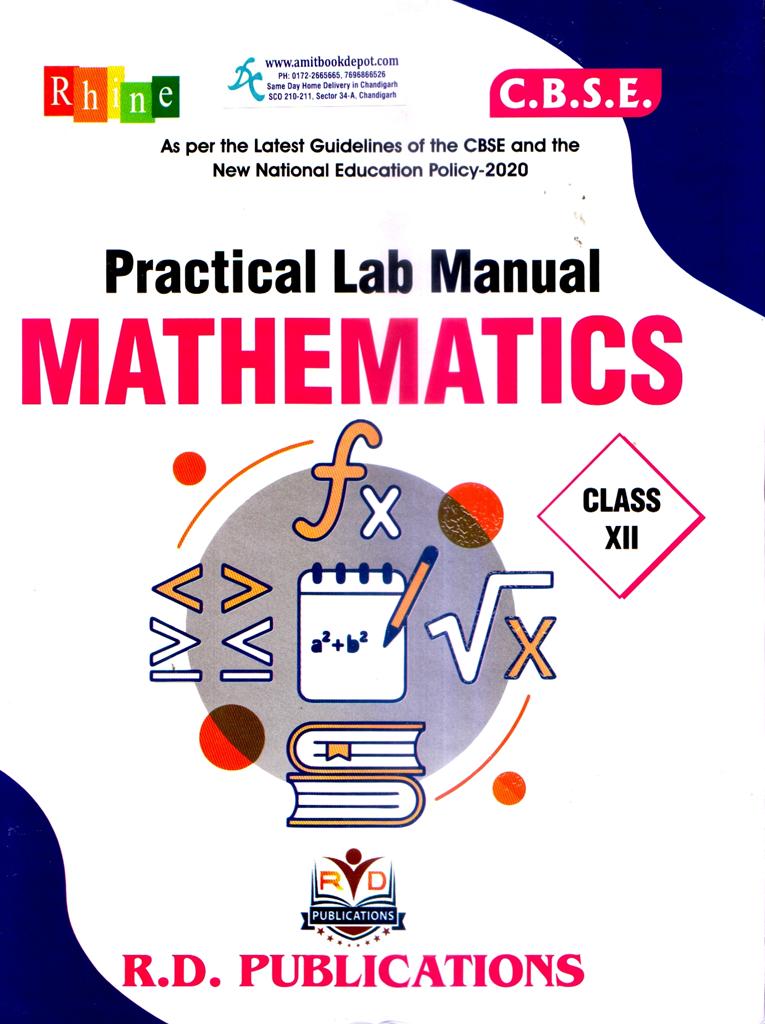
R.D. Mathematics Practical Lab Manual for Class 12th by Aruna Sharma (R.D. Publication) is a CBSE-approved lab manual with 27 activities and 4 projects covering relations, functions, calculus, vectors, 3D geometry, and probability. It helps students verify theorems experimentally, plot graphs, and solve real-world problems. Ideal for board exams, this manual enhances practical understanding through step-by-step activities on continuity, derivatives, integration, and optimization. Includes project work on population estimation, coordinate geometry, and differential equations. Perfect for scoring high in practical exams and strengthening JEE/NEET preparation. A must-have for Class 12 CBSE students.


Yes, it strictly follows the CBSE Class 12 Mathematics practical syllabus.
It contains 27 activities and 4 projects covering key mathematical concepts.
Yes, it includes exercises on plotting sin x, exponential, and logarithmic functions with mirror reflections.
Absolutely! It strengthens calculus, vectors, and 3D geometry—essential for competitive exams.
Yes, projects on cost minimization, population estimation, and cooling processes are included.
Yes, Activity-11 and Activity-12 verify these theorems experimentally.
It includes dice-based experiments to explain conditional probability.
Yes, activities on distance measurement, planes, and skew lines enhance understanding.
Yes, Activity-14 to Activity-18 focus on optimization and area maximization.
Definitely! The clear instructions and illustrations make it suitable for independent learning.
Yes, it strictly follows the CBSE Class 12 Mathematics practical syllabus.
It contains 27 activities and 4 projects covering key mathematical concepts.
Yes, it includes exercises on plotting sin x, exponential, and logarithmic functions with mirror reflections.
Absolutely! It strengthens calculus, vectors, and 3D geometry—essential for competitive exams.
Yes, projects on cost minimization, population estimation, and cooling processes are included.
Yes, Activity-11 and Activity-12 verify these theorems experimentally.
It includes dice-based experiments to explain conditional probability.
Yes, activities on distance measurement, planes, and skew lines enhance understanding.
Yes, Activity-14 to Activity-18 focus on optimization and area maximization.
Definitely! The clear instructions and illustrations make it suitable for independent learning.