-
Mon-Fri: 10AM to 8PM 01722665665
-
My Account
-
-
0
Total :
₹ 0.00

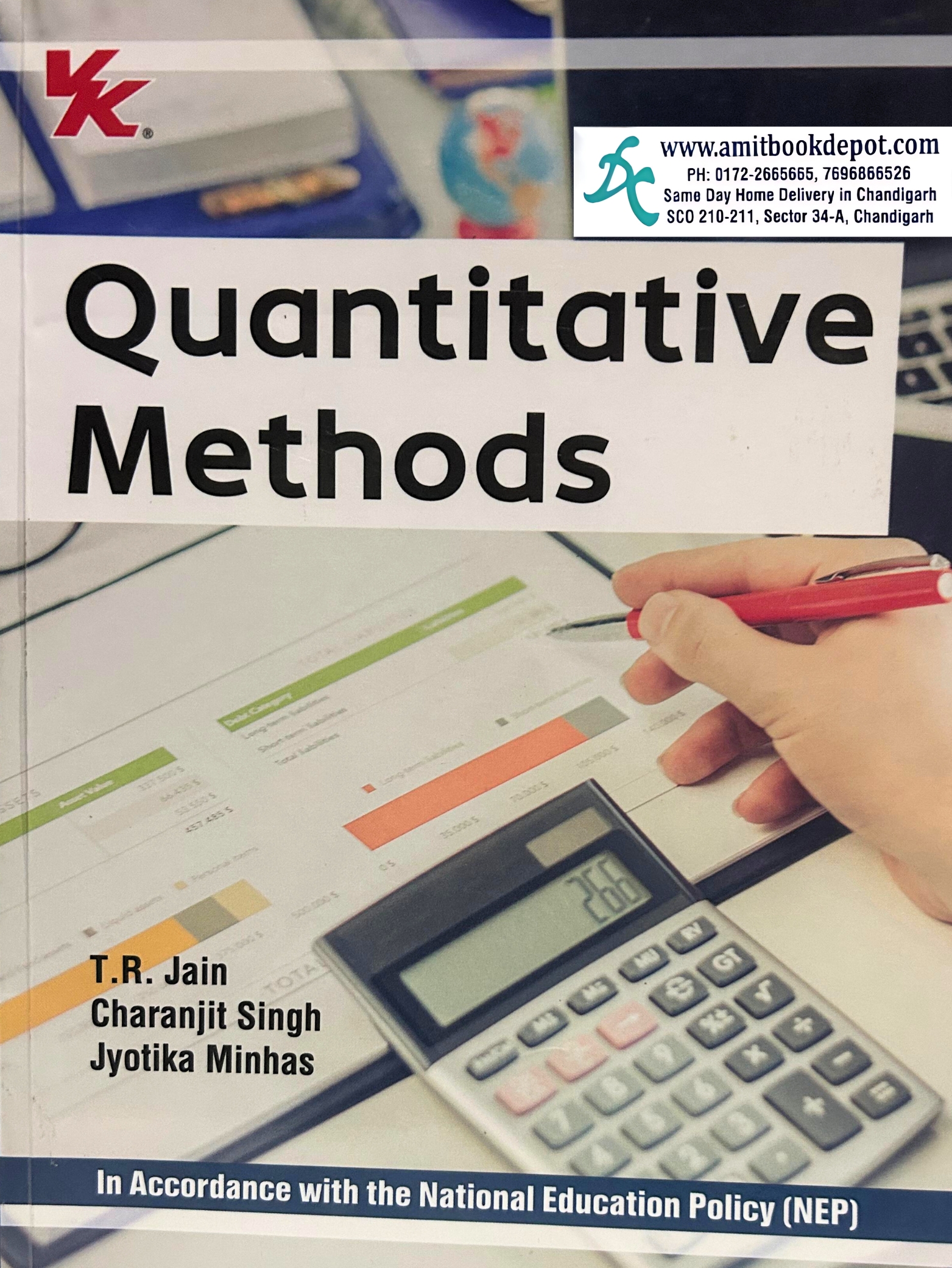

Yes, this book is specifically written and updated to be fully compliant with the latest syllabus prescribed by Panjab University for the BA 3rd Semester Quantitative Methods paper.
The book focuses heavily on providing step-by-step solved examples to illustrate concepts. For additional practice, students are advised to refer to the university's question banks or other companion guides.
Yes, the book contains dedicated Log and Antilog tables at the end, which are a standard and sufficient reference for solving relevant problems during exams.
Absolutely. The book is designed for BA students, many of whom may not have an extensive math background. It explains concepts from the basics using clear and simple language.
Yes, it provides the necessary theoretical foundation for each topic and reinforces it with numerous solved numerical examples, especially in statistics chapters like correlation and regression.
While it is tailor-made for PU, students from other universities with similar syllabi in Quantitative Methods, Business Mathematics, or Introductory Statistics will find the content highly relevant and beneficial.
This book is not generic; it is curated specifically for a single semester of a specific course at a specific university, ensuring 100% syllabus coverage without any irrelevant topics.
The chapter provides a fundamental introduction to Time Series Analysis, which includes its components and basic techniques, forming the groundwork for understanding forecasting.
As a publication from VK Global, a reputed educational publisher, the book maintains high printing standards with clear, legible text and properly formatted mathematical notations.
This book is the core prescribed textbook and covers the entire syllabus comprehensively. For optimal preparation, it should be used alongside previous years' question papers and regular classroom teaching.
No Description Added
Yes, this book is specifically written and updated to be fully compliant with the latest syllabus prescribed by Panjab University for the BA 3rd Semester Quantitative Methods paper.
The book focuses heavily on providing step-by-step solved examples to illustrate concepts. For additional practice, students are advised to refer to the university's question banks or other companion guides.
Yes, the book contains dedicated Log and Antilog tables at the end, which are a standard and sufficient reference for solving relevant problems during exams.
Absolutely. The book is designed for BA students, many of whom may not have an extensive math background. It explains concepts from the basics using clear and simple language.
Yes, it provides the necessary theoretical foundation for each topic and reinforces it with numerous solved numerical examples, especially in statistics chapters like correlation and regression.
While it is tailor-made for PU, students from other universities with similar syllabi in Quantitative Methods, Business Mathematics, or Introductory Statistics will find the content highly relevant and beneficial.
This book is not generic; it is curated specifically for a single semester of a specific course at a specific university, ensuring 100% syllabus coverage without any irrelevant topics.
The chapter provides a fundamental introduction to Time Series Analysis, which includes its components and basic techniques, forming the groundwork for understanding forecasting.
As a publication from VK Global, a reputed educational publisher, the book maintains high printing standards with clear, legible text and properly formatted mathematical notations.
This book is the core prescribed textbook and covers the entire syllabus comprehensively. For optimal preparation, it should be used alongside previous years' question papers and regular classroom teaching.