-
Mon-Fri: 10AM to 8PM 01722665665
-
My Account
-
-
0
Total :
₹ 0.00

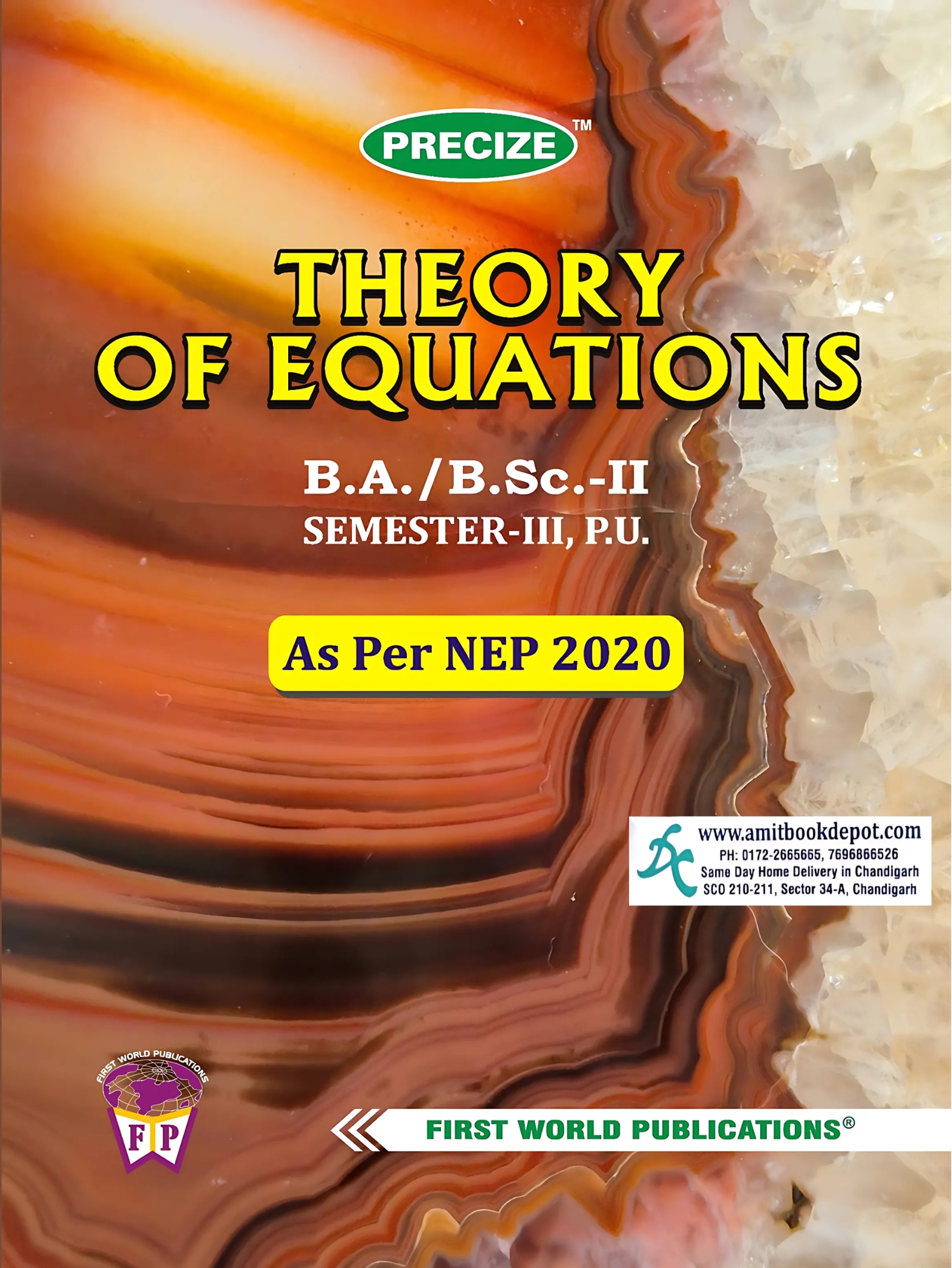
Yes, this book is meticulously crafted to cover 100% of the latest Theory of Equations syllabus prescribed by Panjab University Chandigarh for Semester III. The chapter organization directly corresponds to the four units outlined in the official curriculum.
Yes, the book clearly states the exam pattern: Maximum Marks are 100, divided into 80 for External Examination and 20 for Internal Assessment.
Yes, Unit III of the book specifically covers the transformation of equations, including the solutions for cubic and biquadratic equations when their roots are in H.P., with detailed solved examples.
A dedicated chapter (Chapter 4: Diminishing Roots of an Equation) explains the concept and procedure of diminishing roots by a constant 'h', along with its practical applications in simplifying and solving equations.
Absolutely. Unit IV provides comprehensive coverage of both Cardan's method and the trigonometric method for solving cubic equations, including a discussion on the discriminant and the nature of roots.
Yes, the syllabus for Unit IV, and consequently the book, covers both Descartes' and Ferrari's methods for solving biquadratic equations, providing you with multiple approaches to tackle such problems.
Yes, Chapter 7 (Newton’s Methods for Finding Real Roots) specifically includes Newton's method of divisors for finding integral roots of polynomial equations.
Yes, Chapter 2 (Relation Between Roots and Coefficients) is dedicated to Vieta's formulae, providing a thorough derivation and numerous examples to illustrate their application in solving problems.
Yes, Chapter 3 (Symmetric Functions of Roots) provides a detailed exploration of symmetric functions and how they relate to the coefficients of an equation, a key topic in the syllabus.
Yes, these foundational topics from Unit I are covered in detail in the first chapter, "Polynomials and Polynomial Equations."
No Description Added
Yes, this book is meticulously crafted to cover 100% of the latest Theory of Equations syllabus prescribed by Panjab University Chandigarh for Semester III. The chapter organization directly corresponds to the four units outlined in the official curriculum.
Yes, the book clearly states the exam pattern: Maximum Marks are 100, divided into 80 for External Examination and 20 for Internal Assessment.
Yes, Unit III of the book specifically covers the transformation of equations, including the solutions for cubic and biquadratic equations when their roots are in H.P., with detailed solved examples.
A dedicated chapter (Chapter 4: Diminishing Roots of an Equation) explains the concept and procedure of diminishing roots by a constant 'h', along with its practical applications in simplifying and solving equations.
Absolutely. Unit IV provides comprehensive coverage of both Cardan's method and the trigonometric method for solving cubic equations, including a discussion on the discriminant and the nature of roots.
Yes, the syllabus for Unit IV, and consequently the book, covers both Descartes' and Ferrari's methods for solving biquadratic equations, providing you with multiple approaches to tackle such problems.
Yes, Chapter 7 (Newton’s Methods for Finding Real Roots) specifically includes Newton's method of divisors for finding integral roots of polynomial equations.
Yes, Chapter 2 (Relation Between Roots and Coefficients) is dedicated to Vieta's formulae, providing a thorough derivation and numerous examples to illustrate their application in solving problems.
Yes, Chapter 3 (Symmetric Functions of Roots) provides a detailed exploration of symmetric functions and how they relate to the coefficients of an equation, a key topic in the syllabus.
Yes, these foundational topics from Unit I are covered in detail in the first chapter, "Polynomials and Polynomial Equations."