-
Mon-Fri: 10AM to 8PM 01722665665
-
My Account
-
-
0
Total :
₹ 0.00

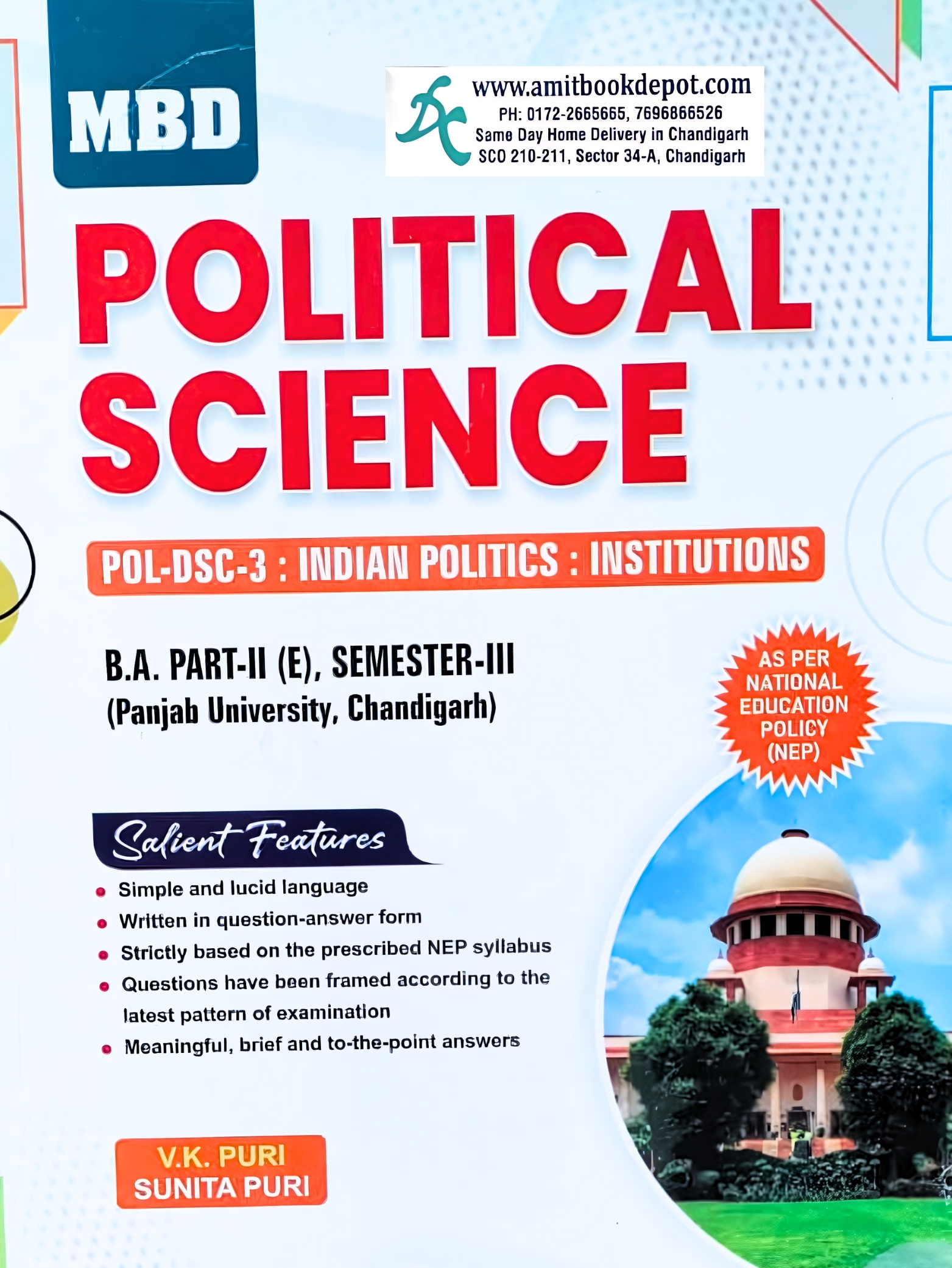
Yes, this book is specifically designed for BA 3rd Semester students pursuing Political Science under the DSE curriculum, providing in-depth coverage of Indian political institutions.
Absolutely. The book offers comprehensive insights into key institutions at both the central and state levels, including the Supreme Court, Parliament, State Legislature, Governor, and Chief Minister.
Yes, the book includes Short Answer Type Questions and Model Test Papers to aid students in practicing and self-assessment.
Yes, every chapter is carefully crafted to cover the entire scope of the PU Chandigarh syllabus on Indian Politics: Institutions.
Yes, it covers electoral reforms and the role of the Election Commission, including recent changes and ongoing debates.
Yes, it provides detailed insights into Indian federalism, center-state relations, and the concept of asymmetric federalism.
The book is authored by V.K. Puri and Sunita Puri, esteemed scholars in political science with extensive experience in Indian political institutions.
Absolutely. Its structured content, practice questions, and model test papers make it ideal for self-study and effective exam preparation.
The description emphasizes clear and accessible language; while it may include diagrams, the primary focus is on comprehensive textual explanations.
It covers the Supreme Court and High Courts, their jurisdictions, and the principles guiding judicial review and independence.
No Description Added
Yes, this book is specifically designed for BA 3rd Semester students pursuing Political Science under the DSE curriculum, providing in-depth coverage of Indian political institutions.
Absolutely. The book offers comprehensive insights into key institutions at both the central and state levels, including the Supreme Court, Parliament, State Legislature, Governor, and Chief Minister.
Yes, the book includes Short Answer Type Questions and Model Test Papers to aid students in practicing and self-assessment.
Yes, every chapter is carefully crafted to cover the entire scope of the PU Chandigarh syllabus on Indian Politics: Institutions.
Yes, it covers electoral reforms and the role of the Election Commission, including recent changes and ongoing debates.
Yes, it provides detailed insights into Indian federalism, center-state relations, and the concept of asymmetric federalism.
The book is authored by V.K. Puri and Sunita Puri, esteemed scholars in political science with extensive experience in Indian political institutions.
Absolutely. Its structured content, practice questions, and model test papers make it ideal for self-study and effective exam preparation.
The description emphasizes clear and accessible language; while it may include diagrams, the primary focus is on comprehensive textual explanations.
It covers the Supreme Court and High Courts, their jurisdictions, and the principles guiding judicial review and independence.